Sacramento County Board of Supervisors Special Meeting: General Plan Annual Report and Housing Infill Workshop - April 11, 2024
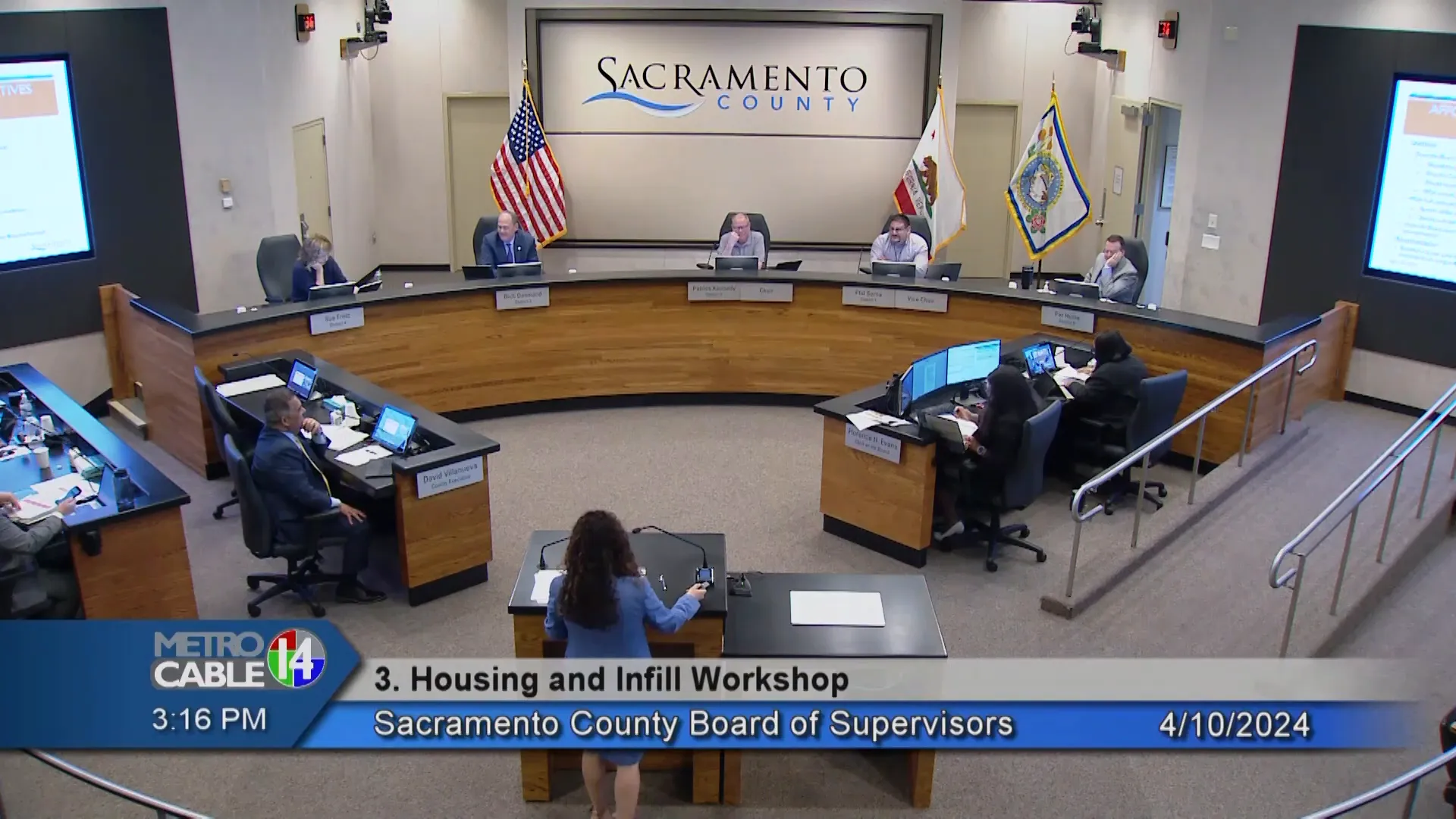
STREAMING COPY IN PREPARATION — RECORDING AVAILABLE FROM THE ORIGINAL SOURCE
Sacramento County Board of Supervisors Special Meeting: General Plan Annual Report and Housing Infill Workshop - April 11, 2024
This special meeting, which the transcript identifies as taking place on Wednesday, April 10, 2024 (though the instruction specifies April 11, 2024), consisted of two main agenda items: the General Plan Annual Report for calendar year 2023 and a Housing and Infill Workshop. The board received the annual report and provided extensive direction to staff on a series of policy and funding proposals to accelerate housing production, particularly infill and affordable housing.
Consent Calendar
- No consent calendar items were listed or discussed.
Public Comments & Testimony
- No public comments were made for item 2 (General Plan Annual Report), as the chair confirmed no speakers were present.
- For item 3 (Housing and Infill Workshop), public comments were taken at several points:
- Chris Norem (North State BIA) expressed general support for the proposed measures and encouraged the board to be open to alternatives.
- George Carpenter (Wyn Communities) praised the planning team and urged continued support and open-mindedness on development standard changes; he noted a specific ready-to-build multifamily site still hung up on process issues.
- Nick Abdis (attorney) commended the new culture of accountability and suggested exploring tax-based incentives like tax increment loans; he encouraged staff latitude to bring back concepts.
- Ralph Propper (Ecosystem Council of Sacramento) supported infill development for climate and housing goals and noted that homelessness is largely local, exacerbated by Bay Area migration.
- Kent Baker (Baker Williams Engineering Group) highlighted that the zoning code lacks flexibility for infill, especially for townhouses and small lots, and praised the current staff's efforts to improve.
- No other public speakers were present for the later sections.
Discussion Items
-
Item 2: General Plan Annual Report for 2023
- Jacob Daw (Associate Planner) presented the report, covering the housing element, environmental justice element, and the energy element (rotating). Key statistics: the county issued building permits for 2,080 units in the first three years of RHNA Cycle 6 (2021–2029), far short of the 19,340-unit allocation; 58 environmental justice measures are being tracked; the rezone program is on track for fall 2024 deadline; the climate action plan CAP is being revised with a notice of preparation published in December 2023. Staff noted that 38% of general plan implementation measures are complete, with 62% incomplete or pending. Issues include staff turnover, aging policies (some from 1993), and an unwieldy 686 implementation measures.
- Supervisors Serna, Hume, and Desmond commented on the anemic production numbers, the cumulative nature of housing need, and the importance of not losing sight of practical housing needs beyond RHNA compliance.
-
Item 3: Housing and Infill Workshop
- Dave Defonte (Community Development Director) and Todd Smith (Planning Director) led the workshop, emphasizing the need for board direction on policy changes to achieve the goal of being the best place to build. The workshop was structured around three buckets: process, hearing body authority, and funding/incentives.
- Development Standards & Ministerial Approvals (Slide 1 questions):
- Question 1: Revise multifamily development standards (height, setbacks, landscaping, parking) to maximize use of already-zoned land. Supervisors expressed broad support but with caveats: Supervisor Desmond emphasized careful transition to single-family neighborhoods and preserving design review; Supervisor Hume supported but noted concentric zoning may allow different standards; Supervisor Frost stressed design quality; Supervisor Serna supported with concerns about parking spillover; Supervisor Kennedy strongly supported, particularly for commercial corridors.
- Question 2: Similar revisions for non-residential uses. Support was unanimous.
- Question 3: Allow missing middle housing (duplexes, triplexes, fourplexes) in single-family zones. Support was mixed; Supervisor Desmond wanted more analysis; Supervisor Hume supported but opposed SB9; Supervisor Frost supported with design sensitivity; Supervisor Serna and Kennedy supportive.
- Question 4: Allow SB9 units combined with ADUs (up to 4 units per lot). Several supervisors expressed concerns about infrastructure and neighborhood character; Supervisor Hume was against; Supervisor Frost had concerns about real estate values; Supervisor Kennedy was curious but cautious.
- Question 5: Allow independent sales of ADUs via condo map (AB 1033). Similar concerns; supervisors generally hesitant.
- Infill Coordinator Position: Staff proposed repurposing a budgeted development program manager to an infill coordinator with an associate planner. Supervisors supported the concept but insisted it be an additive position, not a repurposing, and requested funding in the 2024-25 budget. Supervisor Desmond also asked to include Kiefer Boulevard area.
- SPA/NPA Updates: Staff presented a hierarchy for updating 68 SPAs and NPAs. Supervisors supported revising or eliminating outdated or hindering SPAs, but wanted to preserve community identity in older neighborhoods. They requested sensitivity and robust public engagement.
- Hearing Body Authority: Staff asked whether the board would support by-right ministerial approvals for multifamily projects consistent with adopted plans, and whether authority for subdivision maps consistent with specific plans could be delegated to the Subdivision Review Committee. Supervisors generally supported ministerial approvals for projects that have already passed policy review, but expressed caution about removing community input. Supervisor Serna raised accountability concerns; Supervisor Frost wanted to retain CPAC voices; Supervisor Hume suggested using a litmus test of prior public process.
- Affordable Housing Incentives & Fee Offsets: Claudia Wade (County Engineer) presented options for offsetting impact fees. Current average county impact fees are $4,300/unit (24% of total fees). Options: a specified dollar amount (e.g., $3M/year) or unit targets (100 or 400 units/year). Supervisors agreed to pursue a pilot program funded by a combination of $5M from the Williamson Act reserve and affordable housing fund/trust fund dollars, total $10M over three years. They directed staff to focus on county impact fees only, explore deferring fee payment to occupancy, work with special districts to do the same, and consider extending eligibility to missing middle/workforce housing. Supervisor Hume suggested a target of 800 units/three years.
- Tax Increment Loans: Dave Defonte introduced a novel concept: loaning the county's portion of future property tax increment from a project to the developer as gap financing, repaid with interest. Supervisors expressed interest and directed staff to explore further, including a policy framework and a specific project proposal. Concerns were raised about impacts on other taxing entities and budget constraints.
- Supervisor Hume also suggested exploring zoning yield flexibility and infrastructure financing districts (EIFDs) as future tools.
Key Outcomes
- Item 2: The board unanimously voted to receive and file the 2023 General Plan Annual Report, direct staff to submit it to state agencies, and proceed with the work program.
- Item 3: Staff were directed to compile the board's feedback into a Resolution of Intention to be brought back in short order, outlining the policy changes and financing mechanisms to pursue. This will include:
- Revising multifamily and non-residential development standards to allow more ministerial approvals (with design sensitivity).
- Exploring missing middle housing (duplexes, triplexes, fourplexes) while preserving neighborhood character.
- Adding an infill coordinator position (additive, not repurposed).
- Updating SPAs/NPAs with priority on high-potential corridors and community engagement.
- Considering delegation of subdivision map approvals for consistent master plans to the Subdivision Review Committee.
- Establishing a three-year pilot fee offset program for affordable housing (county impact fees only) using $5M from the Williamson Act reserve and additional funds from the housing trust fund/affordable housing fund, with a target of 800 units over three years and possible inclusion of missing middle.
- Exploring fee deferral to occupancy for all county fees and encouraging partner agencies to do the same.
- Developing a policy framework for tax increment loans and a proposed project.
- Continuing work on EIFDs as a future tool.
Note: The transcript states the meeting was held on Wednesday, April 10, 2024, but the instructions specify April 11, 2024; this summary uses the latter date as directed.
Meeting Transcript
Good afternoon. Welcome to the Wednesday, April 10th, 2024 special meeting or workshop of the Sacramento County Board of Supervisors. Would the clerk please call the role? Yes, good afternoon, board members. Cerna. Here. Desmond. Frost. Here. Human. Here. I mean Hume. I'm human. And I'm here. Kennedy. You flatter him. Here. And you have a quorum. This meeting of the Sacramento County Board of Supervisors is cable cast live on Metro Cable 14, the local government affairs channel on the Comcast, Consolidated Communications, and ATT Uverse Cable Systems. The meeting is closed captioned and is webcast at Metro14Live.SACCounty.gov. Today's meeting will be repeated Sunday, April 14th at 6 p.m. on Channel 14. The Board of Supervisors fosters public engagement during the meeting and encourages public participation, civility, and use of courteous language. The board does not condone the use of profanity, vulgar language, gestures, or other inappropriate behavior, including personal attacks or threats directed towards any meeting participant. Seating is limited and available on a first come, first served basis. Each speaker will be given two minutes to make a public comment and are limited to making one comment per agenda or off agenda item. Please be mindful of the public comment procedures to avoid being interrupted while making your comment. To make a comment in person, please fill out a speaker request form and hand it to clerk staff. The chairperson will open public comments for each agenda or off agenda item and direct the clerk to call the name of each speaker. When the clerk calls your name, please come to the podium and make your comment. If a speaker is unavailable to make a comment prior to the closing of public comments, the speaker waives their request to speak and the clerk will file the speaker request form in the record. The clerk will manage the timer and allow each speaker two minutes to make a comment. You may also send written comments by email to board clerk at SACCounty.gov and your comment will be routed to the board and filed in the record. If you need an accommodation pursuant to the Americans with Disabilities Act or for medical or other reasons, please see clerk staff or assistance or contact the clerk's office at 916-874-5451 or by email at Board Clerk at SACCounty.gov. Thank you in advance for your courtesy and understanding of the meeting procedures. Thank you, Madam Clerk. Will you please join me in the Pledge of Allegiance? I pledge allegiance to the flag of the United States of America. And to the Republic for which it stands one nation under God. First item, please. This would be your public comments relating to matters not on the posted agenda, and we do not have any public comments at this time. Okay, just to ensure there are anyone in the public in the audience that would like to comment. All right. Next item. Okay, item two is the general plan annual report for calendar year 2023. Did you raise that up on the case? I did, yes. Thank you. Good afternoon. My name is Jacob Daw and I'm an associate planner with Planning and Environmental Review.
openpublica.com