Community Meeting on Locke Governance Options – October 30, 2024
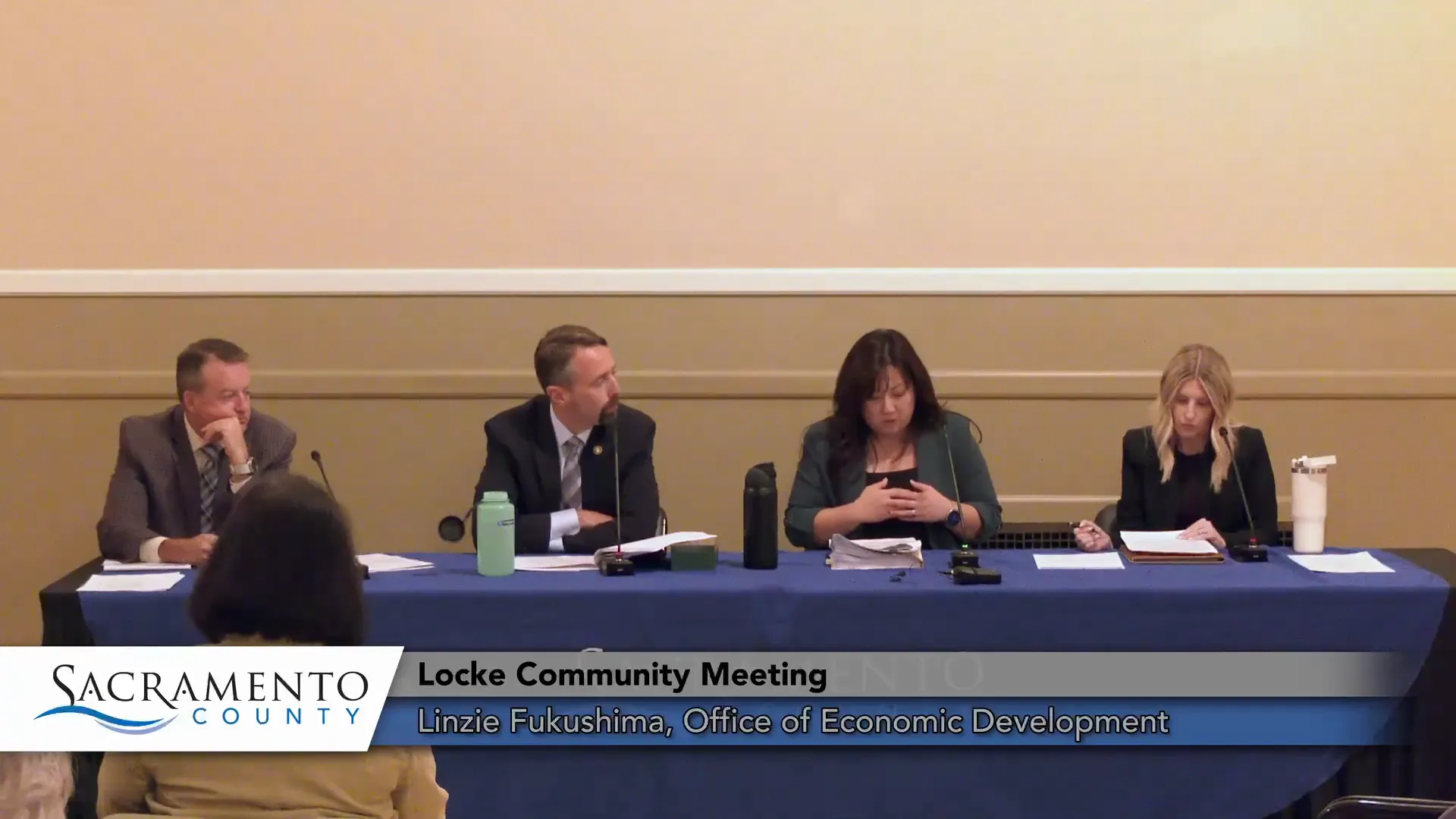
STREAMING COPY IN PREPARATION — RECORDING AVAILABLE FROM THE ORIGINAL SOURCE
Community Meeting on Locke Governance Options – October 30, 2024
Supervisor Pat Hume (Fifth District) convened a publicly noticed community meeting on October 30, 2024, to discuss governance options for the historic town of Locke, Sacramento County. The meeting aimed to address the functioning of the Locke Management Association (LMA) and explore sustainable governance structures. Approximately 70 residents, property owners, business owners, and stakeholders attended. County staff presented two viable options: updating LMA bylaws to remove the county's appointed seat, or dissolving the LMA entirely. Public comment was extensive, with speakers expressing frustration over past county inaction, concerns about the Brown Act, and the need to separate Main Street (commercial/public) from the residential back of Locke. No formal vote was taken; the county will refine options and return in early 2025.
Public Comments & Testimony
- Russell (property owner/board member) strongly opposed eliminating the Brown Act, arguing it would exclude non-property owners (renters, merchants, Chinese American associations) and could lead to gating the community. He detailed past frustrations with county delays and a lack of support for LMA decisions, citing a parking issue that took six months and a dispute that took two years to get on the agenda.
- Lisa (business owner, renter, LMA board member) supported splitting the community: an HOA for the residential back and county management for Main Street. She noted that renters like herself would lose voice under a pure HOA and questioned the ability to get public funding without the Brown Act. She also raised the issue of the LMA paying for lighting on public roads (River Road and Main Street) and asked about removing CC&Rs for Main Street.
- Ginny Giles (business owner, renter, LMA board member) agreed that public restrooms, parking, and maintenance should not fall on building owners. She urged the Locke Foundation to expand its mission to seek grants for public amenities, such as a second paved parking lot for visitors.
- Douglas Shah (former LMA chairman) highlighted that business owners who do not own property have been overlooked in the discussion and should be included.
- Deborah (property owner, secretary for 10 years) advocated for a baby-step approach: first remove the county seat (Option 1) because it has the least unknowns. She expressed concern about losing control over gravel roads and lighting if the county took over, and noted that low assessments ($60/month residential, $120/month commercial) are unsustainable.
- Diane Thomas (business owner, renter) felt insulted and called an “invitee” at previous meetings, saying that property owners should not dictate terms to all residents. She appreciated the open forum but remained skeptical.
- Honey Lum (vice chair/secretary of LMC, also Locke Foundation board) emphasized the town’s decline: population shift from 600+ to 70 residents, deteriorating historical buildings, and inability to secure grants. She said the LMA operates year-to-year without reserves and cannot generate revenue. She asked the county not to remove her legislative seat until a solution is found.
- Maddie Serafin (town manager, hired August 2024) stated she has been met with complaints and yelling. She identified three priorities: community unity, safety, and beautification through revenue. She has reached out to county offices, sheriff, and fire department but received no responses yet.
- Several speakers raised traffic safety concerns on River Road and Locke Road, citing high speeds, near-misses, and fatal accidents. Supervisor Hume noted he would follow up with the Department of Transportation.
- One speaker asked whether any option would remove the board’s nonjudicial foreclosure rights to seize properties. Staff said they would look into it.
Discussion Items
- Presentation of Governance Options – Lindsay Fukushima (Economic Development) reviewed four infeasible options: Property Business Improvement District (PBID), Community Services District (CSD), Community Facilities District (CFD), and County Service Area (CSA). All were deemed too costly ($150K–$200K to establish, $50K/year to run), time-consuming (2–3 years), and subject to the Brown Act. Crystal Bethkey (Economic Development) presented two viable options:
- Update LMA bylaws to remove the county’s appointed seat – No cost, 10–12 month timeline; eliminates Brown Act requirements for LMA, which would then only follow Davis-Stirling Act. The county would help draft amendments and take them to the Board of Supervisors for approval. CC&Rs would remain.
- Dissolve the LMA entirely – No cost from county, but legal counsel needed; 2–3 year process. All debts must be paid; common area maintenance would revert to the county (roads, lighting, bathrooms). CC&Rs would remain, possibly leading to enforcement issues.
- Supervisor Hume’s Observations – He noted that Main Street is a public benefit (county-owned road, bathrooms, parking) currently borne by LMA property owners, which is unfair. He suggested bifurcating the town: the residential back becomes an HOA, while Main Street and its public amenities are managed by the county or a strengthened Locke Foundation. He also mentioned potential state park involvement (since they already own the boarding house) and the possibility of selling the common area parcel for an infusion of cash.
- Public Feedback on Options – Many speakers supported the idea of splitting Main Street (public/ commercial) from the residential back. Several property owners preferred Option 1 as a first step, while others favored dissolution if the county took over maintenance. There was broad agreement that the status quo is not working.
Key Outcomes
- No formal vote or decision was taken.
- Supervisor Hume directed staff to further explore the bifurcation concept (residential HOA in back, county management for Main Street) and to clean up the LMA’s bylaws (including inconsistent naming).
- The county will send the two option handouts in PDF form to all attendees and collect additional questions over the next two weeks.
- A follow-up meeting will be held in early 2025 (after the first of the year) with refined proposals and answers to outstanding questions.
- Hume committed to follow up on traffic safety concerns on River Road and Locke Road with the Department of Transportation.
- The county’s economic development staff may assist the Locke Foundation in building capacity to pursue grants, separate from the governance discussion.
Meeting Transcript
First of all, thank you all for coming out. We'll go ahead and call this community meeting to order. And let me just start there. This is a publicly noticed community meeting. It is being recorded for posterity. And so therefore there are no Brown Act issues for members of the LMAC board to go ahead and share their opinions and uh hear uh one another's thoughts. We just ask that you then not go and discuss it amongst yourselves without being in an open meeting. Okay. Um so thank you all for coming out. My name is Pat Hume. I am the fifth district supervisor uh oversee uh this part of Sacramento County, this wonderful uh part down here in the Delta. And I came to an LMA board meeting, I think back in February, maybe, and proposed doing this, which is essentially getting people together to talk about where lock is, what it was originally set up as, how it's been functioning, how it's not been functioning, and how we can maybe uh go forward in in rowing in the same direction. And so we uh we're here tonight to to have that conversation, and I'm gonna go over some rules of conduct. One that make it easier since it is being recorded, so that folks that are watching this meeting at a later date or or uh on their computers uh later uh are able to track the meeting. But then more importantly, I just want to make sure we have um basically a general sense of decorum and respect for one another, so that we can share our ideas freely, we can talk openly, because I think the one thing that uh I know I certainly uh came to this meeting uh is is that Locke is a pretty darn special place, and I think we can all agree upon that, and we all want to see what's best for it, and we may have different ideas about what that is, um, but we we want to see it move forward and and make sure that it is uh preserved for its rich uh heritage and history, and that future generations will be able to get as much enjoyment out of it as as we all have. So those are the reasons why why we're here. Um when I came to that board meeting, I said that there were a couple of different uh governance options that we could explore. Um, you know, obviously some being uh very uh similar to what's uh happening now, and some being very dissimilar. And so we're gonna go over those. We we explored, I think uh six options total, four of which um once they were teased out, really seem infeasible because of either the complexity or the cost or uh what the the size of lock relative to the type of governance that would be put into place. And so Lindsay will um go over those, and then Krista will come up and she'll kind of talk about the two options that really seem to be most viable going forward. And there are variations of those two options, but we're here to solicit feedback and to find out just kind of the the temperature of of where folks are and and what you you all would like to see uh going forward in the future, and then we'll come back after the beginning of the year and further refine um what we've studied and what we've explored and what it means. And so uh once uh once they present the options, then Dave will kind of go over uh and I'll introduce these folks in just a second. Dave will go over um more of the uh the community discussion and the feedback that we're seeking and why why we need that to inform our decisions, and we will have somebody coming around to you with a microphone so that you can be amplified so that uh the microphones uh pick you up on the recordings. Okay, and then that way we can have a but then those thoughts will be written down. If it's a question we can answer on the fly, we will, but for the most part, we will be writing down these uh questions so that we can take them away and come back with a fully banked baked uh answer um at the end of that. So I'm Pat Hume. I have my chief of staff Rebecca Sloan, my special assistant Stephanie Kause. Uh these are the folks, obviously, when you reach out to the office, you're probably gonna get them more often than you get me. I have with us deputy county executive Dave Defonti. He is the deputy county executive over all of uh community development, so everything that has to do with building planning um it uh situations such as these. And then from the Department of Economic Development, we have the director Crystal Bethkey and Lindsay Fukushima, and so they are here because they are really sort of the um governance uh experts uh relative to uh P bids and uh CSDs and and those types of things. So they're gonna go through all of those options and the intricacies uh therein. So are there any questions before we get started? Yes, Martha. Is there a packet available on the following time? There is, and it will be passed out shortly once we get to the to the two options scenario. So first it's just gonna be a presentation from Lindsay that will take questions uh after we're done with presenting all of the options. But once um Crystal gets up and starts talking about the the two potentialities, then we'll have a packet so that you can see some of the differences between the two. Okay. So with that, I'll turn it over to Lindsay. Well, good evening, everybody. So we looked at, as uh Supervisor Hume was mentioning. We looked at a several different options considering you know the size of this area and the types of properties that exist on it. So one of the things, one of the first ones we looked at was uh a property business improvement district, which is similar in some senses to an HOA, except it's for commercial properties uh only, and it is uh property owner-driven. So the one of the reasons why we looked at that is because it does create stable funding sources assessments. Um it's when a group of property owners agree to start this, they create a district and they decide to self-assess, and through those assessments, um, they get collected from your property taxes. So it creates a much more stable funding source than say a lot of other uh like like an HOA where you pay write a check and you send it in. Um of the things with it though is you know, as part of the governance, you would have to have a 501c6, which would bring you back to kind of where some of your struggles are right now. So you would have beholden to Davis Sterling as well as Brown Act if you were to do a PBID because PBID is only for commercial properties and um multifamily residential, so you would still need something to cover residential properties.
openpublica.com