Sacramento County Planning Commission Meeting - August 14, 2026: Housing Infill Zoning Amendments Workshop & ADU Ordinance Repeal
STREAMING COPY IN PREPARATION — RECORDING AVAILABLE FROM THE ORIGINAL SOURCE
Sacramento County Planning Commission Meeting - August 14, 2026
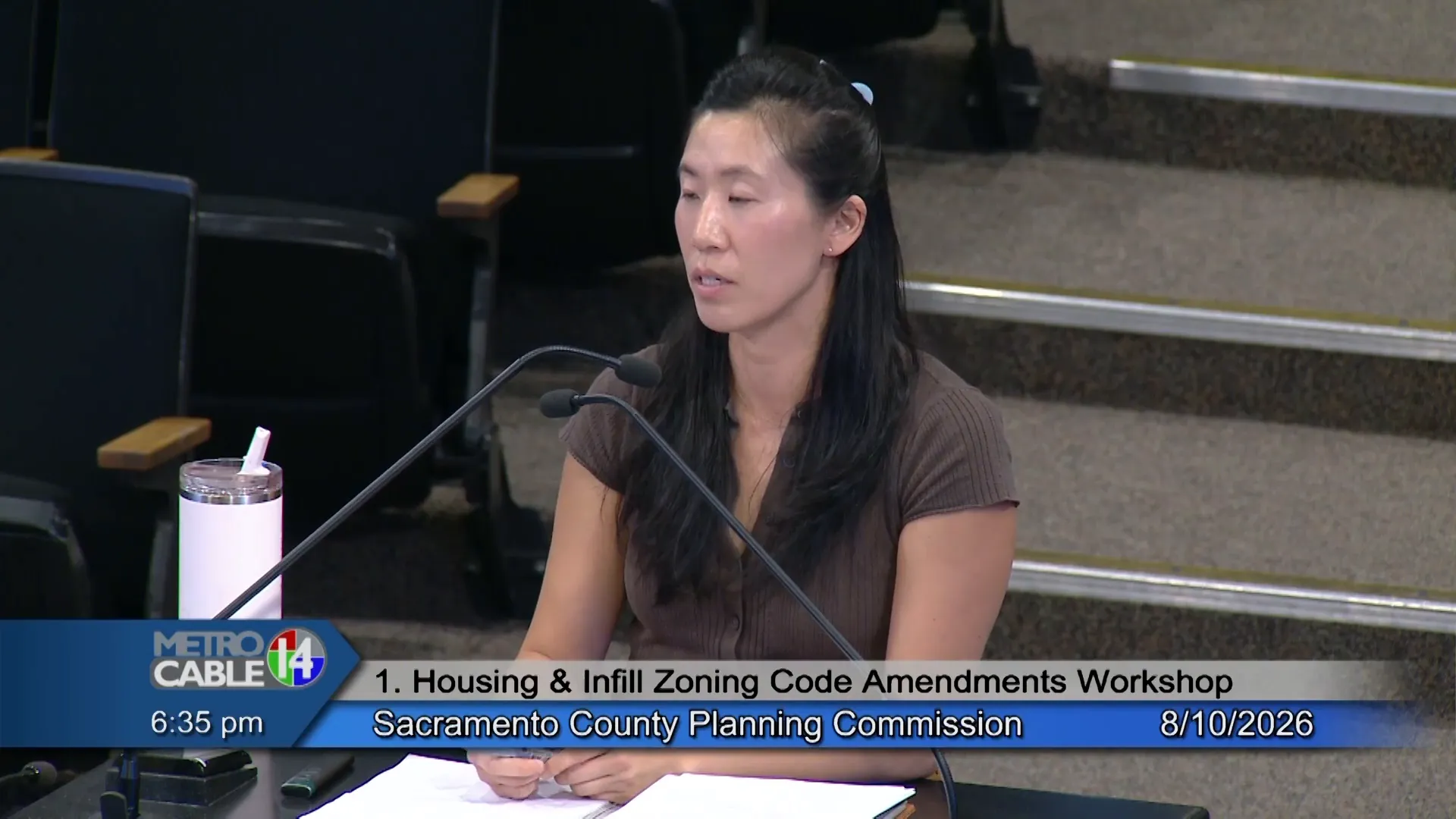
The Sacramento County Planning Commission held a meeting on August 14, 2026, beginning at approximately 2:47 PM (though the transcript starts with "Good evening") and concluding at 7:17 PM. The meeting included a workshop on housing and infill zoning code amendments (Item 1) and a public hearing on the repeal and amendment of the Accessory Dwelling Unit (ADU) ordinance (Item 2). Quorum was established after Vice Chair Devlin arrived. The following sections summarize the discussion and decisions.
Public Comments & Testimony
- Mark McKibben (Orangevale resident and board member of YIMBY group House Sacramento) expressed strong support for the proposed zoning amendments, particularly by-right approvals and reduced parking minimums. He argued that preserving parking minimums is less important than maximizing regional housing production. He also supported the proposed CPAC appeal fee, citing a 2021 Orangevale CPAC appeal that he felt was unreasonable.
- Les Lem (on behalf of the Environmental Council of Sacramento) expressed strong support for the proposed amendments, especially provisions for adaptive reuse, minimized parking requirements, bicycle parking, active transportation, and common open space. He urged the county to move forward with infill development in line with the Green Means Go areas.
- No online public comments were received for either agenda item.
Discussion Items
Item 1 – Housing and Infill Zoning Code Amendments (Workshop)
Staff (Jesse Shen, Infill Coordinator) presented a workshop summarizing feedback from CPACs, developers, and housing advocacy groups on four topic areas:
- Multifamily Amendments: Proposed to remove use permit requirements in BP, RD10, RD15-40 zones; reduce minimum vehicle parking to 1 space per unit (from bedroom-based); remove covered parking requirement; reduce bicycle parking to 25% of vehicle parking; adjust privacy design standards for buildings near single-family zones.
- Neighborhood-Scale Multi-Unit Buildings: Allow duplexes, triplexes, and fourplexes by right in RD7 zones (up to 4 units). Extend existing single-family/duplex design standards. Parking: 1 space per unit required on-site.
- Commercial Corridor Overlay: Apply to 8 corridors, prohibiting auto-oriented uses (e.g., car washes, RV storage) and allowing night markets/food truck plazas. No minimum off-street parking in the overlay. Height up to 75 feet/7 stories. Drive-throughs must be rear-cueing.
- Administrative Amendments: Proposed a $4,000 CPAC appeal fee for residential projects (currently free for community-wide interest appeals). Extend the Special Minor Development Permit (cost ~$1,300) to single-family, duplex, triplex, and fourplex projects for up to 25% deviations.
Commissioner Feedback (Workshop – no formal vote):
- Parking: Commissioners expressed mixed views. Commissioner Verga and Chair Borja raised concerns about on-street parking spillover, citing examples of new developments where parking is already insufficient. Commissioner Verga noted that 2 spaces per unit is the market norm in the county. Chair Borja suggested considering transit availability and encouraged staff to analyze parking needs by area. Commissioner Devlin supported reducing parking minimums to allow flexibility, noting that developers will provide what the market demands.
- Setbacks/Open Space: Chair Borja asked about tree canopy and green infrastructure; staff clarified that removing the 25% open space requirement is duplicative and that other landscaping standards remain. Commissioner Devlin supported removing the minimum storage requirement, arguing the market will provide if needed.
- CPAC Appeal Fee: Multiple commissioners (Verga, Borja, Devlin) opposed the $4,000 fee, arguing it would discourage community engagement. Suggestions included lowering the fee, changing the appeal body to the Planning Commission (instead of Board of Supervisors), or allowing signature gathering in lieu of payment. Staff noted that feedback would be considered and a revised package would be brought back in September.
- Commercial Corridor Prohibitions: Chair Borja expressed concern about blanket prohibitions on auto-oriented uses, urging staff to consider continuity with neighboring jurisdictions and avoid creating blight. Staff acknowledged that the feedback was limited and that they are considering case-by-case approaches.
Item 2 – Accessory Dwelling Unit Ordinance Repeal and Amendment (Public Hearing)
Planner Matthew Jamamoy presented the proposal to repeal the local ADU ordinance and defer to state law, due to HCD's February 2026 letter requiring compliance. The county could not keep pace with annual state law changes and HCD interpretations. To maintain allowances in agricultural/residential/recreational zones, the proposal introduces Agricultural Accessory Dwellings (AADs) – up to two detached units per lot (20 ft height, 1,200 sq ft) by right, with deviations via minor permit. Additionally, an addendum from HCD (July 30, 2026) required the county to allow SB9 (urban lot splits) in AR1-AR10 zones within census-designated urbanized areas. Staff recommended a modified motion to include that provision.
Commissioner Questions:
- Commissioner Verga asked about the practical impact on areas like Rio Linda (well/septic issues). Staff noted they are mapping eligible areas and coordinating with Environmental Management on public health concerns.
- Vice Chair Devlin clarified that the repeal is not a reduction in ADU support but a procedural response to state mandates. He asked about the legal risk of using AADs; staff believed it is defensible given HCD's narrow definition of ADU zones.
- Chair Borja suggested adding a reference to SB9 (2021 statutes) for specificity; staff confirmed it is already referenced in the code section.
Key Outcomes
- Item 1: No formal action taken. The workshop concluded the initial public outreach. Staff will prepare an updated amendment package for a recommendation vote in September 2026, incorporating feedback from the commission and public.
- Item 2: Motion by Commissioner Verga, seconded by Vice Chair Devlin, to recommend the Board of Supervisors adopt the ordinance as modified (including the SB9 addendum). The motion passed unanimously (all present members voted yes). The recommendation will go to the Board of Supervisors.
- Director's Report: Noted next hearing on August 24, 2026, includes two appeals, one from the Rio Linda CPAC.
- Scheduling: Chair Borja noted he will be absent on September 14, 2026.
- Adjournment: Meeting adjourned at 7:17 PM.
Meeting Transcript
Good evening, everyone. Um welcome to this evening's Sacramento County Planning Commission meeting. Um we do not have a quorum yet, but I believe we can still proceed with uh at least the first item, which is um allowing for the workshop. But before we begin, I do want to make a couple of announcements. Um I had originally intended to uh participate remotely, but as you can see now that I am here in person, not just in spirit, and so because I was expected to participate remotely due to the due just cause or to due cost provision, just cost provision that allowed the Bird Clerk to allow for folks if they were interested to also participate, at least for the public comments online. And so for both items, I will be asking Madam Clerk to see if there were any online comments or questions or feedback received from the public. So that is my first announcement. Um shall we proceed with a roll call? I will. So members Virga and Chair Borja. And let the record state that members Deblin and Rokenstein, as well as Corona Sabignano are currently absent. Okay. Thank you. Um you please lead us to the Pledge of Allegiance. And to the Republic for Stands. One nation under God, indivisible with liberty and justice for all. Thank you very much. And Madam Clerk, if you could just proceed with our other announcements this evening. The county fosters public engagement during the meeting and encourages public participation, civility, and the use of courteous language. The commission does not condone the use of profanity, vulgar language, gestures, or other inappropriate behavior, including personal attacks or threats directed toward any meeting participant. Seating may be limited and available on a first come, first served basis. To make an in-person public comment, please complete a speaker request form and submit it to the clerk. Each individual will be invited to the podium to make a comment. Members of the public may send a written comment, which is just distributed to commission members and filed in the record. Contact information is optional and should include the meeting date and agenda off agenda item number to be sent as follows. Email a comment to board clerk at Zach County.gov and mail a comment to 700 H Street, Suite 2450 Sacramento Cal Sacramento, California 95814. And that concludes the comment. Thank you, Madam Clerk. Let's proceed with item number one. Item number one is PLMP 2025-00202 is a sorry 00202. Housing and in-field zoning code amendments, workshop, and informational workshop to discuss and receive feedback on a zoning ordinance amendment to streamline housing production and in-field development. And this is countywide and the environmental document is non-acquible. Okay. Good afternoon, Chair Borja. Commissioner Verga. My name is Jesse Shen. I'm your infill coordinator with Planning and Environmental Review, and I'm here to facilitate the workshop for the housing and infill zoning code amendments. This workshop concludes the public outreach staff has conducted throughout the months of June and July with the CPAC's developers, professional groups, and housing advocacy groups. Throughout this workshop, I'll be summarizing the feedback we've received from each for each topic area. All right. So this amendment stems from a 2024 board workshop following an annual report on housing production to meet the targets for the current housing element cycle. Approximately 2,700 housing units would need to be produced per year. And for the first few years of the cycle, production was less than 50% yearly. Given these shortcomings, staff presented the board a range of regulatory and financial policy considerations at a workshop, and the board adopted a resolution initiating these zoning code amendments to streamline housing and infield development by maximizing by right development and updating development and design standards. There are four topical areas in this amendment. We have multifamily, these are three or more units on one lot. We have our neighborhood scale multi-unit buildings. These are duplexes, triplexes, and fourplexes. Those products and allowing those in the single family zones. We have our commercial quarter overlay, which establishes a zoning overlay over the commercial corridors.
openpublica.com