Sacramento Regional Transit District Board Meeting - September 25, 2017
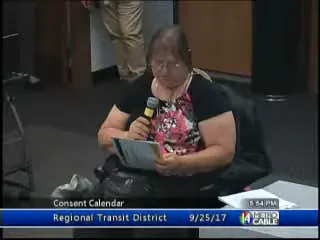
STREAMING COPY IN PREPARATION — RECORDING AVAILABLE FROM THE ORIGINAL SOURCE
Sacramento Regional Transit District Board Meeting - September 25, 2017
The Sacramento Regional Transit District Board met on Monday, September 25, 2017. The meeting was called to order, roll call was conducted, and a quorum was established. The agenda included consent calendar items, a delegation of authority for solicitation of bids and requests for proposals, and an informational item on lifeline passes for seniors. Public comments were heard on several items.
Consent Calendar
- Items 2 and 6 were approved on a single motion by Director Hanson, seconded by Director Jennings. All board members voted in favor with no opposed or abstentions.
- Item 1 (approval of the action summary from September 11, 2017) was approved after a speaker, Brenda Anderson, deferred her questions to a later agenda item.
- Items 3, 4, 5, and 7 had speakers and were discussed separately under Discussion Items.
Public Comments & Testimony
- Brenda Anderson (on item 1): Asked about the status of the lifeline pass for seniors on buses serving senior communities, but was informed the issue would be addressed under item 11.
- Helen O'Connell (on item 3): Thanked staff for bringing fair vending machines to the board and noted the need for better analysis of distribution points and learning from other transit systems.
- Rick Hodgkins (on item 3): No specific comment recorded, but acknowledged as a speaker.
- Russell Rawlings (on item 3): Expressed concerns about the proposed RFP process, emphasizing the need to study other systems and avoid a parochial approach based only on current conditions.
- Robert Copeland (on item 11): Supported exploring a lifetime pass or reduced fare for seniors and disabled populations, citing historical PUC rulings and potential public relations benefits.
- Jeffrey Retardiglia (on item 11): Questioned revenue figures and urged re-examination of the lifetime pass program, noting that fewer than a thousand people use it.
- Steven Barassa (on item 11): Asked the board to direct staff to analyze the cost of a lifetime pass for those 75 and older and its revenue impact.
Discussion Items
- Item 3: Delegation of Authority to Release Solicitation for Relocation of TPSS A1 and A055RC and RFP for Fair Vending Machines on Dynamic Messaging Signs
- Staff (Brent Berninger) explained the two-phase RFP process: soliciting proposals, shortlisting, then further development with board approval.
- Director Hanson raised concerns about the "highest bidder" approach versus best value for the community, suggesting land lease options for affordable housing.
- Director Henry emphasized safety issues at the current bus facility (e.g., crossing a major road to park) and community feedback urging relocation.
- A motion was made to approve the RFP, set aside funds for later, and have staff bring back a comprehensive plan. The motion appeared to be carried (no further vote recorded), but the discussion continued.
- Item 11: Informational Item on Lifeline Passes for Seniors
- Staff (Tim) stated that legal research indicates the Public Utilities Code does not allow free passes for seniors, but the legal department continues to explore options.
- Director Natoli asked about the clarity of the code section; legal counsel confirmed it seems clear but noted ongoing research.
- Board members expressed support for continuing to explore the possibility of a lifetime pass for seniors 75 and older, and for including such a program in a future regional transit ballot measure.
Key Outcomes
- Consent calendar items 2 and 6 were approved unanimously.
- Item 1 (action summary from September 11) was approved.
- Item 3: The board approved the delegation of authority to release the solicitation and RFP, with direction for staff to develop a comprehensive plan and engage the community.
- Item 11: The board directed staff to continue researching the feasibility of a lifetime pass for seniors 75 and older, and to consider including a funding source in a future ballot measure.
- Closed session was announced for a conference with legal counsel regarding a pending case (Sonya Wall vs. RT), with no report out expected.
The meeting adjourned to closed session.
Meeting Transcript
They shouldn't be able to hit the ball. Charles Barkley swing or Jim Horick if you want to look at it. Okay, good evening, everyone. We'll go ahead and call to order the Sacramento Regional Transit District Board meeting for Monday, September twenty-fifth, two thousand seventeen. Would the clerk please call the roll? Director Budge? Director Hansen. Director Harris will be late. Director Hume. Here. Director Jennings. Director Kennedy. Director Miller. Director Natoli. Chair Sh uh, sorry, Director Shanir will be absent, as well as Director Cerna and Chair Moran. Here. With that we have a quorum at 100 votes. This meeting of the Sacramento Regional Transit District will be cable cast without interruption on Metro Cable 14, the local government affairs channel, and will be streamed live on RT's website. Tonight's meeting will air on September twenty-seventh at six PM on Channel 14 and webcast at WWW SACMetroCable dot TV. It is also closed captioned. Members of the audience wishing to address the board should fill out a speaker card located at the rear of the room and provide it to me or Adam. Please speak into the microphone and state your name for the record. Okay, thank you. Thank you, Cindy. Would everyone please rise and join me in the Pledge of Allegiance? Public addresses the board on matters not on the agenda. There's Jeffrey. Um which is hey guys, when you use the connect cards, tap it so you tap it on and off through there to uh use it. That was three and a half years ago that I made that suggestion when they testing the connect card because it was important to get people to uh use it. Now symptom optimization. Uh you know that when you did in Jackson it took eighteen months. Um how how uh how Houston took twenty-four months through here. Um how how uh how Houston took 24 months through here, and now you're gonna try in a year to do that, and you're not gonna do any comprehensive assessment of specific bus stops, but you're doing that already for I-80 because of what you're needing to do and happen around, and you've got several others that it would be, I think, real informative, important, like what you're gonna be doing when you talk about the uh um arena today. Um I'm hoping you include about how you specifically with all the bus service that goes through there now conveniently of what other changes are happening and taking place. Uh the other thing on this is you're saying project thing through there, you got way down there about building stronger relationship with customers and stakeholders. This is where calling system optimization. It's a sheet that you've got floating around through there. I really think that you know, in a year you've got a hard task here to get learn who your riders really are. I think with the connect card that you did this thing that um uh reaching out to the seniors, and I will tell you that uh dealing with Barbara's reach out for the should we say resident advisory boards with the Sacramento Housing and Redevelopment Agency. I think that was appreciated that you guys went out there, and it really thrilled them that for seniors that they could figure out and understand a little bit how to use the connect card. And I got 20 seconds left, so we will turn around and bounce back to the sheet and say, yes, is Doug Carter's contract going to end in June 2018 for the 500,000 dollars, or is this board going to continue it for um dealing with the labor negotiations and other such factors? And is um the item number 11, oh well, um, contract and consulting fees. So with that note, I will leave you guys to um do things as a board. Um, good evening to you. By the way, Robert's last name is Copeland. Hope for the record. Um, but it's it's spelled like Copeland. Anyway, um speaking of Waton I 80, I was at Waton I 80 this afternoon catching the light rail to come down here because he and I both had a meeting down on uh 18th and K at Disability Rights California. And at the vast majority of light rail stations that I've been at since using the Kinet card for the first time back on September 4th of this year, um that this is four weeks ago um or three weeks ago, actually, I um noticed that at Waton I-80, you have two Kinect card terminals that are too close together on the platform side, and you only have one other terminal that is at the bottom of the ramp on you know, the trains coming in to Waton I80 from CRC when you get off you I learned one thing I learned is not only do you swipe your card when you get on the bus, but you have to swipe it before you get on the light rail train and after you get on and get off the train. Nobody told me that.
openpublica.com