Sacramento Regional Transit District Board Meeting - October 9, 2019
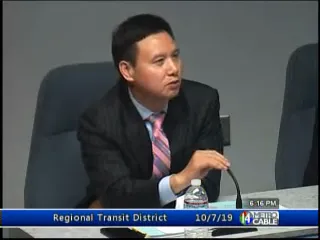
STREAMING COPY IN PREPARATION — RECORDING AVAILABLE FROM THE ORIGINAL SOURCE
Sacramento Regional Transit District Board Meeting - October 9, 2019
The Sacramento Regional Transit District (SacRT) Board of Directors met on the evening of October 9, 2019, to consider reprogramming $29.6 million in high-speed rail Proposition 1A funds for low-floor light rail vehicles and station modifications, authorize a proposal to operate South County Transit services, hear public comments on service animal safety and other issues, and receive reports on the upcoming in-house ADA paratransit service and the new student free ride program.
Discussion Items: Resolution to Reprogram Prop 1A Funds (Item 9)
- The board considered a resolution to repeal prior resolutions (17-06-088 and 18-09-0101) and approve programming up to $29.6 million of Proposition 1A high-speed rail funding for new low-floor light rail vehicles and related station modifications. Staff recommended the reprogramming, prioritizing light rail modernization as SacRT's highest priority.
- Public speakers expressed strong support: Mike Barnbaum emphasized the need for modern vehicles due to aging fleet and parts availability; Rick Hodgkins noted accessibility benefits for people with disabilities, bikes, and those using canes, walkers, or wheelchairs; Delphine Cathcart (STAR) urged approval to avoid delays and cost increases; Stephen Barassa highlighted the 40,000 daily riders and ADA accessibility improvements.
- Director Harris asked about timing for additional funding opportunities for double tracking the Green Line (SVS loop). Director Lee responded that Caltrans/CTC announced up to $1 billion by end of 2019, and the expansion component of the light rail modernization project can leverage additional funds.
- Vice Chair Hansen thanked staff for moving quickly, noting SacRT was one of the last jurisdictions to not expend Prop 1A money, and emphasized the importance of low-floor cars and station improvements, as well as the SVS loop to move light rail closer to the passenger depot.
Public Comments & Testimony (Non-Agenda Items: Service Animals)
- Several speakers addressed issues of pets and service animals on light rail, citing incidents where guide dogs were nearly attacked. Margie Donovan, Shannon Dillon, Rick Hodgkins, Jean Marie Moore, Brooklyn Kelly, and Roger Oberholzer all spoke about the need for better enforcement, reporting, and training of RT police/dispatchers. They described a recent incident where a guide dog team had to exit a train due to a barking dog and received inadequate support from RT police via the alert app.
- Rick Hodgkins also mentioned support for bringing paratransit in-house but raised concerns about taxi dispatch.
- Jeffrey Tardi Gia spoke about the need for re-training on disability accommodations and reporting.
- James Warsnoff alleged misspending of federal, state, and local funds by SacRT management, but Director Lee responded that hiring processes are fair and transparent.
Discussion Items: Resolution to Submit Proposal for South County Transit (Item 10)
- Staff recommended authorizing the General Manager/CEO to submit a proposal in response to the RFP for turnkey operation and maintenance of fixed route and dial-a-ride services issued by the South County Transit System. Staff argued that winning the contract would make SacRT a true regional provider, reduce duplication, and provide seamless transportation options for the south county area.
- Director Natoli emphasized the importance of maintaining intra-city and inter-community connectivity, especially for rural areas and lifeline services.
- Mike Barnbaum supported the proposal, noting it is a logical next step after annexations and the Fly SacRT service expansion, and highlighted that Route 99 (which currently operates only weekdays with a cutaway bus) could be enhanced.
- Jeffrey Tardi Gia noted the difference between a bid and a response to an RFP and raised concerns about dispatch workload and communication across systems.
General Manager’s Report (Item 11)
- Laura (VP of Planning) provided an update on the transition to in-house ADA paratransit service, effective March 29, 2020. Formal termination notice sent to Paratransit Inc. SacRT is expediting purchase of 40 new vehicles (80 total, including 40 recently delivered). Rider policies remain unchanged (1-2 day call-in, zero trip denial, door-to-door service). Paratransit service will be available to the airport once the bus route to the airport launches.
- General Manager Henry Lee reported on the successful launch of the "Ride Free RT" program for K-12 students, with a 40% increase in student ridership in the first week. The program is the first of its kind in the nation, providing free system-wide service to over 200,000 students.
- Lee also announced a station naming partnership with UC Davis Health for the 39th Street Station (now renamed), SacRT's first revenue-generating light rail station naming partnership.
- Lee introduced new staff: Jason Johnson (Budget Director), Joe Field (Senior Community Relations Officer, former Assistant Deputy Director at CTC), Captain Nisa Hand (VP of Security, Safety, and Customer Satisfaction), and Sandy Bobek (Assistant VP of Technology Innovation and Performance Monitoring). All positions are replacements, not new.
Key Outcomes
- Item 9: Motion by Director Harris, seconded by Vice Chair Hansen, to approve the resolution reprogramming $29.6 million of Prop 1A funds for low-floor light rail vehicles and station modifications. Passed 8-1.
- Item 10: Motion by Director Howell, seconded by Director Hume, to authorize the General Manager to submit a proposal for South County Transit services. Passed 8-1.
- Service Animal Issue: Chair Kennedy committed to meeting with General Manager Lee after the meeting to discuss the concerns. The board acknowledged the issue and plans to reconvene the task force.
- Paratransit Transition: Implementation is on track for March 29, 2020, with 80 new vehicles and unchanged rider policies.
- Student Free Ride Program: Launched successfully; initial data shows 40% increase in student ridership.
Meeting Transcript
I'm not concluding my report on this. Moving item number nine, unfinished business resolution. Repealing resolution numbers seventeen oh six O eight eight and eighteen oh nine oh one oh one and approving the programming of up to twenty nine point six million of proposition one A high speed rail funding for the new low floor light rail vehicles and related station modifications. And here to present is Brent Bernicker. Great. Good evening, Chair Kennedy and members of the board. So at the last meeting we were asked to bring back this issue. And what we've done is we brought back the issue as to reprogram the high-speed rail Prop 1A funds to the light rail modernization fund and also come up with some options. The issue paper is in front of you, and I'm here to answer any questions that you may have. Well we actually have uh cards on cards. Yes. I'll speak after that. Okay. Mike Barnbaum. Thank you, Brett. Uh thank you, President Kennedy and members of the Regional Transit District Board. Um here to address you on uh light rail vehicle uh and station uh modification and modernization. Uh the Sacramento Regional Transit District started uh its light rail starter line back in 1987 and procured uh rail cars through Siemens Transportation System. It has ever since uh procured cars through uh construcciones auxiliados Friday Alcatis, based in Spain, uh most know it as CAF, and uh is now uh uh holding a fleet of refurbished cars uh from the Urban Transportation Development Corporation that were once used at the Valley Transportation Authority in Santa Clara County. Uh these uh vehicles um like uh like anything uh we work with uh on an everyday basis, whether it's our uh office and automation systems, uh personal vehicles we use, uh technology we use uh in in personal or professional life, everyone wants the most modern up-to-date thing. And regional transit deserves a modern light rail vehicle network of vehicles that are accessible to all users and not solely exclusively in the first uh car uh upon the train uh boarding in the platform. Many of the reasons why we see a lot of trains have maintenance uh that they uh that they use and uh we're running uh one vehicle uh consists on Sunday and holidays, mostly it can be pointed toward uh the ongoing maintenance of old vehicles which have parts that are hard to get uh as vehicles age. So having a modern vehicle system for the light rail and not uh exclusive just to the buses ensures that Sacramento Regional Transit keeps up with uh the latest in technology and the latest in uh in accessibility uh for the uh future of the system. So I'd be honored uh to second the motion by Director Harris and move this item forward to modernize the light rail vehicle fleet and the stations for low floor services. Thank you. Thank you, Mike. Rick Hodgkins. Can we get a microphone to Rick? Thank you, Chair Kennedy, members of the board. It's been a while since I've been here. I think it's been January, back in January of this year. Uh I have a job that's normally Monday through Friday from 4 p.m. to 8 p.m., but that because I had a doctor appointment today that was late in the afternoon, I asked to skip work so I can be here, but also for the doctor appointment when I found out about a bunch of my fellow blind citizens being here for an item that they want to speak on off the agenda. I decided to be here uh for that item as well as this item, um, as well as to talk about uh previous item that was heard last week that's which I'll talk about later. But I do support uh the low floor light rail vehicles as well as the station modernization and station modification. Um if I am able to ride an adult trike or a bicycle again, uh this would also be good for people with bikes. The other thing that has not yet been mentioned so far thus far is that when you have people with not just canes, but crutches, walkers, wheelchairs of any kind, oftentimes that they have to, and even with guide dogs that which we'll hear about with items not on the agenda, and I mean items not on the agenda later on, that they have to wait for uh for the next train if not the next train, if not the next train, if not the next train, um because the front car is often filled up with disabled people already, and sometimes you have children, uh parents with children occupying uh the front car, the very front of that car. And so having low-floor cars and light rail stations that which can accommodate low-floor cars will eliminate that problem, will completely and totally eliminate that problem. My question is how will people get to the other side if they're going the opposite direction? Um, like if I'm on the 21, how will I get to the other side if I need to go downtown, let's say, instead of going towards Sutter Street to Folsom, you know, if I'm at Mather Field, for example. Um, like I said, I have a job that's normally Monday through Friday from 4 p.m. to 8 p.m. I'm looking to get a job that's in the mornings again so I can come back to RT and give public comment on items again. Thank you. Thank you very much, Rick. Good to see you all again. Good to see you. Delphine Cathcart. Good evening, Chairman Kennedy and board. My name is Delphine.
openpublica.com