San Diego Infrastructure Committee Meeting Summary: November 14, 2018
STREAMING COPY IN PREPARATION — RECORDING AVAILABLE FROM THE ORIGINAL SOURCE
San Diego Infrastructure Committee Meeting Summary: November 14, 2018
On Wednesday, November 14, 2018, the San Diego City Council Infrastructure Committee met to discuss and act on several items, including impact fee studies, capital improvement program updates, and a review of the sidewalk maintenance policy. The meeting featured a special presentation on earthquake resilience and included public testimony on various infrastructure issues.
Consent Calendar
- Approved the meeting minutes from October 24, 2018, unanimously.
- Approved the consent agenda (items 1 and 2) with a commendation from Councilmember Ward for RIC Engineering's work on South Park's 30th Street, noting quick resolution of a parking issue for a local business.
Public Comments & Testimony
- Martha Welch opposed the city's use of sales tax, fuel tax, and other fees, arguing they are illegal and drive up housing costs. She called for an audit of road funds and criticized the city for not putting certain projects on the list.
- Robert Buck (retiree, Local 230, native San Diegan) opposed the relining of sewer laterals in American Park, calling it unnecessary and unwanted. He also objected to plans to underground utilities, stating the city's underground department is unresponsive and inflexible.
- Catherine Rhodes spoke on two items: first, about grandfathered airport revenues, arguing that the city and SANDAG have failed to achieve the promised 14% transit to the airport. She referenced a March 2018 SANDAG analysis that she believes is incorrect. Second, during the earthquake presentation, she urged the city to follow seismic laws and noted that San Diego did not adopt Seismic Zone 4 standards until the mid-1990s, leaving many buildings unretrofitted. She also pointed out that the Mid-Coast trolley and other projects have not adequately investigated fault lines.
- David Swearens (Old Town Community Planning Group member) supported the Old Town Impact Fee Study, stating it eliminates an expensive unnecessary project and spreads costs over a larger pool, reducing fees by nearly a third.
Discussion Items
Earthquake Resilience Presentation (Item 7)
- Dr. Lucy Jones (founder, Dr. Lucy Jones Center for Science and Society) presented on earthquake risks, focusing on the Rose Canyon Fault and its potential for a magnitude 6.9 earthquake. She highlighted vulnerabilities in water systems, buildings (especially unreinforced masonry and non-ductile concrete), and the economic impact of a disaster. She noted that San Diego's lower seismic zone designation has left it with weaker building codes and fewer retrofits compared to Los Angeles. She recommended the city conduct a vulnerability analysis and prioritize seismic-resistant water pipes.
- Committee members discussed local fault lines, the need for an inventory of vulnerable buildings, and the city's water infrastructure. Chair Kersey asked about state requirements for inventorying unreinforced masonry buildings; staff indicated that the city is not required to have such an inventory because it was not in Seismic Zone IV when the 1986 law passed. The committee also discussed the use of seismic-resistant pipes and the need for a plan to address old infrastructure.
Old Town San Diego Impact Fee Study (Item 3)
- Staff presented the updated fee study, which reduces the residential fee from $5,595 to $3,874 per unit (a 31% decrease) and the non-residential fee from $751 to $231 per average daily trip. The decrease is due to additional units and removal of a parking structure from the plan. The Old Town Planning Group voted to recommend approval, contingent on including a roundabout as a priority project.
- Public comment: David Swearens supported; Martha Welch opposed, arguing that fees make housing expensive and are a misuse of funds.
- Committee approved the motion to recommend council approval.
Mission Beach Impact Fee Study (Item 4)
- Staff presented the updated fee study, which sets a residential fee of $3,647 per unit and a non-residential fee of $521 per ADT. The Mission Beach Precise Planning Board voted unanimously to recommend approval. The committee approved the motion to recommend council approval.
FY18 State of the Capital Improvement Program (Item 5)
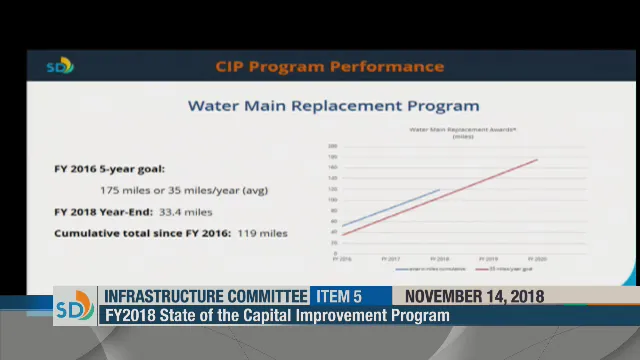
- Public Works staff provided an informational update on CIP achievements, including the Pure Water Program, Clear Wells project, West Mission Bay Bridge, and downtown mobility bikeways. They reported that the city completed 330 miles of road repair in 2018, reaching a cumulative 930 miles, exceeding the 1,000-mile goal ahead of schedule. The FY18 CIP budget was $929 million, with $552.6 million expended. Staff highlighted streamlining efforts, including electronic change orders, and noted challenges with rising construction costs and employee retention.
- 101 Ash Street Update: Staff reported that construction began September 24, 2018, with demolition on floors 1, 2, and 19, and asbestos abatement starting next week. So far, no issues with schedule or budget.
FY19 CIP Mid-Year Budget Monitoring Report (Item 6)
- Staff presented a consolidated action to adjust $74 million in CIP budgets, including returning $3.5 million from completed projects, allocating $23.5 million in new funding, and transferring $28.6 million between projects for cash management. The report also allocated $18.6 million in regional park and Mission Bay improvement funds and $3 million in new grants. Staff noted successful spend-down of Transnet funds held at SANDAG, reducing the balance from $55 million in 2016 to an estimated $27.5 million by end of 2019.
- Committee members praised the efficiencies and asked about specific projects, including Chicano Park and Fairbrook Park. The motion to recommend council approval passed unanimously.
Sidewalk Maintenance Policy Review (Item 8)
- The Office of the IBA presented a report reviewing proposed changes to the city's sidewalk maintenance policy. The report found that shifting all repair costs to the city would increase the fiscal burden (over $50 million backlog) and weaken the city's legal defense in trip-and-fall cases. The IBA recommended that the city develop a plan to address the backlog, including clear goals, staffing, and funding. They also suggested looking at other cities' approaches, such as point-of-sale requirements and lien programs.
- Committee members discussed barriers to fixing sidewalks, including high permit fees and low participation in the 50-50 cost-share program. Vice Chair Alvarez requested that the committee bring back the issue for further discussion and action, particularly before the next budget cycle. The item was informational only; no vote was taken.
Key Outcomes
- Consent Agenda approved unanimously.
- Old Town San Diego Impact Fee Study recommended for City Council approval (motion by Ward, second by Alvarez, passed unanimously).
- Mission Beach Impact Fee Study recommended for City Council approval (motion by Zeff, second by Alvarez, passed unanimously).
- FY19 CIP Mid-Year Budget Monitoring Report recommended for City Council approval (motion by Ward, second by Zeff, passed unanimously).
- Informational items (earthquake resilience, CIP state of the program, sidewalk policy review) were received and discussed; no votes taken. The committee agreed to revisit the sidewalk policy discussion in early 2019, with a focus on creating a plan and exploring options such as permit fee reductions and point-of-sale requirements.
Meeting Transcript
Good afternoon, everybody. Thank you for joining us for today's meeting of the infrastructure committee. Today's Wednesday, November 14th, twenty eighteen. Let the record reflect that we are joined by Council Members Zeph and Ward, and Vice Chair Alvarez will be uh joining us shortly. We also have our City Attorney Representative Tina Ray, our IBA representative, Jillian Cassie, who we're gonna hear more from later. Our mayor representative Lee Friedman, and of course our committee consultant Justin Garver. Joining us in person or watching us on City TV. Uh, we will start as always with non-agenda public comment. We do have three members of the public who would like to speak. Uh starting with Martha Welch. Please come forward. You have two minutes. Surrey's a quick thing for the roads. Most roles something else like overlay and conquer. Surrey um is not the right thing right now. Where's the food tax and uh and on um structure uh fund? We need an audit for those things also. Because we need other but that because I don't think it's right right now, um, you don't fix all these roads because of sales tax and um fuel tax and everything. Now Pump saying two is not on the on the list again, and you voted for that. You know that? You know you do this when the city sales tax, transnet and property taxes. It used to be um use it using sand eggs, also use that. Now we didn't vote for anything only when it passes 2004 0.5. So it should be 6.5, not 7.5. So we didn't vote for 1.5, we didn't vote for that. So it's fake and it's not not legal, and you use that all the time, and it's not right, and someday it'll be fixed, hopefully. Now, RP RTB RTCP I was also never voted, also. Now, if you have property to property tax, you have to vote, and it wasn't doing four, it wasn't there, that's only sales tax. So you always lie about this, and you know what does makes our rents go up because all this stuff you do. You wonder why housing is so expensive sometime. Well, everything you do here makes this housing so expensive. These fees you put on RT RTBIC, it makes our rents go up and also is not legal. And that's what you do here. You don't uh care about the people, I think sometimes, because you don't do the right thing. You make these fees all the time and it makes our rent go up, and wonder why housing is so expensive because you put all these fees also on there, like our this is um regional transmit capital improvement projects. That's what it stands for. And we didn't vote for that, believe me. I've looked at all the elections and it's not there. Thank you. Next up is Robert Buck, followed by Catherine Rhodes. Hello, my name is Robert Buck. I'm a retiree from local 230 and native San Diego. I live in an older community called American Park, and it has been undergoing some unneeded, unwanted, and unnecessary work. Earlier this year, we were saved by the city and had our front yard dug up to reline our sewer laterals that were working fine. Instead, the perfectly functioning VC pipe is now relined with an inferior product. This is not an improvement, it is a step in the wrong direction. Now I'm told the city wants to put utilities underground January 19. Once again, unneeded, unwanted, unnecessary. However, it may be done, it may be done. I have been asking the city underground department, Brianna Busby, the lead engineer, that it be flexible, reasonable, and considerate to the homeowners.
openpublica.com