Browse by city
Date range
Search help

Search titles, summaries, topics and stored transcripts together. Keywords may match separately; put the whole query in double quotes for a phrase. Matching follows word analysis, so punctuation is not exact. Both dates are included. Documents are not searched.

SHOWING 1–10 ENTRIES
01
NOV 20, 2026 · SAN DIEGO, CALIFORNIA · LAND USE & HOUSING COMMITTEE
Special Land Use and Housing Committee Meeting - November 20, 2026

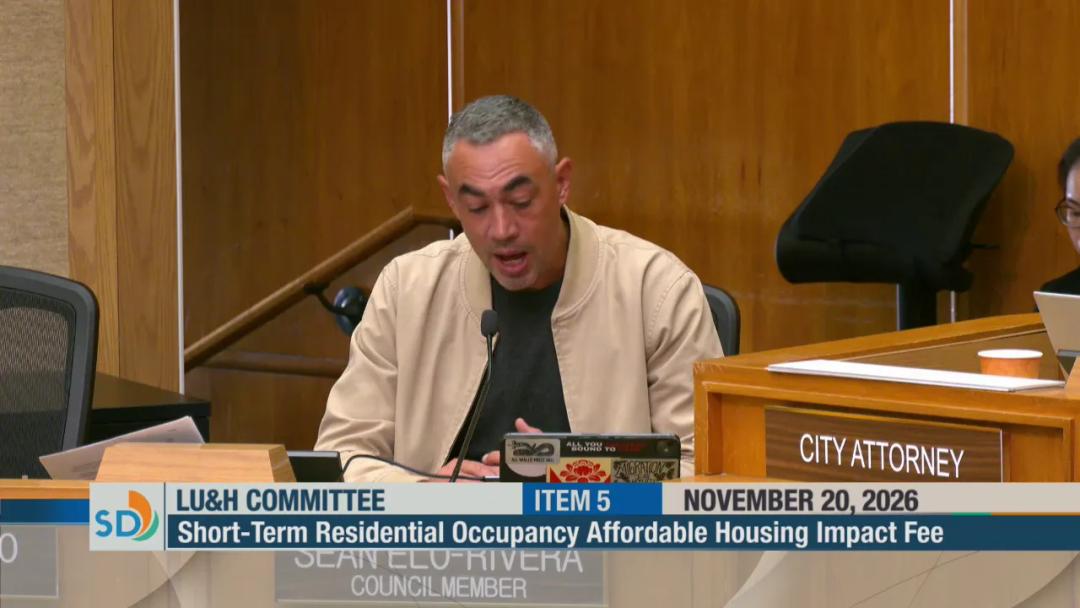
The Land Use and Housing Committee of the San Diego City Council met on November 20, 2026, at 1:00 p.m. (actual start time was after opening remarks) to consider several items including the formation of maintenance community facilities districts, a short-term residential occupancy affordable housing impact fee, and the 2026 annual report on home permitting. The meeting was chaired by Councilmember Kent Lee. Consent Calendar - Minutes Approval: Unanimously approved the committee minutes of October 16, 2026. - Caltrans Relinquishment Agreement: Unanimously authorized execution of an agreement with Caltrans to transfer a street and sidewalk on La Jolla Village Drive between I-805 and Judicial Drive. Public Comments & Testimony - Non-Agenda Public Comment (3 in-person, 6 virtual): - Janet Burjois (East Village resident): Thanked the city for two projects (16th & Island low-income housing and Raider Brady Center), expressed disappointment over the closure of the Neil Good Day Center and closed public bathrooms, and suggested fees on undeveloped lots to encourage development. - Paul Krueger (Talmud, possibly Talmadge): Urged committee members to better engage with community members who feel voiceless, criticized the bike lane planning process as dominated by paid advocates, and noted that 96% of San Diegans do not ride bicycles. - David Modi: Recounted an experience from 2019 where a low-effort solution for planning group agenda compliance was ignored by staff for a year before management folded it into a formal program and then criticized planning groups publicly. - Anthony Ralphs: Thanked the committee for actions taken on a prior Monday (likely November 16), said it restored faith in government, and presented bouquets to council members and staff. - Judy Strang (virtual): Concurred with Krueger and Modi, urged consideration of public health in housing decisions, and advocated for smoke-free and vape-free multi-unit housing. - Blair Beekman (virtual): Asked for clarity on whether rescinding the 2024 smart streetlight contract would also end all pre-2024 placements and requested deeper conversations about reducing surveillance tech in low-income communities. - Becky Rapp (virtual): Urged the committee to direct staff to revise off-site signage regulations for marijuana advertising to align with last year's on-site prohibition, arguing consistency is needed. - Kathleen Lippett (virtual): Thanked Krueger and Modi, opposed marijuana businesses on public land, and requested an independent public review of census tracts that are split. - Abdul (virtual): Called for rapid deportation of illegal immigrants to free up housing for citizens, opposed allowing “moss” (Muslims) into neighborhoods, and supported retaining surveillance cameras in neighborhoods that want them. - Phone number ending in 870 (virtual): Encouraged mass public participation as a wave that moves political will, and thanked Jan, Paul, Mr. Moody, and Anthony for their contributions. - Madison (virtual): Expressed support for smoke-free multi-unit housing policies to protect children and residents with respiratory conditions. - Consent Agenda Public Comment (1 virtual speaker): - Phone number ending in 870: Thanked the city for declaring a surplus land property, supported the Midway Rising DDA, and praised Director Bibler for land work with Caltrans. - Blair Beekman (virtual): Discussed sea level rise issues and accountability in surveillance tech. - Abdul (virtual): Suggested Caltrans add permanent bathrooms under freeways for homeless and build a bridge over the San Diego River for Midway Rising. Discussion Items - Items 3 & 4 – Resolutions of Intention to Form Maintenance Community Facilities Districts (CFDs): - Presentation by Michael Jones, Parks & Recreation: Explained that CFDs levy special taxes for maintenance services, do not issue debt. Item 3: Nakano development (Otay Mesa, Council District 8) for vernal pool and open space maintenance, landowner is Tri-Point Homes. Item 4: Riverwalk project (Mission Valley, Council District 3) for park maintenance including river park, trails, habitat restoration; developer is SD River Walk LLC. A second public hearing and landowner election will follow. - Public comment: Pete Shearer (supporter, Riverwalk developer) said the CFD is in compliance with the 2020 development agreement; Anthony Ralphs supported the habitat restoration; two others registered support without speaking; virtual speakers Abdul praised connections and noted senior golf rates; phone 870 thanked Director Field and called for a maintenance role model; Blair Beekman raised wildlife trail surveillance technology issues. - Committee action: Councilmember Whitburn noted a discrepancy: the Riverwalk CFD charges $240/year for market-rate units and $20/year for income-restricted units, while Nakano CFD charges $240 for both. KMA consultant said flexibility exists to lower the latter. Councilmember Elo Rivera suggested reviewing before full council. Both items passed unanimously. - Item 5 – Short-Term Residential Occupancy (STRO) Affordable Housing Impact Fee: - Presentation by Angeli Hoyos (Council District 6 policy chief) and Kaiser Marston Associates: Updated a 2018 nexus study to quantify affordable housing demand generated by STRO visitor spending. Methodology: spending creates jobs, some low-wage, which increases demand for affordable housing. Maximum supportable nightly fees range from $2.38 (downtown whole-home) to $8.33 (Mission Beach whole-home). Proposed two-tier fee structure: high-tier (La Jolla $7.73, Mission Beach $8.33, Pacific Beach $6.64) and low-tier ($2.38 for all other submarkets), estimated to generate $4.5 million annually. Home-share fees were not included initially (IBA suggested inclusion could increase revenue). Staff recommended drafting a council recommendation. - Public comment (7 in-person, 6 virtual): - Kimberly Jackson (vacation rental owner): Opposed as double taxation; noted $58.9M in TOT already paid. - Aaron Beard (vacation rental manager): Criticized the 1.06 spending ratio as taxing businesses downstream, called fee regressive, and said hotels are not charged. - Matthew Gardner (Mission Beach retail owner & community leader): Argued fee is a tax, not a fee; questioned legal basis and warned of downward impact on industry. - Julieta Ornelis (San Diego Housing Federation): Supported the fee as a modest way to fund affordable housing for workers in tourism-related jobs. - Jeff Hoyter: Emphasized that STROs displace higher-income residents who would otherwise live in the units. - Christine Smith (Ocean Beach resident): Noted 8% of OB housing units are STROs, displacing service workers and segregating poverty. - Anthony Ralphs: Identified as extremely low-income earner who lives an hour away; supported the fee. - Virtual speakers: Angie Stripling (PATH) and Thelma Navarro (Center on Policy Initiatives) supported the fee; Blair Beekman saw it as responsible; Abdul opposed, called it a tax on tourism; phone 870 urged higher fee and collaboration; Saad Asad supported but asked to pair with allowing more homes in coastal areas. - Committee discussion: Chair Lee noted the fee is modest and likely passed to visitors. Councilmember Elo Rivera strongly supported, stating that San Diego must prioritize residents over tourists, citing examples from Barcelona, Puerto Rico, and Hawaii. She asked to examine Ocean Beach specifically. - Motion: Chair Lee moved to direct staff to draft a recommendation for council. Seconded by Councilmember Elo Rivera. Motion passed unanimously. - Item 6 – 2026 Annual Report on Home Permitting (Informational): - Presentation by Matthew Nostarola, City Planning: Reported that in calendar year 2025, 7,630 new homes were permitted, of which 2,050 (27%) were deed-restricted affordable. The city permitted 55 homes per 10,000 residents, outperforming Sacramento, Bakersfield, Los Angeles, and Long Beach. 2,100 ADUs were permitted. 95% of new homes were in climate-friendly areas. 58% were studios or 1-bedroom. The city has permitted 36,533 homes since the start of the 6th RHNA cycle, 34% of the 108,036 goal; but is behind on lower-income targets (needs 57,568 affordable homes by 2029). The report noted increasing use of Complete Communities Housing Solutions Program (2,165 homes, 23% affordable) and decreasing use of Affordable Housing Density Bonus Program. Inclusionary Housing produced only 235 affordable units and $3.04 million in fees. Staff recommended continued focus on affordable production in high-resource areas. - Public comment: Jeff Hoyter (Neighbors for a Better San Diego) presented observations: declining permits due to market saturation, inclusionary fees too low (only funds 3 units annually), need for net-new housing data (AB 670 now requires demolition reporting), and suggested raising complete communities density threshold to 45 du/ac. Julieta Ornelis supported, noted Prop 1 state housing bond. Anthony Ralphs praised 70% annual increase in permits and climate action alignment. Susan Baldwin asked for more off-site analysis. Virtual speakers: phone 870 called for higher inclusionary fees and transparency; Saad Asad argued only upzoning high-opportunity areas can scale; Blair Beekman expressed disappointment in systemic barriers; Abdul again focused on deportation; Stephanie Benvenuto (SD BIA) noted concerning market indicators for 2026-27; Patricia Fillet requested attention to Old Town heritage and infrastructure. - Committee comments: Councilmember Whitburn highlighted top permitting areas (North Park, Uptown, Mission Valley) and noted 27% affordable. Councilmember Elo Rivera acknowledged progress but said private market won't solve the problem; government must fill the gap. Chair Lee noted that even with updated community plans, permits don't automatically follow; also observed that declining rents may make projects less feasible. Key Outcomes - Consent agenda approved unanimously. - Items 3 and 4 (CFDs for Nakano and Riverwalk): Resolutions of intention passed unanimously. Staff to proceed to second public hearing. - Item 5 (STRO affordable housing impact fee): Motion passed unanimously to direct Council District 6 staff to work with SD Housing Commission, City Attorney, City Treasurer, and IBA to draft a recommendation for council, including a proposed fee schedule and code amendments. - Item 6 (Annual Home Permitting Report): No action required; received as information.
AFFORDABLE HOUSING 22% · PUBLIC COMMENT 20% · SHORT TERM RENTALS 19% · HOUSING 11%
02
NOV 19, 2026 · SAN DIEGO, CALIFORNIA · ACTIVE TRANSPORTATION & INFRASTRUCTURE COMMITTEE
Active Transportation & Infrastructure Committee Meeting – November 19, 2026

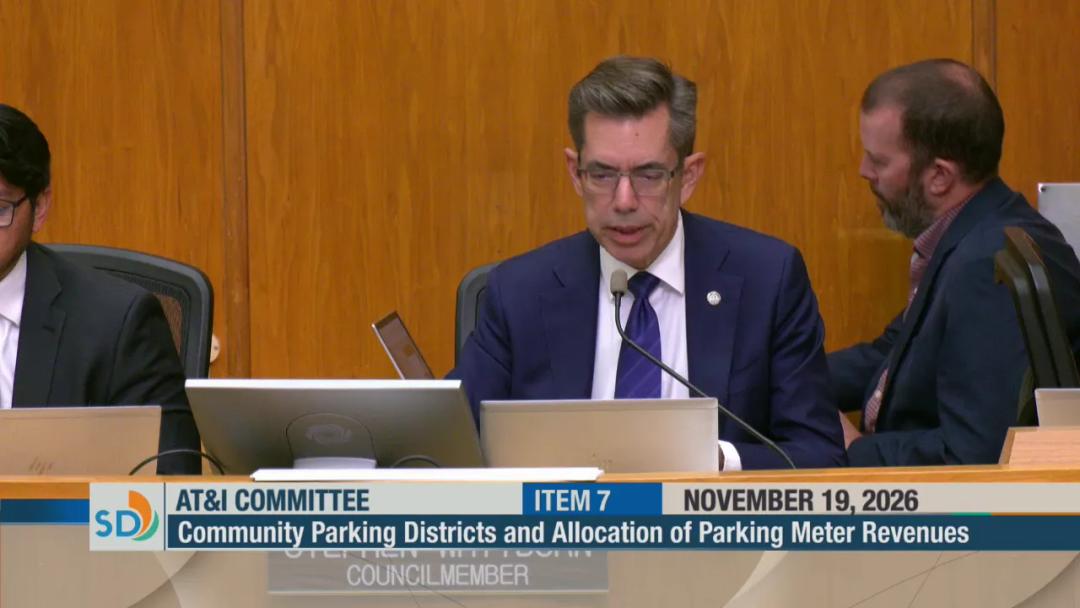
The Active Transportation and Infrastructure Committee met on November 19, 2026, at 9:00 AM. Chair Whitburn presided, with Vice Chair Foster and Council President Pro Tem Lee present; Councilmember Von Wilpert was absent. The meeting covered consent items, a docked bike share presentation, the draft Bicycle Master Plan, amendments to the Community Parking District policy, and the FY2027 Capital Improvements Program mid-year budget report. Numerous members of the public testified on various agenda items, expressing support for safer biking infrastructure, concerns about project outreach, and the need for transparent use of parking revenue. Consent Calendar - The consent agenda (Items 1–5) included approval of committee minutes, a construction change order for the University City Improvement Project (Item 2), change orders for storm drain and sewer projects, and reallocation of park improvement funds. - During public testimony, multiple speakers urged the committee to ensure that the Governor Drive repaving project (Item 2) include bike lanes and traffic calming as outlined in the 2024 University Community Plan. Speakers cited safety concerns for students, families, and cyclists. - The committee approved the consent agenda unanimously (3‑0) with a directive for staff to explore funding (estimated $200,000) for the bike lane improvements on Governor Drive. Public Comments & Testimony - Non‑Agenda Public Comment: - Paul Kruger (in‑person) urged the city to improve outreach and listen to all residents before making street changes. - Blair Beekman asked for clarity on cancelled surveillance contracts (ALPR, smart street lights, Flock). - Jason B requested safe detours for pedestrians, bikes, and transit during construction. - Terry Ann Skelly, Judy Strang, Becky Rapp, and Peggy Walker raised concerns about cannabis‑impaired driving and its risks to vulnerable road users, citing a 55% higher odds of fatal crashes for THC‑positive drivers. - Tanika Tyler (Douglas District) called for early community engagement in planning and proposed the Green Mobility Spine along the 94 freeway. - Henry Lowe suggested Elon Musk’s Boring Company build tunnels under freeways. - Madison urged prioritizing pedestrian, bicycle, and transit safety and linking infrastructure to public health. - Item 2 (Governor Drive Repaving): More than a dozen speakers—including parents, the Bike Coalition (Ian Hembry), Circulate (Arya Grossman), and residents—supported adding bike lanes during repaving, noting the community plan, safety, and Vision Zero goals. - Item 9 (Docked Bike Share): Nearly all callers (residents, business groups) favored bringing back a docked system, highlighting first‑/last‑mile connectivity, economic benefits, and climate goals. One caller cautioned against repeating past mistakes. - Item 6 (Bicycle Master Plan): Public opinion was divided. The Community Planners Committee (Victoria Labruzzo) opposed moving forward before the comment period closed, citing inadequate outreach and maintenance funding. Paul Kruger opposed the plan, saying it ignored non‑cyclists. Others (e.g., Mike Miller, Ian Hembry) supported the plan but urged stronger implementation, maintenance, and safety prioritization. - Item 7 (Parking District Policy): Speakers included downtown business groups (Downtown San Diego Partnership, East Village Association) who advocated restoring the 85/15 revenue split, while a Little Italy resident favored keeping all funds with the city for safety improvements. - Item 8 (CIP Mid‑Year Report): Only three virtual callers provided brief comments, mostly thanking the IBA and asking for continued transparency. Discussion Items - Docked Bike Share (Item 9, Informational): The San Diego Regional Bike Share Alliance presented a plan for a docked e‑bike system, citing benefits like affordable mobility, transit connectivity, and economic gains. They estimated capital costs of $14.2 million for citywide transit‑priority areas and $8.4 million annual operating costs. Committee members expressed support and directed staff to explore next steps. No action taken. - Draft Bicycle Master Plan (Item 6): City Planner Christine Mercado presented the update, which proposes a 2,000‑mile bikeway network (1,100 miles existing, 900 planned) with over 700 miles of separated bikeways. Public comment runs through November 30, 2026. The Mobility Board recommended support (9‑1). The committee debated timing and engagement. - Chair Whitburn noted the grant timeline required a committee recommendation. - Vice Chair Foster opposed, citing insufficient outreach in District 4 and concerns about impacts to main corridors. - Council President Pro Tem Lee supported moving forward but emphasized community input. - The motion to recommend adoption passed 2‑1, but because it lacked three votes, the item will go to full council without a formal recommendation. - Community Parking Districts (Item 7): Staff proposed amendments to Council Policy 100‑18 to have the city administer 100% of parking meter revenues, with CPDs serving in an advisory capacity. The IBA noted that restoring the 85/15 split would shift $1.4 million back to CPDs. - Chair Whitburn moved to approve the staff recommendation but incorporated downtown partnership amendments. No second. - Council President Pro Tem Lee offered an alternative motion: return to staff with direction to restore the 85/15 allocation effective July 1, 2027, preserve CPD control over project selection, and strengthen accountability. Vice Chair Foster seconded. The alternative motion passed 3‑0. - CIP Mid‑Year Budget (Item 8): Staff requested $93.8 million in appropriations and transfers. The IBA highlighted stormwater emergency funding (increased to $45 million) and noted that many transfers shift funding rather than create savings. The committee approved the staff recommendation 3‑0. Key Outcomes - Consent Calendar (Items 1–5): Approved 3‑0, with staff directed to identify $200,000 for bike lanes on Governor Drive. - Docked Bike Share (Item 9): Informational only; committee expressed support and asked staff to explore next steps. - Bicycle Master Plan (Item 6): Motion to recommend adoption passed 2‑1; item moves to full city council without a recommendation due to insufficient votes. - Parking District Policy (Item 7): Alternative motion passed 3‑0, directing staff to develop a revised policy that restores the 85/15 allocation by July 1, 2027, maintains CPD authority over project selection, and strengthens oversight and community engagement. - CIP Mid‑Year Budget (Item 8): Approved 3‑0. - The meeting adjourned to the next regularly scheduled meeting on January 28, 2027.

PARKING MANAGEMENT 18% · BICYCLE MASTER PLAN 17% · PUBLIC COMMENT 13% · BICYCLE INFRASTRUCTURE 11%
03
NOV 18, 2026 · SAN DIEGO, CALIFORNIA · BUDGET & GOVERNMENT EFFICIENCY COMMITTEE
Budget and Government Efficiency Committee Meeting - November 18, 2026

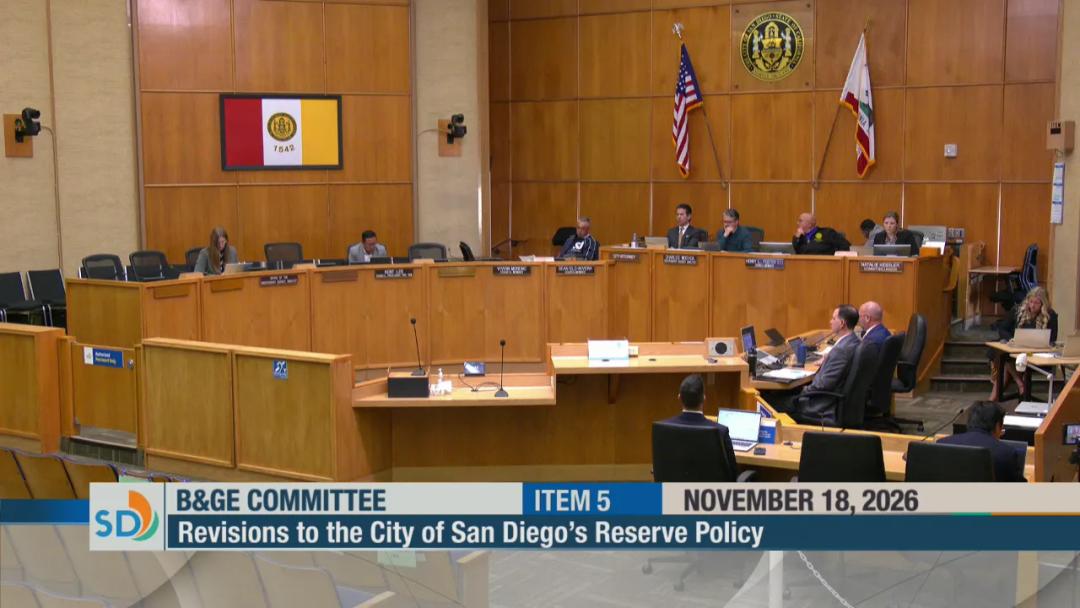
The Budget and Government Efficiency Committee met on November 18, 2026, to consider several agenda items including the approval of consent calendar items, a first-quarter budget monitoring report, a five-year financial outlook, revisions to the city's reserve policy, and an extension of banking services with Bank of America. Public comment was heard on all items, with speakers addressing surveillance technology contracts, youth prevention funding, infrastructure needs, and banking ethics. Consent Calendar - Item 1: Approval of committee minutes from October 21, 2026. - Item 2: First amendment to the Master Services Agreement with CGI Technologies and Solutions Incorporated for application development, maintenance, and support services. - Item 3: Second amendment to the Master Services Agreement with Zensar Technologies Incorporated for network services. - Item 4: First amendment to the Master Services Agreement with Zensar Technologies Incorporated for workplace and enterprise compute managed IT services. - All items were approved 3-0 (Vice Chair Moreno absent). Councilmember Ilo Rivera moved approval; Council President Pro Tem Lee seconded. Public Comments & Testimony - Non-agenda public comment: Several speakers addressed various topics: - A speaker criticized city contracts with large corporations, alleging they enrich billionaires at the expense of local businesses. - Madison encouraged continued investment in healthy third spaces for youth, emphasizing libraries, parks, and recreation centers as prevention infrastructure. - Blair Beekman (calling from Thailand) urged clarity on ending Flock surveillance and ubiquo contracts, requesting a vote before December and reassurance on public safety alternatives. - Peggy Walker raised concerns about youth cannabis use and urged dedicating more cannabis tax revenue to youth prevention programs. - Juan Soto proposed privatizing management of Mission Bay slips and suggested a reparations highway fund for areas south of I-94. - Judy String requested a report on the city's internship program and criticized cannabis billboards. - Joy Sanyata commented on consent agenda items from a prior meeting, supporting a grant for homeless services but noting litigation costs. - Marco Espinoza expressed optimism for the committee's work. - Tony thanked the chair for extended public comment time and praised the cancellation of the Flock contract. - Natalie Rashki praised the Privacy Advisory Board's work and called for community-centered decision-making. - Consent agenda public comment: Speakers addressed items 1-4: - Allegedly Audra criticized contracts with CGI (Canada) and Zensar (India), questioning data security and AI risks, and urged local control. - Blair Beekman thanked Councilmember Foster for work on ALPRs, urged accountability in ending surveillance tech, and raised concerns about cybersecurity practices. - Joy Sanyata supported the IT contracts but highlighted underrepresentation of women and Latinos in workforce reports, urging continued equity monitoring. - Natalie Rashke questioned why work is outsourced to India and raised concerns about technology blackouts. - Juan argued that global corporations dominate, making local alternatives unfeasible, and criticized Chinese ownership of SeaWorld. - Item 8 public comment: Speakers addressed the budget monitoring report: - Allegedly Audra cited CGI data breaches, questioned election costs, criticized police overtime for parking enforcement, and alleged financial mismanagement. - Blair Beekman encouraged discussing public safety expenditures after leaving surveillance tech, and asked for transparency on savings and next steps. - Juan mocked past budget claims about bathroom closures, suggested closing city hall bathrooms to save money, and called for rent collection audits. - Joy Sanyata requested clarity on property tax revenue and opiate settlement fund use, and praised police chief for overtime reduction efforts. - Natalie Rashki questioned how budget numbers reflect real needs for unhoused people and called for innovation. - Item 7 public comment: Speakers addressed the five-year outlook: - Allegedly Audra criticized infrastructure neglect, EV fleet costs, and lack of fiscal responsibility. - Lori Saldania warned about sea level rise impacts on stormwater infrastructure and urged proactive measurement. - Marco Espinoza noted progress but emphasized remaining structural deficit and suggested using calm years for back-office improvements. - Joy Sanyata called for value alignment and a new vision, and stressed the difference between budget deficit and structural deficit. - Blair Beekman supported budget progress and urged patience. - Juan proposed a reparations highway program, vacationing pension payments, and auditing leases. - Lori Lipsman urged a public education campaign on city finances to build trust. - Natalie Rashki emphasized aligning actions with desired outcomes. - Tony agreed on public education and noted restored trust after Flock cancellation. - Item 5 public comment: Speakers addressed reserve policy revisions: - Allegedly Audra criticized city spending priorities, calling for fiscal responsibility rather than new taxes. - Anthony Ralphs thanked staff and IBA for clarity, supported maintaining reserves. - Joy Sanyata requested collaboration between DOF and IBA on reserve target modifications. - Lori Saldania noted vacancies in stormwater inspection positions and urged smarter staffing. - Juan proposed a tariff on Mexican trucks to fund infrastructure and opposed new taxes. - Item 6 public comment: Speakers addressed the Bank of America contract extension: - Allegedly Audra cited Bank of America's federal penalties and ties to BlackRock, Vanguard, etc., questioning fraud prevention. - Anthony Ralphs opposed extension, asking about local credit unions. - Joy Sanyata conditionally supported but wanted to review equity concerns. - Lori Lipsman and others opposed, citing lack of trust and suggesting regional banks. - Juan recommended local credit unions and short contract terms. - Natalie Rashki asked if the city's bank funds surveillance vendors and proposed exploring local options. - Judy Streng suggested regional banks like California Bank and Trust. Discussion Items - Item 8: Fiscal Year 2027 First Quarter Budget Monitoring Report (information item) - Director of Finance Ben Batalia and Financial Operations Manager Amber Gutierrez presented. Major general fund revenues are projected to exceed budget by $12.9 million, driven by franchise fees, sales tax, and transient occupancy tax, partially offset by lower property tax. Departmental revenues decreased by $7 million (Balboa Park parking, EMS reimbursements, etc.). Expenditures increased $5.6 million (public safety overtime, election costs, El Niño prep). Net positive impact $400,000. Reserves at 10.6% of revenues, below 14.1% target. Anticipated $4.8 million Cal OES reimbursement for storm recovery. - IBA Charles Matica offered preliminary observations: positive revenue developments but offsetting pressures; first quarter report limited in scope; comprehensive mid-year report due January 29, 2027. - Councilmember Ilo Rivera questioned unbudgeted police overtime for summer operations, expressing concern about budget credibility. Council President Pro Tem Lee noted the need for flexibility but cautioned against premature optimism given El Niño risks and ongoing structural challenges. - Item 7: Fiscal Year 2028-2032 Five-Year Financial Outlook (information item) - CFO Rolando Charbell and Director Ben Batalia presented. Baseline shows a small surplus of $5.1 million in FY2028, but deficits emerge in FY2029 ($5 million) growing to $36 million by FY2032. Including new facility operating costs and reserve contributions, deficits reach $62 million by FY2032. Major revenue assumptions are conservative. Debt service is a key driver, projected to increase 77% over four years. Infrastructure needs total billions (stormwater $5.5B, streets $1.8B, facilities $1B). - IBA Charles Matica noted progress in reducing the operating deficit but emphasized that long-term structural balance is not achieved. He questioned whether the 16.7% reserve target is realistic and highlighted trade-offs between debt service and services. He suggested a serious conversation about new revenue sources. - Council President Pro Tem Lee stressed the need for honest communication about the outlook, noting that deficits reemerge after FY2028. Councilmember Ilo Rivera echoed that cuts have been painful and the city is under-resourced. - Item 5: Revisions to City Reserve Policy (action item) - CFO Rolando Charbell proposed updating Council Policy 100-20. Key changes: set a hard minimum reserve level of 10% (instead of no floor), require annual maintenance contributions to keep reserves at prior year's percentage, and build reserves using one-time funds (targeting at least 0.5% of revenue base annually). Eliminate the unfunded pension stabilization reserve and adjust risk management reserves. Full target remains 16.7%. - IBA Charles Matica supported the minimum and maintenance contributions but questioned whether the 16.7% target is achievable and whether a lower, more realistic target might be better. - Councilmember Ilo Rivera moved to approve staff recommendation. Council President Pro Tem Lee seconded, requesting further analysis from DOF and IBA on feasible interim targets. Vice Chair Moreno opposed, expressing concern about weakening protections. The motion passed 3-1. - Item 6: Extension of Citywide Banking Services Contract with Bank of America (action item) - City Treasurer Liz Correa and Assistant Investment Officer Trissy Deans presented. Requested a three-year extension with two optional one-year extensions and an NTE increase of $1.5 million (total $3.05 million). Reason: to maintain continuity during the SAP S4/HANA modernization project, avoiding costly transition and redevelopment of interfaces. Sole source approved. - Public comment raised concerns about Bank of America's ethics, suggesting local credit unions. - Councilmember Ilo Rivera moved to approve only the three-year extension (NTE $2.45 million, reflecting $900k for three years plus original amount), with the two optional years requiring future council approval. The motion passed unanimously 4-0. - Chair Foster expressed concern about the SAP project timeline and asked for more accountability. Key Outcomes - Consent Calendar: Approved 3-0. - Item 5 (Reserve Policy): Motion to adopt staff recommendation passed 3-1 (Vice Chair Moreno dissenting). The IBA and DOF will further discuss realistic interim targets before the item goes to full council. - Item 6 (Banking Contract): Approved a three-year extension (through April 2030) with a $900,000 increase in the NTE, and optional one-year extensions subject to future council approval. Unanimous 4-0. - Information items (Items 7 and 8): No action required; reports received and discussed. The IBA will release full analyses on December 7, 2026.

BUDGET 35% · PUBLIC COMMENT 23% · PROCEDURAL 7% · FISCAL SUSTAINABILITY 7%
04
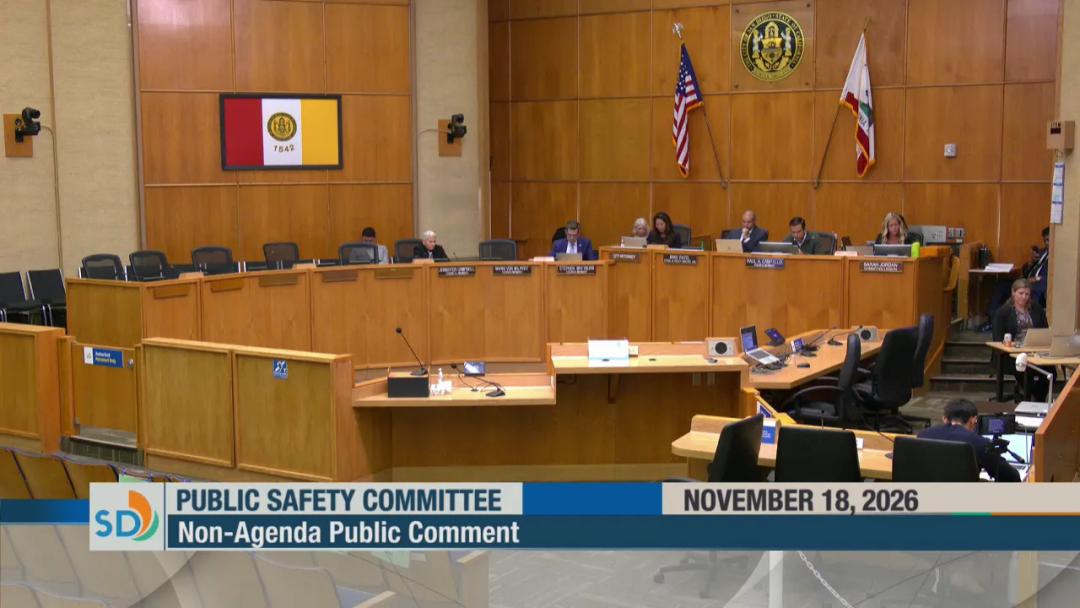
NOV 18, 2026 · SAN DIEGO, CALIFORNIA · PUBLIC SAFETY & LIVABLE NEIGHBORHOODS COMMITTEE
San Diego Public Safety Committee Meeting – November 18, 2026

The San Diego Public Safety Committee met on November 18, 2026, at 10:00 AM. The meeting covered a consent agenda with four items, discussion items on an ammunition contract, the Fire Rescue Department's annual surveillance report, and a brush management performance audit update, as well as a recognition of first responders of the year. Public testimony was heard on multiple items. Key votes included forwarding a tow management software contract to full council without recommendation and approving an ammunition contract. Consent Calendar - Item 1: Approval of committee minutes from October 14, 2026. Approved. - Item 2: Authorization to enter into a contract with UR International Incorporated for tow management and dispatching software. The Division of Race and Equity (Lisa Ann Kim) highlighted equity implications: from 2016–2022, disproportionate impact tows (for five or more unpaid parking citations, expired registration over six months, or 72-hour parking violations) were 45% in District 4 and 39% in District 8, compared to the citywide average of 29%. Councilmember Whitburn expressed concern about equity impacts on low-income residents and unhoused individuals. He noted a new council policy (passed two months prior) directing citations instead of towing for expired registrations. Whitburn moved to approve the consent agenda but forward item 2 to full council without committee recommendation. The motion passed 3-0. Whitburn voted no on item 2 but yes on the balance. - Item 3: Authorization to enter into a contract with WEPA Commercial Cleaning for janitorial services for the police department. Approved. - Item 4: Authorization for the fourth amendment to an agreement with Tablet Command for software licenses, increasing contract value by $640,000. Approved. Public Comments & Testimony - Consent Agenda: Public speakers addressed item 2. Blair Beekman urged focus on pretext stops and ALPR accountability. A speaker (phone ending 870) supported the tow software contract but noted underrepresentation of African Americans, females, and Latinos in the vendor's workforce. Crypto Bradley suggested giving gas cards to homeless individuals instead of tickets and training youth on how to safely interact with police. Natalie Rajke described being unhoused and having her RV towed despite a policy against towing inhabited vehicles. - Item 5 (Ammunition): Public comments raised concerns about lead-free ammunition costs, de-escalation training, and potential conflicts of interest. One speaker suggested using laser training instead of live rounds. - Item 6 (Surveillance Report): Speakers expressed trust in the fire department but warned about data sharing and privacy. One noted the San Diego Law Enforcement Coordination Center as a data fusion point. - Item 7 (Brush Management): A speaker suggested using goats and fire retardants. Another praised the department's work and urged increased funding. - Item 8 (First Responders): Two callers thanked and praised the honorees. - Non-Agenda Public Comments: Topics included AI risks, youth substance use prevention, police pursuits, cannabis taxes, and the city's removal of surveillance technology. One speaker (Francine Maxwell) thanked the council for removing Flock cameras and smart streetlights. Discussion Items - Item 5 – Ammunition Contract: Captain Mike Ramsey and Sergeant Justin Tennebaum presented a request for a one-year contract with four renewal options with San Diego Police Equipment Corporation for lead-free and lead-reduced ammunition, not to exceed $7,662,568 over five years. The current contract expires October 2027. The new contract is needed due to a county requirement for lead-free ammunition. Estimated FY27 expenditure is $604,807. Councilmember Whitburn supported the transition for officer health. The item passed 3-0. - Item 6 – 2025 Fire Rescue Surveillance Report: Assistant Fire Chief Steven Lozano presented the annual report for two technologies: unmanned aircraft systems (UAS) and UASI camera systems. In 2025, UAS were dispatched to 21 incidents and flew on 11; no imagery was retained or shared externally. No complaints, violations, or data breaches occurred. The UASI camera systems are not operational. The Privacy Accountability Board approved the report without modifications. The item passed 3-0. - Item 7 – Brush Management Audit Update: Deputy Director Erica Ferrera reported on implementation of a 2023 performance audit. Parks and Recreation consolidated citywide brush management as of July 1, 2026. Seven recommendations were made; two are complete, three require additional funding. For FY28, the department requests $2.578 million and three new positions to treat an additional 217 acres annually. Four alternative funding levels were presented. This was an information item; no motion required. - Item 8 – Public Safety First Responders of the Year: Deputy Chief Eric Young recognized honorees from SDPD (Evelyn Shea, Zach Feinstill, Brett Crawford) and SDFD (Dustin Fierro, Maureen O'Connor, Kevin Paschal). Statistics noted: SDFD responds to 183,000 calls annually; lifeguards perform 7,000 rescues; SDPD manages 675,000 911 calls. Each honoree or their supervisor spoke. Councilmembers thanked them. Information item. Key Outcomes - Consent Agenda: Approved 3-0; item 2 forwarded to full city council without recommendation. Councilmember Whitburn voted no on item 2 but yes on other items. - Ammunition Contract (Item 5): Approved 3-0. - Surveillance Report (Item 6): Approved 3-0. - Brush Management Update (Item 7): Received as information; FY28 budget request to be submitted. - First Responders Recognition (Item 8): Received as information. - Next Meeting: The next regularly scheduled meeting is Wednesday, January 20, 2027, at 2:00 PM.

PUBLIC SAFETY 18% · PROCEDURAL 17% · PUBLIC COMMENT 15% · WILDFIRE PREPAREDNESS 12%
05
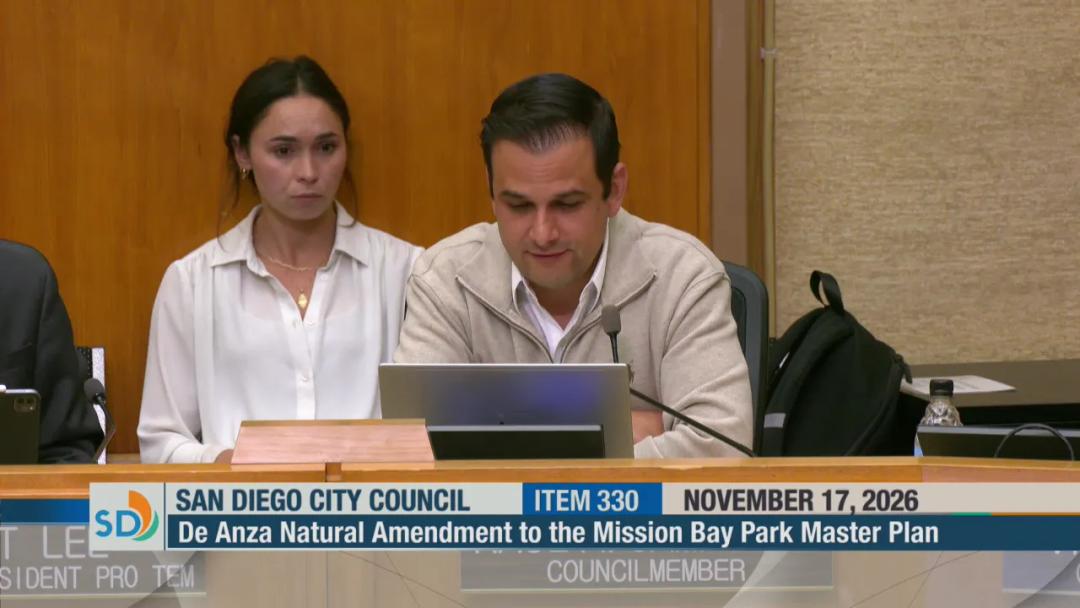
NOV 17, 2026 · SAN DIEGO, CALIFORNIA · CITY COUNCIL
San Diego City Council Meeting - November 17, 2026

The San Diego City Council met on November 17, 2026, in a full-day session addressing major policy initiatives. Key actions included accepting Coastal Commission modifications to the De Anza Natural plan, updating the city's investment policy to prohibit private prison investments, and amending campaign fundraising rules. Several proclamations were adopted and a new underground utility district was created. Consent Calendar - Approved unanimously (8-0, with Councilmember Von Wilpert absent). Items included reappointments to the Commission for Arts and Culture and the Small Business Advisory Board. - Item 60 (Data Centers): Returned to staff for further stakeholder engagement, with a report due in December. - Item 105 (Industrial Wastewater Settlement): A $17.5 million settlement was approved, noted by Councilmember Moreno as a consequence of failing to act on a 2013 auditor recommendation to adjust outdated fees. Public Comments & Testimony - Proclamations (S500, S504): Max Schmidt opposed both items. Multiple speakers (Alita Chavez, Carmina Paz, Nancy Gannon Hornberg, Francine Maxwell) strongly supported the Barry Pollard Day proclamation. Virtual speakers supported the Transgender Day of Remembrance. - Consent Agenda / Beach Bars (Items 50, 103): Several permit holders (Andrew David Kobrinitz, Van Parsegan, Jim Kennedy, Robert Crane, Hans Baumgartner) argued against proposed fee increases and policy changes, stating the core problem is the city's failure to enforce existing rules and issue available permits, not a lack of vacancies or flawed rules. They requested more time to work with staff on solutions. - De Anza Natural (Item 330): Environmental advocates (SURF, San Diego Bird Alliance, Coastkeeper) strongly urged adoption of the Coastal Commission modifications to enable wetland restoration. Campground operators and users (Heather Riley, Jacob Gelfan, Mitch Ingham) expressed support but urged the council to ensure low-cost camping is preserved during phased construction. - Investment Policy (Item S503): Multiple speakers (Evangelina Equia, Christopher Gomez, Rev. Thad Winkle) strongly supported the new restriction on investments in private prison and immigrant detention facilities. - Undergrounding (Item 331): A local homeowner, Justin Wilson, expressed frustration over a lack of clear project timeline information and a desire for greater transparency from staff. - Non-Agenda Public Comments: David Modi criticized past council actions. Speakers addressed concerns about cannabis and tobacco public health impacts. Tony expressed gratitude for council votes on the Flock and smart streetlight contracts. Discussion Items - Item S501 (Ending Perpetual Fundraising): Councilmember Elo Rivera proposed an ordinance to standardize the campaign fundraising start date to 12 months before a primary election. Councilmember Campillo attempted to close loopholes for candidate-controlled committees but faced Brown Act concerns from the city attorney regarding late-added language on ballot measures. The item was trailed to the afternoon session. Councilmember Campillo then successfully offered an alternative motion to set the effective date as March 7, 2027, to avoid a confusing and inequitable short fundraising window in January 2027. - Item 330 (De Anza Natural Coastal Commission Modifications): Staff recommended accepting 32 modifications from the Coastal Commission to avoid a multi-year recertification process. Councilmember Campillo secured a formal commitment from staff to ensure the planning of recreation and wetland restoration occurs simultaneously, and offered an amendment to the resolution reaffirming the council's 2024 policy direction to preserve existing recreational facilities and visitor accommodations until replacement plans are in place. The council president accepted the amendment, which the city attorney confirmed was legally permissible. - Item S503 (City Treasurer's Investment Policy): Staff presented the annual update, which included a new provision prohibiting investments in for-profit correctional facilities (private prisons). Councilmember Elo Rivera spoke at length in favor of the change, citing the profits of Geo Group and Core Civic from immigrant detention. Key Outcomes - Proclamations (S500, S504): Approved unanimously. - Item S501 (Fundraising Window): Passed 5-3 (Councilmembers Moreno, Campillo, Whitburn, Campbell, Lacava in favor; Foster, Lee, Elo Rivera opposed; Von Wilpert absent). The amended ordinance takes effect March 7, 2027, aligning the start of fundraising to 12 months before the primary election. - Item 330 (De Anza Natural Plan): Approved unanimously 8-0. The Coastal Commission's modifications were formally accepted. The council passed a resolution reaffirming the commitment to a balanced, phased implementation that preserves low-cost camping until replacement facilities are operational. - Item S503 (Investment Policy): Approved unanimously 8-0. The city's investment policy was updated to formally prohibit investments in private prison and immigration detention facilities. - Item 331 (Underground Utility District): Approved unanimously 7-0 (Councilmembers Elo Rivera and Von Wilpert absent). The Bay Ho 03 district was created. - Next Meeting: The council adjourned to its next regularly scheduled meeting on December 7, 2026.

PUBLIC COMMENT 25% · ELECTION PROCEDURES 12% · PROCEDURAL 6% · PARKS AND RECREATION 6%
06
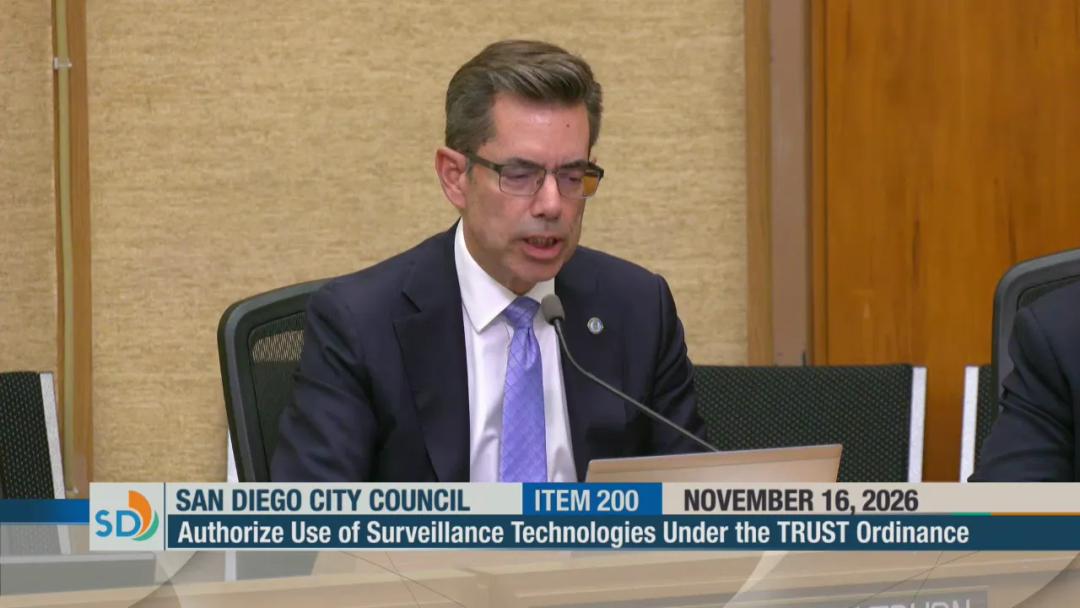
NOV 16, 2026 · SAN DIEGO, CALIFORNIA · CITY COUNCIL
San Diego City Council Meeting: November 16, 2026 - Surveillance Technology Debate and Vote

On Monday, November 16, 2026, the San Diego City Council convened for a regular meeting that began with a closed session at 10:00 AM and reconvened at 2:00 PM. The primary agenda item was Item 200: the annual surveillance report and continued use of 54 surveillance technologies under the Trust Ordinance, with a focus on Automated License Plate Readers (ALPR) and Smart Street Lights. After extensive public testimony and council deliberation, the council voted to rescind the ALPR use policy unanimously and later rescinded the Smart Street Lights use policy by a 5-2 vote. The council also approved the continuation of the other 52 surveillance technologies. The closed session resulted in a vote to initiate litigation (8-0). Consent Calendar - No formal consent calendar was presented; however, the closed session included items CS1 (anticipated litigation), CS2 (Conference with Labor Negotiators - Commission of Police Practices), and CS3 (Conference with Labor Negotiators). The council voted 8-0 to initiate litigation (CS1). Public Comments & Testimony - In-person and virtual testimony was overwhelmingly in opposition to ALPR and Flock cameras. Over 106 e-comments in opposition and 10 in favor were submitted. Three hours of in-person testimony and 29 virtual speakers were heard. Key themes included: privacy violations, misuse of data (including tracking a domestic violence survivor and an internal investigation), false arrests, sharing of data with federal immigration agencies, and distrust of police. Supporters cited crime-solving benefits, recovery of stolen vehicles, and missing persons cases. - Organized presentation by the Trust SD coalition (Seth Hall, Homaira Yousafi) urged the council to reject the ALPR use policy, remove cameras, and cover them until removal. They cited numerous incidents of misuse and violations of state law. - Several UCSD students and faculty, community organizations (e.g., ACLU, PANA, Youth Will), and individual residents testified against the technology. A few speakers (e.g., Mary White, Angela Vetter) spoke in favor, arguing the technology is a useful tool when properly regulated. Discussion Items - Item 200: Authorized Use of Surveillance Technologies – SDPD Chief Scott Wall presented the 2025 annual surveillance report, detailing that no new technologies were proposed, but changes were made to ALPR and drone policies. He reported that ALPR assisted in over 940 investigations, 700 arrests, and recovery of 689 stolen vehicles. He highlighted new auditing and oversight measures. Council members questioned the department about data sharing, misuse (especially tracking a domestic violence victim during an internal investigation), and the lack of progress in finding alternative vendors. Councilmembers expressed that broken trust and changed national context (increased ICE activity) necessitated ending the program. - Councilmember Henry Foster made four motions: (1) rescind the ALPR use policy; (2) bifurcate Subitem A to vote separately on Smart Street Lights; (3) approve the remaining 52 use policies; (4) rescind the Smart Street Lights use policy. All motions were seconded by Councilmember Elo Rivera. Key Outcomes - Motion 1 (ALPR rescission) passed unanimously (7-0, with Campbell and Von Wilpert absent). The council rescinded the ALPR use policy, directing staff to initiate contract termination and camera removal. A labor relations review was required under the Meyers-Milias-Brown Act. - Motion 2 (bifurcation of Smart Street Lights) passed 6-1 (Moreno opposed) to separate the Smart Street Lights vote. - Motion 3 (approval of other 52 surveillance technologies) passed unanimously (7-0). - Motion 4 (Smart Street Lights rescission) passed 5-2 (Campillo and Moreno opposed). The council rescinded the Smart Street Lights use policy, also subject to labor review. - Closed session: The council voted 8-0 to initiate litigation (case details to be disclosed after service of process). - Next steps: Staff will work with vendors (Flock and Ubiquia) to deactivate systems and remove cameras. The city will provide a work plan for dismantling 500 ALPR cameras within 24 hours of the vote. Savings of approximately $2 million per year (from both ALPR and Smart Street Lights) will be realized starting in FY27, with potential current-year savings if the December payment is not made.

07
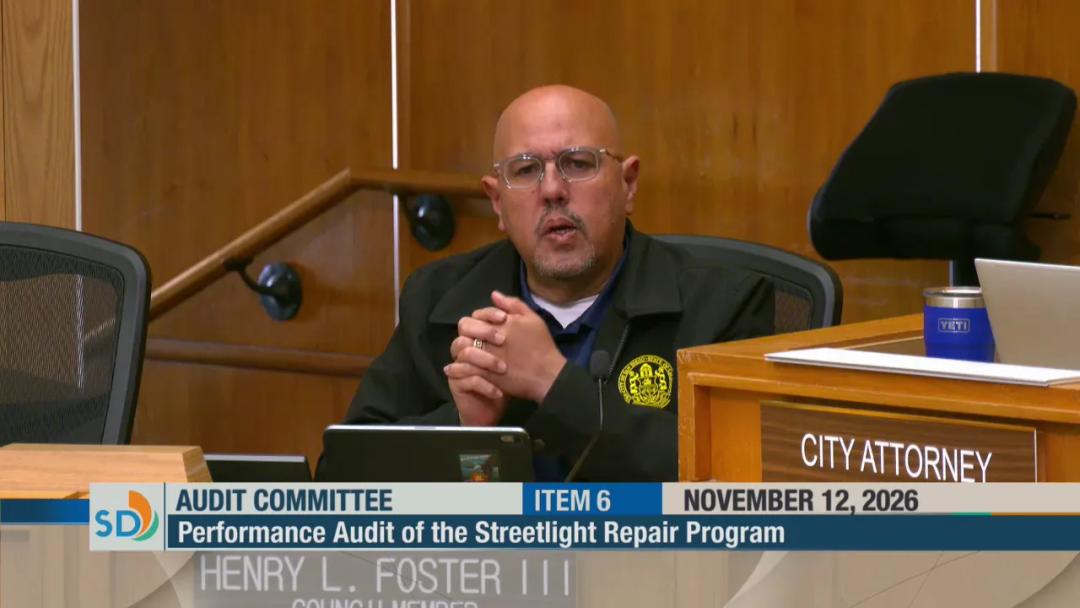
NOV 12, 2026 · SAN DIEGO, CALIFORNIA · AUDIT COMMITTEE
San Diego Audit Committee Meeting Summary – November 12, 2026

The San Diego Audit Committee met on Thursday, November 12, 2026, at 5:00 PM UTC. The meeting included approval of the consent agenda, public comments, and discussions on two performance audits: brush management on private property and the street light repair program. The committee forwarded both audit reports to the City Council. Chair Moreno, Vice Chair Foster, and committee members Halburn, Mafia, and Tapsuri were present. City Auditor Andy Hanao, COO Bethany Bizak, and other officials attended. Consent Calendar - Item 1: Approval of committee minutes from October 7, 2026. - Item 2: City Auditor's Monthly Activity Report. - Item 3: City Auditor's Quarterly Fraud Hotline Report, FY 2027 Q1. - Item 4: Creation of an ad hoc subcommittee to review confidential audit reports. - Motion to approve items 1–4 passed unanimously. Public Comments & Testimony - Non‑Agenda Public Comment: - Joyce Anyada expressed full support for the audit committee's work and praised David Condre's request regarding internal controls over homelessness records. She also raised a question about the audit department's use of AI relative to OECD findings. - Peggy Walker (virtual) urged an audit of the cannabis industry's financial impact on the city, stating that revenue projections (e.g., $22.2M in FY2026) do not account for full administrative costs. She cited a Grand Jury report on the lack of comprehensive accounting. - Hector (virtual) raised concerns about city leases, alleging that the city is leasing land to border patrol/homeland security for free. He also called for a review of the top 10 leases and criticized the ethics committee's slow handling of complaints. - Judy String (virtual) requested clearer public understanding of which programs are audited and asked for audits of code enforcement, particularly minor decoy operations for alcohol, tobacco, and marijuana. - Madison (virtual) requested a comprehensive audit of the cannabis industry's net financial impact, citing a Grand Jury finding that the city lacks a complete picture of program costs. - Consent Agenda Public Comment: - Joyce Anyada asked whether fraud hotline reports not in the purview of the hotline are tracked, and expressed strong support for the ad hoc subcommittee's focus on awareness of confidential report issues (e.g., Pure Water SD and cyber defenses). - Hector (virtual) suggested the city adopt a $30,000 reward for recovered fraud funds and called for a grand jury investigation into homeless fraud. - Item 5 (Brush Management Audit) Public Comment: - Paul Krueger thanked the committee and auditor for their work, urging continued independence and public education. - Hector (virtual) described a previous fire in Mission Valley that he believes was started by a homeless person on city property; he suggested notifying property owners' insurance carriers as a motivator for brush clearance. - Tony (virtual) thanked the committee and staff, emphasizing the importance of efficient inspection routing. - Item 6 (Street Light Audit) Public Comment: - Andres Alva Cardenas (representing ASCME Local 127) argued that the auditor should have immediately referred fraud hotline complaints to the Transportation Department per their MOU, and stated the auditor's actions delayed corrections and harmed employee relations. - Mac Strinski (AFSCME Local 127) echoed concerns, asserting the auditor should follow the MOU and warning that ignoring it could make the auditor a “rogue department.” - Paul Krueger strongly criticized the department for tolerating time card abuse, and supported the audit's findings. - Joyce Anyada urged the committee to address disagreements between the auditor and management constructively, calling it “the art of the audit.” - Hector (virtual) claimed that union workers “have been doing this for decades,” advocated for using private electricians for repairs to reduce overtime costs, and suggested the COO host a televised Q&A. - Tony (virtual) expressed shock at the lack of oversight on overtime and supported the audit's findings. Discussion Items - Item 5: Performance Audit of Brush Management on Private Property - Presentation by City Auditor’s Office (Andy Hanao, Mary Sanchez, Nathan Otto): The audit found that Fire Rescue's inspection program has significant gaps: the new “visual inspection” approach is about 30 times less likely to identify violations than the previous on‑site method; about one‑third of the 45,101 prioritized parcels were not inspected in the last five years; no penalties or reinspection fees were assessed from August 2020 to June 2025; and the department lacks formal performance targets (inspectors have an informal goal of 5–7 inspections/day, management expects 25–50). The audit made 14 recommendations, all agreed to by Fire Rescue. - Discussion: - Committee Member Tapsuri asked about the use of aerial imagery/AI to prioritize inspections; the department does not currently use it. - Committee Member Mafia questioned the correlation between increased inspection frequency and decreased violation rates. The fire department (Alex Kane, Assistant Fire Marshal) explained that the new approach focuses on education (Zone Zero, ember‑cast), not enforcement, reducing violation detection. - Committee Member Halburn noted two recommendations (1.1, 2.6) were past target dates and asked for updates. Kane stated that the department has shifted from enforcement to education and community outreach (door‑to‑door, leaving materials). Halburn expressed concern that education alone may not be sufficient without enforcement. - Council Member Foster noted the need for performance metrics (KPIs) and suggested collaboration between the IBA, auditor, and fire department. - Chair Moreno observed a conflict between the audit's findings (based on the existing enforcement‑focused program) and Fire Rescue's new educational approach. She stated the program needs to be formally updated to reflect current practices, and urged management to align the program with stated objectives. She also emphasized the need for an enforcement mechanism, referencing the August 2020–June 2025 period with zero penalties. - COO Bethany Bizak acknowledged that routing and inspection efficiency improvements could be applied across departments, and the Performance & Analytics team will be deployed to assist. - Outcome: Motion to accept audit report and forward to City Council passed unanimously. - Item 6: Performance Audit of Street Light Repair Program - Presentation by City Auditor’s Office (Andy Hanao, Megan Jaffrey, Jeff Teal): The audit found that despite a 43% increase in electrician positions (28 to 40) and a 148% increase in personnel expenditures ($2.3M to $5.7M), repair times more than doubled (166 days in FY21 to 348 days in FY26) and the backlog grew 181% (2,684 to 7,552 requests). The program lacked reliable data on dig alert workload; a shift to using regular hours only for dig alerts and overtime for routine repairs resulted in 71% of repairs concentrated in three council districts with dedicated overtime funding (CPDs). The audit found that telematics data was not used for routine workforce monitoring, revealing that two city vehicles made 56 stops totaling 200 hours at three locations, indicative of improper activity. Management substantiated the findings and took corrective action. The audit made 12 recommendations; Transportation agreed to all. - Transportation Department Response (Interim Director Naomi Chavez): Management acknowledged the audit's findings but argued that resource constraints remain a fundamental challenge. They described changes already in progress: implementing the Cortera system (start‑stop tracking), creating standard operating procedures, improving oversight (weekly production reviews), and assigning three electricians to routine repairs during regular time. - Discussion: - Chair Moreno expressed frustration that basic service delivery has deteriorated, emphasizing that the 71% concentration of repairs in CPD districts is inequitable. She noted that overtime spending grew six‑fold while service times doubled. She rebuked calls to outsource city work but stated the city must have a plan beyond agreeing to recommendations. - Council Member Foster questioned how the department set productivity standards and whether it used “means and methods” data (e.g., standard hours for a dig alert). The city engineer acknowledged that guidance is being developed. Foster also stressed the need for objective prioritization criteria for streetlight repairs. - Committee Member Halburn asked the auditor about the decision not to refer the fraud hotline complaint to the department immediately. The auditor explained that given 18 prior complaints (half substantiated) and a broader pattern of misuse, investigating within the audit was necessary to identify systemic issues; state law and city charter allow this. Halburn also pressed Transportation on what metrics are currently used; Chavez cited Cortera work order completion rates and weekly production reviews. - Halburn also asked about the city attorney's position on telematics use for workforce monitoring; the city attorney's representative was not present. - Chair Moreno noted that increased enforcement and penalties could help fund the program. - Outcome: Motion to accept audit report and forward to City Council passed unanimously. Key Outcomes - Consent Agenda (Items 1–4) approved unanimously. - Item 5 (Brush Management Audit): Report accepted and forwarded to City Council. All 14 recommendations are agreed to; two already implemented. Fire Rescue has shifted from enforcement to education; this will be evaluated during follow‑up. - Item 6 (Street Light Audit): Report accepted and forwarded to City Council. All 12 recommendations agreed to; Transportation is implementing changes (Cortera, oversight, SOPs). Concerns remain about resource adequacy and equity. - Next Meeting: Scheduled for Wednesday, January 13, 2027, at 9:00 AM.

08
NOV 12, 2026 · SAN DIEGO, CALIFORNIA · ENVIRONMENT COMMITTEE
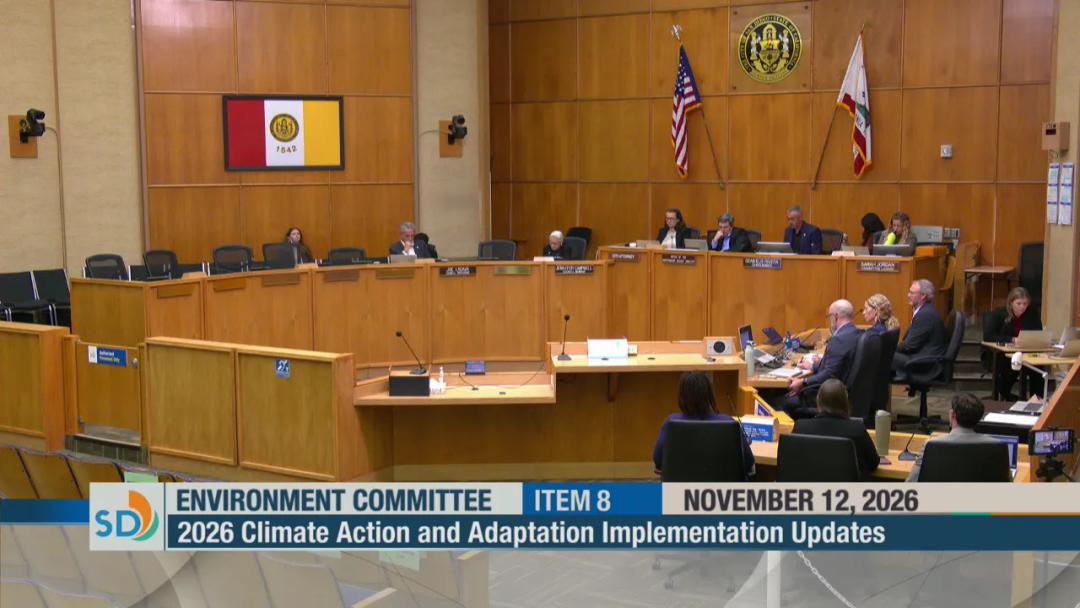
San Diego Environment Committee Meeting: Climate Action Updates and Public Power Resolution - November 12, 2026

The San Diego Environment Committee met on November 12, 2026. Chair Elo Rivera presided, with Council President LaCava and Councilmember Campbell also on the committee. The agenda included non-agenda public comment, a six-item consent calendar, a resolution on evaluating public power, and the 2026 Climate Action and Adaptation Implementation Update. Consent Calendar - Item 1: Approval of committee minutes from October 15, 2026. - Item 2: Modification six to the ground lease between the city and the United States for Miramar Landfill. - Item 3: West Air Gases and Equipment contract for bulk liquid oxygen and carbon dioxide delivery and maintenance services. - Item 4: Pacific Star Corporation contract for lab supplies and small equipment for Public Utilities and Police. - Item 5: First amendment to the calcium hydroxide slurry and chemical feed system agreement for wastewater odor control. - Item 6: Redistribution of Municipal Code Section 22.5401 responsibilities from the Sustainability and Mobility Department. Public comment on consent included concerns about data center water use, landfill expansion and future waste costs, department consolidation, and chemical treatment. One speaker supported the Miramar lease modification with environmental compliance and cited workforce representation figures for the West Air and Pacific Star contracts. Another speaker argued that Midway-area development and pump-station chemical treatment are unsafe given sandy soils, high groundwater, and sinkhole history. Virtual commenters discussed wastewater treatment, distillation alternatives, and cross-border water issues. Council President LaCava moved the consent agenda, explaining that item 6 updates municipal code after department consolidations and that climate action plan responsibilities remain with the departments now doing the work. Councilmember Campbell seconded. Chair Elo Rivera noted that the Miramar lease extension buys six years but should not slow waste-reduction goals. The consent agenda passed unanimously. Non-Agenda Public Comment - Alexander Martin, San Diego Coastkeeper legal program manager, supported the city exploring every option on sea lion harassment at La Jolla Cove and backed a limited-access approach during pupping season June 1-September 15, citing an estimated 40% pup death rate this season. - Joy Sanyata supported a temporary data-center moratorium and suggested a youth think tank on San Diego's future. - An in-person speaker raised concerns that traffic-calming measures impede fire truck access and that Midway Rising's fill site could cause flooding and stormwater costs. - Anthony Ralphs thanked Councilmember Vivian Moreno for slow fashion day and discussed the environmental harms of fast fashion. - Lori Saldania cited a Brooklyn building collapse and argued the Midway-area project sits on sandy soil and high groundwater without a sea-level-rise vulnerability assessment. - Virtual commenters addressed smart-city and surveillance technology, tobacco and vaping as environmental issues, Vision Zero and Imperial Avenue crashes, smoke-free dining protections for workers, and support for seasonal La Jolla Cove sea lion protections. Discussion Item: Public Power Resolution (Item 7) Rosa Lasquaga, Deputy Chief of Staff for Council District 9, presented the resolution supporting affordability, local accountability, workforce protection, and fiscal responsibility in evaluating public power options. She said SDG&E residential rates have risen 98% over the past decade, SDG&E has requested future increases of 8.1% in 2028 and 8.7% in 2029, and Sempra reported about $891 million in profit in 2024. She emphasized the item is not another study; it lays foundations and keeps the process public. Most public speakers supported the resolution, including representatives and members of Public Power San Diego, San Diego 350, Climate Action Campaign, and residents. They cited SDG&E profits, ratepayer hardship, inequity, and the need for a public alternative. Several speakers mentioned a CPUC rate hearing in Santee attended by more than 100 or 300 residents. Opposition speakers argued municipalization could cost more than $9 billion, the city has already spent $3 million on studies, and prior municipalization efforts in Long Island and Boulder had poor results. In committee debate, Chair Elo Rivera said SDG&E's profits and rate requests show the need to disrupt what he called a toxic relationship, and he tied the resolution to worker protections for IBEW Local 465 members. Council President LaCava seconded the motion and asked to add language recognizing the phase one and phase two feasibility studies, keeping options open beyond a distribution-only utility, and creating a firewall between the city's finances and any new public entity. Councilmember Campbell opposed, saying the city already commissioned three studies (2019, 2022, 2025) that found municipalization would cost more than $8 billion, and argued the committee should focus on CPUC accountability and reform instead. The resolution passed 2-1, with Councilmember Campbell voting no. Discussion Item: 2026 Climate Action and Adaptation Implementation Update (Item 8) Staff presented the annual update covering Biodiverse SD, Climate Resilient SD implementation, Greenhouse Gas Inventory progress, and the proposed Climate Ready SD framework. Key points included: - The Biodiverse SD program oversees the MSCP and vernal pool HCP; the 2025 annual reports are available, and the annual MSCP workshop drew nearly 150 attendees. - Climate Resilient SD achievements include $4.7 million distributed to 13 organizations, development of an extreme heat action plan and Heat Risk Explorer, a cool pavement demonstration at Skyline Hills, four renewable microgrids, more than 5,000 trees planted, and adoption of the Coastal Resilience Master Plan. - The 2024 greenhouse gas inventory shows community emissions 23% below 2019 levels and 3% below 2023, but about 6% above the straight-line pace needed for the 2030 goal. Transportation made up more than half of emissions, and buildings/energy made up 39%. - Since 2021, 90% of new homes and 95% of new affordable homes were permitted in climate-smart village areas; in 2025, those figures were 95% and 99%. - Staff proposed Climate Ready SD, which would combine the Climate Action Plan and Climate Resilient SD into one integrated framework. Public engagement and technical analysis would begin in early 2027, with a draft plan planned for 2028. - The Resiliency Advisory Board recommended action on urban forestry, cooling centers, stormwater funding, wetlands/natural resources, and microgrids. It noted unfilled board seats. - The Climate Advisory Board reported 15 meetings, 13 recommendation letters, and 20 presentations, and urged the city to fill vacancies, strengthen transparency, and prioritize high-impact, equitable actions. Public comment on item 8 included support for the combined plan while urging clear GHG targets, concern that sea level rise was absent from the report, requests for better tree-canopy data, and calls to fill advisory board vacancies. Council President LaCava asked about four coastal resilience pilot projects, Prop 4 funding readiness, and board vacancies. Chair Elo Rivera asked how the combined plan would preserve equity focus and the climate equity fund, and stressed that equity investments must remain explicit rather than being absorbed or reduced. Key Outcomes - The consent agenda was approved unanimously. - Item 7 passed 2-1; Councilmember Campbell voted no. The resolution will advance to the full City Council, with Council President LaCava working with Council District 9 on additional language. - Item 8 was received as an informational update; no formal vote was taken. Staff will proceed with Climate Ready SD development, aiming for a draft plan in 2028. - Advisory board vacancies, including two Climate Advisory Board seats that remained unfilled for a full year, were highlighted as needing prompt attention.

PUBLIC POWER 29% · CLIMATE CHANGE 26% · PUBLIC COMMENT 14% · ENERGY AND SUSTAINABILITY 5%
09
NOV 10, 2026 · SAN DIEGO, CALIFORNIA · CITY COUNCIL
San Diego City Council Meeting - November 10, 2026: Proclamations, Consent Agenda, and Grand Jury Report Responses

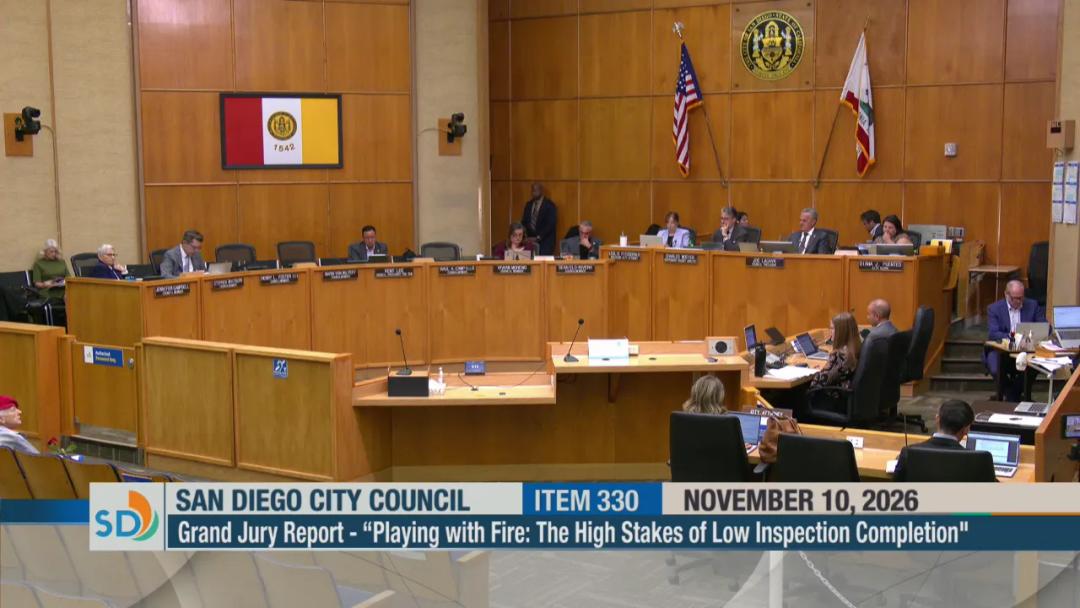
On November 10, 2026, the San Diego City Council convened a regular meeting. The session began with a presentation from Mayor Todd Gloria, Chief David Nisleit, and Assemblymember Tasha Boerner (noted as "Burner" in transcript) announcing a $1.5 million state investment to combat human trafficking, including funding for enforcement operations, digital tools, and a survivor-centered interview room. The council then proceeded through proclamations, a consent agenda, and three items responding to San Diego County Grand Jury reports. The meeting also included significant public comment on a controversial display at Centro Cultural de la Raza and on the implementation of Measure B (Commission on Police Practices). Consent Calendar - Proclamations (Items 30–32 and S500): Approved unanimously (6-0, with three members absent). Included Youth Homelessness Outreach Prevention and Education Month, World Day of Remembrance for Road Traffic Victims (honoring 92 deaths and 398 serious injuries in 2025), and First Gen Week. - Consent Agenda (Items 10, 50–57, 100–114, S501–S505): Approved unanimously (6-0, with three absent). Key items included: - Item 50: Administrative code update reflecting department consolidations (e.g., removal of Sustainability and Mobility Department). Council President LaCava noted a docketed item to redistribute responsibilities. - Item 53: Ordinance establishing cryptocurrency ATM warning sign requirements (final passage). - Item 56: Second reading of smoke-free outdoor dining ordinance (prohibiting smoking/vaping within 25 feet of outdoor dining areas). - Item 108: $30 million five-year contract with West Coast Arborist for tree maintenance. - Item 109: Cannabis delivery service permit fee ($51). - Item 114: Reappointments of Sabrina Bazo, Dr. Sarah Brown, and Dr. Stephen Jones to the Human Relations Commission. - Items S502–S503: Leases for agricultural land in San Pascual Valley, including a lease to Food Shed Cooperative for regenerative farming. Public Comments & Testimony - Human Trafficking Announcement: Mayor Gloria, Chief Wall, and Assemblymember Boerner spoke in support of the funding; no public comment on this item. - Proclamations: Multiple speakers addressed the proclamations. Joy Sanyata urged compassion for homeless youth and opposed the term "killed in violence" for traffic deaths. Ian Henry (San Diego County Bicycle Coalition) honored Laura Keenan. Aria Grossman (Circulate San Diego) noted 1,343 countywide killed or seriously injured. Allegedly Audra criticized the city’s response to homelessness and traffic safety. Juliana (via Zoom), mother of Hudson (a 6-year-old killed in a crash), expressed gratitude for the proclamation. - Consent Agenda: Public comment focused on item 56 (smoke-free dining), with strong support from speakers including Judy Strang and Madison. Speakers also supported item S503 (agricultural lease) and reappointments to the Human Relations Commission. One speaker (Bob Kazuski) questioned the renaming of the Master Records Schedule and oversight of leases at Torrey Pines. - Non-Agenda Public Comment (Morning Session): Several speakers raised concerns about a Dia de los Muertos ofrenda at Centro Cultural de la Raza in Balboa Park, which included images of leaders of U.S.-designated terrorist organizations. Daniel LaSalle (via video) alleged he was physically assaulted by staff when trying to view the display. Multiple callers urged the council to take action, including terminating the lease and recovering public funds. Other speakers addressed police pursuits, youth homelessness, and the Get It Done app. - Item 331 (Commission on Police Practices): Speakers including Donna Kaiser, Andrea St. Julian, Kate Yavenditti, Dr. Darwin Fishman, Tasha Williamson, Francine Maxwell, and others criticized the city’s proposed response as inadequate. They urged the council to agree with all grand jury findings and recommendations, citing delays in implementing Measure B, the misclassification of complaints (79% as “miscellaneous”), and lack of subpoena power and independent investigators. - Item 330 (Fire Inspections): Speakers Joyce Sanyata and Allegedly Audra commented. Joyce requested respectful language toward the fire department. Audra noted union restrictions preventing use of civilian inspectors. A speaker (Larry) criticized state funding and supported police. Another speaker raised concerns about short-term rental inspections. - Item S506 (Bicycle Mobility): Multiple speakers (Martha Woodka, Ian Henry, Victoria Labruzzo, and others) argued that the city’s response to recommendation one (prioritize continuous bike infrastructure) was inaccurate. They cited examples like Governor Drive where bike lanes were removed during resurfacing, and called for a strengthened response. - Housing Authority Consent Agenda: One speaker (Allegedly Audra) criticized conflicts of interest and the Midway Rising project. Non-agenda public comment included concerns about housing affordability, the Midway arena, and general governance. Discussion Items - Item 331 – Grand Jury Response: Commission on Police Practices: The Office of the Independent Budget Analyst (IBA) presented the proposed joint response, which disagreed in part with findings 1, 2, 3, and 4. Key points: The commission (CPP) operates under interim procedures; meet-and-confer with labor unions is ongoing; the city lacks a performance auditor due to budget constraints; litigation prevents full response on finding 3. Council President LaCava and Council President Pro Tem Lee expressed frustration with the limited response options and proposed amendments. After discussion, the council voted 5-1 (Campbell opposed) to amend the response: changing findings 1 and 2 from "disagree in part" to "agree," and striking the word "permanent" from finding 2’s narrative. The mayor’s office concurred. - Item 330 – Grand Jury Response: Fire Inspections (Playing with Fire): The IBA presented the proposed response, which disagreed with several findings. The council voted unanimously (6-0) to approve the response as presented, with no amendments. - Item S506 – Grand Jury Response: Bicycle Mobility (Shifting Gears): Council President Pro Tem Lee proposed amendments to change findings 1 and 8 from "disagree in part" to "agree," and to change recommendations 1 and 8 from "implemented" to "not yet implemented but will be in the future," with timelines tied to completion of the Bicycle Master Plan (February 2027) and implementation of the Speed Management Plan (end of FY27). The mayor’s office agreed. The motion passed unanimously (6-0). Key Outcomes - Human Trafficking Funding: The $1.5 million state grant was announced, with the city committing to use funds for enforcement, technology, and survivor support. - Proclamations Approved: Unanimously adopted. - Consent Agenda Approved: Including the smoke-free outdoor dining ordinance, cryptocurrency ATM warning signs, tree maintenance contract, and cannabis fee. - Grand Jury Response – CPP: The council approved an amended response that agreed with findings 1 and 2, reflecting the view that the CPP lacks full capabilities and adequate permanent staff. The response maintains that recommendation 1 (finalize meet-and-confer) has not been implemented but will be; recommendation 3 (appoint executive director) is implemented. - Grand Jury Response – Fire Inspections: Approved without change. - Grand Jury Response – Bicycle Mobility: Approved with amendments agreeing with findings 1 and 8, and committing to future implementation of recommendations 1 and 8 with specific deadlines. - Public Comment on Centro Cultural de la Raza: No formal council action was taken during this meeting, but the issue was raised multiple times. Several speakers demanded lease termination and recovery of funds. Council President LaCava did not address the matter directly in his remarks. - Council Adjourned: The meeting recessed for lunch and reconvened for the afternoon session. The housing authority consent items were approved, and non-agenda public comment was heard.

PUBLIC COMMENT 23% · POLICE OVERSIGHT 15% · BICYCLE INFRASTRUCTURE 9% · PROCEDURAL 8%
10
NOV 9, 2026 · SAN DIEGO, CALIFORNIA · CITY COUNCIL
San Diego Special City Council on Midway Rising & Lawsuits - 2026-11-09

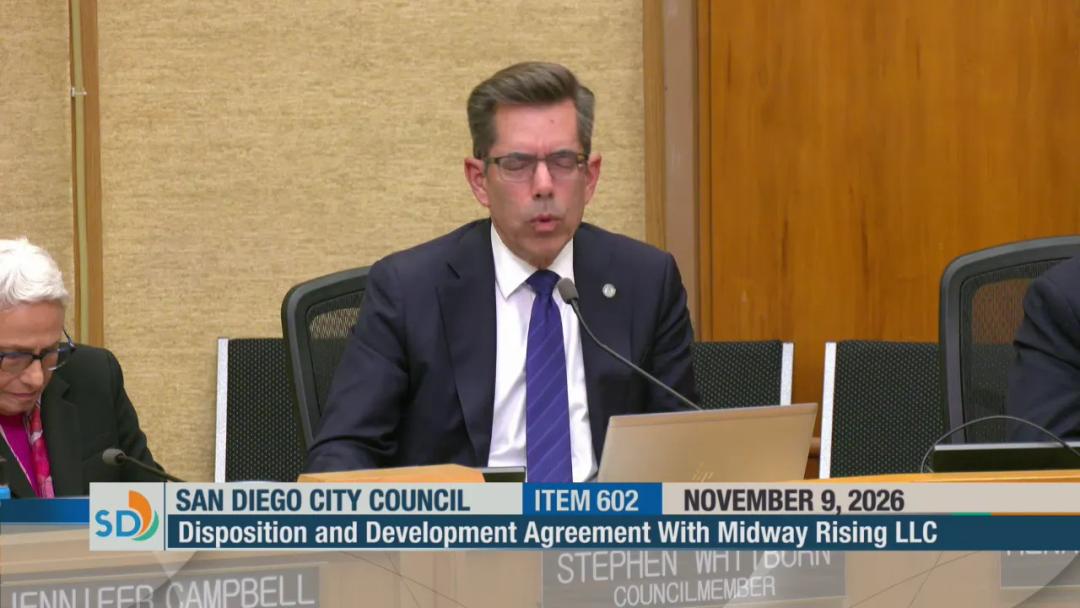
San Diego City Council Special Meeting on Midway Rising and Closed Session - November 9, 2026\n\nThe San Diego City Council held a special meeting on Monday, November 9, 2026. The morning began with a closed session regarding three pending lawsuits followed by public comment, and the council reconvened at 1 p.m. to deliberate on the Midway Rising project, a major redevelopment of the Sports Arena site. After extensive public testimony and council deliberation, the council approved three interconnected items: an Enhanced Infrastructure Financing District (EIFD, Item 600), a land use and specific plan package (Item 601), and the Disposition and Development Agreement (DDA, Item 602).\n\n Closed Session & Related Public Testimony\nThe council held a closed session to discuss three lawsuits: CS1 (trip and fall), CS2 (trip and fall), and CS3 (a fatal police shooting involving a person in mental health crisis). During public comment, speakers expressed empathy for the plaintiffs and criticized the city’s infrastructure maintenance and police accountability. One speaker noted the city’s unfunded infrastructure liability is estimated at $6–8 billion, linking this to the rise in litigation. Another speaker stated that police officers in San Diego often shoot within seconds of arriving, arguing that training does not reflect the costs of litigation borne by taxpayers.\n\n Discussion Items: Midway Rising (Items 600, 601, 602)\n- Item 600: Enhanced Infrastructure Financing District (EIFD)\n City Finance staff presented the plan to form an EIFD to fund public infrastructure for the project. The district would capture 100% of the city and county's incremental property tax growth over 45 years. The projected combined tax increment is $1.2 billion, providing approximately $985 million in net bonding capacity to reimburse the developer for eligible costs. Eligible costs include site preparation, public streets, sidewalks, utilities, parks, and portions of public parking garages.\n- Items 601 & 602: Midway Rising Land Use & Development Agreement\n Economic Development and Development Services staff presented the project details. The redevelopment of the 48-acre city-owned site includes 4,254 dwelling units (2,000 deed-restricted affordable units at an average of 60% AMI), a 16,000-seat entertainment center, 14.5 acres of parks and public spaces, and 130,000 square feet of retail. The city retains ownership of the land under a ground lease structure of up to 85 years. The city's revenue comes from ground rent on market rate housing and retail, a ticket fee on the arena ($1.50/ticket escalating at 3%), and participation in capital events. Staff valued the extraordinary public benefits at $1.2 billion.\n The Independent Budget Analyst (IBA) stated the proposed agreement represents a “reasonable balance of risk, financial returns, and public benefits.” The IBA projected the city’s total revenue over the lease terms at $884 million to $1.2 billion in future value, equivalent to $38 million to $69 million in present value (at a 4.5% discount rate). The IBA also highlighted that the EIFD’s revenue is generated slowly over its first 15 years and that 75% of the arena ticket fee revenue for the city accrues behind a 16.5% levered IRR hurdle.\n\n Public Comments & Testimony\nThe council heard from over 100 speakers.\n- In Favor: Speakers included labor unions (Building Trades, IATSE, Unite Here, Carpenters), YIMBY organizations, affordable housing providers, the Chamber of Commerce, and the Midway Pacific Highway Community Planning Group. Supporters argued the project delivers much-needed housing (2,000 affordable units), thousands of union jobs, and is the result of years of community planning. Some urged the council to move transit improvements (dedicated bus lanes) to Phase One to reduce traffic congestion.\n- In Opposition and Concerns: Residents, environmental advocates, and the operator of Kobe's Swap Meet raised concerns about traffic and mobility, flooding and sea level rise, soil contamination from a former landfill, and seismic liquefaction risks. Several speakers stated the project is a bad financial deal for the city, noting that the city’s land is appraised at $75 million but generates only $100,000 per year in base rent for the first 15 years. Opponents also expressed concern that the phasing of the project could delay affordable housing delivery by a decade or more, and criticized the EIFD as a large taxpayer subsidy to a billionaire developer. Kobe's Swap Meet requested a specific plan for relocation.\n\n Key Outcomes\nAll three items were approved unanimously (8-0, with Councilmember Von Wilpert absent).\n- Item 602 (DDA) PASSED (8-0): Approved the Disposition and Development Agreement with amendments.\n - Amendment (Council President Pro Tem Lee): Adds a provision for the city to receive 5% of net refinancing proceeds above a 19% levered IRR and 10% above a 30% levered IRR, with advanced notice and documented accounting required from the developer.\n- Item 600 (EIFD) PASSED (8-0): Adopted the resolution of intention to form the Midway Rising EIFD and established the Public Financing Authority (PFA). A public hearing on the Infrastructure Financing Plan (IFP) is scheduled for August 27, 2027.\n- Item 601 (Land Use Actions) PASSED (8-0): Approved the specific plan, community plan amendment, rezone, development agreement, and certified the SEIR with two amendments.\n - Amendment (Council President Lacava): Removed a 50-foot “district identity pylon” sign from the public right-of-way in the specific plan, as it cannot be permitted under current law.\n - Amendment (Councilmember Campillo): Secured a $2 million commitment from the developer for traffic transportation improvements in the Midway community, payable upon the final inspection and certificate of occupancy of the entertainment center.\n\nThe council directed staff to finalize the form of the affordable housing ground lease within 180 days. The city will hire a project coordinator to oversee implementation of the development agreement.

AFFORDABLE HOUSING 22% · PUBLIC COMMENT 14% · PUBLIC SAFETY 8% · LAND USE AND PLANNING 8%
0102
NEXT →
OPENPUBLICA · PUBLIC MEETING INDEXUPDATED DAILY · openpublica.com