Active Transportation Infrastructure Committee Meeting - December 11, 2019
STREAMING COPY IN PREPARATION — RECORDING AVAILABLE FROM THE ORIGINAL SOURCE
Active Transportation Infrastructure Committee Meeting - December 11, 2019
On Wednesday, December 11, 2019, the Active Transportation Infrastructure Committee met to discuss sidewalk repair programs, the Mobility Action Plan, and the fiscal year 2019 Capital Improvement Program status. The meeting was chaired by Councilmember Kersey, with Vice Chair Ward and Councilmember Kate present; Councilmember Moreno was absent. The committee also recognized Lee Friedman's last meeting as mayoral representative.
Consent Calendar
- The committee adopted the minutes from the November 20, 2019 meeting unanimously.
- Two consent items were forwarded to the full City Council. For item 1, the staff noted that only two of three proposed actions required council action; the third (sequel determination) was previously resolved in August and was removed from the staff report.
Public Comments & Testimony
- Martha Welch spoke against the consent agenda and sidewalk consultant contracts, alleging corruption, lack of city employees, and failure to address potholes and road conditions. She also criticized the Point Loma wastewater treatment plant and claimed the city operates illegally.
- Nikayla Jefferson urged the committee to declare a climate emergency, citing the urgency of reducing carbon emissions within eight years and noting that 62 other U.S. local governments have already done so. She emphasized the threat to public health, coastlines, and forests.
- Sophie Wolfram and Andy Hanshaw (Mobility Board) presented a joint statement recommending that the Mobility Action Plan (MAP) clarify phase structure, include specific CAP mode share and VMT reduction targets, integrate the Bicycle Master Plan's strategic implementation plan, track mode share, commit to a Vision Zero action plan, define "communities of concern," prevent displacement, fund education programs, and remove "innovation and technology" as a standalone principle to avoid prioritizing innovation over equity and safety.
Discussion Items
- Sidewalk Program Update (Item 3): Staff presented the status of the citywide sidewalk repair program. Since the 2015 assessment, 27,000 repairs have been completed, with 11,000 more funded. An estimated 81,000 locations remain, with a total repair/replacement cost of $90–$100 million. Options to accelerate work include expanding the slicing contract (currently $625,000/year, covering 8,500 repairs), in-sourcing slicing work (potentially cost-saving but requiring new hires), increasing the 50/50 cost-share program (currently $300,000/year, serving 40–50 homeowners, with 230 on a waiting list), and reducing sidewalk permit fees (currently ~$2,000, with $800–$850 for inspection). Chair Kersey noted that the issue is primarily budgetary and committed to including sidewalk funding in his budget priority memo. Vice Chair Ward supported exploring property tax assessment options for homeowners and praised the comparison of in-house vs. contract costs. Councilmember Kate asked about the replacement cost breakdown ($95 million of the $100 million for replacement) and the timeline for the 230 waiting list homeowners (estimated 130 per year with a dedicated crew). No action was taken; the item was informational.
- Mobility Action Plan (MAP) Status Update (Item 4): Staff presented the MAP, which consolidates transportation policies (General Plan, Climate Action Plan, bicycle/pedestrian master plans, Vision Zero) into a vision document with 24 goals and 31 actions organized around four principles: connected communities, safety, health/climate, and innovation. The next phase (MAP 2.0) will focus on integrating priorities into asset management and CIP project selection. Vice Chair Ward asked about Vision Zero and Phase 2 timelines; staff stated a comprehensive Vision Zero strategic plan is expected in 2020 and Phase 2 will begin in FY21. Councilmember Kate raised concerns about prioritizing communities of concern over other areas with high potential for mode shift (e.g., Mira Mesa, Miramar), noting that such areas are often overlooked. Chair Kersey requested a list of CIP projects supporting the MAP. The item was informational.
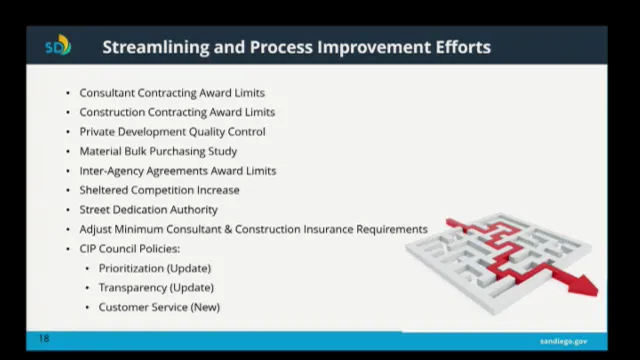
- FY19 Year-End State of the CIP Report (Item 5): Staff presented the annual CIP report, covering fiscal year 2019 (July 2018–June 2019). The adopted CIP budget was $558 million, later increased to $706 million, with $582 million expended. Key highlights: 959 active projects, completion of the Miramar clear well (first of two) and West Mission Bay Bridge trestle, 31 of 50 parks completed under the mayor's pledge, and 1,300 miles of road repaving (exceeding the 1,000-mile goal). The committee noted a 17–19% vacancy rate, difficulty retaining engineers, and rising construction costs (e.g., building costs rose from $135 to $210 per square foot). Staff discussed regional competition for talent and a planned apprenticeship program. Vice Chair Ward asked about a customer service council policy, which staff said will be presented in January 2020. Councilmember Kate questioned the quality of consultant deliverables and the status of the Gold Coast Drive project (design to be completed by July 2020, with construction funding uncertain). The item was informational.
Key Outcomes
- The committee unanimously approved the November 20 meeting minutes.
- Consent agenda items 1 and 2 were forwarded to the full City Council (with the third action of item 1 removed).
- No formal votes were taken on informational items, but the committee provided direction to staff on sidewalk repair priorities, MAP refinements, and CIP staffing challenges.
- The committee's next meeting is scheduled for January 29, 2020.
Meeting Transcript
Well, good afternoon, everybody. We're gonna go ahead and get started. Thank you for joining us for today's special meeting of the Active Transportation Infrastructure Committee. Today is Wednesday, December 11, 2019. Let the record reflect that we are joined by Vice Chair Ward and Councilmember Kate. Uh Councilmember Moreno will not be joining us today, but we'll look forward to her being back next month. Uh we're also joined by our City Attorney Representative Tina Ray, our IBA representative Jillian Cassie, our mayoral representative Lee Friedman, and our committee consultant Justin Garver. And uh I'd be remiss if I did not mention this will be Lee Friedman's last meeting uh representing the mayor. Uh and he's going to be transitioning over to a new role uh here in the city, so he will of course be missed. Uh I want to thank everybody who's here with us in person or watching on City TV. Uh so let's get started. Non-agenda public comment. We have two members of the public who like to speak on items not on our agendas today. They are Martha Welch and Nikayla Jefferson. Uh Ms. Welch, if you would come forward. You have two minutes. Martha Welch. You didn't vote for two minutes in this committee. That's we we vote for something we don't get. We we don't get every um that's we don't we don't get uh everything, but we don't get it with that. That's a bad thing. Right now, um you're legal with this because we never voted for it. We we don't uh we vote for something we don't get it, and we don't vote, it comes here. That's not right also. Now the city uh is is way behind in everything. I don't think he built it for a long time. Um Point Loma Online is fifteen fifty eight. And also uh problems um two is the same thing, same year, and career work that's the same year. So what's going on here? Well, I know I've a dirty secret. These the bribes the county is worse than the city, but they could be SSD bribes or normal taxes, or other other bribes that goes on here. Um the federal government is so mad I approved it with with the government um what they were doing with SSD and that opened everything up. Bill Horn is main caller, his name is really Horn. That's his real name. Um he can't call anymore. You can wait forever and you won't get a call. Right now, um this is a bad thing. Why I have potholes everywhere and it doesn't get fixed that I see uh roads are in bad condition. Everything is bad condition. Doesn't get done, nothing really gets done unless it's done private. Private is a big thing in the city. You do this as either private, state federal, us to pay. It's never the city, it seems like has money. It's always consultants and all that kind of thing we have here. We don't have employees, that's a big problem here. That's what we're gonna have employees because Prop B, you can't you you put it in the charter, which is also all legal, not legal. We didn't vote for that. Again, something we vote for we don't get. See, and we don't vote and we get it.
openpublica.com