Budget and Government Efficiency Committee Meeting on Minimum Wage and Sick Leave Implementation - June 22, 2016
STREAMING COPY IN PREPARATION — RECORDING AVAILABLE FROM THE ORIGINAL SOURCE
Budget and Government Efficiency Committee Meeting
On June 22, 2016, the San Diego City Council's Budget and Government Efficiency Committee met to discuss the implementation of the Earned Sick Leave and Minimum Wage Ordinance, which was affirmed by voters on June 7 with 63% approval. The committee also considered a contract extension for bond analytics software, the fiscal year 2017 Appropriations Ordinance, and the Statement of Budgetary Principles.
Consent Calendar
- The record of actions from the May 25, 2016 meeting was approved by unanimous consent without discussion.
Public Comments & Testimony
- Rod Betts (partner at Paul Plevin, Sullivan & Cannotin, representing employers) expressed support for the ordinance's substance but requested clarifications to align with state law on sick leave front-loading and carryover to reduce administrative burden.
- Robert McNamara (District Ree) supported a strong compliance component, recommending enforcement be placed in an existing department (e.g., Economic Development) and merged with living wage enforcement.
- Alora Calderon (Director, Employee Rights Center) supported the memorandum’s recommendations, but urged higher retaliation penalties (e.g., $5,000-$10,000 per violation) and simpler complaint processes in multiple languages.
- Juan Pablo Sanchez (small business owner, Super Cocina; City Heights Business Association) stressed the need for clear, accessible compliance information for employers and effective enforcement to ensure a level playing field.
- Alma Rodriguez (small business owner, Queen Bee Art & Cultural Center) expressed pride in the ordinance and called for continued enforcement support.
- Albert Clark Castaneda (Chair, San Diego County Hispanic Chamber of Commerce) offered strong support for enforcement and outreach, emphasizing the need for public awareness campaigns in multiple languages and a dedicated enforcement agency.
- Luis Osuna (La Raza Lawyers Association) supported broad enforcement powers (subpoenas, record inspections, off-premises interviews), annual quantitative reporting, and a public hearing process. He noted the $400,000 enforcement cost is 0.02% of the city budget, contrasting with $700,000 for a vehicle ordinance.
- Susan Swan (Secretary, Lawyers Club of San Diego) supported effective enforcement, noting over half of affected workers are women already facing a gender wage gap.
- Dr. Peter Brownell (Research Director, Center on Policy Initiatives) supported enforcement, citing a wage theft study in restaurants, and emphasized the need for political independence of the enforcement office.
- Julia DeBeers (Evans Hotels) requested clarification that front-loading 40 hours of sick leave annually complies with the ordinance, benefiting part-time employees.
- Brad Barnum (Associated General Contractors) asked for clarifications on implementation date, whether the law adds 2 or 5 days to state law, and definition of "repeat offenders." He urged enforcement to begin with outreach and training before penalties.
- Javier Guerrero (via translator, Employee Rights Center) shared personal experience of wage theft and disappointment with the state labor commissioner, advocating for a city office that provides multilingual assistance.
Discussion Items
- Earned Sick Leave and Minimum Wage Implementation Ordinance: Chair Todd Gloria presented recommendations from his office, including establishing an enforcement office (later proposed to be in the City Treasurer's Office), clear multilingual notices, complaint adjudication, public hearings, non-discretionary fines, anti-retaliation measures, collaboration with community organizations, proactive investigations, subpoena power, business license suspension, and debarment of repeat violators. He requested direction to the City Attorney to draft an implementing ordinance and to the Mayor to enter a partnership with the California Labor Commissioner.
- Committee members discussed enforcement location, budget ($400,000 allocated), proactive vs. complaint-driven investigations, definitions of "employer" for out-of-city businesses, and aligning sick leave provisions with state law (allowing accrual and front-loading). Councilmember Kate raised concerns about proactive investigations and requested more clarity in the ordinance language. Councilmember Sherman supported enforcement but asked about fines (noting the $1,000 figure for retaliation was from LA/SF), debarment, and responsibility for temp agency workers. Chair Gloria amended his motion to include policy direction for sick leave consistent with state law.
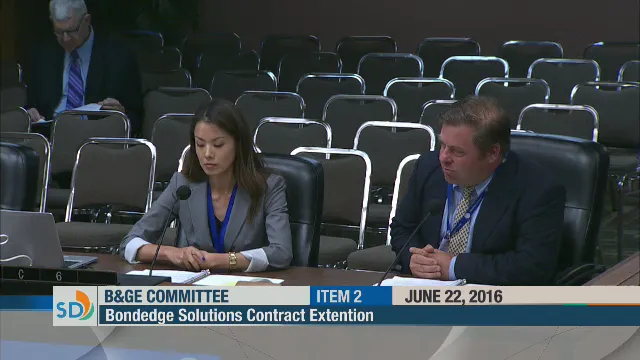
- Bond Edge Solutions Contract Extension: The City Treasurer's Office requested a 4-year extension (through July 29, 2020) at a cost not to exceed $350,000 for bond analytics software. The committee approved the extension unanimously.
- FY 2017 Appropriations Ordinance: The Financial Management Department presented seven updates (streamlining CIP, removing outdated authorities, technical adjustments) and noted an accelerated timeline for adoption (July 11, 2016). The committee approved forwarding to City Council unanimously.
- FY 2017 Statement of Budgetary Principles: The Independent Budget Analyst reported on the change to a performance dashboard (launching July 1) in lieu of quarterly reports. Councilmember Kate requested additional direction for Performance & Analytics to return to committee in September/October to review performance measures for FY 2018 and the dashboard. The motion passed unanimously.
Key Outcomes
- The committee unanimously approved a motion (moved by Chair Gloria, seconded by Councilmember Cole) directing the City Attorney to draft an implementing ordinance based on the policy direction in Gloria's memo, including sick leave front-loading/accrual consistent with state law, and directing the Mayor to enter a partnership with the California Labor Commissioner. The ordinance and certification resolution are expected to be considered by the full City Council on July 11, 2016.
- The committee unanimously approved the Bond Edge Solutions contract extension (4 years, up to $350,000).
- The committee unanimously forwarded the FY 2017 Appropriations Ordinance to the City Council for adoption on July 11, 2016.
- The committee unanimously approved the Statement of Budgetary Principles with additional direction for the Performance & Analytics Department to report back on performance measures and the online dashboard by September/October 2016.
Meeting Transcript
All right, good morning, ladies and gentlemen. I will call the meeting of the budget and government efficiency committee to order. Note for the record that a quorum of uh members is present, consisting of actually all members of the committee, Mr. Kate, uh, Ms. Cole, Mr. Sherman, and myself. Uh we'll move right uh this morning uh to our record of actions from our May 25th, 2016 meeting. Those will uh stand as approved uh by unanimous consent unless pulled uh for discussion. Do we have any requests to pull this record of action? Seeing none, uh, we'll move right along to non-agenda public comment. This is an opportunity for members of the public to discuss an item not on this morning's agenda. At this time we have no requests from members of the public uh to uh speak on. I thought I saw a green slip in the audience. Why don't you come on down? Your window of time is closing, so hustle all over to the podium and we'll clue you in. If there's anyone else, speak now or hold your peace, or at least hold it to one of the agendized items. Actually, uh Mr. Beers, this is actually for uh the item that's on today's agenda, item number one. Uh this would be a time to talk to us about, well, if you've ever seen a meeting, anything. Um that's okay. That's all right. We'll go easy on you. Uh we'll we'll save this for item number one, which is coming right up. No problem at all. Um anyone else going going on? All right. Any committee member comments at this time? Seeing none. Any mayor, IBA or city attorney comment? None. All right. Uh any requests for continuance for an item today. None. Okay. We'll move right into our discussion agenda. Mr. Beers, this is when this will be your time in a moment, okay. Um item number one is a review uh report from my office regarding the earned sick leave and minimum wage implementation ordinance. Uh we do have a number of speakers on this item, so we'll take uh my presentation, public testimony, uh, and then council deliberate or committee deliberation. And so on uh as a refresher, on June 7th, uh San Diego voters affirmed the City Council's decision to provide five earned sick days and increased wages for hardworking San Diegans with a vote of 63 percent for approval. Uh the next step to responsibly comply with this voter mandate is to expeditiously develop a strong implementing ordinance to enforce and administer this voter-approved policy. Uh as such, my office has been working closely with the City Attorney's Office to review best practices for enforcing the earned sick and minimum wage laws in California, uh, which have informed the recommendations that I'll lay out uh this morning. Uh included for your reference in the backup materials is a UCLA and UC Berkeley report outlining best practices for enforcing city minimum wage laws in California and a sample partnership agreement with California Labor Commissioner's Office and same enforcement ordinances uh from San Francisco and Los Angeles County, which we hope to use as a model for our local ordinance. Based upon this research and the implementing ordinances, the implementing ordinance should be uh built upon uh in implementation, enforcement, and remedies section of the ordinance that was approved by voters, and include the following provisions. First, establish and designate the enforcement office in the appropriate city department or office and require annual reporting to the city council. Uh provide clear noticing policies in multiple languages so that workers will be made well aware of their rights and be more likely to report noncompliant employers. Establish a system to receive complaints and a system to adjudicate complaints and order relief in cases of violation. Uh establish a public hearing process for appeals and mandate non-discretionary fines to ensure a transparent and fair public process. Establish strong anti-retaliation measures, including civil penalties and fines payable to the employee as laid out in my memorandum. Include higher fines for employers who repeatedly violate the sick leave and minimum wage requirements, and establish the authority for the enforcement office to collaborate and/or contract with community-based organizations and community outreach and enforcement strategies.
openpublica.com