Budget and Government Efficiency Committee Meeting - March 22, 2017
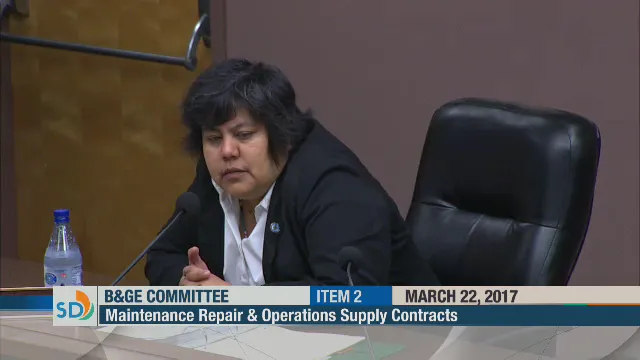
STREAMING COPY IN PREPARATION — RECORDING AVAILABLE FROM THE ORIGINAL SOURCE
Budget and Government Efficiency Committee Meeting - March 22, 2017
The committee met at 5:00 PM on March 22, 2017, to review three action items: revisions to the municipal code for alarm permits and fees, approval of amendments and increased expenditure authority for maintenance, repair, and operations (MRO) supply contracts, and approval of a consulting agreement for fleet software upgrade. All items were approved unanimously and forwarded to the full City Council. The committee also received an informational presentation on the FY2018 budget process from the Independent Budget Analyst (IBA).
Consent Calendar
- The committee approved the record of actions from the March 8, 2017 meeting by unanimous consent.
Discussion Items
- Alarm Ordinance Revisions: The San Diego Police Department proposed amendments to the municipal code related to burglary and panic alarms, including a shift from two-year to one-year alarm permits, reduced permit fees ($10 annually), and escalating fines for false alarms. The new system uses enhanced call verification (two calls to the alarm user before police dispatch) and the CryWolf software for tracking. The department estimated a 70–90% reduction in false alarm responses, freeing up approximately 20,000 officer hours annually. Revenue is projected to decrease by $1.7 million due to fee reductions and fewer false alarms, but the department emphasized that enhanced call verification and fine increases would offset some losses. Committee members expressed strong support, citing the value of officer time for proactive policing. The motion to forward to the full council with a positive recommendation passed unanimously.
- MRO Supply Contracts: The Purchasing and Contracting Department requested approval of first amendments to MRO supply contracts and an increase in expenditure authority to $56.4 million for contract years two through five. The new contracts include fixed pricing on a market basket of goods, tiered pricing for non-listed items, and provisions for emergency response. The department noted that previous cooperative agreements expired in June 2016, and the new contracts were initially executed under the purchasing agent’s $3 million authority due to time constraints. The increased authority aims to capture approximately $30 million in MRO spending that previously occurred outside contracts. Upcoming integration with the Ariba system will further improve spend visibility and control. Committee members praised the progress and the link to audit recommendations. The motion to approve and forward to council passed unanimously.
- Fleet Software Consulting Agreement: Fleet Services requested approval of a $375,000 consulting agreement with CST Fleet Services to upgrade the vehicle maintenance software from version 6.3 to version 16. The project includes on-site support (40 hours per week), computer-based training for 178 technicians across 13 locations, and procedural adjustments to align with industry best practices. Funding was included in the FY2017 budget, so no additional budget action is required. Committee members noted the significant efficiency gains expected. The motion to approve passed unanimously.
Information Item
- FY2018 Budget Process Overview: Independent Budget Analyst Andrea Tevlin presented the budget timeline. The mayor’s proposed budget is due April 14, 2017, with the IBA review released April 28. Council hearings as the Committee of the Whole are scheduled May 2–10 (with additional days if needed), a public hearing on May 15, and final adoption by June 15. The IBA emphasized that the council has final budget authority and can override mayoral vetoes with six votes. Committee members noted upcoming budget town halls in their districts and highlighted priorities such as equity, key performance indicators, and community engagement.
Key Outcomes
- All three action items were approved unanimously: Item 1 (alarm ordinance) and Item 2 (MRO contracts) were forwarded to the full council with positive recommendations; Item 3 (fleet software) was approved as presented.
- The meeting adjourned at approximately 5:45 PM, with the next committee meeting scheduled for April 19, 2017.
Meeting Transcript
Um good morning, everyone. Um we have uh one of our members, George Egomez is held up in traffic, but we do have a quorum, so uh we're going to get started. Um I'll call now call the meeting of the government and the budget and government efficiency committee to order. A quorum is now present, consisting of committee members, um council members uh Sherman Kate and me, Barbara Bree. Uh we also have with us from the City Attorney's Office, Brant Will, our committee consultant, Vicki Joes from the IBA, uh Andrea Tevlin and from uh Financial Management, uh Tracy McCraner and from the IBA, Christiana Galgar. Did I say your name right? Your last Golgar, sorry, Christian. Um good morning. Uh moving right along. Um, the committee record of actions from the March 8th, 2017 meeting will be approved by unanimous consent unless pulled for discussion. Do we have no seeing none? Uh we have no non-agenda public comment today. So do we have any committee members uh or represent other people who would up here who would like to say something before we get started? Okay, no. Okay, item number one. Good morning, Chair Chair Bree and fellow committee members members. The San Diego Police Department has revised the municipal code. We're proposing changes to the municipal code related to burglary and panic alarms. We've also revised the alarm system permit fees and fines and penalties. We're looking for approval for those two, as well as to amend the fee schedule maintained in the office of the city clerk. How we got here. Yeah, I'm gonna go ahead and take that. Thanks. So how we got here is um back in November of 2010, California voters approved proposition 26, which limits the government's ability to impose certain fees and charges. The proposed alarm fees in this revised ordinance fall within two categories that are exemptions under Prop 26. Those are reasonable regulatory costs for the administration of the permit, and then fines and penalties to gain compliance. In 2011, the grand jury conducted an audit and they published a report entitled No Cost for Alarms. The audit revealed a significant loss of income to the city due to uncollected fees and penalties. The grand jury made seven recommendations, four of which directly impacted the regulation and enforcement of alarms. In summation, the grand jury wanted to ensure alarm permits were issued before activation and to come up with a better data system to track alarm permits. They also wanted the department to establish a more effective penalty-based program and to adhere to the regulations regarding permits and fees. In October of 2011, the city, the Office of the City Auditor published the results of a performance audit of the police department's permits and licensing unit. Of the 15 recommendations, three directly addressed the alarm permit program. To reduce false alarms, ensure alarms have proper permits. The city auditor wanted the department to amend the municipal code, establish a more effective penalty-based program, and adopt national strategies. The city auditor wanted also wanted us to remove the cost of responding to false alarms from the current permit fee and come up with a better data system to track and collect fees. In response, the San Diego Police Department purchased a new software program called CryWolf. The department also proposed changes to the municipal code and conducted a fee analysis on permit costs, and we also surveyed what other cities charge for fines and penalties. And I'll talk about each of these specifically in the in the upcoming slides. It provides citizens online access to their account information, automatically generates notices, creates invoices, calculates fees, it integrates alarm incidents, billing, and account receivable, provides comprehensive management reports, fully automated interface with our CAD system. It allows alarm companies to a portal to update customer information and tracks the filing and adjudication of hearings and appeals. We expect the software to be fully operational with our anticipated start date of July 1st. The other response is that we went to the municipal code and we we took the the different audits and um propositions and we looked at modifying that. We proposed a new section stating the purpose of the ordinance. Definitions were added and/or amended. Alarm businesses are to provide current customer information to the department. A separate alarm permit is required for each address, and alarm businesses must provide a signed certification that includes instructions on enhanced call verification and possible consequences of false alarms. And I'll talk about enhanced call verification a little in a little more detail in the in the upcoming slides. Alarm system permits shall expire in 12 months. This is different.
openpublica.com