Budget and Government Efficiency Committee Meeting - June 21, 2017
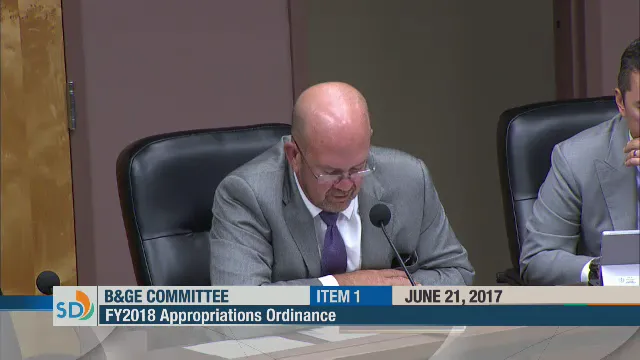
STREAMING COPY IN PREPARATION — RECORDING AVAILABLE FROM THE ORIGINAL SOURCE
Budget and Government Efficiency Committee Meeting - June 21, 2017
The meeting was called to order at 17:00 UTC on June 21, 2017, with a quorum present consisting of Chair Bream, Councilmember Sherman, and Councilmember Gomez. The committee approved the record of actions from the May 24, 2017 meeting by unanimous consent. No non-agenda public comment was offered. The primary agenda item was a review of the Fiscal Year 2018 Appropriations Ordinance.
Discussion Items
Financial Management Deputy Director Matt Vespe, along with Michael Clark and Adrian Del Rio, presented the FY2018 Appropriations Ordinance. The ordinance is the final step in the budget process, appropriating funds based on the previously approved salary ordinance and budget resolution. Staff recommended forwarding the ordinance to City Council for approval. The presentation detailed 14 proposed changes, grouped into two categories: CIP cash management (7 changes) and technical adjustments (6 changes). Key CIP cash management changes included:
- Replacing the "waterfall list" with authority to transfer project savings from completed projects to an annual allocation of the same asset type.
- Authority to administratively remove unexpended balances from annual allocations at year-end.
- Ability to add restricted funds to projects without increasing overall budget, freeing up less restricted funds for council reprogramming.
- Clarifying language to close projects when funding is removed for future programming.
- Expanding authority to close funds with no revenue (increasing from $15,000 to $25,000 and including any fund type).
- Authority to change project accounting from preliminary engineering to other project types, and to transfer subprojects from annual allocations into standalone projects for transparency.
Technical adjustments included clarifications on CFO authority to transfer CPPS budget, removal of Connect Careers language from TOT fund (since program is now general fund supported), removal of authority related to consolidated maintenance assessment district funds, adding the new road maintenance fund (from SB passage) to existing gas tax authority, updating the San Diego Regional Parks project list, adding two fleet service replacement funds to internal service fund list, and minor grammatical corrections.
Jillian Cassie from the Independent Budget Analyst (IBA) offered three recommendations:
- Specify a cap of $100,000 on the level of funding that can be transferred to an annual allocation under the new waterfall list replacement.
- Require reporting to council on transfers made under the authority to return unexpended balances from prior year annual allocations to fund balance.
- Clarify language to ensure the authority to transfer appropriations from an annual allocation to a new CIP project is limited to converting an existing subproject into a standalone project.
Councilmember Sherman expressed support for the changes, particularly the effort to close small funds, and made a motion to approve and forward to council with the IBA recommendations. Councilmember Gomez seconded the motion. Gomez raised concerns about the mayor's veto authority and checks and balances in the strong mayor system, and asked the IBA about potential future discussions. Councilmember Kate (likely Mr. Kate) asked questions about the waterfall list, the police range project, and the IBA's clarifying language, and provided historical perspective on council authority during the budget process. Chair Bream thanked staff and the IBA for their assistance during her first budget cycle, and expressed optimism about working together.
Key Outcomes
- The committee voted unanimously to approve the motion to recommend City Council approval of the FY2018 Appropriations Ordinance, including the IBA recommendations. The motion was made by Councilmember Sherman and seconded by Councilmember Gomez. All members present voted in favor.
- The meeting was adjourned, with the next meeting scheduled for July 12, 2017 at 9:00 a.m.
Meeting Transcript
Good morning, everyone. I'll now call the uh meeting of the budget and government efficiency committee to order. Uh a quorum is now present, consisting of uh Mr. Sherman, uh myself the chair, and councilmember Gomez. Moving right along, um, the committee record of actions from the May 24th, 2017 meeting will be approved by unanimous consent unless pulled for discussion. Uh do we have a request to pull the record of actions? Nope. Okay. Uh well, we'll we would now proceed with non-agenda public comment, but I don't see anybody here to do that. Uh do we have any committee member, mayor, IBA, or city attorney comments today. No. Okay. Okay. Um are there any requests to continue an item on today's agenda? Okay. Uh we'll now proceed directly to our action agenda, which is to review a report from the financial management team recommending council approval of the fiscal year 2018 appropriations ordinance. And I, Matt, are you our presenter? Yep. Good morning. So good morning, thank you. Uh so my name is Matt Vespe, Deputy Director of the Financial Management Department. And uh with me this morning is Michael Clark and Adrian Del Rio, both coordinators within financial management. And this morning we're here to present the fiscal year 2018 appropriations ordinance. So the appropriations ordinance really uh really marks the final step in the fiscal year uh 2018 budget process. Uh this document, the ordinance appropriates the budget based on the two controlling documents that have already been approved. Those are the salary ordinance and the budget resolution. The appropriations ordinance defines the legal levels uh that control both that control both operational and capital expenditures in accord in accordance with City Charter Section 69. Also, uh City Charter Section uh 69 requires uh that this ordinance be approved by June 30th each fiscal year. And with that, staff recommends uh forwarding the FY18 appropriations ordinance to City Council for approval. So each year, financial management brings the appropriations ordinance forward for uh City Council approval. Um each year typically we have a number of edits, changes, improvements that we that we request approval of. Uh this year is no different. Uh we've got about 14 changes that we're requesting approval of. We've uh grouped them into two primary categories. Those are CIP cash management and then technical adjustments. The CIP cash management uh changes requested authorities. We identified those uh primarily through our CIP uh semiannual monitoring reports that we've been doing over the last two years. As you are aware, those reports have become lengthy. They are lengthy documents. Um a lot of the items that we requested approval for in those documents are uh ministerial administrative type adjustments within the capital improvement program. As a result, um continuing to try to further improve our cash management within the CIP program. We've identified a number of authorities that we'd like to request addition or adding to the AO to allow us uh staff to administer, make those changes at a staff level and uh bring the CIP monitoring reports back to a higher level policy discussion of what really uh the focus should be of those reports. The changes that we've identified are strictly intended to continue to improve cash management within the capital improvement program. Uh Mike's gonna go through the details of each of those requested authorities, uh but I want to be clear that City Council action would still be required uh to add close or substantially change any ongoing CIP projects if these authorities were added to the AO. This slide provides a short list of uh those adjustments. And this slide provides a short list of our technical adjustments, uh which Adrian will cover in detail later in the presentation. Uh with that, I'll turn it over to Mike to cover the details of the CIP cash management authorities. Thank you, Matt. Starting off with our first recommended change for this year. As we've reported in our both of our semi-annual reports this year, the underfunded projects list or the waterfall list we've noticed, which was the list of projects to fund with project savings.
openpublica.com