Budget and Government Efficiency Committee Meeting - November 13, 2024
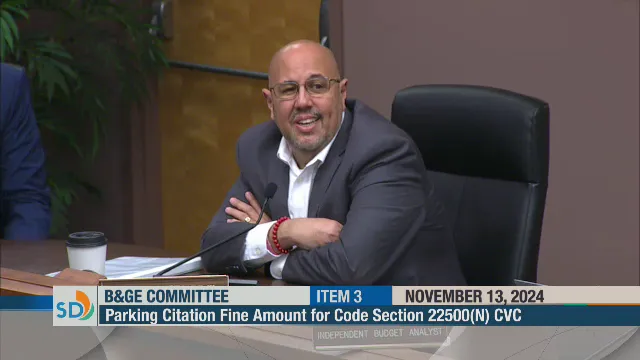
STREAMING COPY IN PREPARATION — RECORDING AVAILABLE FROM THE ORIGINAL SOURCE
Budget and Government Efficiency Committee Meeting – November 13, 2024
The Budget and Government Efficiency Committee convened on Wednesday, November 13, 2024, at 9:00 a.m. (Note: the meeting started at approximately 9:00 a.m. based on the agenda timeline, though the transcript timestamp indicates 17:00 UTC which corresponds to 9:00 a.m. PST). The committee, chaired by Councilmember Lee, took up consent items, a parking citation fine, a junior lifeguard fee increase, and informational reports on the first quarter budget and the living wage ordinance.
Consent Calendar
- Item 1: Approval of the committee minutes of October 16, 2024.
- Item 2: Approval of the First Amendment to the agreement with SAP Public Services to increase expenditure authority for SAP Cloud Services.
- Both items were approved unanimously (3-0) with one member absent (Councilmember Moreno).
Public Comments & Testimony
Non-Agenda Public Comments (5 speakers):
- Madison (first name only): Expressed support for prevention measures for college-age students regarding marijuana and vaping, citing a study showing high rates of use. Proposed budgeting for prevention programs.
- Terry Ann Skelly: Urged the committee to examine the role of for-profit addiction industries (tobacco, marijuana, CBD) in undermining housing and health programs, referencing CalAIM funding for the unsheltered.
- Becky Rapp (public health educator): Questioned the city’s progress in collecting taxes from marijuana businesses, noting a 2022 auditor’s report that less than 50% paid taxes. Asked where collected funds are allocated and if a marijuana auditing department has been established.
- Blair Beekman: Apologized for misinterpreting a previous city treasurer’s report; emphasized limiting fossil fuel use. Also raised concerns about security at the Tijuana-San Diego conference and about surveillance technology in parks.
- Jason Yata (District 3): Commented on the city treasurer’s report, expressing comfort with a “bathtub” metaphor for fund management. Expressed concern about the new SERPA system implementation and its timing with the budget process.
Public Comments on Consent Agenda (2 speakers):
- Joyce Yata (spoke as phone number ending 7968): Expressed support for the SAP cloud services item, emphasizing the importance of IT and AI investments.
- Blair Beekman: Spoke on item 2, urging that AI be treated as a human rights issue.
Public Comments on Item 3 (Parking citation fine):
- Jason Yata: Expressed strong support for the AB413-related fine, highlighting pedestrian safety and Vision Zero goals. Appreciated the outreach and implementation timeline.
- Blair Beekman: Cautioned against using Vision Zero as a punitive law enforcement tool, urging a focus on community harmony.
- Anar Salaev (Executive Director, Bike San Diego): Commended the city for pushing AB413 forward, noting it will save lives. Suggested future enhancements like hardscaping and bike share stations instead of just red curbs.
Public Comments on Item 4 (Junior Lifeguard fee increase):
- Kathleen Lippitt (parent, grandparent, public health researcher): Emphasized the value of the program for youth development and urged the city to support it, even if subsidization is needed.
- Jason Yata: Supported the fee increase, noting the program’s value in preventing drowning and its scholarship component.
- Blair Beekman: Acknowledged the retirement of a long-serving lifeguard and the importance of diversity in the program.
Public Comments on Item 5 (First quarter budget monitoring report):
- Jason Yata: Appreciated the report’s transparency; urged community support for the Department of Finance during challenging economic times.
- Blair Beekman: Criticized high police overtime costs and property tax issues, calling for more accountability and progressive taxation.
Public Comments on Item 6 (Living Wage Ordinance annual report):
- Jason Yata: Praised the outreach efforts, especially regarding language barriers, and encouraged employees to advocate for their rights.
- Blair Beekman: Supported the living wage concept but expressed concern about the rejection of inflation-tied wage adjustments; linked the ordinance to addressing wage theft.
Discussion Items
Item 3 – Establishing Parking Citation Fine Amount for Code Section 22500N (CVC)
- Staff Presentation: Jonathan Carey (Deputy Director, Office of City Treasurer) and Beth Nokan (Parking Program Manager) presented the proposed fine of $65 for stopping or parking within 20 feet of a crosswalk (15 feet with curb extension) as required by AB413. The fine matches the existing red zone violation. Outreach and warnings will begin January 1, 2025, with a 60-day warning period. The total citation amount including state surcharge is $77.50.
- Committee Discussion: Chair Lee and Council President Pro Tem Lakaba expressed support. Councilmember Foster raised concerns about the lack of state funding for implementation and the difficulty of determining 20 feet from unmarked crosswalks, especially in residential areas. She asked for a standardized media kit and noted the impact on communities with high parking demand. The police department indicated enforcement would be complaint-based in many areas. The item passed unanimously (3-0).
Item 4 – San Diego Junior Lifeguard Program Fee Increase
- Staff Presentation: Chief James Gartland (Lifeguard Chief) and Michelle Yamamoto (Fiscal Director, Fire Rescue) presented the proposed fee increase from $669 to $890 per student to achieve full cost recovery and comply with Proposition 26. The program serves about 1,250 youth (ages 9-17) plus a Grommet program for 287 8-year-olds. Scholarships are provided via a partnership with the Prevent Drowning Foundation (60 scholarships; 36 awarded in FY24). The program also serves as a recruitment pipeline for lifeguards.
- Committee Discussion: Council President Pro Tem Lakaba moved the item, expressing support but noting the need for full cost recovery given current fiscal constraints. Councilmember Foster seconded, requesting data on scholarships by district. Chair Lee noted the importance of the program and willingness to help bridge scholarship gaps. The motion passed unanimously (3-0, with Councilmember Moreno absent).
Item 5 – Fiscal Year 2025 First Quarter Budget Monitoring Report (Informational)
- Staff Presentation: Ben Battalli (Assistant Director, Finance), Rolando Charvel (Director of Finance), and Chris Purcell (Financial Operations Manager) presented the report. Key points:
- General fund revenues are projected $10.1 million below budget, driven by sales tax ($11.6M below) and transient occupancy tax ($4.2M below). Property tax and franchise fees slightly offset.
- Expenditures: Public safety overtime is projected $15.2M over budget (fire and police), but still below FY24 actuals. Non-discretionary expenditures are $10.3M under budget (energy, debt service, fuel, water savings). Other departmental increases (transportation, parks, library) are partially offset by lower election costs.
- The projected ending fund balance is not adjusted, but the reserve percentage is expected to drop to 11.8%, below the 13.58% target, requiring a $31.2M contribution to meet policy.
- Committee Discussion: Chair Lee noted the revenue shortfalls and asked about the use of excess equity from FY24. Staff responded that the report is biased toward underperforming revenues and over expenditures; a comprehensive mid-year report will provide a fuller picture. Council President Pro Tem Lakaba stressed the need to focus on revenue generation rather than cutting public safety. The item was informational; no motion needed.
Item 6 – Fiscal Year 2024 Living Wage Ordinance Annual Report (Informational)
- Staff Presentation: Christiana Gogger (Chief Compliance Officer), Erin Leah Enderlunis (Program Manager), and Leslie Cerritos (Supervising Compliance Officer) presented the report. Highlights:
- The living wage rate for FY24 is $20.42 (base $17.13 + health benefit $3.29).
- The program monitored 1,168 contracts, reviewed 388 exemption applications (approved 380), conducted 94 outreach events, and investigated 5 worker complaints, recovering $7,037 for 49 workers.
- Committee Discussion: Chair Lee noted that the base living wage rate ($17.13) is already below the city’s minimum wage ($16.85, set to rise to $17.25 in January 2025) and asked if the ordinance could be updated to prevent falling below minimum wage. Staff acknowledged the issue and said they are researching potential updates. Council President Pro Tem Lakaba thanked staff for enforcement and noted a larger conversation is needed about the ordinance’s philosophy and adjustability. The item was informational.
Key Outcomes
- Consent Agenda Items 1 and 2: Approved unanimously (3-0).
- Item 3 (Parking fine): Resolution to adopt a $65 fine amount for Code Section 22500N adopted unanimously (3-0).
- Item 4 (Junior Lifeguard fee): Authorization of fee increase from $669 to $890 per student adopted unanimously (3-0, with Councilmember Moreno absent).
- Item 5 (Budget report): Received as information; no action taken. The next quarterly report (mid-year) is due January 31, 2025.
- Item 6 (Living Wage report): Received as information; no action taken. Staff will continue research on potential ordinance updates.
- The committee adjourned to the next regularly scheduled meeting on December 11, 2024, at 9:00 a.m.
Meeting Transcript
Audio test one, two, three. Welcome to the Budget and Government Efficiency Committee meeting of November thirteenth, twenty twenty-four. Our committee lays on Natalie Kessler. We'll go over instructions for today's meeting. This meeting is being televised and live streamed on the city's website, and the council administration will continue to make arrangements for the public to comment using the Zoom webinar platform. Members of the public who wish to provide public testimony must enter the virtual queue by raising their hands before the queue closes. Chair. Thank you. I will now call the budget and government efficiency committee meeting of Wednesday, November 13th, 2024 to order. Natalie, please call the rule. Vice Chair Marino, Council President Pro Tem Lakaba. Present. Councilmember Foster. Here. And Chair Councilmember Lee. Here. Also attending the meeting today, Charles Matica and Lisa Byrne from the Independent Budget Analysts Office. David Powell from the City Attorney's Office. Matt Vesby, Chief Financial Officer. If you're in person, please complete a speaker slip located at the entrance of chambers and place it on top of the box indicated at the speaker's lecture at the front of the room. Please do so in a timely manner to ensure proper meeting management. In-person testimony will conclude before virtual testimony begins. Members of the public can also join the webinar by computer, tablet, or smartphone by accessing the link, which is listed online in the preamble language of the agenda on the city's webpage. If you need to participate by telephone, dial 1669-2545252. The webinar ID is 160074-2406 pound. This information is also available on the agenda and will appear on the screen during the public comment period for each agenda item. Chair. Thank you, Natalie, for reviewing those instructions for the benefit of the public. A quorum is now present. We will now take up non-agenda public comment. The council members respect and appreciate the public's input and are fully committed to protecting every participant's free speech rights at council and committee meetings. Natalie, do we have any non-agenda public comment? Thank you, Chair. Yes, we currently have five hands raised in the virtual queue. Per rule 2.7 non-agenda public comment is an opportunity for members of the public to comment on items that are not on the agenda but within the subject matter jurisdiction of the committee. Each speaker will have two minutes. And if you've joined the Zoom webinar online or by phone and have non-agenda public comment, please raise your hand at this time if you wish to speak. And Chair, we have not received any speaker slips from individuals in the committee room, but we do have five hands raised in the virtual queue. I've started the five-minute timer for all those in the queue to indicate that they wish to provide non-agenda public comment. And we will begin with Madison. Madison, please begin. You'll have two minutes. Hi, thank you for the chance to speak this morning. Um, I just was talking to my husband who's a new professor at San Diego State University, and we were kind of discussing the students that he's working with and just the importance of this time of life for these students and college-age kids who work their whole life basically to get to this point to attend a university or at least during high school, you know, they're working hard to get good grades and do all the extracurriculars so they can get to that point. And I've been working in some um substance prevention and just realizing that people that age are using a lot of vaping and cigarettes. And so I just wanted to propose something in the budget that we can do for prevention for college-age kids. Um, there was a study recently that found that cannabis and psychedelics are increasingly popular with rates of use at historically high levels in 2023. And for those age 19 to 30, 42 percent said they've used marijuana in the past year. 29% have used it in the past month, and 10% are using it daily, which is defined as used on 20 or more occasions in the past month. So more people are now using marijuana daily than are using alcohol daily.
openpublica.com