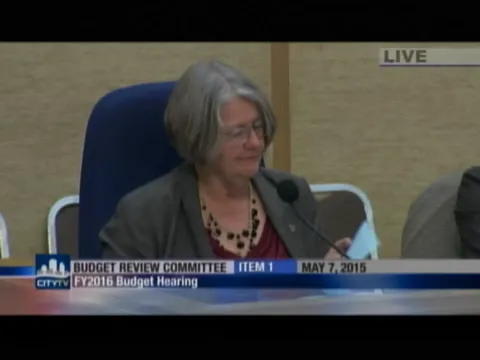
San Diego Budget Review Committee Meeting - May 7, 2015
STREAMING COPY IN PREPARATION — RECORDING AVAILABLE FROM THE ORIGINAL SOURCE
San Diego Budget Review Committee Meeting - May 7, 2015
The Budget Review Committee of the San Diego City Council met on May 7, 2015, to review the proposed fiscal year 2016 budgets for the San Diego Convention Center Corporation, the Ethics Commission, the Personnel Department, and the City Auditor. The meeting also included discussion of the Fifth Avenue Landing lease default, infrastructure needs, and hiring challenges.
Public Comments & Testimony
- Mr. Ross spoke against the Ethics Commission, arguing it is unnecessary and costly. He cited the commission's proposed FY16 budget of $1,048,924 and suggested a return to a citizen jury panel. He also noted the commission's revenue was $29,650 in 2013.
- Clive Richard spoke in support of the City Auditor's budget, emphasizing the importance of IT audits and the savings generated by the office. He urged the committee to follow the audit committee's recommendation for a salary increase and an additional IT auditor position.
Discussion Items: San Diego Convention Center Corporation
- Presentation: Laurie, Gil, and Mark presented the FY16 budget. Total expenses budgeted at $33.8 million, an increase of $1.9 million from FY15. Personnel expenses increased by $950,000 due to step increases, merit increases, and increased part-time hours (2.47 FTEs). Non-personnel expenses increased by $918,000 due to electricity rates and ground lease costs for the proposed phase three expansion. Revenue increases across the board, notably a new 10-year telecommunications contract expected to yield $800,000 in additional revenue annually. The corporation expects to reach its operating reserve goal of $4.5 million by the end of FY16. Infrastructure capital projections over five years total $32.5 million; operations and maintenance projections total $11.3 million. The corporation requested an additional $3.9 million from the city for FY16 infrastructure.
- Naming Rights: The corporation has engaged a consultant (Superlative Group) for naming rights. Primary opportunities estimated at $450,000–$650,000 per year; secondary at $225,000–$350,000 per year. Agreements expected by summer 2016.
- Fifth Avenue Landing Lease Default: The corporation was unable to make the final payment of $13.8 million on May 6, 2015, due to the invalidation of the financing plan. The leasehold reverts to the owner; the note is non-recourse. Council members expressed concern about lack of advance notice and the impact on a contiguous expansion. Council President Leitner said the default effectively ends the contiguous expansion option. The corporation is conducting a market study (with CSL) to evaluate contiguous vs. non-contiguous expansion options.
- Councilmember Sherman suggested looking at Los Angeles' privatization model for convention center operations. Councilmember Kirsey mentioned I Bank loans as a potential funding source for capital needs. Councilmember Gloria noted positive feedback from a convention center visitor.
Discussion Items: Ethics Commission
- Presentation: Stacy Fulhorst presented the proposed FY16 budget of $1,048,924, essentially unchanged from FY15. The increase of $57,000 covers salary adjustments, fringe benefits, and technology costs. Three new unclassified positions are offset by three classified positions. The commission is lean compared to Los Angeles and San Francisco (both have over 20 employees and budgets of $2–$2.5 million).
- Councilmembers Leitner and Gloria praised the commission's responsiveness and training. Councilmember Gloria noted the commission's work in keeping campaign laws relevant, including recent reforms on credit card donations. The commission is working on disclosure laws for the referendum process.
Discussion Items: Civil Service Commission / Personnel Department
- Presentation: Hadi Degani presented the FY16 budget. Major changes include an increase of 0.68 FTE for non-standard hour staffing, addition of four program coordinators offset by four classified positions, $100,000 for increased contractual costs for medical exams and drug testing, and $22,229 for IT system conversion. No change in user fee for LiveScan fingerprinting.
- IBA (Lisa Byrne) noted that hiring and placements increased 113% from FY11 to FY14. As of January 2015, there were 868 vacancies. Performance measures for certifications and classifications have slowed. Personnel requested three additional positions (two associate personnel analysts and one payroll audit specialist) that were not funded in the proposed budget. The department is implementing an online hiring center pilot and other efficiency improvements.
- Councilmembers expressed concern about the ability to handle the planned 424 new positions citywide without additional staff. Councilmember Alvarez asked for an analysis of the impact of not funding the requested positions. Councilmember Gloria noted the illogical nature of not resourcing the department for such a large hiring effort. Councilmember Leitner and others stressed the need for efficient hiring to compete for talent. Councilmember Cole highlighted the risk of losing candidates due to long hiring times. Councilmember Zap questioned whether the additional positions are needed long-term or are temporary.
Discussion Items: City Auditor
- Presentation: Eduardo Luna proposed a FY16 budget of $3.7 million for 21 positions, an increase of $145,000. The audit committee recommended a $12,000 salary increase for the city auditor and an additional IT auditor position ($129,000). The IT auditor would conduct a comprehensive IT risk assessment and target audits of high-risk systems, including cybersecurity and data privacy. The auditor's office has issued over 750 recommendations with near 100% agreement from the administration.
- IBA noted a $31,000 increase in training budget and a $50,000 decrease in CAFR expense.
- Councilmembers praised the auditor's office for its work and savings. Councilmember Zap highlighted the high implementation rate of recommendations. Councilmember Gloria expressed strong support for the IT auditor position, citing concerns about data security and privacy, including police department use of information technology. Councilmember Leitner requested an audit of the convention center. Councilmember Sherman noted the value of IT audits given the city's increasing reliance on technology.
Key Outcomes
- No formal votes were taken; the committee reviewed budgets and will forward recommendations to the full council.
- The convention center's request for $3.9 million in additional infrastructure funding will be considered further.
- The Fifth Avenue Landing default will be discussed at a future Budget and Government Efficiency Committee meeting.
- The May revise may include additional personnel department positions (three requested) and the city auditor's salary increase and IT auditor position, as supported by several council members.
- The committee encouraged continued collaboration on funding solutions for convention center capital needs, including I Bank loans and naming rights.
Meeting Transcript
100,000 visitors will come from out of town and their spending will result in over 21 million dollars in TOT and sales tax revenues to the City of San Diego. Annually, the corporation and our partners at the San Diego Tourism Authority sell the building to events that will occur in future years. The largest clients usually book their events five to ten years in advance. When the event is confirmed, the client also works with our teams to arrange contracts with local hotels to secure blocks of rooms. The annual goal for the sales teams is to book events that will generate 900,000 room nights for the destination, which are spread into future years when the event is scheduled to occur. The sales terms are divided into long-term sales and short-term sales based on when the event is scheduled. Long-term sales team has an annual goal of 860,000 future room nights, and short-term sales team has a room goal of 40,000. This chart provides a summary of total future room nights that were sold in a given year. The last two columns show the combined sales efforts for the fiscal years 13 and 14 when the corporation contracted with the tourism authority to handle our long-term sales. This pace is ahead of last year, and based on the events detailed in the section of this chart, marked tentative, you will see, the SDTA believes that they will meet their annual goal this year. In fiscal year 2014, SDTA booked 816,188 room nights, 95% of the long-term sales goal. This chart provides an update on the short-term sales team's progress in the current fiscal year, which ends June 30th. As of March, the end of March, the team has secured 95 events that will generate more than 21,000 contracted room nights. The short-term sales team also believes that it will meet its annual goal this year. In fiscal year 2014, the short-term sales team exceeded their room night goal, booking $41,072 room nights and achieving $103% of their goal. The short-term sales team also exceeded their revenue goal by 15%. This slide details the two phases of this effort. As you can see, the first phase is now complete, and we are now currently in the market having meetings with potential naming rights sponsors. I want to assure you that we are moving as rapidly as possible to secure a partner that can help address the funding needs for organizing infrastructure capital operations and maintenance for the facility. The contract was extended to fiscal year 26, resulting in 1.47 million dollars in additional revenues over the next five years. An effective beginning fiscal year 2016, the new telecommunications data and internet services contract carries a significantly higher commission percentage to be paid to the corporation. In 2012, the corporation estimated numerous positions, in 2012, the corporation eliminated numerous positions, resulting in a $2 million savings over a five-year period. Additional staff reductions were done in the summer of 2014, providing additional savings. The corporation continues to implement operational strategies to reduce costs as well. This slide shows how efforts to reduce utility use through the installation of low energy lighting on our exhibit hall and throughout the building will save the corporation approximately $660,000 a year in utility expenses. The LED retrofit is unfolding in two phases. We are estimating a savings of 1.2 kilowatt hours in phase one and another 1.2 kilowatt hours savings in phase two. Each phase of the LED project should save about $215,000 in electric utility costs annually. The cost of this retrofit will be recouped within one year of its installation. We have been updating the facilities as well of our older restrooms and installing low-flow faucets and toilet fixtures. In addition to responding to our statewide and regional water crisis, this has so far saved the corporation $34,547 annually. This savings is growing as the cost per 100 cubic feet of water gets more and more expensive. I'm going to turn it over to Gil now to introduce you to our budget presentation. Thank you, Laurie. Good afternoon, everyone. As Chair of the Budget Committee and former member of the audit committee, I wanted to briefly outline the various tools and processes that we use to monitor the corporation's finances, provide oversight, and give direction to the staff. This slide outlines the our key tools, including monthly and quarterly financial statements, including uh that include any major budgetary uh variances. On a monthly basis, we also receive a report on capital expenditures. The budget committee and our audit committee regularly review the financial records and reports, drive the budget process and perform our annual corporate audit. The board is actively involved beyond just scheduling scheduled meetings as we are regularly in communication with senior staff on all issues tied to finance and budget throughout the year. One of the requests included in the council members we receive uh council members we received was additional information about performance measures that we are tracking. This slide provides some of the key performance measures that we track. Um for example, all major expense categories are tracked by event on a monthly basis, labor costs by division or compared to revenues monthly and annually and reviewed as well by event. Utility consumption is reviewed monthly, and financial statements are reviewed in detail monthly to identify any issues, trends, or errors. And one of the most valuable activities the corporation undertakes is benchmarking is a benchmarking effort of our operations to test uh against the industry's best practices. Go to the next one. Okay. Sorry, I'm going to turn over to Mark to give you an overview of the budget process. Okay. All right, thank you, Gil.
openpublica.com