San Diego Budget Review Committee Meeting on Housing Commission, Successor Agency, and Civic San Diego Budgets, May 7, 2015
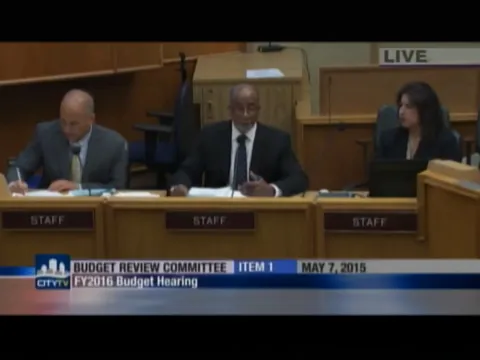
STREAMING COPY IN PREPARATION — RECORDING AVAILABLE FROM THE ORIGINAL SOURCE
San Diego Budget Review Committee Meeting on Housing Commission, Successor Agency, and Civic San Diego Budgets, May 7, 2015
The San Diego City Council Budget Review Committee, chaired by Councilmember Todd Gloria, convened on May 7, 2015, to review the proposed fiscal year 2016 budgets for the San Diego Housing Commission, the Successor Agency to the former redevelopment agency, and Civic San Diego. The committee also heard public testimony on capital improvement projects and other matters. No final votes were taken on the budgets; the committee requested additional information and scheduled further discussions.
Public Comments & Testimony (Non-Agenda)
- Catherine Rhodes (Point Loma) urged the city to spend more from location-based funds, noting that only 10.4% of such funds were projected to be used in the next year, and argued that CIP projects should include completion dates.
- Clive Richard (9th Council District) raised concerns about public access to PowerPoint slides during televised meetings, saying the Brown Act's spirit of transparency is undermined when home viewers cannot see the presentations.
San Diego Housing Commission Budget
- Financial Management staff (Michelle Yamamoto) reviewed the proposed FY16 budget of $325 million, a net decrease of $12.4 million (3.7%) from FY15, driven by a $24.7 million (26.3%) reduction in reserves, including $15 million for the purchase of Village Senior North. Personnel costs increased $2.8 million (11%) due to 13 new positions, a 2.5% COLA, a 3% performance incentive, and a 5% class/compensation study placeholder. The budget includes $2.04 million from the city's general fund for homeless solutions.
- San Diego Housing Commission staff (Jeff Davis, Leslie Levinson, Tracy McDermott) presented the budget, highlighting that only $11.8 million (17%) of $69.2 million in reserves is unrestricted, with contingency reserves maintained at 5% of revenue. Revenue changes included a decrease in Section 8 MTW funding of $3.5 million, elimination of rehab grant revenue, and a $1.6 million increase in real estate revenue. Program expenses increased $13.1 million, and personnel positions are projected at 284 FTE, up from 275 in FY15 but below the 285 FTE in FY14. Note: Financial Management reported 13 additional positions; Housing Commission staff indicated 9 new positions, a discrepancy the committee did not resolve.
- IBA (Trisha Tackey) reported that the Housing Commission achieved the IBA's recommended 5% unobligated reserve goal, detailed the $2.04 million homeless services funding breakdown, and noted the commission's Housing First San Diego program. She also highlighted that 46,000 households are on the Section 8 waiting list with an 8–10 year average wait, and that the general plan calls for 9,600 affordable units but actual needs are much greater.
- Public comment included Martha Welch disputing the effective use of HUD funds and Section 8 responsiveness, and Catherine Rhodes urging the use of $32 million in unencumbered low/moderate income housing fund reserves, criticized Civic San Diego's plan not to spend funds until 2018, and advocated for tenant-based rental assistance and removing conditional use permit requirements for homeless services.
- Committee members asked about federal funding decreases, reserve strategies, vacancy rates (22 positions in recruitment), inclusionary housing fee projections, the linkage fee, Section 8 inspection frequency (biannual, 13 inspectors), and the waiting list process. Councilmember Emerald suggested close coordination between Housing Commission inspectors and city code enforcement to address substandard housing.
Successor Agency Budget
- Wanda Nations (Civic San Diego) presented the successor agency's proposed FY16 administrative and project management budget of $6.7 million, a 10% decrease ($746,000) from FY15, covering 34.25 FTEs. The budget is tied to ROPS 8 (July–December 2015) and ROPS 9 (January–June 2016).
- IBA (Jeff Coir) noted the decrease is consistent with winding down redevelopment and highlighted an ongoing dispute with the Department of Finance over approximately $69 million in CDBG repayments, for which HUD had sent a letter supporting the city's position.
Civic San Diego Budget
- Financial Management (Matthew Vespey) reviewed the proposed FY16 budget of $7.4 million, a 10.1% ($685,000) increase, with 40 FTEs (up 5). Personnel expenditures increased 13.1% ($570,000) due to new positions and merit pool; non-personnel increased 4.8% ($115,000) offset by lower rent plus $300,000 for economic development outreach.
- Civic San Diego staff (Reese Jarrett, Pamela Rojas) presented the budget and accomplishments, including over 7,000 homes developed (84% affordable), 500 affordable units under construction, 16 new design permits (100% increase), 83 land use permits, and $58 million in New Market Tax Credit allocations. They proposed five new positions, a 3.5% salary merit pool, and increased permit fees.
- IBA noted the budget increase is matched by revenue, with the largest driver being New Market Tax Credit fees. It also discussed a $375,000 general fund contribution, including a $125,000 rebudget for a transit-oriented development fund and downtown library adaptive reuse, and recommended regular updates. A discussion on modifying the city's consulting agreement with Civic is scheduled for June 4.
- Public comment: Gretchen Newsom (community budget alliance/IBEW 569) argued Civic's community benefits policy lacks substance and enforcement, and urged adherence to city living wage and prevailing wage policies. Jarvis Ross criticized Civic as an "ongoing institution siphoning money" and opposed the budget increase. Martha Welch expressed hope for affordable housing outcomes. Monica Ball (25 Cities initiative) stressed the urgent need for housing inventory, noting 2,300 veterans need housing and that even all vacancies would not meet the goal. Catherine Rhodes urged the city to force Civic to spend $32 million in cash reserves immediately rather than waiting until 2018, and opposed the 3.5% merit pay increase.
- Committee members raised questions about funding discrepancies, the city attorney's authority over Civic's budget, New Market Tax Credit project selection and transparency, the EB5 program, the Bayside Fire Station site transfer, and the downtown shuttle and library plans. Councilmember Gloria expressed frustration with incomplete projects and stated patience is wearing thin. Councilmember Cole announced she would review Civic's operating agreement and bylaws at the June 4 EDIR meeting.
Key Outcomes
- The committee did not approve the budgets; the review serves as input for future council actions.
- The housing authority special meeting unanimously approved a motion to waive council rules to allow Councilmember Todd Gloria to chair the budget review meeting (with districts 2 and 5 absent).
- Councilmember Alvarez requested written responses from Civic/IBA regarding funding discrepancies and budget line items.
- Councilmember Lightner requested actual expenditure comparisons for FY14 and estimated FY15.
- Councilmember Gloria asked the IBA to work closely with Civic to examine its budget and requested that Civic provide a breakdown of projects and ownership timeline for the Bayside Fire Station.
- The committee recessed at the end of the morning session and was scheduled to reconvene at 2 p.m. to review the Convention Center Corporation budget.
Meeting Transcript
The budget today you have four um the um twelve four um uh uh twelve four um twelve million and um four and eleven um um eleven million on the housing. So I know you can only once. I want I guess we know I can't uh uh to the um lawsuit because remember um the check would um over the uh to um San Diego gas left over there and came here by twelve million. You know, this and it doesn't matter because this is the park um project, so they'll they'll get this money and the park um so you can't get it out of this because it's in the park or division, but it's very confusing. Are you confusing everybody because you can't where the money came from because the these fingers come all the time. So it's hard to um which one is true. That's what I'm saying. Thank you. Ms. Rhodes, followed by Mr. Richards. Hi, Catherine Reds from Point Loma. And what I wanted to talk to you about since I didn't get to to do this was for the CIP projects that you already looked at. So anyway, um when I just looked at the location base funds, um you have in facility benefit assessments you have 185 million in the fund. You're only spending 12 point six. For the developer impact fees, you have eighty-eight million in the fund, you're only spending 17.8. And for maintenance and assessment, you have 20 million in the front, and you're only spending 125,000 dollars. So what I see here, just adding up the numbers, is that um you're only using 10.4 percent of these location based funds in this next year. And because you are um, you know, some of them you have to use it or lose it. Um they have you know that five year, you should be using it within five years for CIP projects. So I think that you should actually use more money from those particular three location-based funds. And then the other issue um where they came up, um, they have some Civic San Diego managed projects for CIP, which is great. Um, you know, fire station number two and East Village Green, the Department of Finance already said yes to those projects. So my recommendation would you for you guys to get um the 180 million in revenue of RPTTF is still coming in every year. And if you don't have any money in reserves, if you use all your money up, then you get new money. You could get um $50 million cash for those two projects, and then all the money that you're going to spend on East Village Green and Fire Station number two can go back to the general fund or however you're going to um to fund those. And then let's see. And then, you know, what's missing from the CIP budget is um you actually have to have what dates they're going to be um completed. Every project has to have a completion date, and so far no project has that. Thank you. Thank you, Ms. Rhodes. Clive Richard. Thank you, Mr. Chairman. Chair Gloria, members of the uh budget review committee. My name is Clive Richard, and I live in the ninth council district of this city. I've got to tell you, it's very different being in the uh chamber than it is watching this on television. One of the things I've noticed is that when slides are being presented, when the PowerPoints are being presented by staff. We in the um television world don't see those slides. We assume that they're being projected on all of these large screens. But in the television world, we don't see that. So it's kind of like I find it necessary to come down here in order to see what the slides with the PowerPoint presentation look like. It's always been great uh getting this in color with the glossy photos. And one of the worst things that I experienced is that they would be in black and white. So you have this beautiful color slide with different shades of black. My point being it's unfortunate that the people sitting outside of this room don't experience what's being presented. It's kind of like the Brown Act doesn't really mean anything. The public is really excluded. By some reason for some reason, and I don't understand it.
openpublica.com