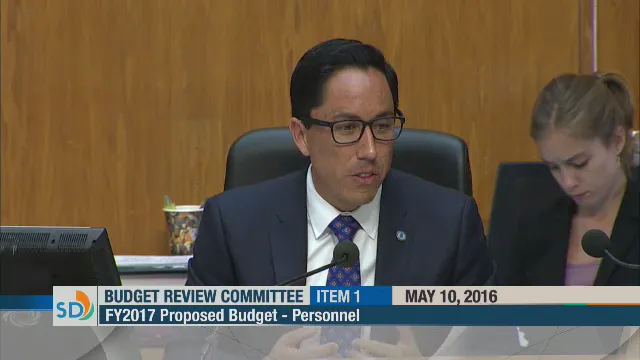
San Diego City Council Budget Review Committee Meeting - May 10, 2016
STREAMING COPY IN PREPARATION — RECORDING AVAILABLE FROM THE ORIGINAL SOURCE
San Diego City Council Budget Review Committee Meeting - May 10, 2016
The Budget Review Committee of the San Diego City Council met on May 10, 2016, to review the proposed fiscal year 2017 budgets for several city departments, including the San Diego City Employees' Retirement System (SDCERS), the City Attorney's Office, the Ethics Commission, the Personnel Department, and the Communications Department. The committee heard presentations from department heads and then discussed budget details, staffing needs, and policy questions. No public speakers testified on any of the agenda items. The meeting concluded with announcements of upcoming hearings on May 16 and May 19.
SDCERS (San Diego City Employees' Retirement System)
- Presentation: Matt Vespe (Deputy Director of Financial Management) gave a technical review. Mark Hovey (SDCERS Administrator) and Ted LaSalvia (Controller) presented the FY2017 budget. The proposed budget totals $46.9 million, a decrease of $1.8 million (3.7%) from FY2016. Administrative expenses are $13.6 million (down $671,000), and investment management expenses are $33.4 million (down $1.1 million). Staffing is reduced from 58 to 54 positions through attrition. The pensionable pay freeze remains. SDCERS manages nearly $7 billion in assets. Key accomplishments include a secure member portal with over half of 20,000+ members registered, near completion of a data integrity project, and an asset liability study confirming the current 78/22 investment split. A charter for operational and investment risk assessments was completed.
- Discussion: Committee members asked about potential one-off financial impacts from data corrections, the timing of the discount rate review (July 8, 2016), and the new pension reserve. Councilmember Gloria noted that the mayor is not proposing to use the pension reserve for the FY2017 ADC but may reevaluate after the July meeting.
City Attorney's Office
- Presentation: City Attorney Jan Goldsmith and Deputy Director Tanya Tomlinson presented. The proposed budget includes an increase of 5.52 FTE for a total of $2.6 million from the previous year. Highlights: adding two deputy city attorneys for homelessness efforts (neighborhood prosecution unit), one for the capital improvement program, one for real estate assets, and one paralegal. A May revise request adds four positions (program manager for community justice initiative, principal clerk, principal legal secretary, word processing operator) totaling $338,000. Goldsmith emphasized that the office is a bargain at 3.7% of the city budget and highlighted litigation successes (De La Fuente case turned $130M award into net gain of $8.2M; recovered $1.6M on plastic pipe case; $15M insurance settlements for Bay cleanup; $5M/year ongoing TOT revenue; $5.4M cash recovery by civil prosecution unit; $238M post-redevelopment recovery).
- Discussion: Councilmember Zaff inquired about the community justice initiative (formerly community court) to address homelessness-related lawlessness. Goldsmith explained the program uses a model of long-term beds, wraparound services, and accountability. Councilmember Cole asked about community impact panels. Councilmember Gloria and Kersey questioned the workload increase from Proposition 47 and resources for homeless interventions. Goldsmith noted a shift to more intensive drug cases and the need for drug counseling in jail (a county responsibility). The mayor's office confirmed $170,000 for expanding the serial inebriate program (SIP) with 28 beds, though a provider procurement is pending. Committee members stressed that homelessness should not be criminalized and that the program must include robust services.
- Outcome: The committee requested data on pre- and post-Prop 47 misdemeanor caseloads. Some members expressed support for funding the program manager position in the May revise.
Ethics Commission
- Presentation: Executive Director Stacy Fulhorst presented. The proposed budget has no significant adjustments; the increase is almost entirely due to fringe benefit changes from reclassifying positions from classified to unclassified. Staffing remains at five positions. The commission provides education, investigations, and auditing. Workload in investigations has decreased, attributed to effective advisory services. The commission is not seeking restoration of two previously eliminated positions. Informal advice requests are in the high hundreds to over a thousand annually.
- Discussion: Committee members asked about the fringe benefit increase, which was explained as a budget software quirk (new unclassified positions counted as post-Prop B hires, but incumbents had pension benefits). Fulhorst noted that when a key staff member retires in a few years, additional funding may be needed. Councilmember Leitner praised the commission's efficiency.
- Outcome: No changes requested; budget noted.
Personnel Department
- Presentation: Personnel Director Hadi Degani and Assistant Director presented. The department oversees classified employee selection, promotion, and removal. FY2017 proposed budget includes $25,000 for a new NEOGOV web interface for dispatcher test scores. Accomplishments: reduced average days to issue an eligible list from over 100 to under 50; completed 335 recruitments; evaluated nearly 47,000 applications; administered 28 out-of-town police recruit tests. The department requested two additional positions (word processing operator and test administration specialist) in the May revise, and also mentioned needing an additional associate personnel analyst.
- Discussion: Councilmember Sherman thanked Degani for improvements after a previous audit. Councilmember Leitner asked about the benefits of the requested positions. Councilmember Alvarez highlighted the need for efficient hiring, especially for public safety. Councilmember Gloria noted the city's increased hiring (additional 240 FTEs) and asked about non-monetary policy relief; Degani said no policy changes are needed currently. The IBA recommended considering the requested positions.
- Outcome: The committee expressed support for the positions and urged the mayor's office to include them in the May revise.
Communications Department
- Presentation: Director Katie Keach and Deputy Director Tracy Campbell-Morales presented. The department was created in FY2015 to centralize communications. FY2017 budget proposes no staffing changes (32 staff), a decrease of one unfilled intern position, and a $6,000 increase for staff training. They highlighted 11 NATOA award nominations for video features, ongoing work on a citywide communication plan, and efforts to standardize outreach across departments. Revenue of $1.6 million is projected from enterprise funds, but the IBA noted actual revenue may be about $400,000 lower.
- Discussion: Councilmember Kersey asked about the social media policy (draft under review). Councilmember Alvarez requested data on the allocation of staff time to enterprise vs. general fund departments, statistics on the InsideSanDiego.org website (12,966 page views in first 90 days), and a breakdown of contracts. Councilmember Leitner asked about training needs; Keach confirmed additional funds would be used efficiently. Councilmember Zaff praised improved outreach to council offices. Chair Gloria expressed concern about the necessity of a separate website (InsideSanDiego.org) versus sandiego.gov and asked about cross-linking.
- Outcome: The committee requested additional performance data on the communications department. No budget changes were proposed at this meeting.
Key Outcomes
- No formal votes were taken; the committee heard presentations and will consider feedback during the May revise process.
- The committee will hold an evening hearing on May 16, 2016, at 6 p.m. for additional public testimony.
- The next budget review committee meeting is scheduled for May 19, 2016, to review the FY2017 May revise and the FY2016 year-end budget monitoring report.
- Councilmembers' final budget modification priorities are due to the independent budget analyst on May 27, 2016.
- Several departments (City Attorney, Personnel) have requests pending for the May revise; committee members expressed support for some of those requests.
Meeting Transcript
All right, good afternoon, everyone. Welcome back. This is the budget review committee of the San Diego City Council. We'll jump right off right into where we dropped off. What am I saying? You know, it's the last day, so I can't be expected to do grammar. Uh but I will balance the budget, right? Um we uh we'll start we'll pick up where we left off, which is with the San Diego uh employee retirement system. Uh Markovi is here. Mr. Hovey, always good to see you. How much time do you need for your presentation? Fifteen minutes. Oh, and I'm sorry, I yeah, okay. 15 minutes for you. Uh Matt Vespe is here to do the technical review, so we'll do Matt, then yourself, then the IBA, and then public comment, potentially. And we'll go from there. Matt, do you want to lead us off? Sure. Thank you. So good afternoon, committee chair, members of the committee. My name is Matt Vespi, Deputy Director of Financial Management. Uh this afternoon I will provide a brief a brief overview of SD SERS fiscal year 2017 proposed budget as discussed in financial management's technical review, released on May 4th, 2016. The fiscal year 2017 proposed budget for SD SERS includes expenditures totaling 46.9 million, which represents a decrease of 1.8 million or 3.7 percent from the fiscal year 2016 budget. SD SERS expenditure budget can be broken down into two primary components administrative expenses and investment management expenses. As a result of changes in a cruel practices in fiscal year 15, administrative expenses are now funded annually by each of the plan sponsors based upon their based upon the ratio of their members to total membership of the pension system rather than being amortized and included in the annual actuarily determined contribution payment. Approximately 92 cents of each administrative dollar for SD SERS is funded by the City of San Diego, while advanced investment expenses are deducted from the pension system investment earnings. For fiscal year 2017, administrative expenses are anticipated to decrease by $700,000 as a result of reduced salary and wages expenditures that can be primarily attributed to vacancies, and reduced non-personal personnel expenditures as a result of the anticipated completion of the purchase of service credit litigation. In conclusion, SD SERS proposed budget is currently available via website link in the city agency section of volume one in the proposed budget document. Thank you. Thank you, Mr. Vespey. Mr. Hovey, you need 15 minutes, and you got it. So thank you. With me this morning as well as Ted Lesalvia, the controller for ST SERS. I'll start off and then Ted will pick up with some numbers. I'll come back to our next year's priorities at the end of today's presentation. The next slide, Ted. Our board has already approved our budget, but we're very pleased to be here today and answer any questions that you may have on our budget. What I'd like to do is quickly highlight some key accomplishments in 2016, which the year is not over, but it's close. First, in terms of reaching out to our members, we now have over half of our 20,000-plus members who have registered on our secure member portal, which allows them to gain insight into specific member information on their accrued contributions and accrued service credit. It was a great outreach, I think, to our active and inactive members, many of whom had no idea what their accumulated contributions had been. So that was a good key accomplishment. Second, we are just about putting a final nail in the coffin of a multi-year project to look at the data integrity of our new pension system, which went live a few years ago when we converted over. There were a number of data anomalies leading to some member adjustments, and we are nearly through with that project. This was resulting in a substantial enhancement to the data integrity of our systems. Third, we do manage nearly $7 billion, and so you would expect it's been we spend quite a bit of time ensuring that that is done correctly. One of the things that we did just complete and will be discussing with our board this Thursday and Friday is something called an asset liability study, where we take a look at the assets that we have on hand and their projected growth as well as the liabilities that we have and that their projected growth and whether we are investing appropriately to ensure that our assets and liabilities will meet each other at the end of the day. And the study confirms that our current approach of investing 78 percent in return-seeking assets like stocks and private equity and real estate and a 22 percent risk mitigating strategy, which is on more conservative investments like bonds and fixed income is appropriate.
openpublica.com