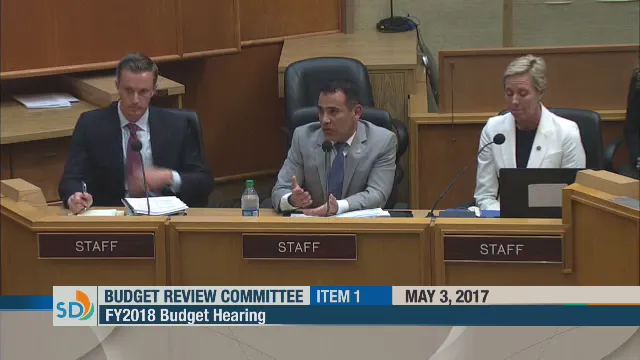
San Diego Budget Review Committee Meeting - May 3, 2017
STREAMING COPY IN PREPARATION — RECORDING AVAILABLE FROM THE ORIGINAL SOURCE
San Diego Budget Review Committee Meeting - May 3, 2017
The Budget Review Committee convened on May 3, 2017, at 10:00 AM to review the proposed FY2018 budgets for the Fire Department, Office of Homeland Security, Financial Branch, City Treasurer, City Comptroller, and Debt Management. Discussions focused on staffing, overtime, response times, enforcement of the minimum wage and earned sick leave ordinance, and new revenue sources such as cannabis business tax and short-term rental TOT. Public testimony highlighted concerns about local enforcement of wage laws. The meeting was adjourned to reconvene on Friday, May 5, 2017, at 10:00 AM.
Public Comments & Testimony
- Minimum Wage Enforcement: Multiple speakers (Steve Rivera, Emily Howe, Adriana Huerta, Peter Zhishi, Anthony Ortiz, Christina Griffin, Martha Welch) urged the city to establish a robust local enforcement system for the minimum wage and earned sick leave ordinance. They argued that the current process, which directs minimum wage complaints to the state Labor Commissioner, creates confusion and delays for workers. Speakers emphasized that voters overwhelmingly supported the ordinance and that effective enforcement is necessary to protect low-wage workers. Martha Welch also criticized the proposed parking meter hour changes in Hillcrest.
Discussion Items
-
Fire Department Budget: Chief presented the FY2018 budget. Key topics included:
- Full Staffing & Overtime: Full staffing means having a body for every operational seat, but overtime will still occur due to vacation and leave. The budget includes $2.7 million for leave usage per MOU. Overtime is expected to decrease as the FRS (Fire Response Service) program transitions to full-time positions.
- RAP Program (Resource Access Program): Council members expressed support. The program was deprioritized due to budget constraints; creative solutions (e.g., using light-duty personnel or single-role paramedics) are being explored.
- Lifeguard Positions: Council President Cole requested additional lifeguard positions (two FTE Lifeguard IIIs, one Marine Safety Lieutenant, one Clerical Assistant) but they were not included due to budget cuts. The TOT transfer of $9.1 million only maintains status quo.
- Skyline Hills Fire Station: The temporary station is fully staffed, but no progress on a permanent station. Council President Cole made it a top priority.
- Dispatch Center: Five additional dispatchers and one supervisor are included, with a plan to request six more next year.
- Performance Metrics: Response time targets are not being met, but there has been an 11% improvement since 2010. Chief noted that additional stations or peak hour engines would be needed to improve.
- FRS (Fire Response Service): The San Pascual Valley FRS, a partnership with the county, is now permanent. No new FRS units planned for FY2018.
- Lifeguard Academy: The advanced lifeguard academy ($230,000 total) was cut as a one-time item, but the department has a promotion list to fill vacancies without it.
- Vessel Replacement: The lifeguard vessel replacement fund is being depleted; a new surf rescue boat (~$160,000) will be needed in 1-2 years. Possible use of the city's Equipment and Vehicle Financing Program (EVFP).
-
Office of Homeland Security Budget: Executive Director John Valencia presented. Highlights:
- Budget reduction of $86,000 and elimination of one unfilled position (associate management analyst) that was grant-funded. The department plans to seek supplemental funding for it.
- Reclassifications: Two supervising homeland security coordinators to program coordinators, and one downgrade.
- Performance metrics: The percentage of city staff designated in emergency response roles was reduced to 90% because the pool was expanded. Training targets are being revised upward.
- Outreach: The Sorrento Valley evacuation guide is a pilot; expansion to other communities is planned. The UAS (drone) ordinance will be promoted through a multi-department working group.
-
Financial Branch Overview: CFO Mary Lewis presented. Key points:
- The city received an unmodified audit opinion for FY2016 and a GFOA award.
- The FY2018 budget includes $22 million in ongoing reductions, which are critical to balancing FY2019 when a $21 million baseline shortfall is expected.
- A new General Fund commercial paper program will launch in FY2018.
- The cannabis business tax revenue estimate of $2.4 million is conservative, based on 18 dispensaries. No additional FTE for monitoring yet; needs will be assessed.
- The Earned Sick Leave and Minimum Wage Enforcement Office was established with four positions (three filled). The city is partnering with the state for enforcement, but critics argue local enforcement is insufficient.
-
City Treasurer Budget: Gail Granowich presented. Key topics:
- Minimum Wage Enforcement: The office has handled 13 formal and 36 informal complaints since September 2016. Minimum wage and retaliation complaints are referred to the state Labor Commissioner; the city enforces earned sick leave and posting requirements. Council members expressed concern about bifurcation and lack of a signed partnership agreement with the state.
- Cannabis Business Tax: $250,000 in MPE (mayor's proposed expenditure) for collection costs; revenues projected at $2.4 million for half a year. The city will use existing business tax system; audit staff will be requested in FY2019.
- Short-Term Rental TOT: Five positions added: two for revenue audits (TOT, lease, franchise) and three for short-term rental compliance. An additional $2 million in TOT revenue is projected from these positions. The city continues to collect TOT from short-term rentals regardless of land use policy.
- Parking: Extension of hospitality zone hours in Hillcrest (8 a.m. to 6 p.m. changed to 10 a.m. to 8 p.m.). $300,000 for 100 new vehicle detection sensors as a pilot.
- Delinquent Accounts: Reduction of one account clerk is being offset by transferring a public information clerk position; no revenue impact expected.
-
City Comptroller Budget: Rolando Charvel presented. Key points:
- Budget of $12.1 million, reduction of 1.25 FTE. Positions eliminated: principal accountant (half-time), admin aide, and account audit clerk. Reclassification of a senior management analyst to an accountant.
- The city's first Popular Annual Financial Report (PAFR) will be issued.
- New accounting standards for pensions and OPEB require additional staff focus.
-
Debt Management Budget: Lakshmi Comi presented. Key points:
- Department manages $3.1 billion debt portfolio. Recent accomplishments: successful launch of water commercial paper program, restructuring of former RDA bonds, and formation of the Otay Mesa Enhanced Infrastructure Financing District (EIFD).
- FY2018 includes $145,000 for the EIFD (election and infrastructure plan) and a $12,000 reduction. No new positions.
- General Fund commercial paper program to be brought to council in fall 2017.
Key Outcomes
- No formal votes were taken; the meeting was informational and for discussion.
- The committee adjourned at approximately 5:00 PM, with a motion to reconvene on Friday, May 5, 2017, at 10:00 AM in council chambers to continue reviewing remaining budget items. The meeting on May 4, 2017, will proceed as scheduled.
- Council members expressed intent to revisit minimum wage enforcement, the RAP program, and the Skyline Hills fire station as priorities.
Meeting Transcript
Good afternoon. We'll reconvene. We now have a quorum with Council President Hall, Councilmembers Ward, Kate, Sherman, and myself. And we'll start with Council Member comment and questions for the fire chief. Thank you, Madam Chair, and thank you, Chief, for the presentation and the IBA on the review. Just a couple of quick questions for the sake of time. In terms of the move to full staffing and then the overtime component, can you talk a little bit about that and the balance between going to full staffing and then having but dollars budget for overtime? You bet. You know, um what full staffing means is that we physically have a name or a body to put in every operational uh seat you know in the field. You know, we operate 62 uh operational units times four, then the battalion chief. So that that takes us right to where we need to be uh from a fully staffed. So in in theory, if nobody were to call in sick, you know, you would not incur any overtime. Uh I believe we're also going to see a reduction based on the um FRS now being you know staffed with full-time equivalent positions as opposed to overtime positions, which cost us about a million dollars this year. But that's that that's what fully staffed means is we actually have a name, a body to put every vacant seat out in operation. So we're still going to see overtime expenditures despite having the full staffing. Well, you you know, you will. Um there are people that are going to take vacation, and I believe um, you know, the presentation spoke to the additional uh money going into the budget to account for the uh leave that individuals are going to have to take per the MOU to get down uh below their leave accrual uh threshold. So uh we've still got a couple of years of that. But uh the the funds that were put into the budget this year mirror uh what the cost was, the actual costs were this year for the MOU agreed upon. Sure. On the revenue category, there's an increase six point three million dollar increase on charges for services. Can you get into that a little bit on accounting for that? I'll defer to Michelle and I would page two thirty-two of the budget. Councilmember Kate, I don't have the breakdown um at this moment. I can provide that to you uh at a later time. Yeah, sure. It's uh under the revenues by category, the first items charging for services, and there's an increase for the if I could add uh Councilmember Kate too. Uh this was the first year we had to utilize TOT transfers to help offset the continuing expense of the lifeguards division. So uh big chunk of that almost nine million represents uh the TOT transfer we were able to make to continue those services. So it's a charge against the TOT fund for the service provided. Right. Okay, perfect. Wanted to make sure we're not expecting something big and getting reimbursements. Um last question, Chief, and uh if I have other ones I'll submit them in writing, but um when we had a presentation, gosh, I was in time now two months ago, I think, at PSNLN on the RAP program. Have you is there any movement on that? I know there was some conversations about having to be staffed and um uh making sure there are paramedics to provide for that service of the program. I won't get into what the program is, but obviously it helps out with um our our homeless population as well, too. Have we seen any positive movement in that front, or there's still a need for bodies and and and paramedics to to be a part of that program? Yeah, the resource access program is a very valuable program and is demonstrated to save money and time for not just the firefighters and paramedics, but the police officers. When their uh response compliance you know dipped below an acceptable level, they largely swept those positions out and put them in ambulances to really focus on the response compliance, and they have not returned. In speaking with uh rural metro and AMR, they're they're looking at at placing those people back into the program. And we're looking at some uh uh creative ways to perhaps uh work people, whether it be uh you know, whether their light duty limitations allow them to to work or perhaps uh offer opportunities to our single role paramedics to work uh as community paramedics. Um it's a program um when we looked at you know overall our overall budget, um we couldn't really support those positions above or in front of any of the other items we had. I mean, if you were to ask me today, hey, we could give you a couple paramedics, what would you drop off? I'd tell you nothing. I said that those paramedics, the community paramedics actually fall to a lower priority than everything else we've got in the case budget. I'm I'm gonna circle back with you offline on this. Thank you. Thank you, ma'am chair. Thank you.
openpublica.com