San Diego City Council Budget Review: Infrastructure CIP – May 4, 2017
STREAMING COPY IN PREPARATION — RECORDING AVAILABLE FROM THE ORIGINAL SOURCE
San Diego City Council Budget Review: Infrastructure & CIP (May 4, 2017)
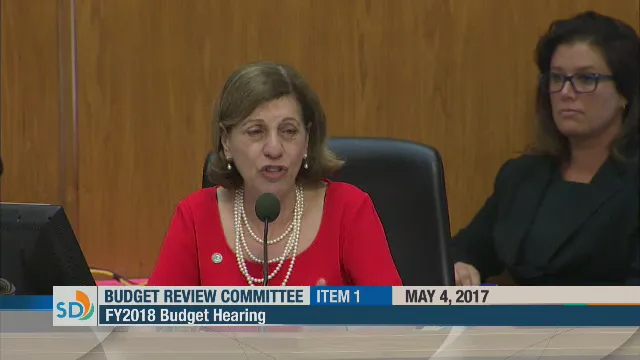
The San Diego City Council’s Budget Review Committee held its second day of hearings on the FY2018 proposed budget on May 4, 2017, chaired by Councilmember Barbara Bree. The session focused on the Infrastructure and Public Works branch, including an overview, the FY2017 State of the Capital Improvement Program (CIP) mid-year update, and the FY2018 proposed CIP budget. Council members discussed staffing, project prioritization, funding sources, and specific district projects. One public speaker addressed the committee.
Public Comments & Testimony
- Martha Welch (first speaker, on non-agenda budget items): Expressed frustration with the budget process, alleging that the city created homelessness by removing tents and storage. Criticized police and fire payroll allocations, questioned separate budget lines for a new police chief, and argued that council votes for minimum wage and library funding (6% of general fund) are not being implemented despite available money.
- Martha Welch (second speaker, on CIP awards): Disputed the merit of project awards (e.g., Torrey Pines golf course without bathrooms, Mission Bay with broken showers). Argued that funds should go to parks and public needs rather than golf courses, and questioned the proliferation of special funds.
Discussion Items
-
Infrastructure/Public Works Branch Overview (Paz Gomez)
- The branch (Environmental Services, Public Utilities, Public Works, Transportation/Stormwater, Infrastructure Asset Management) proposes 3,638 FTEs (increase of 86.5) and an additional $18.5 million over the previous year.
- Councilmember Alvarez requested a consolidated list of allocations (federal, CDBG, TransNet, DIF, FBA, General Fund) across CIP projects for easier tracking.
- Councilmember Ward asked about recruitment and retention challenges. James Nagelvoort noted difficulty in hiring experienced engineers and HVAC technicians due to competition with the private sector; the city is successful recruiting entry-level engineers from universities but struggles with mid-career hires.
- Councilmember Gomez inquired about Phase 1 of the IM San Diego project (infrastructure asset management). Paz Gomez confirmed go-live is second quarter of FY18; current phase involves integrated testing to enable real-time maintenance analysis and asset planning.
-
FY2017 State of the CIP Six-Month Update (James Nagelvoort & Marnell Gibson)
- Covered the performance period July–December 2016. Total project budget (including carryover) was $1.4 billion. Water main awards averaged 35 miles/year; at mid-year only 1.3 miles awarded (within target due to prior year over-delivery). Sewer pipeline goal 45 miles/year; 13.1 miles achieved mid-year, on track.
- Mayor’s street resurfacing pledge: 1,000 miles in 5 years (200/year). At end of FY16, 325 miles completed; mid-FY17 reached 64 miles; target 270 miles for FY17, impacted by a lawsuit and contractor challenges.
- TransNet: $4 million CIP expenditures at mid-year, $21 million as of presentation; $17 million encumbered. Deferred capital bonds: Bonds 1, 2, and 2A fully spent; Bond 3 had $37 million expended by December 31, $36+ million current.
- Benchmarking: City 5% above statewide average for soft cost ratios (soft cost/construction value). Goal to improve through streamlining.
- Outreach: 350+ attendees in first half for small/local business events; small/emerging local business participation increased 10% to 34% of CIP dollars (prime and subcontract).
- Councilmember Ward questioned why data was four months old; staff explained it is a mid-year cut for consistency, and a full-year report comes in November. Councilmember Alvarez requested project status columns in the deferred capital bond list; staff agreed to add.
- Councilmember Zaff praised the CIP as a bright spot given general fund constraints, noting the Naval Training Station building conversion to a rec center.
- Chair Bree acknowledged training and praised the La Jolla Shores Avenida de la Playa project completion before Memorial Day. She asked about Bond 3 exhaustion timeline: staff expects funds fully encumbered by fall 2017, with a new project list coming to council this summer.
-
FY2018 Proposed CIP Budget (James Nagelvoort, Michael Clark, Marnell Gibson)
- Proposed budget: $445.4 million for 6 new and 81 continuing projects (total $8.2 billion multi-year program). An additional $316.5 million anticipated requiring future council action (including commercial paper, grants, FBAs).
- Largest asset category: Buildings (including water/wastewater facilities), followed by water distribution, pure water program, and wastewater. Funding sources detailed: Infrastructure Fund (new, $18M total; $2.7M to CIP for parkade elevator modernization and CNG fueling station); TransNet ($19.2M); enterprise funds ($376.2M for water/sewer, pure water, AMI); park funds (Mission Bay, Regional Park, Environmental Growth, etc.).
- Introduced new “P” (Preliminary Engineering) project type for projects in early phases to improve transparency and capitalization tracking.
- Planned construction contracts for FY18: 150 projects, estimated value over $514 million (largest to date).
- Award highlights: 23 American Public Works Association awards (15 honor, 8 project of the year), including projects like Mission Beach Boardwalk Bulkhead, Torrey Pines North Course renovation, and adaptive traffic control systems.
- Council President Cole inquired about specific district projects: Bay Terraces (design funded, construction summer 2018 via CDBG); 94/Euclid interchange ($2M TransNet, design complete, construction this fall); Streamview Drive (phase 2 design funded $150k, seeking grants); Skyline Hills ADA improvements and Hog Pocket Park (staff to follow up).
- Councilmember Alvarez asked about FBA (Facility Benefit Assessment) allocations – none in proposed budget but anticipated; specifically requested prioritization for Otay Mesa and Southeastern mini-parks (Gamma Street construction summer 2018; Island Avenue design complete Jan 2018, construction Sept 2018). He also asked for clearer tracking of bundled park projects.
- Councilmember Gomez expressed disappointment that District 9 projects requested in memos were not included in the CIP budget; staff agreed to work on inclusion. He asked about TransNet reserves: $27 million in continuing appropriations, with $32 million estimated annual revenue (received incrementally). He questioned how CIP projects align with the Climate Action Plan; staff noted new projects require compliance checklists through planning department.
- Councilmember Kersey asked if FY18 is the largest capital budget ever – staff confirmed it is until next year. He noted potential additional street funding from SB1 (state gas tax) and asked about flexibility to reallocate; Chris McFadden stated adjustments will be considered in the May revise.
- Councilmember Kate asked about Proposition H (Charter 77.1) baseline: $18 million, used for slurry seal, CNG station, and parkade elevators. She questioned whether it is one-time or ongoing; city attorney staff agreed to clarify. She also asked about AMI pilot results – Leanne Joan Santos reported success with larger customers and increased monitoring, with full rollout in 24-30 months.
- Councilmember Ward raised concerns about Proposition H effectively shifting funds from other priorities (e.g., arts, recruitment) to one-time street repairs, suggesting the mayor consider suspending Prop H for one year (requires 2/3 council approval). She also requested details on TransNet allocations for bike/sidewalk and sidewalk inventory (memo due that day).
- Chair Bree asked about using the Park Improvement Fund for the Mark Park Master Plan – staff clarified it is ineligible because it is an operating expense, not a capital project.
Key Outcomes
- No formal votes were taken during this hearing; it was a review session with questions and staff responses.
- Staff agreed to: provide consolidated funding source lists (Councilmember Alvarez); expand deferred capital bond spreadsheet with project status (Councilmember Alvarez); provide detailed project lists for bundled items (e.g., Southeastern parks, TransNet projects, TSMP signals) (Councilmembers Alvarez, Ward, Kate).
- The Infrastructure Fund (Prop H) discussion left open: Councilmember Ward requested the mayor consider suspension; city attorney to clarify whether funds are one-time or can be used for other priorities. This may be revisited in the May revise.
- The IBA noted that the proposed CIP is 6% higher than FY17 adopted, and 84% from sewer/water funds. They highlighted pending SB1 gas tax revenues could free up commercial paper for other projects.
- The meeting was adjourned at approximately 12:00 PM (midday) and reconvened at 2:00 PM for departmental reviews (not included in this transcript).
Meeting Transcript
Um good morning, everyone. Uh welcome to the second day of the budget review for the hearings of the San Diego City Council. A quorum is now present, consisting of Council President Cole and Council members Ward, Kate Alvarez, and myself, uh Barbara Breed. Uh we will now take up uh non-agenda public comment. Clerk uh please proceed. Yes, thank you. And non-agenda public comment is an opportunity for members of the public to speak on items that are not on the agenda but are within the subject matter jurisdiction of the budget review committee. The time is limited to two minutes per speaker. We have one this morning. Martha Welch, please come forward. Good morning, Martha World. I think people are frustrated with the budget so far. Always see his payroll with police and the fire. Everybody wants us talk about what's going on in those apartment. We don't have that. I the police right now, I saw them housing their own homewards all the time. I see it. And also in the meeting, we have we somebody was in the companion about the police. They say they go up there and talk and all of that, and it's one year of training, not academy. And you created the homeless, if you ask me, because you took away the the tents, the storage place is gone, you know. It's a hotel now. You don't have that. And uh also you purge them, and um, you don't have uh tent, and you two years we have the um we have in the tent. So the homeless is your your problem, and you don't have you don't have resources or storage or tents or or transiting how how and uh and all the fire. We went off the trucks. We don't have anything about that. Is it another department or something like that? The chief, we talked about the chief, we want to have money for a new chief for the police, but it's another place on the budget. It's not all together. It's like you know, um, most places where you have a budget for something, you get all the money at your department, and you think about what you're gonna do, not here. It's like payroll. Now we also saw payroll. Um are going back to central centrally again. We on budget for somebody told that was going. So how can you talk payroll if it's going back central again? So um this is what you're doing. You're not talking about the department. Just like we voted for the um minimum wage, and now we we we we talked about we want people to make sure it works and everything, and you're not money, it's not uh not money for that also. What does it do any good if we vote for something and we don't get it? We vote for things and we don't get it. Just like the library, we voted for six percent of the general fund. And I haven't seen the budget yet, but um, that's we uh past years we didn't do that stuff, and if we have money, we should do that. And I and I can see money in this budget, and you're not doing that. Thank you. That concludes the non-agenda non-agenda budget review committee comment. Is there any committee comment this morning? Great. Any uh comment from the city attorney, the or the IBA. Mayor staff, nope, seeing none. Uh clerk, please proceed with the next item.
openpublica.com