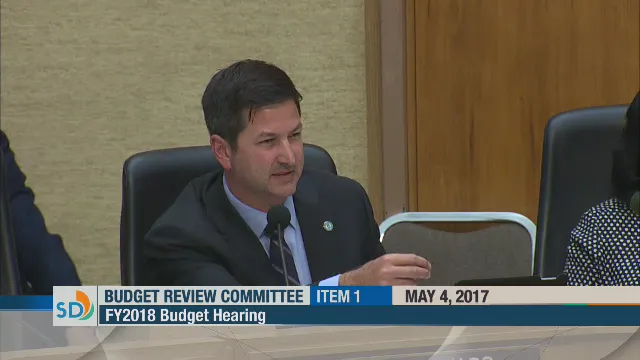
Budget Review Committee Meeting - May 4, 2017
STREAMING COPY IN PREPARATION — RECORDING AVAILABLE FROM THE ORIGINAL SOURCE
Budget Review Committee Meeting - May 4, 2017
The Budget Review Committee, with Council President Cole, President Pro Tem Kersey, and Council Members Ward, Alvarez, Gomez, and Chair Bree, met to review proposed budgets for Public Works, Public Utilities, Transportation & Stormwater, and Environmental Services for Fiscal Year 2018. The meeting featured departmental presentations, public testimony, and committee discussion on key issues including staffing cuts, capital project investments, urban forestry, stormwater compliance, and community requests.
Public Works General Services Facilities and Publishing
- Presentation: Director James Nickelford presented the proposed FY18 budget for Public Works, covering three branches: General Services (facilities maintenance, publishing), Engineering & Capital Projects (ENCP), and Public Works Contracts. Key points included a $3.7 million increase for facilities, elimination of five vacant positions (three custodial, one roofer, one plasterer) to meet general fund cuts, and a request for 71.1 new FTEs in ENCP to support the growing Capital Improvement Program (CIP), which is expected to total $3 billion over five years. Performance indicators showed 72.8% of projects on schedule (below 80% target) and a change order rate KPI of ≤4% for FY18.
- Public Testimony: Martha Welch opposed the lack of bathrooms at Horton Plaza Park and expressed concerns about pure water, solid waste, and maintenance. Don Taylor (Chair, Kensington-Talmage Planning Group) spoke in favor of implementing the El Cajon Boulevard study.
- Committee Discussion: Councilmembers questioned the rationale for cuts, hiring challenges (especially HVAC technicians), and the impact of reducing custodial staff during the transition to 101 Ash Street. Councilmember Alvarez noted vacancies in facilities and asked about recruiting. Councilmember Ward discussed soft costs and streamlining. Councilmember Zapf requested funding for preliminary engineering for the Ocean Beach Lifeguard Station ($175,000–$200,000). The IBA emphasized the need to fill existing vacancies and monitor facility condition backlog ($829 million needed).
Public Utilities Department
- Presentation: Director Hollerassick and Deputy Director Seth Gates presented the water and wastewater funds. Key items: $2.8 million for condition assessments, $1.5 million for laboratory supplies, $3.7 million for water purchases (total $253.8 million), and nine new FTEs for the Pure Water program. The wastewater fund reduced $8.6 million via 3.5% cuts, including $3 million from Metro Sewer Agency contracts. The water fund cut $7.2 million, including $3.5 million from Sweetwater desalination project funding.
- Public Testimony: Tiffany Mitchell (Vice Chair, Independent Rates Oversight Committee) expressed unanimous support for the budget.
- Committee Discussion: Councilmembers emphasized the importance of Pure Water and climate action plan (CAP) alignment. Councilmember Ward requested updates on the Point Loma permit modification for secondary equivalency and water/wastewater infrastructure needs in Balboa Park. Councilmember Kate questioned consumption trends (within 1% of estimates) and the San Vicente Pump Storage project (to be developed via a third-party). Councilmember Gomez asked about water rate review (starting July 2017) and CAP performance measures. Councilmember Alvarez inquired about costs for school water testing (absorbed within department).
Transportation and Stormwater Department
- Presentation: Director Chris McFadden presented the FY18 budget of $121 million, a 8% reduction from FY17. Key reductions: tree trimming frequency changed from once every 7 years to once every 15 years (saving $882,000), weed abatement on paper streets ($400,000), stormwater education and outreach (35% cut), and as-needed contracts for TMDL studies and monitoring. The department added no new general fund FTEs but requested six positions for utility undergrounding. Street repairs remain ahead of 200-mile/year goal, with 458 miles completed in 21 months. Sidewalk repair backlog is $52 million.
- Public Testimony: Multiple speakers expressed opposition to tree trimming cuts (Bill Tippetts, Sophie Wolfram, Troy Murfrey, Ann Faye) citing impacts on urban forest, stormwater, and climate action. David Modi (Talmadge) requested a stormwater study for Aldine Drive. Tom Coate (Pacific Beach) and Michelle Grinowitz (Crown Point) asked for roundabouts at Foothill/Loring and Crown Point shores to improve safety. Don Taylor requested funding for lighting replacements in Kensington.
- Committee Discussion: Councilmembers supported maintaining tree trimming and planting. Council President Pro Tem Kersey inquired about asphalt quality and the possibility of the city purchasing materials directly (pilot project planned for FY18). He also discussed sidewalk backlog and eligibility for commercial paper funding. Councilmember Ward emphasized the need for sidewalks and asked about performance metrics for street repairs. Councilmember Kate questioned the reduction in FY17 street miles (due to contractor issues) and asked about traffic signal optimization. Councilmember Gomez supported Aldine Drive project and lighting in Kensington. Councilmember Alvarez requested a better understanding of tree trimming impacts, stormwater channel maintenance, and a plan for sidewalk repairs. Chair Bree supported IBA's recommendation for a five-year CAP implementation plan.
Environmental Services Department
- Presentation: Director Mario Sierra presented the FY18 budget of $106 million, including $39.7 million in general fund. Reductions: continue $2/ton tipping discount ($600,000) and eliminate general fund subsidy for illegal dumping abatement ($800,000). Requests: $1.3 million for converting diesel packers to CNG, two recycling specialists ($368,000) for public space recycling, two code compliance officers ($251,000) for enforcement, and $1.5 million for roof and mechanical replacements at Ridgeline facility. The department supports CAP with ~$14 million in programs.
- Public Testimony: Gary Wannicott, John Vallis, Will Shussel, and Andy Chatner (all Mission Beach residents and stakeholders) requested $80,000 for a second weekly summer trash pickup to prevent fly infestations, citing health concerns and tourism impacts. They noted the community could not agree on a Maintenance Assessment District (MAD) and asked for general fund support.
- Committee Discussion: Councilmember Zapf (read by Chair Bree) stated she included the second pickup in her budget priorities and asked the community to consider expanding the existing MAD for long-term funding. Councilmember Alvarez noted potential funding from TOT or health sources. Councilmember Gomez asked about grant opportunities for CNG trucks (California Energy Commission – 210-day timeline is too short; department working on a waiver). He also inquired about corporate partnerships for vehicle advertising and potential revenue from recycling events (not currently lucrative). Councilmember Kate asked about the battery drop-off pilot program at libraries (deferred due to cost).
Key Outcomes
- The committee heard presentations and public testimony on all four department budgets. No formal votes were taken; the committee will use the input to inform budget recommendations.
- The May Revise is expected to include additional funding for tree planting ($100,000), adjustments for Horton Plaza Park security transfer to Parks & Rec, and updates on SB1 gas tax funds.
- Councilmembers directed staff to report back on: Point Loma permit modification progress, a five-year CAP implementation plan, sidewalk repair prioritization, and the feasibility of a stormwater study for Aldine Drive.
- Councilmember Zapf committed to seeking $80,000 for Mission Beach second trash pickup and encouraged the community to pursue a MAD.
- The IBA highlighted the importance of monitoring facility maintenance backlog, stormwater permit compliance (3.1 billion needed through 2035), and the need for a CAP implementation plan.
Meeting Transcript
Good afternoon, everyone. I'd like to uh welcome you to the uh budget review committee meeting. Uh we have a quorum uh consisting of uh Council President Cole, Council President Pro Tem Kersey, and Council Members Ward, Alvarez, Gomez, and myself. Um Clerk, uh please introduce the next item. Our next presentation is Public Works General Services Facilities and Publishing. And it's uh being presented by James Nickelford. Good afternoon. This will take about 20 minutes. Uh good afternoon, everybody, Councilman Member Bree and fellow council members, it's an honor being here. Uh as it's already stated, we're here to present our proposed operating budget for fiscal year 2008. I'm again James Nugelvort, the director of public works, and sitting to my uh left is Marnell Gibson. She's the assistant director, and also your city engineer. Let's start first with a presentation. You wanted me to be okay. Okay. So we'll start first with a little bit about what the department is and how we're organized. Uh we are a there's one correction, we are an organization made up of three branches. We're actually made up of of seven different divisions in that. So the first branch is general services. It's made up of the facilities maintenance division that is responsible for maintaining all the city's facilities citywide, about sixteen hundred buildings. Also in that group is uh the publishing services are sometimes uh referred to as the print shop, and they're responsible for for managing all of the city's printing needs and the and the citywide copy or contract. Uh the largest part of our organization is the Injuring Capital Projects branch, which is responsible for managing the city's capital permit program, providing engineering services, design services, construction management services. But also in that branch, our construction management field services division is responsible for managing all subdivisions and permits of private development that occurs within the right-of-way, and any new facilities, any facilities being built by a developer that's going to be turned over to the city. And then lastly, in our group, um, we have a uh unit uh our division called Public Works Contracts. This is the group that's responsible for putting out all of the construction contracts citywide and also all the consultant contracts associated with uh AE services, engineering, and architectural services. Our mission statement is to deliver high quality public infrastructure systems by cultivating expertise and leveraging our engineering responsibilities in a collaborative environment. Our vision to be the innovative industry leader in developing public infrastructure systems. Start with a couple of accomplishments. CFP expenditures uh by the end of this fiscal year are on track to get to about a half a billion dollars. These are expenditures of paying contractors, consultants, vendors, and also city staff, and all of the investment to deliver all the capital improvement projects we have citywide. And then lastly, um, out of our facilities maintenance division with the support of Injurant Capital Projects, we completed assessment of six hundred and ninety-nine general fund buildings uh citywide. Uh those are anything from the size of this building, the city administration building, all the way down to comfort stations in that citywide. Looking forward, you may recall in this CIP outlook, we're identified and we're we expect to be driven to have funding to do three billion dollars worth of capital improvement program work over the next five years. Mathematically, that works out needing us to have expenditures kicked up to 600 over 600 million dollars a year. So we're still in the mode where we've got to increase and continually increase our capacity. We are very supportive and been very much involved in the IEM project. That's the infrastructure asset management project that we're looking forward to that coming online in September. It'll support our facilities maintenance division, but also there's an aspect to it that's called AMP asset management planning. That's part of the tool that allows our engineering staff to be able to use some software applications to analyze citywide needs, infrastructure needs to then build your future capital improvement programs. And then lastly, um, with you'll you'll notice a number of staff we've been bringing on board in organization and a number that we're asking to still be able to bring on board. We're an organization of well over 200 staff that are fairly new to the city that we're having to work with to develop their skills, teach them uh project management skills, construction management skills, and to really really get them to be really solid, solid engineers. Some of the key performance uh indicators, KPIs. Uh first one up is for facilities. Uh we have a we have a desire uh to try to get ourselves out of the reactionary business that we've been in for so many years. So much of facilities work because we have so many buildings that are in need of a repair uh that so much of their work is about responding to the elevator that's down or the plumbing that's gone out, or during this rainy season, the roofs that are leaking. So one of our performance indicators is about trying to drive us to get more of our resources directed towards preventive maintenance to see if we can get ahead of the curve. Our target for fifth uh for fiscal year 2017 was 30% of all the work tickets. We wanted that to be for preventive maintenance. We're not quite there. We're only at 16% of those work tickets.
openpublica.com