Budget Review Committee Afternoon Session - May 9, 2017
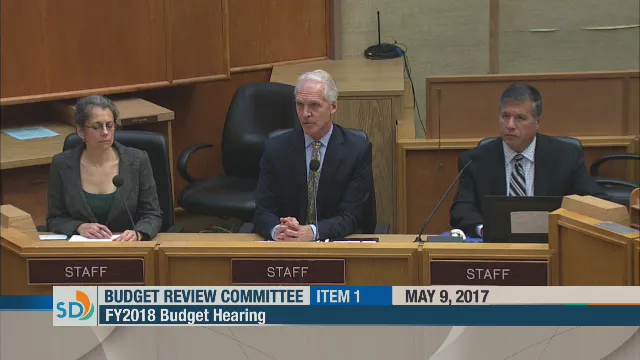
STREAMING COPY IN PREPARATION — RECORDING AVAILABLE FROM THE ORIGINAL SOURCE
Budget Review Committee Afternoon Session - May 9, 2017
This afternoon session of the Budget Review Committee featured presentations from the San Diego Housing Commission, the San Diego Employees Retirement System (SD SERS), the San Diego Convention Center Corporation, and the Ethics Commission. The committee heard public testimony and discussed budgets, homelessness programs, investment returns, facility maintenance, and regulatory oversight. The meeting was chaired by Councilmember Barbara Breed with a quorum present.
Consent Calendar
- No consent calendar items were identified.
Public Comments & Testimony
- Martha Welch (speaker in opposition) criticized the Housing Commission budget, alleging "50 million for salaries" and stating that the Section 8 program is not functioning properly because landlords are not paid by the county and that the AMI calculation is preventing affordable housing.
- Ann Murphy (Cortez Hill Residents Group) opposed using the old Central Library as a homeless facility, urging alternative locations outside downtown, such as Golden Hill.
- Todd Hutchins (speaker in opposition) argued the Housing Commission's plan has not worked, stating homelessness is skyrocketing and affordable housing declining. He claimed rehabbing units displaces low-income people and that proposed 500 new permanent supportive units are insufficient compared to 8,000 homeless.
- Bob Link (East Village resident) spoke in favor, congratulating the Housing Commission on an aggressive budget to address homelessness, but requested accountability for placement numbers and suggested using the Midway Post Office site for immediate impact.
- Sarah Watkins (East Village resident) noted an oversized concentration of homelessness in downtown, reducing the tax base and hindering redevelopment.
- Joan Wolchik (President, East Village Residence Group) supported the budget but opposed using the old library, recommending Golden Hall for 18 months while developing long-term solutions like Sunbreak Ranch and the Campo juvenile facility.
- Daniel Reeves (Downtown San Diego Partnership) supported the Housing Commission budget but urged using funds for long-term solutions rather than a temporary shelter at the old library.
- Claudine Scott (East Village resident) encouraged not using the old library, suggested selling it for $12 million to fund permanent housing, and favored Golden Hall.
- Jason Wood (East Village resident, business owner) expressed concern over concentration of homeless facilities downtown and urged moving more resources outside downtown.
- David Gapp (retired Lieutenant Colonel) supported the budget but asked the council to mitigate the impact of homelessness in East Village and not put more services in the old library.
- Michael Trimble (Gaslamp Quarter Association) favored approving the budget but requested resources be directed away from the old library, suggesting 20th and B or Golden Hall.
- John Clut (business owner, Cafe Chloe) described physical attacks on himself and guests, stating the coexistence of homeless services and businesses in East Village is untenable for both.
Discussion Items
San Diego Housing Commission (FY 2018 Proposed Budget)
- Presenter: Jeff Davis (Chief of Staff) and Tracy McDermott (CFO). The budget request is $433 million, up from $368 million in FY 2017 (an increase of $65 million, 17.7%). The increase is attributed to $21.3 million in federal funds for affordable housing acquisition/rehabilitation, $32.7 million in fund balance from prior years, and new programming.
- Key Elements: Hiring 26 additional staff; $28 million for the third phase of "Housing for San Diego" (three-year proposal) including prevention/diversion for 1,000 families, rapid rehousing for 600 families, expansion of landlord engagement, and acquisition/construction of up to 500 new permanent supportive units.
- Financial Management Technical Review: Presented by Adrian Del Rio. Noted the budget includes 5% reduction in actual disbursements from HUD for housing assistance programs. Reserves of $84.3 million (increase of $5.4 million).
- IBA Comments: Presented by Trisha Tackey. Highlighted $70 million for homeless program expenditures (increase of $55% over FY17). Noted relocation of Neil Good Day Center no longer likely; renovation plan being developed by city and Housing Commission. Noted federal funding reliance (81% from federal sources) and potential impact of proposed elimination of CDBG and HOME programs.
- Council Questions:
- Councilmember Ward inquired about the impact of the new funding for housing first and additional $29 million from linkage fees; noted the old library site is not funded in this budget.
- Councilmember Gomez asked about the new prevention/diversion program, best practices, and eligibility for Section 8 waitlist (75,000 families). She also asked about raising payment standards and the status of the 2016 performance audit response (due June 30, 2017).
- Councilmember Zaff noted the tripling of homeless expenditures from $21M to $70M and asked about staff roles; housing navigators were described as "real estate agents for the homeless."
- Council President Cole commended increased homeless efforts.
- Councilmember Sherman asked about using reserve funds before losing them; noted in-lieu fee balance may decline as more projects choose on-site affordable housing. Asked about construction cost comparison report (to be followed up offline).
- Chair Breed asked about inclusionary housing opinions; Gentry noted agnostic position, but on-site gives better economic integration.
San Diego Employees Retirement System (SD SERS) – FY 2018 Budget
- Presenter: Mark Hovey (CEO) and Ted Lesalvia (CFO). Total budget is $48 million ($13.3 million administrative, $34.7 million investment management). Administrative budget decreased 2.1% ($289,000) due to reduced headcount (54 to 50) and lower legal fees. Investment management expenses increased 4% ($1.3 million) due to higher asset levels and new private equity/real estate investments. Asset assumption: 7% growth, average $7.3 billion.
- Highlights: 20-year investment return 7.9% net (top 5% of public pensions); 8.3% return for year ending Dec 31, 2016 (top 15%); preliminary nine-month return 8.6%. Board priorities: member service, data accuracy, investment excellence, governance.
- Financial Management Technical Review: Presented by Matt Vespy. Administrative expenses: $13.3M (down $300K). Investment expenses: $34.7M (up $1.3M). 93 cents of every administrative dollar funded by City.
- IBA Comments: Referenced report; no additional comments. Noted budget approved by Board of Administration, does not require council approval.
- Council Questions:
- Councilmember Kate asked about actuarial cost overages (experience study); Hovey confirmed non-retainer work drove higher costs. Asked about investment performance by category; Hovey agreed to provide memo.
- Councilmember Gomez asked about storage area network expense (necessary, deferred from FY17).
- Councilmember Sherman asked about the actual return for year ended June 30, 2016 (1.1%) and congratulated improvement.
- Councilmember Kersey asked if higher fee investments (real estate, private equity) justify returns; Hovey said they do (real estate earned over 9% net).
- Councilmember Alvarez asked about projections for ADC payment; no projections provided.
San Diego Convention Center Corporation – FY 2018 Budget
- Presenter: Gil Cabrera (Vice Chair) and Mark Emsch (CFO). Budget: $38.5 million in expenses (increase of $2.8 million). Revenue increase of $600,000. New revenue category: co-promoted events/sponsorships ($500,000). Personnel increase of 6.15 FTE (2 full-time, rest part-time). Non-personnel increase due to chair replacement and depreciation.
- Reserves: Targeted minimum 8%, goal 14%; projected to drop to ~5% due to capital investments. 10-year capital and OM needs: $81 million total, including $61.5 million in capital (with $13.9 million from IBank loan). The city provides $3.4 million annual support payment (same as last year). Total annual city payments in support: $16.8 million (including debt service and dewatering).
- Performance: FY17 projection: record 707,354 attendees, 845,582 room nights, $681 million direct spending, $25.6 million in hotel/sales tax. 75% occupancy. 150 events, 66 conventions. $1.15 billion regional economic impact.
- IBA Comments: Presented by Jeff Kawar. Noted the IBank loan of $25.5 million at 3.6% for 25 years. Capital projects must be completed by January 2019. Annual debt service of $1.7M begins FY2020. Also noted a proposed TOT increase could cover expansion and capital costs of existing facility if approved by voters.
- Council Questions:
- Councilmember Sherman commended the level of detail; asked about the 2012 audit recommendations (not yet fully implemented). Noted dewatering costs decreased after requesting detailed backup. Capital infrastructure spending for FY18: $5.3 million (excluding IBank).
- Councilmember Ward asked about revenue above projections (TwitchCon was a data-intensive event); they are trying to bring them back in 2019. Occupancy at 75% is record, leaving little room for additional events.
- Councilmember Gomez asked about expansion bond payoff (2028), IBank project timeline (escalators until Jan 2019), and parking revenue (goes to port entirely). Naming rights: only interior sponsorships ($150,000), not whole building naming (requires port approval).
- Councilmember Kersey congratulated on IBank loan and noted the process was cumbersome but successful.
- Council President Cole expressed support for naming rights from port.
Ethics Commission – FY 2018 Budget
- Presenter: Stacy Fulhorst. Budget is bare bones, no significant adjustments. Focus on education/training: 15 live sessions, 450 advice requests, proposed updates to campaign laws. 100% response rate within 24 hours. Audit of 50-75% of committees from 2016 election cycle planned. Key performance indicators: 90% of investigations completed within 180 days; educational materials updated within 30 days of law changes.
- Financial Management: No report.
- IBA: No additional comments.
- Council Comments: Councilmember Alvarez thanked for prompt responses; Councilmember Kersey suggested renaming the commission; Chair Breed praised responsiveness as a former candidate.
Key Outcomes
- No votes were taken at this meeting; it was a review and discussion session.
- The committee heard presentations and public testimony; further deliberation will occur in subsequent sessions.
- The Housing Commission's budget will need formal council approval; SD SERS budget is approved by its board; Convention Center budget was approved by its board on March 22, 2017; Ethics Commission budget is part of city budget.
- Councilmembers expressed support for increased homelessness efforts, requested additional reports on Housing Commission performance audit (due June 30, 2017), and noted concerns about federal funding cuts and reserve levels for the Convention Center.
- The committee is scheduled to reconvene at 9:30 AM the next day (May 10, 2017) for a short meeting on communications.
Meeting Transcript
Um good afternoon, everyone. I'd like to welcome you to the afternoon session of the budget review committee. We now have a quorum consisting of Councilmember Zaff, Councilmember Kate, Council President Cole, Councilmember Sherman, and myself, uh Barbara Breed, the chair of the committee. Um, clerk, please um introduce the uh next item. Our next presentation is from the San Diego Housing Commission. We've got presenting CFO Tracy McDermott and Chief of Staff Jeff Davis, and I believe you need eight minutes. Is that correct? Please. Good morning, Chair Bree, Council President Cole, Council members. I'm Jeff Davis, Chief of Staff at the San Diego Housing Commission. With me is Tracy McDermott, our chief financial officer. Today I'll be providing a brief overview of some of the major highlights of our budget, and then Tracy's going to walk you through the details. So we are very pleased to present to you the proposed FY 2018 budget. This is an ambitious budget. It reflects actions that will expand many of our major programs and add new programming that will positively impact the lives of thousands of low-income families and homeless persons in San Diego. Last year you approved our FY 2017 budget in the amount of 368 million dollars. This year we will be requesting your approval of a 433 million dollar budget. We want to assure you that this budget we are presenting to you today is a conservative budget. It incorporates figures from the fiscal year 2017 federal budget approved by the House of Representatives last Wednesday and the Senate the following day. And it also reflects the latest fiscal year 2018 federal budget proposals in circulation. At this time, it does appear that we may experience a minimal reduction in our moving to work funds, which does account for our largest source of revenue. However, due to years of careful fiscal management, along with some innovative moving to work programs, the Housing Commission has carefully been able to accrue the funds necessary to be utilized in the coming years to support these expanded activities that you're going to hear about today. Doing more does require additional staff, so we are requesting to hire 26 additional staff at the agency to support the increased activity. Some of these are temporary positions, some of these are permanent. Tracy will now walk you through the details of our budget. Thank you, Jeff. In interest of time, I would like us to skip over objectives and deliverables and begin on page 17 with sources of funds. This slide summarizes total funding sources of 2018 compared to 2017, which increased by 65 million dollars, primarily for three reasons. First, utilizing MTW flexibility and for acquisition and rehabilitation of affordable housing. Second, additional affordable housing funds of 29 million dollars that will be deployed to achieve our planned objectives. And last, the strategy to set aside real estate reserves to fund future rehabilitation efforts. This schedule compares total funding sources available in 2018 versus 2017. Here's a pie graph of our new revenue for 2018. The blue area represents federal revenue, about 81% of our projected new revenue. Now let's discuss our uses of funds. This is a summary of total uses of 2018 over 2017, which increased by 60 million dollars, primarily due to targeted efforts to acquire and provide financing for the development of affordable units, significant homelessness efforts, and the rehabilitation of the San Diego Housing Commission owned assets. This is a year over year comparison of funding uses by major category. This chart depicts total funding uses, not including reserves by major division. The rental assistance division, the blue area on the pie chart, is almost half of the funding uses for 2018. And now we'll turn this back to over to Jeff. The slide before you is a summary of the staffing year over year, shows the changes in staffing we're requesting per division. In total, again, we are requesting 26 positions being added to the budget. Eleven of these positions are needed to support the efforts proposed in the budget to provide permanent housing over the next three years to 3,000 San Diegans who are either homeless or at risk of homelessness, as well as to continue the agency's substantial existing efforts in the area of homelessness. Seven of these positions will go to our real estate division, and it will support the increased activities proposed in this budget to systematically address the capital needs of our aging portfolio, as well as the planned construction and acquisition of new affordable units and the provision of property management to the increasing number of families we serve. Four of these positions will go to our rental assistance division to support the continued growth both through the addition of veteran vouchers as well as the creation of homeless and other special population voucher programs and the provision of workforce readiness training and support for these clients. And lastly, four of these positions will support the increased capacity needed in our financial services, information technology, and human resources departments. Slide 25 illustrates for you the significant and growing investment by the housing commission towards the growing issue of homelessness in our city. Approval of this budget will make possible the launch of the third phase of housing for San Diego. This phase is a three-year proposal, and this slide outlines our year one expected expenditures by our major components in 2018, totaling over 28 million dollars. The primary components of this new phase of housing for San Diego includes funding for a new homeless prevention and diversion program that will keep over 1,000 families from entering homelessness, a new rapid rehousing program to be operated by the Housing Commission that will assist assist at least 600 families in obtaining permanent housing, an expansion of the landlord engagement efforts that have shown success in opening up high demand vacancies for homeless San Diegans, and funding for the new construction and or acquisition of up to 500 new permanent supportive units for San Diegans.
openpublica.com