San Diego City Council Budget Review Committee Hearing: FY18 Year-End Report and FY19 May Revision - May 17, 2018
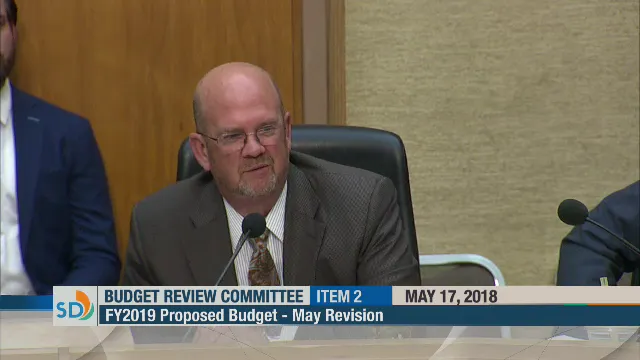
STREAMING COPY IN PREPARATION — RECORDING AVAILABLE FROM THE ORIGINAL SOURCE
San Diego City Council Budget Review Committee Hearing: FY18 Year-End Report and FY19 May Revision - May 17, 2018
The San Diego City Council Budget Review Committee met on May 17, 2018, to review the Fiscal Year (FY) 2018 Year-End Budget Monitoring Report and the Mayor's May Revision to the FY2019 Proposed Budget. The meeting featured presentations from Financial Management staff, comments from the Independent Budget Analyst (IBA), and extensive council member questioning and priority-setting. Key topics included fire-rescue overtime overages, budget surplus and excess equity, one-time vs. ongoing funding, and council member requests for services like tree trimming and code compliance. No public testimony was given.
Consent Calendar
No consent calendar was present at this meeting.
Public Comments & Testimony
No speakers signed up for non-agenda public comment, and no public testimony was given during the hearing.
Discussion Items
Fiscal Year 2018 Year-End Budget Monitoring Report
Financial Management Director Tracy McCraner and staff (Jose Mendoza, Matt Vespie) presented the FY18 year-end report based on nine months of actuals and projections for the remaining three months.
- Revenue and Expenditure Variances:
- General fund revenues projected to exceed budget by $13.4 million (1%), driven by a $4.2 million increase in franchise fees (notably from San Diego Gas & Electric and refuse haulers), a $2.5 million increase in miscellaneous revenue from special revenue fund closures, and a $5.5 million increase in departmental revenue (primarily fire-rescue reimbursements for lifeguard services, strike team deployments, and FEMA reimbursements).
- General fund expenditures projected to exceed budget by $8.5 million, largely due to a $7.6 million increase in salary and wages (mainly fire-rescue overtime) and a $3.5 million increase in fringe benefits (supplemental pension savings plans, Medicare, and OPEB). A $2.7 million increase in contracts supported fire-rescue air operations, bridge shelters, safe parking, hepatitis A response, sanitation efforts, and executive complex relocation.
- Unbudgeted Expenditures:
- Hepatitis A response and sanitation: $3.8 million unbudgeted (including $1.1 million for ongoing sanitation).
- Bridge shelters: $3 million unbudgeted.
- Safe parking program: $310,000 unbudgeted.
- Executive complex relocation: $1.24 million net unbudgeted (contractual services, asbestos inspection/abatement, and leases) offset by $730,000 decrease in rent.
- Fire-rescue air operations: $1.3 million for two Type 2 air tankers, $780,000 for a Cal Fire call-when-needed helicopter, $120,000 for a manned intelligence/reconnaissance aircraft, and $450,000 for a mountain aviation platform.
- Fund Balance and Reserves:
- FY17 ending fund balance: $218.2 million; projected FY18 ending fund balance: $214.2 million.
- After reserve contributions (including pre-funding FY19 general fund reserve), projected excess equity at FY18 end: $22.7 million.
- The proposed FY19 budget used $12.3 million of excess equity; the May Revision adds $8.6 million, leaving $1.8 million unprogrammed.
- Risk management reserves: Long-term disability projected at $15.7 million against $5.5 million target (over target identified for negotiations and offsetting operating expenses). Public liability projected at $34.7 million against $32.6 million target (meeting policy goal early). Workers' compensation projected at $41 million against $30 million target (used to offset pay-go expenses).
- Requested appropriation adjustments: $7.3 million increase in general fund revenue/expenditures (for fire costs, bridge shelters, hepatitis A, sanitation, park water, etc.), plus typical year-end budgetary control authorities.
- Staff Answers and Council Questions:
- Councilmember Alvarez asked about vacancies: Public Utilities had filled 7 of 10 new positions; Public Works still had 97 vacancies (including prior year positions). He also asked about micro-bid funding; staff noted micro-bids were no longer funded due to SPEP reductions, but CDBG micro-lending is ongoing.
- Councilmember Sherman asked about stormwater equipment rental increase ($2.6 million), noting it had declined from mid-year ($1.9 million) due to fleet adjustments. He also questioned fire overtime patterns and requested historical data.
- Councilmember Kate asked about park water cost increases ($2.7 million year-end; 1.6 mid-year) and confirmed that FY19 budget was adjusted to about $11 million. He also asked about SDG&E revenue increase being one-time; staff clarified it increases the base for FY19 projection.
May Revision to FY2019 Proposed Budget
Financial Management staff (Tracy McCraner, Matt Vespie, Adrian Del Rio) presented the May Revision.
- Citywide Overview:
- Proposes increasing expenditures by $26.3 million, including 148.8 FTEs. General fund increases by $9.7 million in revenues/expenses (including 10.88 FTEs). The May Revision maintains a structurally balanced budget with ongoing expenditures supported by ongoing revenue.
- General Fund Resources:
- $8.6 million of FY18 excess equity for one-time expenditures (on top of $12.3 million in proposed budget, totaling $20.9 million of $22.7 million).
- Increases: property tax (+$500,000), sales tax (+$200,000), transient occupancy tax (+$500,000); decreases: franchise fees (-$200,000); net increase of $100,000 in other miscellaneous and departmental revenue.
- Strategic Expenditures:
- $6.8 million for fire-rescue overtime (half considered one-time due to expectations of reduced leave balances from updated MOU provisions).
- $935,000 contribution to the Infrastructure Fund (based on increased major revenues; $200,000 programmed for Isabel Creek Road, $735,000 unallocated).
- Five new City Attorney positions to support Family Justice Center and Civil Litigation/Criminal Division.
- Restoration of $400,000 for community plan updates and internship/work-readiness program.
- One police captain to oversee recruitment/onboarding.
- Non-General Fund Adjustments:
- Added a position to support the Climate Action Plan in the Office of Sustainability (a new branch).
- Low and Moderate Income Housing Fund increased by $17.8 million (total $47 million) for expected projects including 13th & Broadway and San Ysidro Senior Village.
- Adjustments to risk management and IT funds.
- Council Questions:
- Councilmember Alvarez asked about the 1.6/1.8 million ongoing vs. one-time funding; FM confirmed 1.6 million could be considered ongoing. He also asked about TOT baseline calculations; staff stated the allocation to arts/culture is not recalculated with updated receipts. On the Low & Moderate Income Housing Fund, staff explained it is a city fund for future council decisions. On 101 Ash Street, no changes in May Revision; CIP report would address tenant improvements.
- Councilmember Sherman asked about fire overtime history and the need for new City Attorney positions given vacancies (29 vacancies). Staff promised a written response.
- Council President Cole expressed strong disappointment about lack of basic services in District 4 (sidewalks, streetlights, tree trimming, weed abatement) and requested one FTE for council administration and a senior management analyst for lifeguard services.
- Councilmember Gomez asked about county reimbursement for homelessness costs (no update), utility undergrounding delays (staff to provide impacted projects list), and that tree trimming restoration was not included in the May Revision (staff noted urgent situations like fire overtime overtook it). He also asked about operational efficiencies from the Office of Sustainability; staff said it aligns CAP implementation but adds capacity, not fiscal savings. He confirmed police recruitment extra funding is for the captain position, not the marketing contract.
- Councilmember Ward asked how the fire overtime spike was not anticipated earlier; staff explained mid-year report had a November cutoff and December fire season (Lilac, Santa Barbara) was extreme, and the new MOU provision's impact only became apparent later. They now track monthly. Ward also confirmed the reorganization was budget-neutral, asked about the HR position for opportunity youth mentoring (staff said it coordinates with youth services), and raised concerns about code compliance, tree trimming, and homelessness reduction.
- IBA Comments:
- IBA will issue final report June 4. Noted fire overtime was $12.9 million over budget in FY18, with $9.3 million funded from excess equity/public liability; $6.8 million added in FY19 May Revise (half considered one-time). Expressed concern about adequacy of the 3.4 million one-time portion and need to address MOU provisions. Pointed out that $1.6 million of one-time costs are funded with ongoing revenue, allowing it to be considered ongoing; also identified $734,000 in Infrastructure Fund and $2 million in Capital Outlay Fund from land sales. Noted Mayor did not restore reductions like tree trimming, graffiti abatement, park maintenance, making budget decisions harder. Encouraged focus on one-time expenditures to avoid structural deficit.
Key Outcomes
- FY18 Year-End Report: Projected $4.8 million budgetary surplus; $22.7 million excess equity of which $1.8 million remains unprogrammed. Recommended appropriation adjustments totaling $7.3 million in general fund, plus non-general fund authorities.
- FY19 May Revision: Approved for further discussion; includes $26.3 million expenditure increase (148.8 FTEs) citywide and $9.7 million general fund increase. Maintains structurally balanced budget.
- Council Direction: Council members will submit final budget modification priority memos to the IBA by Monday. Requests included positions for lifeguards, code compliance, council administration, and one-time funding for tree pruning, graffiti abatement, library security/programming, and racial impact reports. Some requests could be funded by reducing new engineering positions in Public Works, as vacancies remain.
- Next Steps: IBA final report on June 4; CIP year-end monitoring report to be released that night (May 17) and discussed in Infrastructure Committee; council to deliberate final budget in upcoming weeks.
Meeting Transcript
Good afternoon, everyone. Uh welcome uh back to the budget review committee hearings of the San Diego City Council. A quorum is now present, consisting of Councilmember Zaff, Council Member Ward, Council President Cole, Council Members Kircy, Kate, Sherman, Alvarez, Gomez, and myself. We will now proceed with non-agenda public comment. Clerk, please proceed. There are no speakers for non-agenda public comment. Is there any committee comment? No. Are there any comments from the city attorney, IBA, or mayoral staff? No. So the format for today before the clerk introduces the item is we're going to take items one and two together. Then we're going to have comment from the IBA, then public testimony, and then committee member comments and questions. Great. Clerk, please proceed. So item one will be the fiscal year 2018 year-end budget monitoring report, followed by item two, the May revision to the FY19 proposed budget. Please introduce yourselves. Thank you. Good afternoon, Chair Bree and members of the council. I'm Tracy McCraner, Financial Management Director. And to my left is Jose Mendoza. And to his left is Matt Vespee, both with financial management. So we're here today to talk about the 2018 year-end budget monitoring report. This report is based on nine months of actuals and then projected out for the remaining three months of the year. We'll discuss variances between general fund revenues as well as expenditures. Both of them are projected to exceed budget revenues by 1%, expenditures by just a little over half a percent. We are looking at a $4.8 million budgetary surplus for the end of 2018 and fund balance, which is balance above required reserve targets of 22.7. And the mayor has recommended using reserves in both the proposed budget and the May revision. So at a high level, uh revenues continue to trend up. They are expected to exceed budget by 13.4 million, which is one percent. But with the excess revenue, uh we are projecting a 4.8 million dollar surplus. When you compare our year-end results with our mid-year report, uh remember, mid year has five months of actuals, so this report has nine. While we are doing better by about 10.4 million, there were some significant variances that did net to um just that one percent bump. And we're gonna go over the details of those variances now, and I'm gonna hand it to Jose Mendoza. So in this slide, we're gonna be talking about general fund revenue projections. When comparing current budget to year and projections, the primarily the primary drivers for the variants are associated to the following: a 4.2 million dollar increase in franchise fees, primarily due to increased revenues for San Diego Gas and Electric and also refuse haulers, a $2.5 million increase increase in miscellaneous revenue associated to the ongoing evaluation and closure of special revenue funds with limited activity and also a $5.5 million increase in departmental revenue, which is associated to an increase in the fire rescue department, associated to TNT TOT reimbursements for lifeguard services and strike team deployments and FEMA reimbursements. So that in total gives us a $13.4 million increase or less than 1% uh from budget. So now we're gonna turn it over to the next slide. And this slide we'll discuss general fund expenditure projections. The primary drivers of the $8.5 million variance over budget is this primarily associated with an increase in salary wages and fringe benefits. A $7.6 million increase in salary and wages primarily associated with overtime expenditures in the fire rescue department, associated with higher than anticipated reimbursable deployments, weather-related increased staffing and backfill overtime for annual leave out annual leave absences and compensation time taken during fire suppression person. The back the overtime is as a result of the following. A provision that became effective on July 1st of the of this fiscal year, which provides non-productive hours taken during a 28-day 212 hour cycle to be counted as hours worked for FLSA overtime. Similarly, all non-productive time taken once the FLSA overtime is triggered is now paid at a premium. Overtime pay or one and a half times the employees rate of pay. As a result of this provision, there is an also an offsetting decrease in salary and wages. The next major contributor is a $3.5 million increase in fringe benefits, primarily associated with an increase in supplemental pension savings plans, and Medicare associated with over budget overtime expenditures, and an increase in the general fund's proportionate share in the actually determined contribution and other postemployment benefits. In addition to that, there's also a $2.7 million increase in contracts, primarily associated to support the fire rescue air operations, bridge shelters, safe parking program, hepatitis A and ongoing sanitation efforts, executive complex relocation, which we'll be discussed in the next slide. This is offset with the decrease in the transfer to the public liability operating fund. So now in this slide, we'll be going over the general fund initiatives that primarily that exceeded the fiscal year 2018 budget. So in the first uh line, we see hepatitis A response and ongoing sanitation efforts.
openpublica.com