San Diego FY2021 Budget Public Hearing: April 30, 2020
STREAMING COPY IN PREPARATION — RECORDING AVAILABLE FROM THE ORIGINAL SOURCE
San Diego FY2021 Budget Public Hearing (April 30, 2020)
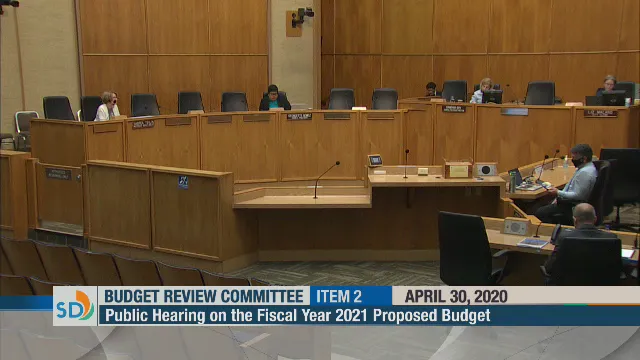
The San Diego Budget Review Committee (BRC) held a public hearing on the proposed Fiscal Year 2021 budget on Thursday, April 30, 2020, via teleconference and live stream due to the COVID-19 pandemic. The meeting's primary purpose was to hear public testimony on Mayor Kevin Faulconer's proposed budget, which faces a $250 million revenue shortfall and proposes significant cuts to city services. Council members also provided updates on their budget priorities in light of the pandemic. No votes were taken.
Public Comments & Testimony
Over 60 public speakers called in, with one minute each, expressing concerns and priorities. Key themes included:
- Road repairs in Mira Mesa: Numerous residents (e.g., Nelani Woods, John Kurt, Robert Kendall, Pam Stevens, Jeff Stevens) urged the council to fund the reconstruction of Gold Coast Drive and Parkdale Avenue, citing severe potholes, safety hazards, and years of neglect. Several noted that the proposed budget includes $11.1 million for these projects.
- Smart Streetlight Program: Many speakers (e.g., Dr. Cyrus Barucha, Seth Hall, Layla Azisa, Kate Metcalf, Genevieve Jones-Wright) opposed the proposed $1.3 million increase in funding for smart streetlights, calling it an invasive surveillance system and a wasteful use of funds, especially during a budget crisis. They urged reallocation to core services.
- Tenant protections and rental assistance: Numerous speakers (e.g., Noemi, Blake Hosstead, Belene Hernandez, Megan Johnson) urged strengthening the eviction moratorium, canceling rent and mortgage debt, and increasing rental assistance. Estimates indicated that $140 million would be needed to assist all tenants unable to pay rent in May.
- Worker protections: Speakers (e.g., Dr. Derek Robinson, Reverend Sherry Mateir) called for at least 15 days of paid sick leave, enforcement of labor laws, and unemployment benefits covering full lost wages with a right to return to work.
- Arts and culture funding: Multiple speakers (e.g., Elizabeth Tobias, Steve Schneider, Ileana Ova, Maria Hernandez) urged the council to preserve funding for the Commission for Arts and Culture and organizational support programs, emphasizing the sector's economic impact (a billion-dollar industry, 35,000 jobs) and its importance for recovery.
- Libraries and recreation centers: Speakers (e.g., Patrick Stewart, Matthew Goldberg, Lupe Diaz) opposed cuts to library hours, materials, and staff, and cuts to park and recreation services, emphasizing their importance for youth and low-income communities.
- Support for STAR/PAL: Several speakers (e.g., Letitia Dupree, Catherine Jones, Tamara Mohammed) advocated for maintaining funding for the STAR/PAL program, which provides youth mentoring and police-community engagement.
- Other concerns: Comments addressed the Office of ADA Compliance (opposition to moving it to the Mobility Department), stormwater funding (opposition to cuts), police releasing detained individuals to prevent COVID-19 spread, and the need for multilingual city communications.
Discussion Items
- Councilmember comments on budget priorities: Council members from Districts 2, 3, 4, 6, 7, 8, and 9 provided opening statements and later updated their priorities under COVID-19. Common themes included preserving core city services (police, fire, libraries, parks), using the $248 million in CARES Act funding effectively, protecting vulnerable communities, and exercising fiscal caution.
- Specific positions:
- Councilmember Chris Ward (District 3) noted the importance of public input during a pandemic and planned community conversations.
- Councilmember Monica Montgomery (District 4) emphasized homelessness outreach, safeguarding neighborhood services, and ensuring equity in capital projects.
- Councilmember Chris Cate (District 6) advocated for road reconstruction, particularly Gold Coast Drive, and focused on core services.
- Councilmember Vivian Moreno (District 8) urged using all $248 million in CARES Act funding, criticized use of one-time reserves, and opposed new spending like smart streetlights and CleanSD ($7 million), suggesting contract cuts instead (citing potential $71 million savings).
- Council President Georgette Gómez (District 9) supported free Wi-Fi for underserved communities, opposed new departments, and opposed smart streetlight funding.
Key Outcomes
- No votes were taken; the hearing was informational.
- The committee adjourned to the next BRC meeting on Monday, May 4, 2020, at 9 a.m.
- Upcoming budget dates announced: May 21 (May Revise consideration), May 22 (council budget priority memos due), June 3 (IBA final report), June 8 (final budget public hearing).
Meeting Transcript
Good evening and welcome to the first fiscal year 2021 budget review committee meeting. Before I do the formal legal remarks, I'd like to thank you all for participating tonight from wherever you are in San Diego. And I'd like to thank San Diegans everywhere for what a great job you've done with sheltering in place, with adhering to social distance guidelines, and for doing a great job of going to the beach and in our parks in an appropriate way. And I look forward to the continued opening of our economy in a way that is safe for everyone. Now per executive order 29-20, which suspends certain requirements of the Brown Act. Some of the council members will be participating via teleconference, and no members of the public will be in attendance at the meetings in the interest of public health and safety. In addition, this meeting is being televised and live streamed on the city's website, and the clerk and council committee liaison have made arrangements for the public to comment via telephone and electronically. We appreciate the public's cooperation. I will now call the budget review committee meeting of Thursday, April 30th, 2020 to order. Please note that we will be taking item number two first. Since the primary purpose of this meeting is to give the public an opportunity to comment on the mayor's proposed budget for fiscal year 2021, we will begin this meeting by listening to their comments. We have several members of the committee and staff calling via teleconference. Clerk, please proceed. Yes, thank you. And before I note who's present, all of the members of the public who are currently on the public comment line, please hang up your phones. You will be given the opportunity to call in when your item is called. However, the first item is non-agenda public comment. So everybody that's on that line, please hang up now. We will give people an opportunity to call in for non-agenda public comment. But right now you're clogging the lines. And when uh item two comes up, you'll be given the opportunity to call in and speak to the budget. But everybody that's on there right now needs to hang up. Thank you. For purposes of the roll call, the folks on teleconference include Councilmember Campbell, Councilmember Ward, Councilmember Montgomery, Councilmember Kercy, Councilmember Kate, and Councilmember Moreno. Each council member will be watching the meeting from their remote location via City TV and is live on our teleconference over chambers. But when it comes time for each council member to comment, they will be asking all questions, making their comments, and speaking on the record over the teleconference. These council the council members present in chambers are Council President Gomez and Council President Pro Tem Bree. Also on the teleconference line is Deputy City Attorney Brett Bartelata, Independent Budget Analyst Andrea Tevlin, and Director of Policy and Council Affairs for Mayor Faulkner, Jessica Lawrence. For purposes of this meeting, written comments submitted using the public comment form prior to the start of the meeting have been distributed to the council and posted online. All written submissions received after the start of the meeting will be made a part of the permanent record. These comments will no longer be read into the record because we are now able to provide for phone-in live public testimony. And again, all of you folks who are currently on the line, you need to get off the line. The first item is non-agenda public comment. I apologize. I apologize, Andrea. So the public may call in. Once you're told to call in, all 12 of you that are currently on the line, you need to get off. Tommy Howe, Tam Lisbeth, Antonia Lorenzo. All of you folks need to hang up your phones and you'll be given the opportunity to call in. But at the time that you're told to call in, you'll be there'll be information on the screen, and you'll be able to call 619 541 6310 and enter conference ID number 105579 and press the pound key to be placed in the queue for public comment. Please note that members of the public wishing to speak on an item should call in when the item is introduced. A slide will go up indicating that the public comment period is open. And once all members in the queue have had an opportunity to speak, the public comment period will be closed. This same process will be used for all other items on the agenda. When you're in the queue, you'll be able to hear the meeting and all others that are providing comment. You will know that it is your turn to speak when you hear the system prompt saying your phone has been unmuted. When you hear this prompt, state your name and make your comment. Each speaker will have one minute. Please hang up your phone when you conclude your comment so the next speaker can be cued up to speak. This is not a question and answer period.
openpublica.com