San Diego City Council Meeting and La Media Road Ribbon Cutting, June 2, 2025
STREAMING COPY IN PREPARATION — RECORDING AVAILABLE FROM THE ORIGINAL SOURCE
San Diego City Council Meeting and La Media Road Ribbon Cutting, June 2, 2025
On June 2, 2025, the San Diego City Council held a formal session at 2 p.m. following a morning ceremony at Otay Mesa celebrating the completion of the La Media Road intersection improvements. The council addressed the Commission on Police Practices standard operating procedures, a comprehensive parking reform package, and heard public comments on a range of topics. The meeting also included a closed session report on grievance settlements.
Ceremonial Event: La Media Road Ribbon Cutting
- Mayor Todd Gloria, Councilmember Vivian Moreno, and other officials celebrated the completion of the La Media Road and Airway Road intersection improvements. The project raised the intersection, installed new drainage, expanded the road to six lanes (five lanes in another segment), and added bike lanes, landscaping, traffic signals, and crosswalks. The project cost over $60 million and was funded partly through state trade corridor funds. Speakers noted that 3,000 to 4,500 commercial vehicles carrying tens of billions of dollars in goods pass through the Otay Mesa port of entry annually. Councilmember Moreno and others emphasized that this is phase one, with a phase two (La Media Road South) still needed.
Public Comments & Testimony
- Closed Session Items: One speaker (Joyce Sanyata) urged the council to resolve grievances in the spirit of the law and to increase public involvement in rate-setting processes to avoid litigation.
- Item 200 – Commission on Police Practices SOPs: Several speakers expressed support for the commission and the need to build trust through the collective bargaining process. One speaker noted that the commission's recommendations are often not enforced. Another speaker highlighted the importance of community engagement and timely access to information from the police department.
- Item S400 – Parking Reform: Numerous speakers addressed the parking reform package. Supporters included representatives from the Hillcrest Business Association and the Downtown San Diego Partnership, who praised the updates but raised concerns about restrictions on use of funds. Opponents, including Shane Harris (People's Association of Justice Advocates) and several residents, opposed Sunday parking enforcement, arguing it would burden working families. Speakers from Balboa Park institutions (Balboa Park Cultural Partnership, Forever Balboa Park) urged that any paid parking be implemented thoughtfully, with free parking for volunteers and staff, and that revenue be reinvested in the park. Other speakers expressed concerns about the speed of implementation and the impact on low-income residents.
- Non-Agenda Public Comment: Commenters addressed topics including the condition of the Convention Center (deferred maintenance), the need for a public awareness campaign about unclaimed city monies, opposition to the city's trash fee (Proposition B), and concerns about marijuana businesses and public health (including impacts on youth and pregnancy). Several speakers also commented on the recent ICE enforcement action in South Park, with some condemning the action and others defending federal agents.
Discussion Items
- Item 200 – Commission on Police Practices Standard Operating Procedures: Doug Case (Commission Chair) and Bart Miesfeld (Interim Executive Director) presented the SOPs, which were developed over 18 months. The SOPs cover complaint administration, investigation, hearings, and other functions. The council was asked to direct the city's management team to engage in collective bargaining with employee unions before final approval. Councilmember Von Wilpert made the motion, noting that the vote was only to trigger the meet-and-confer process, not to adopt the SOPs. Councilmember Elo Rivera expressed concern about potential delays by the police union. The motion passed 7-0.
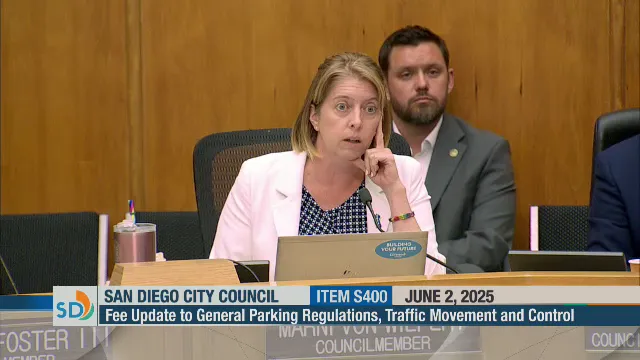
- Item S400 – Parking Reform: Staff presented a package of amendments to the municipal code and council policies to modernize parking management. Key elements: dynamic pricing (rates up to $20/hour), Sunday enforcement, changes to residential parking permit programs, updates to community parking district policies, and fee increases for valet permits and construction blockage. The IBA noted that the reforms are anticipated to increase revenue. Councilmember Whitburn, the motion maker, emphasized that Sunday enforcement would require a residential permit zone before affecting residents. He also stressed that any Balboa Park paid parking must include free options for volunteers and low-income families. Councilmember Elo Rivera proposed amendments to direct the city treasurer to develop a resident/non-resident parking program and to bring a user fee schedule for Balboa Park, but these were not incorporated into the motion due to Brown Act concerns. Council President Lacava secured a commitment from the mayor's office to bring forward those items by July. After debate, the motion passed 5-2, with Councilmembers Moreno and Von Wilpert voting no.
Key Outcomes
- Item 200: The council voted 7-0 to approve the resolution directing the city's management team to engage in collective bargaining on the Commission on Police Practices' standard operating procedures. The SOPs will return to council for final approval after the meet-and-confer process.
- Item S400: The council voted 5-2 to approve the staff recommendation, which includes:
- Amendments to Municipal Code Chapter 8 (Articles 2 and 6) to allow dynamic pricing, Sunday enforcement, and updates to residential parking permit programs.
- Amendments to Council Policies 100-18, 200-4, and 200-15 to streamline parking management, update community parking district operations, and adjust valet parking fees.
- Fee updates for valet permits and construction blockage. Councilmembers Moreno and Von Wilpert voted no, citing concerns about the impact on residents.
- Closed Session: The council approved settlement agreements for three grievances related to registration pay gaps, totaling $206,727.62 (Jaftta Gilliam Michael: $80,257.84; Ryan Reid: $71,162.55; Loretta Graham: $55,307.23).
- Commitments: The mayor's office committed to bringing back a resident/non-resident parking program and a user fee schedule for Balboa Park by July 2025, to allow for potential implementation before the proposed budget adoption.
Meeting Transcript
Good morning everybody. It is great to be here this morning in Otay Mesa, one of the most dynamic places in the city of San Diego with a great new uh uh announcement to make. I'm joined this morning uh by San Diego City Councilmember Vivian Moreno. We're in her district. Uh also Alejandro Amir Tiran, executive director of the Otai Mesa Chamber of Commerce. Uh David Wick, the president and CEO of TruckNet and a member of the Otai Mesa Community Planning Group. Uh we also have uh two of our city's shining stars, uh our city engineer Ronia Aman uh and her team from the engineering capital projects department, as well as Bethany Bizak, our director of transportation and some of her folks, I believe, and then last but certainly not least the champion for border uh cross-border binational relations, uh former Senator Denise Ducheny is here. Uh Senator, always great to see you. Uh so why are we here today? We're here to celebrate the completion of one of the region's most important infrastructure projects, improvements to the intersection uh here at LaMidia and Airway Roads. Uh Lamidia Road is a designated truck route that serves as a vital connection for goods uh between the United States and Mexico. Uh it is a critical quarter for California imports and exports with roughly 3,000 commercial vehicles carrying tens of billions of dollars of worth of goods through the Otai Mesa port of entry each and every year. Uh yet this economic engine has faced persistent flooding and congestion at this former two-lane Lamidia Road uh that what used to be right here that slowed down cross-border traffic uh in commerce, making that more challenging for local businesses uh as well as the overall Otay Mesa community. So that was the problem. What do we do about it? Well, we raised this entire intersection and installed new drainage systems below to alleviate the longstanding flooding. We expanded Lamidia Road into a six-lane primary arterial here at Airway Road all the way up to State Route 905 and a five-lane major road between Airway and Sampraviva Road to relieve congestion uh as well as to boost commerce. Uh we've also added bike lanes, provided parkway landscaping, new traffic signals, curb ramps, and crosswalks to make this intersection much more safe and I'd say a lot better looking. It looks pretty good out here. Uh this project is a symbol of progress here in our city. Uh it is also the expansion of opportunity for all San Diegans, uh bringing with it a myriad of benefits uh from reduced traffic congestion to enhance economic growth to improve safety and to a more sustainable future. By investing and working together to accomplish infrastructure projects like this one here at La Media, we are investing in the well-being of our residents and helping to make our city an even better place for all of us. And with that, it's turned over to the person that's been helping make this possible, uh council member as I mentioned for this area, council member Vivian Moreno. Council member. Thank you, thank you, Mayor, thank you. Uh good morning everybody. Um it's an honor to be here as we prepare to fully reopen La Media Road. Um, something I know that many of us have been waiting for and working really hard for. Uh when I first came into office in 2018, La Media Road was in terrible shape. It was dangerous, it was neglected, and it was holding back the economy and logistics potential of Otai Mesa. But the hardest part wasn't seeing the problem. It was convincing others that this road and this community were worth investing in. This project was not a priority to anyone but the people who worked here in this community. It was too far south, too expensive, and too easy to ignore. When I pushed the city to do something, the answer that I always received was we don't have the money. That was the wall that we hit early on. Political indifferences, financial uh roadblocks, but that's when we had to get very creative. We created a working group, we met regularly to make sure that the city stayed on track. I even remember going to Gary Chewy at the Transportation Department and literally begging him to apply to California Transportation Commission funding, and we were extremely successful. The trade corridor funds. I do want to acknowledge someone who played a major role in making this reality. Mario Orso, who at the time was with Caltrans. Without his advocacy and support, this project would still be a dream instead of a milestone. I also want to give a big shout out to Alejandra Mireterran, who's been a huge advocate for this project and for Otai Mesa. And I especially want to thank David Wick. Mr. Wick has been a constant presence and voice for accountability throughout this process. He made sure the city followed through, and I'm incredibly grateful for his support and partnership every step of the way. La Media Road is more than just a street. It's a symbol of what happens when community demands investment, when leaders don't take no for an answer, and when innovation fills the gap left by inaction.
openpublica.com