San Diego Economic Development & Intergovernmental Relations Committee - September 29, 2016
STREAMING COPY IN PREPARATION — RECORDING AVAILABLE FROM THE ORIGINAL SOURCE
San Diego Economic Development & Intergovernmental Relations Committee - September 29, 2016
The Economic Development and Intergovernmental Relations Committee met on September 29, 2016, at 2:00 PM. Chair Cole presided, with Vice Chair Kercy and Councilmember Alvarez present. The committee approved minutes from July 14, 2016, received updates on the San Diego Convention Center, the Open Data Portal, and a new business portal (Open Counter), and took action on reinvesting former Enterprise Zone funds and the 2017-2019 Economic Development Strategy.
Consent Calendar
- The committee record of action from July 14, 2016, was approved unanimously without discussion.
Public Comments & Testimony
- Martha Welch spoke about MTS budget concerns, questioning where funds were spent, citing lack of connectivity between rapid buses and trolleys, and inadequate restroom facilities. She also advocated using the old central library as a homeless resource, criticizing the city's approach to homelessness, and praised San Francisco's model of housing homeless individuals.
Discussion Items
San Diego Convention Center & Tourism Authority FY2016 Update
- Stephen Cushman (Convention Center Board) stressed that two conferences (Lightfair and Specialty Graphic Imaging Association) were lost because they outgrew the facility, representing $70 million and $17 million in regional impact, respectively.
- Rip Rippeteau (President/CEO, Convention Center) reported 158 events, 824,276 attendees, $1.1 billion regional impact, 737,155 room nights, and $23.9 million in hotel/sales tax revenue—the highest since 2008. The center had 66% building occupancy (above 49-50% national average), trending to 70% in FY17.
- Joe Tursey (President/CEO, San Diego Tourism Authority) noted the center booked over 1.1 million room nights, a new record. Lost business reasons: 67% due to lack of preferred dates/space; only 14% lost to competitors. The building is effectively full, with many conventions booking 10+ years out.
- Committee members (Alvarez, Kercy, Cole) requested more detailed data on lost business, cumulative booking snapshots, and occupancy potential. Staff agreed to provide a deeper analysis.
Open Data Portal Update
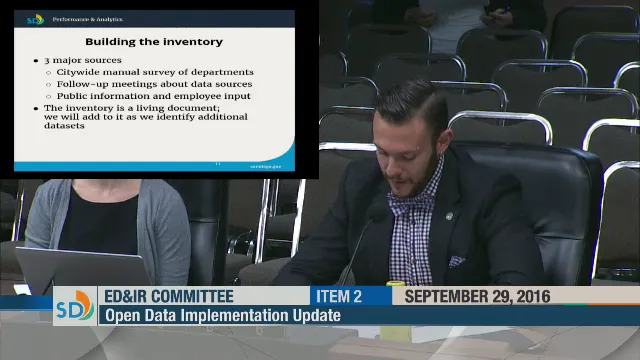
- Alma Udris, Maxim Pachursky, and Andrew Bauer (Performance & Analytics) reported the launch of data.sandiego.gov on July 1, 2016, with 44 datasets (121 files) from all city departments. The portal had over 24,000 page views and 13,000 downloads as of August 31.
- Top downloaded datasets: police calls for service, indicator bacteria/drinking water test results, and community planning boundaries.
- City staff prioritized datasets based on public demand (via voting), PRA requests, and automation feasibility. All data is auto-updated to eliminate manual processes.
- The city moved from 67th to top 10 in the Sunlight Foundation's open data census. Future plans include a data help desk, city data day, and expanding analytics.
- Committee members (Kercy, Alvarez) asked about tracking data usage by district and the timeline for publishing the budget data as open data. Maxim stated the budget data is targeted for this fiscal year.
Open Counter Business Portal
- Christina Vincent (Economic Development) and Peter Coate (Open Counter co-founder) presented a new online business portal (sandiego.opencounter.com) to help entrepreneurs navigate permits, fees, and codes. The tool mimics TurboTax, using a question-and-answer format to identify required permits based on business type, location, and operations. It automatically populates application forms and estimates fees.
- Open Counter is live in 41 California cities and 16 states. San Diego's setup cost ~$56,000 with a ~$150,000 annual service contract.
- The portal currently covers commercial activities but can be expanded. Spanish language and ADA compliance are included.
- Committee members (Alvarez, Kercy) praised the tool for simplifying city permitting and reducing staff time. Kercy suggested integrating county and state permits in the future.
Enterprise Zone Fund Reinvestment
- Kevin Sullivan (Economic Development) explained that the California Enterprise Zone program ended in 2013, but the San Diego Regional Enterprise Zone accumulated a $3.5 million surplus from processing 23,000 voucher applications in the final 18 months. The funds must be spent in the former zone on economic development activities.
- Eric Caldwell (Economic Development) proposed disbursing 27% ($945,000) to Chula Vista and National City (based on their share of applications). The city's remaining $2.5 million would fund eight initiatives:
- Water/sewer capacity bank ($750,000) – revolving fund to buy/sell capacity.
- Fee payment incentive ($240,000) – covers difference between express and expedite fees for job-creating businesses.
- Code for America portal (ongoing support) – one-stop shop for incentives/programs.
- Connector Careers ($300,000 over 3 years) – youth workforce development.
- Revolving loan fund study ($100,000) – improve utilization from 50% to 90%.
- Placemaking loan fund ($500,000) – revolving for temporary land activation.
- Activation grants ($250,000) – grants for city permit fees for community projects.
- Capacity building initiative ($300,000) – grants up to $20,000 to non-profits new to city funding.
- Committee members (Alvarez, Kercy) raised questions about metrics, sustainability, and community input. The motion to approve passed unanimously.
2017-2019 Economic Development Strategy Update
- Lydia Moreno and Christina Benson (Economic Development) presented updates since the March 10, 2016 committee review. Changes include more precise metrics, completion statuses, acknowledgment of new initiatives (e.g., Connector Careers, reinvestment funds), and inclusion of Civic San Diego's work plan.
- Councilmember Alvarez requested stronger emphasis on housing as a key economic development factor. The committee approved the strategy with direction to integrate housing metrics before final council consideration. The motion passed unanimously.
Key Outcomes
- Open Data Portal: Informational report received; no motion required. Staff will continue expanding datasets and community engagement.
- Open Counter: Informational report received; portal is live and will be formally unveiled at the end of October 2016.
- Enterprise Zone Funds: Motion to authorize disbursement to Chula Vista and National City and to authorize the CFO to expend the city's share on the eight programs passed unanimously.
- Economic Development Strategy: Motion to forward to council with direction to include housing metrics passed unanimously.
Meeting Transcript
Good afternoon. Welcome to the September 29th 2016 Economic Development and Intergovernmental Relations Committee. Yes, sir. It is the longest committee name. Let the record reflect that Vice Chair Kercy, Councilmember Alvarez are present. Welcome back, gentlemen. I look forward to hearing about your recent trip to D.C. And Councilmember Kate is away on an economic development related trip. Also in attendance today, our Deputy City Attorney Nate Slagers. Kristen Tilquist, representing the mayor's office, and Jeff Quarr from the Office of the Independent Budget Analyst. And our fabulous committee consultant, Pam Ison. We will begin today with the approval of the minutes. The committee record of action uh from July 14, 2016 will be approved unanimously unless pull for discussion. See none. We will now hear from the public with non-agenda public comment. I believe we have one person. We have Martha Wilch. You have two minutes. Martha Wells. I'm here to talk most about MTS. MTS budget in 2015. They said 50 30 million on uh on the trolley um Elkhorn and somebody in in Trilovia. But I went there for years and nothing happened there. No money. I can't see it. It's the same every time ago. I've been there for years and years, and it hasn't changed it at all. So where did it go? I don't know. Where it happened. Now on the rapid and downtown, they rapid and the buses are can't connect. So if you want to hold the horse, if you want to go to the court, you can't do that. It's not right they're doing that. But good thing the trolley has times now on the line. You can tell when the trolley is that's a good thing they're doing right now. But bathrooms is the other problem. Now on the uh over there on the new park over there, the drivers have a key for the bathroom, not the people. Also, I don't now they on on 12th imperial they use the bathroom in the tower, but that closed at five o'clock. So the is not true, they don't have bathrooms everywhere, they go uh everywhere on the lines because it's not done in this county or in the city. I don't think you like bathrooms or something. Because there's never bathrooms anywhere, and a maintenance is a problem because um there is one in the trolley, but I everybody told me it's very bad in alcohol and it's the only go in that bathroom. And it's got key it got a uh you have to pick codes on that one. Now, another thing, San Francisco did a good thing. They took their carry and they put homeless in there. Six thousand in there, right? They're feeding them and betting them and programs with that. Now we have the old library, it's in civic right now. And I think that would be a perfect thing to do in this city. We could open that. It has a lot of room, has bathrooms and everything.
openpublica.com