San Diego City Council Committee Meeting on Federal Update and Economic Forecast – July 13, 2017
STREAMING COPY IN PREPARATION — RECORDING AVAILABLE FROM THE ORIGINAL SOURCE
San Diego City Council Committee Meeting – July 13, 2017
The committee met to receive a federal legislative update from the Mayor's Office and Squire Patton Boggs, followed by a presentation from the San Diego Regional Chamber of Commerce on the county business forecast. Both items were informational; no votes were taken. The meeting also included approval of prior minutes, non-agenda public comment, and a welcome to visiting students from Taiwan.
Consent Calendar
- The meeting minutes from June 15, 2017, were approved by unanimous consent with no changes or comments.
Public Comments & Testimony
- Lon Jefferson (Commissioner, CEO C) introduced himself and stated that commissioners are working to build healthy relationships with the council and committees.
- Marcel (last name not given) read from a Caber book and expressed concerns about housing rules, stating that most housing comes from economic development and that HUD money goes to them. He criticized the rules for making it hard to move into housing, citing the Talmud Gateway project as an example where only seniors can enter.
Discussion Items
Federal Legislative Update (Presented by Pam Welsh, Cameron Simmons, Patrick Witteller)
- Pam Welsh provided an overview of 2017 federal actions, including the completion of FY17 budget, executive orders, and withdrawal from international agreements. She reported that all of San Diego's FY17 appropriations priorities were successful, notably the Urban Area Security Initiative (UASI) which secured $16 million for San Diego (ranked 9th nationally).
- For FY18, the city's requests include continued funding for UASI, the US-Mexico border water infrastructure program, transportation priorities (Mid Coast Corridor, Otay Mesa port of entry, southbound truck route), Pure Water (WIFIA program), Point Loma wastewater waiver, and homelessness funding formula reform.
- Welsh noted that the city has submitted a letter of intent for Pure Water under the WIFIA program, and is optimistic about being selected. The Point Loma waiver renewal process is ongoing; the current waiver is good for five years.
- On the border wall, the House included $1.6 billion in its FY18 bill, but Senate Democrats oppose it. The city continues to engage with DHS and CBP on border wall prototypes.
- Regarding immigration, the city opposes HR 1813 (fees on remittance transfers) and is monitoring Kate's Law (mandatory minimums for deported immigrants who commit crimes).
- Councilmember Kersey asked about the municipal bond tax exemption, infrastructure/tax reform linkage, and marijuana banking. Welsh stated that the municipal bond exemption remains a concern but is a top priority for city associations. On repatriation, she noted bipartisan support. On marijuana banking, Congressman Vargas is aware but no concrete action.
- Councilmember Alvarez asked about the Tijuana River Valley and San Diego River levy feasibility studies, which will be authorized through the Water Resources Development Act. He also noted concerns about lack of action by IBWC.
- Councilmember Bry asked about the likelihood of Pure Water being selected for WIFIA; Welsh said they are very optimistic, with EPA viewing it as a poster child.
- Councilmember Zapf expressed frustration that many issues (e.g., medical device tax, repatriation, CDBG) have been discussed for years without resolution. She asked about the federal law requiring cruise ships to cross an international border, which hurts San Diego's cruise business (each ship worth about $2 million). Welsh said she would look into it.
San Diego County Business Forecast (Presented by Sean Carefin, Vice President, San Diego Regional Chamber of Commerce)
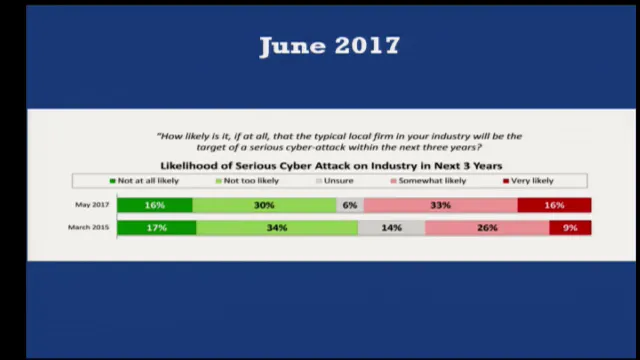
- Carefin presented results from the Chamber's monthly business outlook survey, which includes a Business Outlook Index. The index has been in positive territory since late 2013, with the highest levels in early 2014. Recent dips were tied to events like the minimum wage increase and the election. The most recent June 2017 survey (200 businesses) found that nearly half of businesses (up from 35% two years ago) believe a serious cyber attack is somewhat or very likely in the next three years.
- In May 2017, after the gas tax increase, businesses in negatively impacted industries opposed it, while 3% saw a positive impact. In April, the top challenge for small businesses was government regulations, taxes, or fees (31%), followed by the minimum wage increase (16%) and cost of health care (11%).
- In February, large businesses were more likely to have disaster recovery plans than small businesses. In December 2016, 32% of businesses did not see workforce health programs as important. In November 2016, most businesses reported participating in corporate social responsibility.
- A slide from August 2016 showed that businesses overwhelmingly believe housing is too expensive; employers see it as a major issue for attracting and retaining talent.
- Councilmember Bry asked about the profile of chamber members (mostly small businesses, stratified across sectors) and whether the survey asks what businesses like about San Diego. Carefin said yes, and can provide those results.
- Councilmember Alvarez asked about regional breakdowns; the survey is cross-tabulated by geography. He noted a dip in October 2016—Carefin said it was likely due to election uncertainty. Alvarez also noted that some South County chambers are not participating, and he would share the invitation.
- Councilmember Kersey asked why housing is not listed among the top challenges in the April slide. Carefin noted that a separate July 2016 survey found that the number one issue for employers was retaining/attracting talent, and the top reason was housing. Kersey suggested adding housing to the list of challenges.
- Councilmember Zapf observed that the index's highest point was in early 2014 and has not recovered, possibly due to the presidential campaign. She noted that the survey results align with what she hears from small businesses about regulations, taxes, and minimum wage.
Key Outcomes
- No decisions or votes were taken. The committee received both reports as informational. No referrals or directives were issued.
Additional Notes
- The committee welcomed 24 high school students from Taichung, Taiwan, who were visiting City Hall. President Jong Wong introduced the group.
- The meeting was adjourned after the second item.
Meeting Transcript
Okay, uh we have a quorum president, so we can go ahead and and uh get going. Um we have uh joining us today, council members Barbara Bree and Mark Kirsey. Um David Alvarez will be joining us shortly. We also have Deputy City Attorney Nate Slagers, Mayor's um staff will be here. Uh Jeff Kawar from our independent budget analyst, and Ryan Purdy, our committee consultant. So our first record of action is um our meeting minutes from June 15th, and they will be approved by unanimous consent unless anyone has any changes or comments. Seeing none, we will move right into our non-agenda public comment. And first up, we'll have uh is it Lan Jefferson and Martha Welch, and you have two minutes on non-agenda. Lon, thank you, Lon. Do I hit anything? Oh, my name is Commissioner Lon Jefferson. I'm with the CEO C and I'm just here to introduce myself because all of the commissioners are trying to build and encourage healthy relationships with the council, especially also the committees, and so you'll be seeing different one of us um attending some of the committee meetings. Okay, thank you. Thank you for that. Good afternoon, Marcel. I've read the caber book where it's economically put out. And the library's top at two nine in two thousand nine. I've read them. Most of the housing comes from that. It makes higher uh low um um um rent, you know. A M meaning in uh income. Uh tiers and everything like that, and property age section section eight. Also, I saw this uh com to two, I saw them four times. Um Victoria PASSE, two, and seniors. But they said it's all the same every time it's the same thing every time, every time. It talks about uh every time you have that uh commentary that has the same description but not true either because you don't have um uh place for kids downstairs. Uh you don't have that. The the towns are uh are not built yet uh also. So this is going on with the city. Uh these rules come from economic mostly because the HUD money goes to them also. And so this is what's the problem with San Diego. If you want to solve the homeless and and and for um and all this stuff to get in into housing, like gateway, uh the new one, um Talmud Gateway is now painted, it looks much better and looks as almost open, but uh it's gonna be pace in 55 old older homeless people. I don't know what the rules are gonna be there or not. I I haven't found out what the rules are gonna be there. If you want to move the into that building, it has to be a senior at least, and that the new one over there, I've seen it. So this is the problem of San Diego, all these rules makes it hard to move out and it comes from economic development. Uh they're one of the people, the players with these rules. Okay, thank you. Um okay, we'll go right into we only have uh two items today, and the first one is a uh report from the office of the mayor as well as uh Squire Patton Boggs um firm regarding our legislative federal update. And Mr. Alvarez has joined us as well. Thanks. Hi, Chair and Council members. Uh Patrick Witteller, City of San Diego Government Relations. Um we're here to give our federal government relations legislative update. Uh with me is Pamela Welsh and Cameron Simmons from Squire Pat and Box. And without further ado, I will hand it over to Pam. Good afternoon. It's good to be here. Thank you for having us.
openpublica.com