San Diego Economic Development and Intergovernmental Relations Committee Meeting – February 22, 2018
STREAMING COPY IN PREPARATION — RECORDING AVAILABLE FROM THE ORIGINAL SOURCE
San Diego Economic Development and Intergovernmental Relations Committee Meeting – February 22, 2018
The Economic Development and Intergovernmental Relations Committee met on February 22, 2018, with Councilmembers Alvarez and Bree present and Council Vice Chair Kircy absent. The committee approved the January 31, 2018 minutes, postponed one agenda item, and heard presentations on municipal broadband and net neutrality, the economic impact of Balboa Park, and the economic impact of arts and culture programs. No action was taken on the informational Balboa Park or arts and culture items.
Opening, Postponement, and Approval of Minutes
- The committee approved the record of actions from January 31, 2018 by unanimous consent.
- Item 4, the San Diego Workforce Partnership Connected Careers update, was postponed due to a scheduling issue and will be brought back to a future committee meeting.
Public Comments & Testimony
- Martha Welch argued that the county and city are not properly handling property tax responsibilities, that certain taxes and projects such as the RTP CIP were not approved by voters, and that the 2004 sales tax cannot be used for other purposes. She stated that property tax and sales tax are different and described several tax-related actions as illegal.
- For the municipal broadband item, Chanel Hawken, representing Cox, opposed municipal broadband, citing failed municipal networks, including Seattle's estimated $500 million cost and $75 per month service. She noted Cox's $10 billion infrastructure investment, gig-speed deployment, free Wi-Fi at city libraries and events, and the $9.95 per month Connect to Compete program.
- Ignacio DeLatore, representing AT&T, opposed municipal broadband, stating that San Diego already has abundant and low-cost broadband, including $5 to $10 per month options. He argued that the Stockholm model is more relevant to smaller 'B cities' and that numerous municipal broadband ventures have failed, making taxpayer investment risky.
- Buzz Schott, representing Charter Communications, opposed municipal broadband, saying government-owned networks mostly fail. He cited Charter's $25 billion infrastructure investment over four years.
- On the Balboa Park item, John Stump said the economic report omitted a full accounting of expenses and maintenance needs. He identified the zoo tax as the largest source of park funding, requested a second report on needs, asked how much park payroll goes to San Diego residents, and urged true cost accounting, including the environmental costs of tourism, and a trolley connection up Park Boulevard.
- On the arts and culture item, Carla Velasquez, a Barrio Logan parent, expressed strong support for arts and culture programs, saying that without them her son would need to travel an hour away, or ten hours per week on a bus. She praised the '52 Weeks of Science' program and said such programs have improved Barrio Logan's reputation.
- Taylor Ward, chair of Rising Arts Leaders of San Diego and representing the Rise Up for the Arts and Culture movement, urged the committee not to cut arts funding. He said the arts are a struggling sector, that OSP and CCSD support more than a hundred institutions, and that many arts employees would not survive cuts.
- Garrett Redlings, a North Park parent, supported continued and increased funding for arts and culture, especially the San Diego Youth Symphony, which he called one of the crown jewels of Balboa Park.
- John Stump also spoke on the arts item, saying he supports the arts but asking that cuts be made from the top rather than the bottom. He suggested that organizations receiving city funding with chief executive salaries higher than the Parks and Recreation director should be ineligible, and that larger institutions with large budgets and free rent should perhaps pay triple net leases. He asked for data on how many City of San Diego residents are employed by arts organizations.
Discussion Items
- Municipal Broadband and Net Neutrality Referral: John Stump, who initiated the referral, argued that the city should examine whether residents and businesses are getting the best, least expensive, and most available internet service. He provided background on city council policies, cited Stockholm's city-owned fiber network where providers rent access, and urged the committee to study different municipal broadband approaches. Councilmember Bree said that municipal broadband is not the right path at this time, but expressed concern about the FCC's December net neutrality repeal and said she wants to pursue statewide solutions and affordable internet for every family. Councilmember Alvarez asked about the status and timing of cable franchise agreements and highlighted the digital divide in his district. Chair Ward noted concern about net neutrality and the changing technology landscape, including a SpaceX launch that morning. The committee passed a motion, unanimously, to request the mayor's office and relevant departments to examine feasibility, opportunities, and barriers for broadband, explore Wi-Fi hotspots in city parks and libraries, and report back, with additional information on franchise agreements.
- Balboa Park Regional Economic Impact Study: Thomas Herrera-Misler, President and CEO of the Balboa Park Conservancy, presented a study by SDSU's Payne School of Tourism and Hospitality. He reported that Balboa Park generates approximately $600 million in annual benefits for San Diego, including $192 million in direct visitor spending, 311,000 hotel nights, $6.7 million in hotel taxes, and $3.2 million in local sales tax. The study found $111 million in value from free or subsidized recreation, $44 million in health benefits for 40,000 people who exercise in the park, and about 1,100 jobs with $52 million in annual salaries. About 2.6 million local residents visit the park an average of ten times per year, and about two million visitors come from outside the region. Herrera-Misler said the park is an underperforming asset, with only about half of the master plan improvements completed, and he called for sustained public funding and reinvestment. In response to questions, he clarified that the study counted only visitors who came to San Diego primarily or largely because of Balboa Park, based on a survey of 2,200 people, and that the zoo was not included. Councilmembers discussed the park's return on investment, tourism marketing, and the need for a master plan implementation plan. This was an informational item.
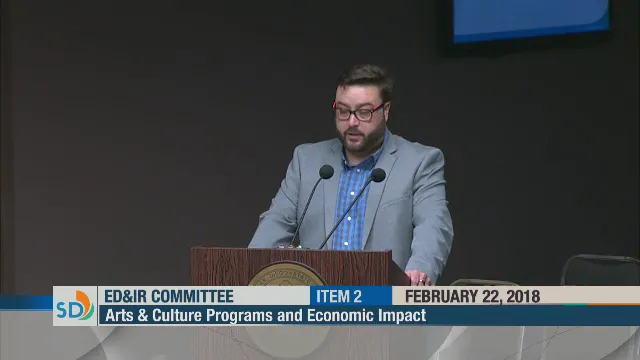
- Arts and Culture Programs and Economic Impact: Janet Poutre, Chair of the Commission for Arts and Culture, and Tyler Hughes, Chair of the Arts and Culture Advocacy Committee, presented an update. They reported that in FY18 the commission contracted with 133 nonprofits and distributed $11.3 million through operating support and Creative Community San Diego grants, and that 156 applications were under review for FY19. Hughes presented data from an Americans for the Arts study showing over $1.1 billion in annual economic activity from arts and culture organizations and audiences, $48 million in direct tax revenue, and almost 36,000 full-time equivalent jobs. The study counted 3.6 million non-resident attendees, representing 30% of total attendance and 2.5 times the economic activity of local attendees. He noted that cultural tourists spend more, and that about 13,000 volunteers contribute an estimated $13 million in time. Councilmember Alvarez said arts funding should not be cut and suggested exploring the roughly $30 million TMD reserve for potential lawsuit liabilities as a possible source. Councilmember Bree noted that six of nine council members prioritized arts funding in budget requests and asked about grant process transparency and philanthropic support. Poutre said organizations must provide a three-to-one match, so every city dollar is at least tripled. Chair Ward highlighted the relationship between arts and economic development and the discrepancy between projected TOT growth and possible arts cuts. This was an informational item.
Key Outcomes
- Approved the January 31, 2018 committee minutes by unanimous consent.
- Postponed the San Diego Workforce Partnership Connected Careers update.
- Passed a unanimous motion on the municipal broadband/net neutrality referral, directing the mayor's office to study feasibility, opportunities, and barriers, explore Wi-Fi hotspots in parks and libraries, and report back, including information on franchise agreements.
- Received the Balboa Park economic impact study and the arts and culture economic impact report as informational items, with no formal action.
- The committee's next meeting was scheduled for March 22, 2018 at 2 p.m.
Meeting Transcript
All right, good afternoon, everybody. I want to welcome you to the February twenty second, two thousand eighteen meeting of the Economic Development and Intergovernmental Relations Committee. Let the record reflect that council members Alvarez and Bree are present, and Council Vice Chair Kircy will not be joining us. He's absent today. Also attendance today are Deputy City Attorney Nathan Slagers, Director of Government Relations, Patrick Buteller from the Mayor's Office, Jeff Kawar from the Office of Independent Budget Analysts, and our committee consultant Lucas O'Connor. I want to note that we're expected to lose quarantine today around four PM. We only have three items that I'm sure we'll be able to accommodate all of those uh items. I'll also uh note that item number four, San Diego Workforce Partnership Connected Careers update uh has been uh postponed due to a scheduling issue, so we will be returning that to staff and bringing that back to a future committee meeting. With that, today we'll begin with approval of the minutes. The committee record of actions from January thirty first, two thousand eighteen will be approved by unanimous consent unless pulled for discussion, seeing none. First, we have we have one uh member of the public who wishes to speak, and that's Martha Welch. Martha Bros. The County of San Diego does new doing their jobs. Remember, property is supposed to be spit for the county and the city. Now, public house is a city um county, but right saw a line on on the budget about that. Not right because that uh they put that's for the job of the county. Also, I saw one time annual approval, but I don't think that's I think the county uh does that right now. Now also um property is um taxes uh is county also. Now they did we don't have to vote everything we have um property have to vote everything you want and has certain time and also um a certain project. That's in that doesn't do that. Because right now the new one is RTP CIP. Regional transfering um capital and um project. That's what it stands for. And we didn't vote for that. We have to vote everything with tax without it's not illegal. I told the supervisor, I told them the same thing. Um I looked to uh I looked to elections to back to it's 19 um 1990. I went to all the elections, look for vote, I can't find it. Only thing I have had were 2004 sales tax. Uh um for what's a bit uh two thousand um point three two five point uh that's for 40 years. And you can't use that vote because uh that was that was back in 2004. You can't use that for RTC, you can't use it. It's not the same thing. Property tax is one thing, and sales tax is something else. So this is going on. It it helps affects everybody in the county. Uh if you rent or anything, it it's affects you. And everything on property tax, I don't think we voted sewer and water. We didn't vote for that either. So all this stuff is illegal and it's illegal, and it's it's it should be straightened out someday because right now. Thank you, Ms. Welch. Uh, do we have any city attorney IB IBA or mayoral staff comment before we move on to the discussion agenda and any committee member comments for the good of the order? Well, thank you. Uh we are going to move on to our discussion agenda item. Uh, number one is referral from the rules committee, net neutrality, open access, internet for San Diego. I'm pleased to welcome Mr. John Stump uh at the January 10th committee meeting for the rules. Uh it was uh recommended that it we be that the item be moved to this committee to discuss municipal broadband internet in the city of San Diego. Mr.
openpublica.com