Economic Development and Intergovernmental Relations Committee Meeting, June 27, 2019
STREAMING COPY IN PREPARATION — RECORDING AVAILABLE FROM THE ORIGINAL SOURCE
Economic Development and Intergovernmental Relations Committee Meeting, June 27, 2019
The Economic Development and Intergovernmental Relations Committee of the San Diego City Council met on June 27, 2019, at 10:00 a.m. Present were Vice Chair Montgomery, Councilmember Bree, and Councilmember Kircy (arriving later). Staff included Deputy City Attorney Daphne Scogan, Felipe Monroy from the Mayor's Office, Jordan Moore from the Office of the Independent Budget Analysts, and committee consultant Lucas O'Connor. The meeting began with approval of the June 6, 2019 minutes.
Consent Calendar
- Approval of Minutes – The committee records of action from June 6, 2019, were approved unanimously on a motion by Councilmember Bree, seconded by Vice Chair Montgomery.
Public Comments & Testimony
- Kelly McCormick (public comment on non-agenda item) – McCormick raised concerns about the lack of certified marijuana testing facilities in San Diego County. She stated that only a fraction of regulated marijuana is tested, noting that zero testing labs exist in the county and that a recent Associated Press investigation found only 93 of over 1,000 licensed manufacturing companies participate in the state's track-and-trace system. She said nearly 4,000 growers exist but only about 7% use track-and-trace, and only 208 of 1,532 growers have regular annual licenses. She cited investigations by NBC Los Angeles finding banned pesticides, fungicides, heavy metals, and other contaminants in products for sale. She urged greater regulatory oversight.
Discussion Items
-
Fiscal Year 2020 Property and Business Improvement District (PBID) Annual Report – Presenters Elizabeth Studebaker (Neighborhood Investment Manager) and Luis Ojeda (Community and Business Development Manager) from the Economic Development Department presented the annual reports for downtown San Diego and North Park PBIDs. Services include maintenance, sanitation, landscaping, administration, commercial enhancement, and a disorder abatement program (downtown only). The downtown PBID covers 13,906 parcels over 275 blocks with six neighborhood zones and one commercial overlay; it was first formed in 2000, renewed in 2005 and 2015. North Park PBID includes 522 parcels along University Avenue and 30th Street, formed in 2017. The city contracts with downtown San Diego Partnership and North Park Main Street to administer the districts. The committee approved the FY2020 annual reports and authorized the CFO to appropriate and expend operating funds (motion by Councilmember Ward, seconded by Vice Chair Montgomery, passed unanimously). Discussion included questions about other communities exploring PBID formation, renewal schedules (downtown 2025, North Park 2022), the $55,000 general benefit in North Park used for a homeless outreach coordinator, the $2.2 million allocated for contracted security downtown, and the $150,000 city fee for oversight. Councilmember Ward requested a clearer justification of the city fee.
-
San Diego Convention Center Corporation Mid-Year FY2019 Sales and Marketing Update – Chair of the board Zima Jacobson introduced the presentation, joined by CFO Mardine Maddox and San Diego Tourism Authority President/CEO Joe Terzi. The corporation retained short-term sales (18 months or less); the Tourism Authority handles long-term sales under a contract approved by City Council last year. Terzi reported that FY2019 will achieve a record sixth consecutive year of over one million room nights booked. 21% of new bookings were new accounts, helping fill gaps between large conventions. Priorities include retaining major conventions and attracting new business. The team closed a gap in 2022 bookings from 21% behind to only 4% behind. Competition includes Anaheim (recent expansion), Los Angeles (planning expansion), Seattle (multiple expansions), Orlando, Chicago, Atlanta, and Las Vegas. Short-term sales exceeded goals, projecting $2.7 million in rental revenue. The presentation was informational; no action taken. Councilmember Kircy asked about major competitor cities that have expanded facilities; Terzi noted most have expanded or are planning to. Councilmember Bree asked about best-performing groups; Terzi cited corporate opportunities (e.g., Cisco Live spent $9 million on food and beverage) and medical conventions as high-value. Vice Chair Montgomery asked about loss of business due to preferred dates/space; Terzi said 60–70% of lost business is due to inability to accommodate preferred dates and/or space.
-
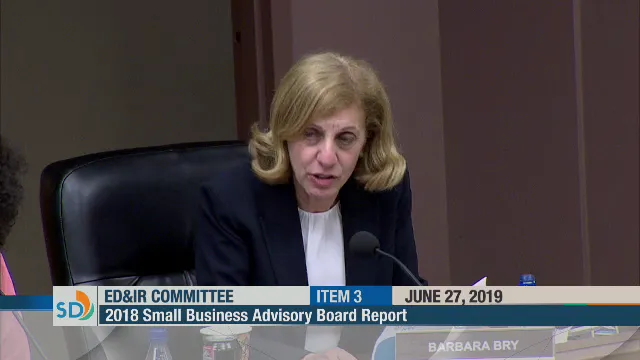
2018 Small Business Advisory Board Annual Report – Presenters: Shane Beard (Vice Chair, small business owner), Ruben Garcia (SBA district director), and Edward Barbad (attorney). Small businesses represent 94% of all businesses in San Diego (about 98,000 with 12 or fewer employees). The board meets monthly at the downtown library, conducts business walks, and collects surveys (240 in the last year). The board helps evaluate economic development funding applications and advises staff. Challenges include lack of quorum due to vacancies (8 of 11 seats expired or termed out). The board expressed frustration with low attendance at meetings and requested more active engagement from council. Councilmember Bree and Kircy noted difficulties small businesses face with city contracting and permits. Councilmember Bree offered to nominate a member. Councilmember Ward suggested addressing quorum issues by potentially changing the quorum definition. The board hopes for regular communication and collaboration. The report was informational; no action taken.
-
Federal Legislative Update for 2019 – Presented by Patrick Batcheller (Director of Government Affairs), Denise Garcia (Director of International Affairs), and Pamela Welsh (Squire Patton Boggs, D.C. representative). Highlights:
- The House passed a $4.6 billion humanitarian aid package for the border, including $30 million for local governments/NGOs; San Diego may receive a portion.
- The Supreme Court ruled on the census citizenship question, allowing the Commerce Department to add justification; the president suggested delaying the census (likely unconstitutional).
- Funding for Pure Water, the Tijuana River Valley, and infrastructure: FY19 programs saw slight increases; FY20 House bills show significant increases, but sequestration looms if no budget agreement.
- Housing: The city supported the Housing Commission’s appeal on fair market rent, resulting in a 14% increase ($20 million annually). They opposed a HUD rule on verification of eligible status.
- Opportunity zones: Treasury and IRS released guidance; EDA and HUD will prioritize opportunity zones.
- Infrastructure: Continued support for SANDAG Mid-Coast project (secured $80 million to cover a $75 million gap). The presidential permit for Otay Mesa was renewed.
- Tijuana River Valley: EPA study identified six projects; the House has $30 million pending; Mexico’s new government committed funds. The new IBWC commissioner is more engaged.
- Offshore drilling: City opposed opening waters off California.
- Homelessness: Advocacy to update the HUD formula continues but no movement expected; the city received $9 million for youth homelessness. The update was informational; no action taken. Councilmember Kircy asked about the HUD formula (no change expected) and the Pure Water loan (distribution terms to be determined by Public Works). Councilmember Bree inquired about the census decision timeline (possible further appeals).
-
Welcoming San Diego Strategic Plan Update – Presented by Denise Garcia (Director of International Affairs) and Joel Day (Director of Boards and Commissions). The plan is a five-year blueprint for integrating immigrants and refugees, based on a year-long process including a kickoff summit, data analysis, seven community forums (600+ attendees), online portal (hundreds of comments), attitudinal surveys (600+ responses), and peer city reviews. Steering committee of 70+ organizations (including Alliance San Diego, Chamber, EDC, RISE San Diego, Business for Good). Four cross-sector recommendations and recommendations in five areas: economic opportunity, education, inclusive access, civic engagement, and safe/connected communities. Key data: immigrants are 24.1% of San Diego County’s population, 22% more likely to start businesses than native-born, pay taxes at higher rates, and are core to the economy. The next step is hiring an Immigrant Affairs Manager (position approved by Civil Service Commission, to be posted next week, aiming to fill by end of summer). That manager will analyze costs and structure for a potential Office of Immigrant Advancement, considering models from Los Angeles, Seattle, and New York. The website New San Diegans currently provides resource links; a consolidated site is planned. The report was informational; no action taken. Councilmembers praised the inclusive process and emphasized ongoing communication.
Key Outcomes
- Approved: FY2020 PBID Annual Reports for downtown and North Park; authorized CFO to appropriate and expend operating funds (unanimous).
- Informational items received:
- Convention Center Corporation mid-year FY2019 sales and marketing update.
- Small Business Advisory Board 2018 annual report (with commitment to fill vacancies and improve engagement).
- Federal legislative update for 2019.
- Welcoming San Diego Strategic Plan update (with timeline for hiring Immigrant Affairs Manager).
- No other votes or formal actions taken.
Meeting Transcript
Oh short scene of the dark. Is it you late? Silently reach you for hands to all the code. And after stomping through the years, I found you just to fade out into the night. Oh short seen the dog. Broker. Watching City TV twenty-four. Your access to City Hall of the Commandments. And I want to welcome you all to the June 27, 2019 meeting of the Economic Development and Intergovernmental Relations Committee. We want to let the record reflect that we have Vice Chair Montgomery and Councilmember Bree present, and Councilmember Kircy will be joining us shortly. Also in attendance are Deputy City Attorney Daphne Scogan, Felipe Monroy from the Mayor's Office, Jordan Moore from the Office of the Independent Budget Analysts, and our committee consultant Lucas O'Connor. We will begin today, of course, with the approval of the minutes, and we have the committee records of action from June 6, 2019. I see no public comment on this item. Is there any issue from the uh any comments on the minutes? See none, I'll entertain a motion. By uh Councilmember Bree, seconded by Vice Chairman Gummery. All in favor. Aye. Minutes pass. Underway. Alright, uh, non-agenda public comment, an opportunity for members of the public to speak on any item under the jurisdiction of this committee, not on our agenda. We have one member so far, and that is Kelly McCormick. Mr. Formick, you'll have up to well, give you three minutes. Great, thank you. And I would like to thank the um council members who have heard part of this before for your patience. Um, I'm Kelly McCormick, and I would like to bring your attention to an issue with this city's local pipeline for marijuana that isn't widely acknowledged, and that's the lack of certified marijuana testing facilities. Consumers are misled into thinking that marijuana is adequately screened for the presence of pesticides, heavy metals, and other contaminants before it's offered for sale. Most consumers are unaware that only a fraction of the regulated marijuana is actually tested. There are numerous exceptions that allow untested pot into the marketplace and almost no regulatory oversight. In fact, there are zero testing labs in San Diego County, and there aren't even enough in the state to handle the volume of marijuana products that are being produced. A recent investigation by the Associated Press revealed that only ninety-three of more than one thousand licensed manufacturing companies are participating in the state's track and trace system. This means there is no way to reliably know if their products are tested or not. Of nearly 4,000 growers in the state, only about 7% are using track and trace. On top of that, only a tiny fraction of growers have obtained regular annual licenses from the Bureau of Cannabis Control. Only 208 out of 1,532 growers. The vast majority are operating on provisional permits, which means they are not subject to the same testing and environmental requirements, yet they're still allowed to sell their products. The BCC is a small agency and does not conduct quality control inspections. For this, we have had to rely on investigative journalists. Two different investigations by NBC Los Angeles has turned up high rates of contamination in products that are for sale. Most recently finding banned pesticides and vape cartridges. One of these pesticides becomes poisonous hydrogen cyanide when heated. When vaped, the poison is going directly into the user's lungs and then straight into the bloodstream in a concentrated form. Other investigations have found fungicides, rodenticides, mold, heavy metals, solvents, E. coli, and other impurities that are dangerous to human health. To say that all regulated pot is tested is wishful thinking. Thank you. Thank you. Do we have any IBA city attorney or mayoral comment generally? Seeing none, any committee member comment also seeing none.
openpublica.com