San Diego Economic Development Committee Meeting - October 24, 2019
STREAMING COPY IN PREPARATION — RECORDING AVAILABLE FROM THE ORIGINAL SOURCE
San Diego Economic Development and Intergovernmental Relations Committee Meeting - October 24, 2019
The committee met on October 24, 2019, to discuss divestment and socially responsible investing, updates to the regional revolving loan fund, and the 2020 Census. Vice Chair Montgomery and Councilmember Kercy were present; Councilmember Bree joined later.
Consent Calendar
- The committee unanimously approved the minutes and record of action from the September 26, 2019 meeting.
Public Comments & Testimony
- Non-agenda public comments (4 speakers):
- Martha Welch criticized county property tax practices and claimed county failure in animal control and 911.
- Rosa Vidal (Paradise Hills resident, District 4) demanded agenda time for community data on cannabis equity, arguing the cannabis industry had an hour to present while the community was not given time.
- Imani Marshall (Mid City Canns) stated that Black San Diegans are arrested for cannabis at six times the rate of white San Diegans, Pacific Islanders at four times, and Latinos at nearly double. She requested time at the November meeting to discuss law enforcement data.
- Diana Ross urged the committee to allow community data and stories on cannabis arrests, noting her brother’s incarceration and that statistics represent real broken homes.
- Public comments on Item #1 (Socially Responsible Investment Policy):
- Tony Young (Civic Link Strategies, representing SDG&E) commended the initiative but urged removing the ban on investor-owned utilities, citing SDG&E's record of minority/women/LGBTQ hiring, union contracting, and climate leadership.
- Nancy Cottingham (Hillcrest Indivisible) strongly supported divestment, drawing parallels to South Africa divestment and urging consistency with the city’s Climate Action Plan.
- Scott Murray (Carmel Mountain Ranch) spoke from experience managing a trust, saying divestment did not reduce returns. He cited personal losses from gun violence, tobacco, and fossil fuels, and criticized investor-owned utilities for hindering renewable energy.
- Laura Walsh (Surfrider Foundation) supported the policy, noting it reflects prior council actions like Community Choice Energy, offshore oil bans, styrofoam bans, and border wall opposition.
- Several additional speaker slips were submitted in favor.
Discussion Items
- Item #2 – Fossil Fuel Divestment and Socially Responsible Investment Policy (Informational)
- Masada Dizenhouse (San Diego 350), Wendy Wheatcroft (San Diegans for Gun Violence Prevention), and Malika Marsden (Climate Action Campaign) presented. They defined divestment and highlighted that 1,115 institutions have divested over $11 trillion from fossil fuels, including California cities. Proposed divestment categories: fossil fuel extraction, firearms illegal in California, tobacco/nicotine/vaping, private prisons/immigration detention, investor-owned utilities, single-use plastics, border wall expansion, and palm oil. They urged proactive investment in renewable energy and environmental justice.
- Martha Welch spoke in support, expressing strong opposition to fracking.
- Item #1 – Socially Responsible Investment Policy (Discussion)
- Brian Elliott (Council District 3 staff) presented a proposed policy with two components: divestment from listed industries and proactive investment in clean energy, equality, community economic development, and environmental justice. The city currently holds ~$30 million in corporate notes from fossil fuel companies. Proposed implementation: 30 days after council passage, existing funds held to maturity.
- Councilmember Bree learned the city invests in corporate bonds (e.g., Exxon, Chevron) and requested a full list. Chief Investment Officer Kent Morris noted the city’s investment portfolio is limited by state law (Gov. Code 53601) to high-grade securities; corporate bonds are only a small portion (~28%). CFO Rolanda Trev clarified that such divestment policies typically apply to larger pension funds, not the city’s constrained portfolio.
- Councilmember Kercy expressed concern about subjectivity: who decides which industries are harmful? He asked about opioid manufacturers like Johnson & Johnson, and noted the list could expand arbitrarily. He argued the treasurer’s duty is to earn returns, not make moral judgments.
- Vice Chair Montgomery supported moving the item forward but raised issues about local lending practices (e.g., Bank of America contract with no branches in District 4) and the need for inclusive criteria.
- Councilmember Bree supported further analysis but noted most of the policy does not apply to the city’s limited portfolio; the real target is the pension fund (independent of council control). She suggested focusing on what the city can actually invest in.
- Kent Morris estimated implementing the policy would cost ~$250,000 for compliance (staff, software) plus ~$250,000 annual lost earnings from needed divestment from the state pool (LAIF).
- Item #3 – San Diego Region Revolving Loan Fund Update (Informational)
- Christina Bibler and Rosalina Enriquez (Economic Development) presented a consolidated loan fund merging two prior funds. Since 2002, 79 loans totaling $8.9 million have been made. Current available lending: $2.1 million. New features: micro-loans ($10K-$50K), standard loans ($50K-$500K), interest rates 4%-10%, online application, and priority for underserved communities and startup businesses (6 months operating history). The loan advisory board approved updates; EDA approved consolidation.
- Kevin Pointer (City of Chula Vista) praised regional collaboration.
- Vice Chair Montgomery asked about targeting underserved areas; staff confirmed priority for Promise Zones, opportunity zones, and older commercial neighborhoods using census tract data. Councilmember Bree asked about turnaround time; staff hopes for 30 days or less and will market through BIDs and business associations.
- Item #4 – 2020 Census San Diego Informational Update
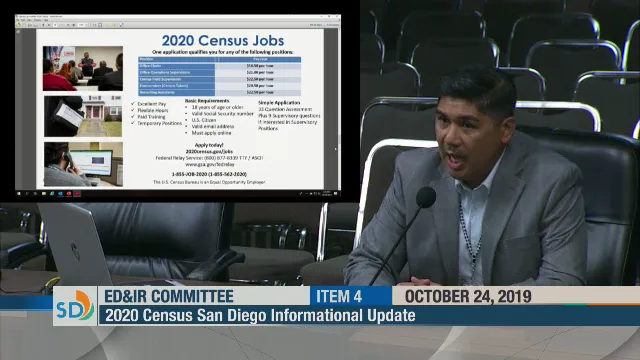
- Andrew O’Marel (U.S. Census Bureau Partnership Specialist) presented. The census determines distribution of $675 billion in federal funds. In 2010, national response rate was 80%, but 416,427 San Diegans needed enumerator follow-up. There are 49 hard-to-count census tracts in San Diego (population 256,000) with participation rates below 70%. This year, online response begins March 12, 2020; paper forms available; call centers in 13 non-English languages; language guides in 59 languages. The Bureau is hiring 7,700 employees for San Diego County, paying above living wage. Key challenges: hard-to-count communities (immigrants, LGBTQ, homeless, children under 5). O’Marel encouraged council offices to promote the census, host events, and share information.
- Vice Chair Montgomery raised concerns about funding distribution: the city forwarded allocation to United Way without specific conditions. She requested more involvement in how outreach funds are spent. O’Marel noted the SANDAG Complete Count Committee allocated funds; further discussion with United Way possible after October 31. He encouraged the city to form its own Complete Count Committee.
Key Outcomes
- Item #1 (Socially Responsible Investment Policy): A motion to direct staff (city attorney, mayor’s office, council staff) to draft a policy was made and seconded. After discussion, the motion resulted in no recommendation out of committee; the item will be submitted as a Legislative Service Request (LSR) to the city attorney’s office for further analysis. Councilmember Bree will also receive a full list of the city’s corporate bond holdings.
- Item #2 (Divestment Informational): No action required; the presentation concluded the informational item.
- Item #3 (Revolving Loan Fund): Informational only; no motion. The updated loan program will begin active outreach.
- Item #4 (2020 Census): Informational only; no motion. The committee encouraged continued engagement and noted the need for city coordination on hard-to-count communities. The next meeting of this committee is scheduled for November 14, 2019 at 2:00 p.m.
Meeting Transcript
How is the taste of one was better than the last taste of going pains? I knew what has to stop and that fee of closing. I don't know why I see no light in anything. But I'm in the middle. So it's a liquid in his speaker. She said, I don't usually do this kind of thing. Sometimes I closed me. Sometimes I see you say me home. Will we talk in the morning? Watching City TV twenty four. Your access to City Halloween. All right, well, good afternoon, everybody. I would like to welcome you to the October 24th, 2019 meeting of the Economic Development and Intergovernmental Relations Committee. We'll let the record reflect that Vice Chair Montgomery and Councilmember Kercy are present, and Councilmember Bree should be on the way. Also in attendance today are Deputy City Attorney Keith Malcolm, Zil Malus Crespo from the Mayor's Office, Jordan Moore from the Office of the Independent Budget Analyst, and our committee consultant Lucas O'Connor. We'll begin today with the approval of the minutes and the committee record of action from September 26th, 2019. So moved by uh Councilmember Kersey and seconded by Vice Chair Montgomery. We're all in favor. Aye passes unanimously. Next we'll have non-agenda public comment, an opportunity to speak on any item within this committee's jurisdiction. We at the moment have four requests for non-agenda comments. So we are going to begin with Martha Welch and then Rosa Ollis excuse me, Ola Vidal. And we'll have two minutes. Obviously. That's the problem with this. The county doesn't the right thing. A properties um tax, they put some RTCIP on there over a thousand. And we would never vote for that. Believe me, we didn't vote for that. And they put it on there. And it's not legal, and they put it on there, and that's why it's so bad. That's why your property went so much like that, where that rents went up. The county did this. The properties um um tax is a the worst pace a person doesn't do his job. Also, what happens with the money right there doesn't go to the cities in the whole county. That's also the problem with all the cities. For example, in the newspaper. So this is a problem with with this county. They don't do the right thing. Now the city takes over like animal control. And nine one one, it's not wrong. This is the county's this is the county's job. The county does not do their job. This is a problem. If you think the mad caller is nice, you not call, he can't call. He did it himself because he doesn't have a can't get a phone. That's the problem. And then nothing happens, believe me. He has all these lies and everything. He's in control of the city.
openpublica.com