Environment Committee Meeting Summary - December 8, 2016
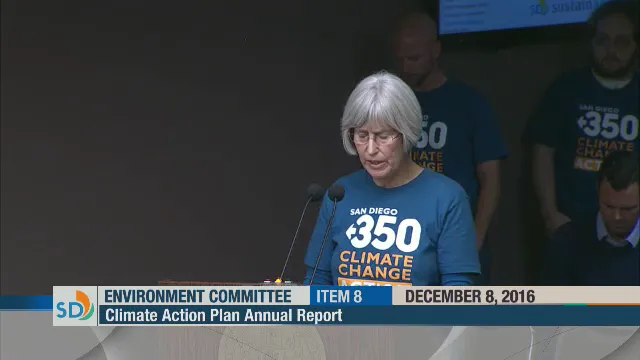
STREAMING COPY IN PREPARATION — RECORDING AVAILABLE FROM THE ORIGINAL SOURCE
Environment Committee Meeting Summary - December 8, 2016
The Environment Committee of the San Diego City Council met on December 8, 2016, to discuss a range of environmental and sustainability topics including the utility undergrounding program, LED street lighting, recycling at city facilities, expanded polystyrene foam food container recycling, the first annual Climate Action Plan report, and the Urban Forestry Program five-year plan. The meeting included public testimony, committee discussion, and unanimous votes on several action items.
Consent Calendar
- Approved the record of action items from the October 12, 2016 meeting by unanimous consent.
- Approved two consent agenda items: an as-needed engineering consultant services agreement with Kleinfelder and Corollo Engineers Inc. (each up to $5 million), and one other item. Both were approved unanimously after Martha Welch spoke in opposition. Staff clarified that annual average expenditure is half a million to a million dollars for these services.
Public Comments & Testimony
- Don Kelly (consultant to advise the council on IROC) thanked staff for work on IROC and expressed hope it would appear on the February 2, 2017 agenda.
- Martha Welch spoke twice. First, in non-agenda public comment, she complained about missing street lights and criticized water management, claiming the city has spent millions without results. Second, on the consent agenda, she opposed the engineering contracts, questioning the use of funds and commercial paper/bonds, and demanded an accounting of city funds.
- Climate Action Plan (Item 8) public testimony included:
- Nicole Capretz (Climate Action Campaign) praised progress but stressed need for post-2020 targets, better transportation data, equity metrics, and an adaptation plan.
- Carolina Rodriguez (Climate Action Campaign) announced San Diego received a gold standard in their regional report card, but emphasized implementation.
- Nicholas Banning (student) urged improved public transit and bike infrastructure.
- Alice Who (intern, Climate Action Campaign) shared personal challenges without a car and asked for mode share goals to be prioritized.
- Nicole Burgess (Bicycle Advisory Committee) called for a mobility champion, support from SANDAG for bike projects, and continued resurfacing efforts.
- Joy Williams (Environmental Health Coalition) thanked staff but requested a comprehensive set of equity metrics, dedicated staff time, and prioritization of disadvantaged communities.
- Simon Mayevsky (San Diego 350) emphasized implementation, smart housing, and transportation decisions.
- Elaine Maltz (San Diego 350) asked for leadership on lifestyle changes and clean public transit for aging residents.
- Joyce Lane (San Diego 350) noted that most reductions came from state leadership and urged a citywide approach to align community plan updates with CAP transportation and land use goals.
- Tyson Siegel (San Diego 350) urged adoption of Community Choice Energy, citing potential for lower rates and higher renewables.
- Barry Donnelly supported Community Choice Energy as a way to give consumers choice and reduce climate impact.
- Urban Forestry (Item 9) public testimony:
- Lynette Short (CAL FIRE) thanked the city for developing the five-year plan and urged its adoption.
- Carolina Rodriguez (Climate Action Campaign) requested the committee recommend adoption to city council, noting trees' role in climate mitigation.
Discussion Items
-
Adobe Falls Challenge (Item 3): Presentation by Dr. Eric Frost (SDSU Homeland Security Graduate Program) on addressing graffiti and environmental degradation at Adobe Falls. Discussed multi-jurisdictional ownership (Caltrans, SDSU, city), social media attraction, and a potential solution using a tunnel from SDSU as a front door. Councilman Sherman thanked Dr. Frost and students. This was an informational item.
-
Utility Undergrounding Program (Item 4): Staff reported on the status, including completion of over 400 miles, annual revenue increase to $68 million, and 21 projects construction-ready this fiscal year. A new master plan will focus on a five-year horizon. Public outreach starts January 2017. Council approved a motion to accept the report and forward to full council (unanimous).
-
LED Street Lighting Agreement (Item 5): Staff presented a purchase and service agreement with Current powered by GE and a master lease agreement with GE government finance for retrofitting 14,000 street lights with LED and adaptive controls, at a cost of approximately $30 million over 13 years, with annual lease payments ~$2.5 million and annual savings of $2.4 million. Council approved the motion unanimously.
-
Recycling at City Facilities (Item 6): Staff reported on progress toward 50% diversion by 2020. Current 27% diversion rate from Republic Services data is likely understated as other recycling streams (tires, metal) are not captured. Next steps include gathering data from all vendors and developing a strategic implementation plan. This was an informational item.
-
EPS Food Container Recycling (Item 7): Staff reported that after a feasibility study, an alternative approach could add expanded polystyrene foam food containers to the curbside program at an estimated cost of $90,000 per year (transportation and tipping fee to a facility in LA). Negotiations with the contractor would be needed. Council expressed support. No action required; staff will return with a potential amendment.
-
Climate Action Plan Annual Report (Item 8): Cody Hooven presented the first annual report, showing 2015 citywide greenhouse gas emissions tracking ahead of 2020 targets. Major reductions from grid renewables (35% renewable in 2015) and energy efficiency. Challenges remain in transportation and land use. Council discussed the need for a citywide strategy to meet mode share goals, equity metrics, and community choice energy. The item was informational.
-
Urban Forestry Program Five-Year Plan (Item 9): Jeremy Barrick presented the plan, which aims to increase urban tree canopy from 13% (2015) to 15% by 2020 and 35% by 2035. The plan includes 65 actions across three goals: increase canopy, maximize efficiencies, minimize risk. Council adopted a motion to recommend council adoption (unanimous).
Key Outcomes
- Consent agenda items approved unanimously.
- Utility Undergrounding Report: Motion to accept report and forward to full council passed unanimously.
- LED Street Lighting Agreement: Item approved unanimously (motion by Councilmember Kate, second by Sherman).
- EPS Food Container Recycling: Staff will negotiate contract amendment; no vote required.
- Climate Action Plan Report: Informational; no vote.
- Urban Forestry Five-Year Plan: Motion to recommend council adoption passed unanimously (motion by Sherman, second by Kate).
- The meeting concluded with thanks to colleagues and anticipation of a productive 2017.
Meeting Transcript
Good afternoon, everybody. Welcome to our December 8th, 2016 Environment Committee meeting. We have both Councilmembers Kate and Sherman present and myself today. And we are going to start with non-agenda public comment. We do have two items. I'm sorry, two individuals who wish to speak. And so we'll start first with Don Kelly, and then we will move on to Martha Welch. And you each will have two minutes to speak. Uh consultant to advise the council in IROC. I understand after talking to Mr. Mordecai, he's worked very hard on this. And I just wanted uh to let everybody know that we understand why it's not on today's agenda. Um we're hopeful that we can make the February 2nd agenda. And I wanted to say thank you and have a Merry Christmas. Thank you, Don. Appreciate your uh words for our staff. And with that, we'll move on with Martha Welch. Martha Welch, last slide on K Usland Turker followed up. There's a basket card about missing of there. And there's no no lights. Why? That's not right. He talked to uh um um the um Lori about this. She might work on that hope so because uh they can't at five o'clock, it's dark. You know about that. And the reader has a nice uh article about water. Luther on the main uh on water commitment board of uh the mayor, non program. They're poking uh about um later uh f uh it's uh uh brain child folk uh people. You know why? It we use the mayor to um not do um uh on the um mayor. Wow. You know, water. It shows right here. You're you're not having money uh not uh water is not going uh don't have money uh uh water can't um you don't have um recycled doesn't have water because the plants aren't up or something like that. I think you look and uh sweet water, I think that's where you water, because I don't think it's a operative here. You know, we've had how much we had uh before two thousand and ten, hundred uh hundred two million already. Then we had uh more fifteen million, fifty million uh two thousand, you know, it's going on, go on. All this money, and it's still not working. And point long, it's not a sewer plant, it's water. So where's that? I don't know. It's a secret. You know what you do, dry solids. That's not right. You know, that's not right. You know, this is an antique, and it's uh where's all that going to riverside or something? I don't know where you all this it's a pile someplace. I don't know you keep the the solids, I don't know. In your backyard or someplace, I don't know you keep it, but it's not right to do that. Thank you very much.
openpublica.com