Environment Committee Meeting - February 16, 2017
STREAMING COPY IN PREPARATION — RECORDING AVAILABLE FROM THE ORIGINAL SOURCE
Environment Committee Meeting Summary: February 16, 2017
The San Diego City Council's Environment Committee met on February 16, 2017, to address various environmental and infrastructure issues. The committee heard public comments, received updates on the Oroville Dam situation, discussed water rate consultant services, approved multiple State Revolving Fund (SRF) loan applications, reviewed the Otay Valley Regional Park Concept Plan Update, and adopted its work plan for the year. All votes were unanimous.
Consent Calendar
- Items 1-3: Approved the action items from the December 8, 2016 meeting by unanimous consent.
Public Comments & Testimony
- Steve Guest (non-agenda): Business owner in Logan Heights, reported 11 flooding incidents in the last 13 years, including 8 in the last 6 years, due to lack of maintenance on Choyas Creek. He noted a 2002 Enhancement Program and recent emergency cleanup but no permanent repairs.
- Don Kelly (UCAN): Expressed support for the IBA's recommendations but suggested adding clarifying language to include specific review of assumptions, estimates, and forecasts. He emphasized the importance of transparency and oversight in rate-setting.
- Carolina Rodriguez (Climate Action Campaign): Voiced strong support for the work plan, emphasizing community choice aggregation (CCA) as the most cost-effective path to 100% clean energy. She urged honoring commitments to community plan updates and developing clear quantitative guidelines for fair share emissions reductions.
- Tyson Siegel: Clean energy advocate, highlighted three reasons for CCA: saving money, increasing local jobs, and reducing pollution. He noted that 24% of city CO2 emissions come from electricity generation and that a CCA could reduce that to zero.
- Joyce Lane (San Diego 350): Expressed support for the work plan, particularly on equitable climate action, mass transit infrastructure, CCA implementation, and climate resiliency planning. She urged adequate funding for the CAP.
- Mia Weaver-Lowe (non-agenda): Raised concerns about the City charging residents for replacement of trash cans that are City property, citing a $75 fee plus $25 delivery. She highlighted the burden on fixed-income residents.
Discussion Items
- Oroville Dam Update: Presented by Halla Razak, Director of Public Utilities. Provided background on the February 2017 spillway incident, noting water releases were increased, the emergency spillway was used for the first time since 1968, and evacuation orders were issued for 100,000+ residents. She confirmed no immediate impact on San Diego's water supply, as 3% of regional water comes from the Bay Delta system, and local reservoirs are at ~50th percentile.
- IBA Report on UCAN Proposal for Water Rate Consultant: Presented by Charles Modica of the IBA. The report reviewed UCAN's proposal to hire a consultant to review PUD's rate-setting. IBA recommended against hiring a consultant for the interim reviews of funds but suggested one for the FY2021 Cost of Service Study (COS). Estimated consultant costs: $200k–$400k for a full COS review, $150k–$300k for a review of funds, or $50k–$100k for an individual consultant.
- Motion and Debate: Councilmember Sherman moved to adopt IBA's four recommendations. Councilmember Kate expressed frustration over delayed timelines for reviews of funds and rate reform, requesting written schedules. The motion passed unanimously.
- SRF Loan Approvals (Items 6-10): Presented by Lakshmi Committee and Brian Mandel. Approved loan applications for sewer and Pure Water projects, including a $7 million increase for Pump Station 2 (total $50 million) at 1.7% interest, and $71 million in planning/design loans for six Pure Water projects ($45.2 million water, $25.9 million wastewater). All items passed unanimously.
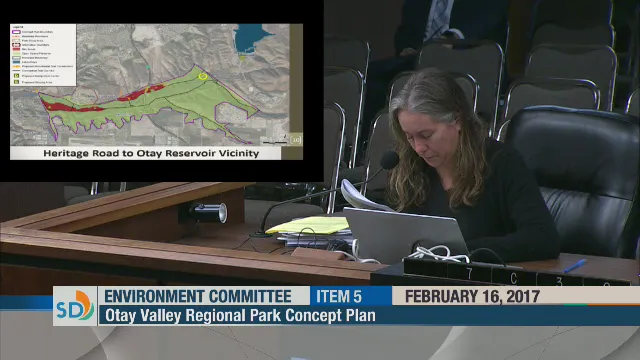
- Otay Valley Regional Park Concept Plan Update: Presented by Casey Smith and Laura Ball. The plan updates the 2001 plan, incorporates new trails, adjusts boundaries (e.g., includes Swiss Park staging area), and removes the skydiving operation. The County and Park and Rec Board have already approved. The committee moved to forward it to City Council.
- Committee Work Plan for 2017-2018: Presented by Chair Alvarez. Priorities include CAP implementation, CCA exploration, urban forestry, bike plan, recycling, regional parks (including new Choyas Creek Regional Park), and undergrounding. Public speakers urged focusing on CCA and community plan updates.
Key Outcomes
- Approved Action Items (Items 1-3) unanimously.
- Approved IBA recommendations (Item 4) unanimously; authorized IBA to hire a consultant for future cost of service studies and rate designs, with funding from water/sewer funds; directed PUD to report on outreach, create a transparency policy, and update on tiered rates; requests for written timelines from PUD.
- Approved SRF loan applications (Items 6-10) unanimously, including $7 million increase for Pump Station 2 and $71 million for Pure Water planning/design.
- Approved forwarding Otay Valley Regional Park Concept Plan Update to City Council unanimously.
- Adopted the 2017-2018 committee work plan.
- Set next meeting date: March 16, 2017.
Meeting Transcript
We will get started. Thank you very much. Welcome to the February 16, 2017 meeting of the environment committee. We have all members present at the time. We have one non-agenda public comment before we go on to the uh docketed agenda items. Um so I will take Steve Guess. Mr. Guess, you will have uh two minutes to share with us. We want to come up to the lectern. And uh we have handouts that we've yes, yes. Everybody's received it. Go right ahead, sir. Good afternoon. My name is Steve Guest, and I am a business owner and property owner in Logan Heights on Logan Avenue, where Logan Avenue dead ends into Choyas Creek. I'm here to talk about the concerns that our neighborhood is having with flooding issues caused by Choyas Creek. And these issues are being caused by, in my opinion, lack of maintenance and lack of repairs on Choice Creek. I have a copy of the Choyas Creek Enhancement Program from 2002 that stated that a lot of these issues that we're having were to be addressed, and nothing has been done in that area until last year when they did an emergency clean out of the debris in Choyas Creek to help the flow down to the bay. We've been there for over 30 years, and the first 18 years that we were there, flooding was not an issue. The last 13 years we've been there, we've been flooded 11 times from anywhere six inches to two feet of water in our offices in our building, and in the last six years, we've been flooded eight times. And as recently as three weeks ago, we were flooded. And the handout that I gave you, there are some pictures of some of the reasons that were getting flooded. One is if you would reference picture number two. That is a gunnite berm that was put on the street side of the levee where Choyas Creek is. Well, I met with I met with your staff, and they took some pictures and brought it to your attention. And a couple months later, there was postings on the chain link fence that there were repairs scheduled to be made. A couple months later, those postings came down and nothing's been done. Thank you very much. Appreciate you being here. Gene. We've also shared it with uh C R C O O Scott Chadwick. So we can respond to gentlemen if you need his information, we have it here. Thank you, sir. Thank you. All right. We uh will now move on to committee comment if there is any. I don't see anybody wishing to speak. So then we will move on to uh Mayoro or City Attorney or IBA comment. Anybody? Yes, I for our comment I wanted to uh invite Hala Rasak, the director of public utilities. She wanted to provide a quick update on um Orville Dam that which you may have heard uh in the recent news. Good afternoon. Um I wanted to give you a quick update on the situation of Orville Dam and give you a little bit of background on how the situation developed and what impact this might have on our water supply here in San Diego. Next slide, Seth. So this is a quick uh aerial photograph of the dam, and you will see where the main spillway is right to the to the if you're facing the dam uh is to the left hand side of the dam. And then the emergency spillway. You will notice that the main spillway is the is concreted in, but the emergency spillway it is not, is a natural terrain that then would lead back into the to the feather river. The um this dam is is the tallest earthen dam in the United States, and it holds uh a big portion of the Bay Delta water that then supplies the rest of the State of California. On February 7th, during a uh route routine use, reservoir releases through the operational spillway were increased from 44,500 to 54,000 to offset increased inflows from rainfall. That's all the rainfall that was large amounts of um inflow into the reservoir. Um this kind of increase um caused the damage that you can see in the picture.
openpublica.com