Environment Committee Meeting - May 25, 2017: Lead Testing, Rate Consultant, EPS Recycling
STREAMING COPY IN PREPARATION — RECORDING AVAILABLE FROM THE ORIGINAL SOURCE
Environment Committee Meeting - May 25, 2017
The Environment Committee of the San Diego City Council met on May 25, 2017, to discuss several items including a lead testing update in schools, a contract amendment for a rate consultant, and the expansion of curbside recycling to include expanded polystyrene (EPS) food containers. Councilmembers Ward, Kate, and Sherman were present.
Consent Calendar
- The committee approved the record of action items from April 13, 2017, by unanimous consent (Sherman absent).
- Four consent agenda items were moved and approved unanimously.
Public Comments & Testimony
- Healthy Soils Coalition: Mickey Nabb, director of operations for Mesa Family Restaurant Group, spoke on behalf of the coalition requesting an organics policy innovation process. He described two local innovators (Closing the Loop and Food to Soil) and his own experience diverting 60% of waste from landfill while saving money. The coalition requested a one-year exemption for existing organics operators and a fast-track process to avoid being outlawed as of July 1, 2017. The chair directed the mayor's office and Environmental Services Department to review the proposal.
- Jim Ambroso (Resource Management Group) echoed the request for an exemption for small food waste collectors up to 1,000 tons per year and asked for more time.
- Carolina Rodriguez (Climate Action Campaign) supported the Healthy Soils proposal as a win-win for the city, restaurants, and small businesses.
- Anne Feige (Community Forest Advisory Board) thanked the committee for confirming new members and expressed concern about lack of staffing for the urban forestry program, noting only three staff (two vacant) for a city of San Diego's size.
Discussion Items
Lead Testing in Schools (Informational Update)
- Peter Vroom (Deputy Public Utilities Director) provided an update on lead testing in K-12 schools. Of 202 schools tested, results for 164 were returned: 161 below the action level (15 ppb), three above. Two schools (Emerson Elementary and San Diego Co-op #2) were co-located and remediated; Bernie Elementary was pending retest. San Diego Public Utilities has received 250 requests, representing over 25% of all statewide requests. Testing costs: $230,000 startup, $2,200 per school. The state permit requires testing through November 2019. Councilmembers Kate and Ward asked about cost reimbursement, school district remediation deadlines, and the potential for legislative changes. No action taken.
Rate Consultant Contract Amendment
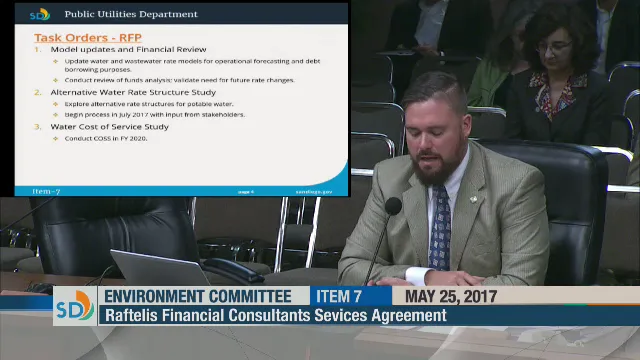
- Staff presented an amendment to a contract with a financial consulting firm to provide rate consultant services, including model updates, alternative rate structure review, and cost-of-service studies for water and wastewater. Councilmember Kate requested adding specific language ensuring the consultant would present multiple viable rate structure options with comparative analysis to the council. After discussion, a motion to approve with that clarification was made and seconded, and passed unanimously.
Fifth Amendment to Curbside Recyclable Materials Processing and Marketing Contract
- Angela Colton (Waste Reduction Deputy Director) presented the amendment to include expanded polystyrene (EPS) food containers in the city's curbside recycling program. Implementation target: July 1, 2017. Estimated cost: $90,000 per year. Public speakers supported the amendment: Clarissa Falcon (Dart Container Corporation), Chris Duggan (California Restaurant Association), and Sophie Barnhorst (San Diego Regional Chamber of Commerce) all urged approval. Councilmember Sherman noted the importance of outreach to educate residents. A motion to approve and send to full council passed unanimously.
Key Outcomes
- The committee referred the Healthy Soils Coalition's organics proposal to the mayor's office and Environmental Services Department for analysis.
- The lead testing update was received; no action taken.
- The rate consultant contract amendment was approved with a request for explicit language on rate structure options.
- The Fifth Amendment to the curbside recycling contract was approved and sent to the full City Council.
The meeting adjourned. The next regularly scheduled Environment Committee meeting is June 29, 2017, at 9:00 a.m.
Meeting Transcript
Good afternoon, everybody. We'll call to order the meeting of May 25th, 2017 of the Environment Committee. Councilmembers Ward and Kate are present. Councilmember Sherman will be joining us shortly. The first thing that we will do today is uh approval of the record of action items for April 13th, 2017, our last meeting. Unless there's any committee questions, um, we will approve that by unanimous consent, noting Mr. Sherman absent. Move on now to the non-agenda public comment. We have an opportunity for members of the public to uh speak on an item not on today's agenda that's pertinent to this committee. We have an organized presentation. I think Mickey Nabb might be the one giving this, but Sarah Boltwalla, Bray Young, Ellie Brown, Dan DiMarco, and Pia Pisotelli are um listed as the uh those submitting slips in support or seating time, I should say, uh, to this presentation from the Healthy Soils Coalition. Um we'll put 15 minutes on the clock. You'll see I think those lights where you're standing work, it goes from green to yellow. Yellow means I think you've got about a minute left. Um if you're all going to speak, you manage your own time. If it's just uh one individual, then that's okay as well. So um we'll start your time. Thank you. Thank you. Uh environment committee members, thank you for your time and attention. My name is Mikey Nabb. I'm the director of operations for the Mesa Family Restaurant Group. Uh today I'm speaking on behalf of the Healthy Soils Coalition, of which I'm a member. Our mission is to support entrepreneurship activity in San Diego around organics, which includes food and yard waste. Next slide. Our vision is for San Diego to be a leader in building healthy, resilient, and even more productive food system. This can be achieved by keeping our organic food waste local and directed to highest and best use in our community. Our county has more small farms and organic farms than any other county in the country. When we say highest and best use, we refer to the food waste pyramid hierarchy promoted by the San Diego Food System Alliance. First food for people, then animals, and then soil. When it comes to food scraps, there's room for all players, but we need to prioritize efforts that keep our compost piles closest to us. So community gardens and farms. Our coalition consists of organic recyclers, nonprofits, local food businesses, farmers, gardeners, and advocates. First, innovation and small business success and jobs. Second, services at a competitive price point. Third, environmental stewardship and education. Fourth, positive impact for the city's climate action plan goals, and finally, healthy soil for gardens and farms. I'd like to share stories of two innovators in our emerging market. First, closing the loop, a disabled veteran-owned business, operating in a HUD zone, employing local citizens from the neighborhood. They divert a million pounds of food waste a year for vermicomposting, providing local farms with free, natural, nutrient-rich fertilizers. My second example of an innovation in food waste diversion and organics market growth is food to soil. A social enterprise collective of chefs and community gardens that transforms the pre-consumer kitchen scraps from member restaurants into compost for urban gardeners. The collected is the collective is funded by its members. Restaurants who pay membership fee to participate in the collective and community gardens who make in-kind contributions of space and water towards the composting activity. Food to soil hires technicians who are passionate about growing soil in the community. For Ponce, I'll tell a story of how I came to learn about this coalition. About 18 months ago, I started asking our franchise hauler if we could do composting. The answer was no. And when I asked why, they said San Diego doesn't have a facility that can process organic food waste. They're not accepting new end users.
openpublica.com