Environment Committee Meeting - July 28, 2017: Bike Plan, Litter Abatement, School Lead Testing
STREAMING COPY IN PREPARATION — RECORDING AVAILABLE FROM THE ORIGINAL SOURCE
Environment Committee Meeting - July 28, 2017
The Environment Committee met on July 28, 2017, to discuss the bicycle master plan strategic implementation, a pilot program for litter and graffiti abatement, and an update on lead testing in schools. The committee approved consent items and heard public comments on community choice energy and waste issues.
Consent Calendar
- Unanimously approved the record of action items from the June 29, 2017 meeting.
- Approved two consent items (no additional details provided).
Public Comments & Testimony
- Sophie Wolfram (Climate Action Campaign) expressed strong support for community choice energy, citing a feasibility study showing rates competitive with SDG&E, potential for over $50 million annual revenue for clean energy initiatives, and benefits for achieving climate action plan goals.
- Martha Welch (public comment) expressed concern about rising garbage costs and lack of street recycling in San Diego, urging the city to improve recycling services.
- Patricia Murphy (San Diego 350) expressed support for community choice energy, highlighting its potential for more renewable energy at lower cost, economic development, green jobs, and consumer choice.
Discussion Items
1. Bicycle Master Plan Strategic Implementation Plan
- Staff Presentation: Linda Morabian (Deputy Director, Transportation Engineering) and Brian Genovese (Senior Traffic Engineer) presented staff responses to the Bike Advisory Committee's (BAC) strategic implementation plan. Staff agreed with 24 of 32 tasks, partially agreed or disagreed with 8 tasks related to budget, staffing, and feasibility. Key disagreements included completing high-priority projects by 2020 (estimated $77 million), updating the bicycle master plan (pre-dates climate action plan and Vision Zero), and dedicating 6% of transportation funding to bike projects.
- BAC Chair Andy Hanshaw emphasized the need for accelerated implementation, protected bike networks, and prioritization of Vision Zero corridors and underserved communities. He noted the plan's alignment with climate action goals and the downtown mobility plan.
- Public Comment (Sophie Wolfram) reiterated concerns about outdated bicycle master plan not aligning with climate action targets and lack of firm funding commitment. She urged integration of mode share targets and updated planning documents.
- Committee Questions: Councilmembers asked about ridership tracking (counters being installed, challenges with vendors), costs of bike elements in resurfacing projects (approximately 10% additional), funding sources (grants sought, $10 million in FY18), and the need for a safe routes to school coordinator.
- Councilmember Alvarez stressed the need for measurable metrics (mode share, greenhouse gas reductions) and accountability. He questioned whether updating the bicycle master plan would help align with climate action plan targets.
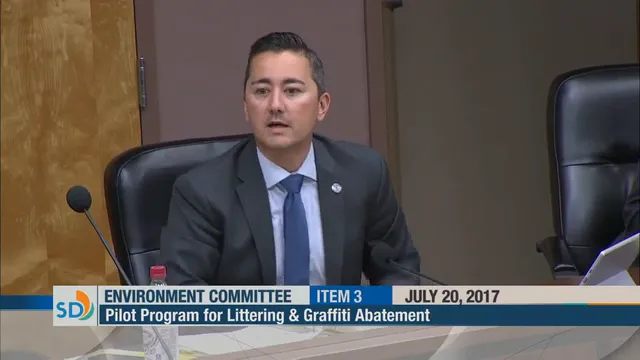
2. Litter and Graffiti Abatement Pilot Program
- Staff Presentation: Darren Greenhall (Assistant Director, Environmental Services Dept.) presented the 12-month pilot program (FY 2018, $800,000) targeting nine neighborhoods. Early results (May-July): collected 126 tons of waste, 736 bulky items, 250 mattresses, and various appliances. Crews operate Monday-Friday with two four-person teams; graffiti abatement coordinated with Streets Division (over 300 reports, 150 abatements to date).
- Public Comment: Jim Varnador (City Heights Town Council) supported the program and requested focus on alleys in City Heights, urging future budget expansion.
- Committee Questions: Councilmembers discussed selection criteria (hot spots, complaint data), potential expansion, data tracking by neighborhood, coordination with existing maintenance assessment districts and community cleanups, and enforcement against illegal dumping. Councilmember Alvarez requested a mid-year update for budget planning.
3. Lead Testing in Schools Update
- Staff Presentation: Peter Broom (Deputy Director, Public Utilities) reported that San Diego Public Utilities completed sampling at 236 schools (198 San Diego Unified, 38 others) ahead of schedule, representing 47% of county requests and 20% of statewide requests. Of 1,115 samples, only five exceeded the action level of 15 parts per billion, from four schools (Emerson Elementary, San Diego Co-op #2, Smythe Elementary, and one in San Ysidro School District). City costs to date: $480,000 (88% labor); estimated total $905,000. City will seek state reimbursement via a test claim.
- Committee Questions: Councilmembers probed costs (rate-payer dollars), timeline for state reimbursement (uncertain), workload for remaining schools (140 requests possible by 2019), and potential annual testing legislation. Staff noted they have not costed annual testing but will share data with Assemblymember Gonzalez Fletcher to inform policy.
Key Outcomes
- Bicycle Master Plan: The committee directed the Bike Advisory Committee to incorporate staff analysis and committee comments and return with a final strategic implementation plan at the September meeting for potential action and recommendation to full council.
- Litter Abatement Pilot: No action required; staff will provide a mid-year update to the committee to inform future budget decisions.
- Lead Testing: No action required; informational item. City will continue to sample upon request and pursue state reimbursement.
Meeting Transcript
Good afternoon, everybody. Thank you very much for your patience. We will I will call the meeting to order. This is July 28th, 2017 Environment Committee meeting. All council members are present. First thing we'll take up is the approval of record of action items for our June 29th, 2017 meeting. We'll now move on to the consent. Sorry, to the uh non-agenda public comment. We have three speakers, so we can be prepared. Sophie Wolfram, Martha Welch, and then Patricia Murphy. Come on up. You'll have two minutes each. Good afternoon, Sophie Wolfram with Climate Action Campaign. We just wanted to share that we are very excited about, encouraged by the results of a technical feasibility study for community choice energy, which was released, of course, last week. The study found that rates in a community choice program would be at least competitive with SDG and E's rates, if not lower. Beyond that, the program would likely be in the black within five years. And once it's generating revenue, we'll see over $50 million annually to spend on clean energy initiatives that previously would have gone to shareholders. We can subsidize solar EVs, efficiency retrofits, or other programs that would go towards achieving our climate action plan goals. Community choice energy sets the stage for building local clean energy, creating jobs and growing our economy here in San Diego. And community choice will give us lower bills, cleaner air, and the freedom of choice for the families and businesses that are currently stuck under the monopoly of SDG with no choice and no control. So we look forward to a discussion with this committee later in the year. Thank you very much. Thank you. We will have that at our September meeting. Thank you very much. Martha Welch and then Patricia Murphy. Martha Welch, good afternoon. About the garbage. And the reader told me about this on the garbage is going up like that. How high is it going to go? Oh, I I look on the computer and I can't see the dun county. The county uh uh saying I'm not knowing the can about that. On the streets of San Diego, we won't have recycle on the streets right now, and that's you should do that because we're working for zero uh waste, but that'd be very good because we can't do it in not the city, but the whole city should do that on the streets downtown. I don't know if the downtowns there or not, uh I'm I'm sure if that's them or not. But we should do that because you know we can catch a lot of um trash that way and recycle it if we can, because I know the county sold that the their time for their pent. So I don't uh I think it's private right now for all that stuff because the county did that. Now in Francies, you know, the trash and everything, you know what it is. Because um if they can't you if you pay they pay you, and then you don't pay them because and then and then we have to put if if it you're private, like a part or something, then the trash goes higher. Now I know the houses are free because of citizens uh citizens and uh citizens um citizens uh pro whatever it was called. It's free, it's free for free for houses. But um that's what's a problem with San Diego. That's that that's how you do stuff. Uh you uh you make us pay more because all these fans um um from Francis fees or whatever you call them. I see it all over the city. You have this stuff, and it uh uh if if if they can't money uh business has to make money. So if they don't get money from you and you pay you, they have the money over here, much be higher. That's what you do. You don't care about garbage to see me because you don't um have um um recycling on the streets. It must make to me. Thank you, Patricia Murphy.
openpublica.com