San Diego Environment Committee Meeting Addresses Water Billing, Undergrounding, and Climate Action Plan – February 8, 2018
STREAMING COPY IN PREPARATION — RECORDING AVAILABLE FROM THE ORIGINAL SOURCE
San Diego Environment Committee Meeting – February 8, 2018
The Environment Committee of the San Diego City Council convened at 9:00 AM on Thursday, February 8, 2018, with Chair Alvarez and Councilmembers Kate, Sherman, and Gomez present. The agenda covered updates on water billing errors, utility undergrounding, and the Climate Action Plan, along with approvals for a water pipeline loan, a consulting agreement amendment, and a joint use agreement with SDG&E. Public testimony focused heavily on Community Choice Energy.
Consent Calendar
- Approval of the record of action items from the December 7, 2017 meeting: unanimous consent with an abstention from Councilmember Gomez (3–0–1).
Public Comments & Testimony
- Non-agenda public comment: Martha Welch spoke about high SDG&E kilowatt rates, the absence of a city/county sewer plant, and untreated sewage going into the ocean.
- Sophie Wolfram (Climate Action Campaign) reported San Diego scored bronze on CAP implementation, and said a 20% drop in transportation emissions was a "statistical glitch" due to SANDAG modeling changes, with VMT rising since 2012.
- On the SDG&E joint use agreement, Jay Powell opposed, asking why a major transmission-line investment was proceeding before the master plan update.
- On the CAP/100% renewable item, many speakers supported Community Choice Energy, including Aaron Wilson, Joyce Lane, Sonia Robinson, Mikey Nabb, Ryan O'Connor, and Sebastian Saria. They cited SDG&E rate increases (24% between 2015 and 2017 per the Office of Ratepayer Advocates), monopoly concerns, and the need to move forward. Rochelle Melius urged tree preservation and code compliance enforcement. Sophie Wolfram recommended adding an FTE for equity criteria, completing a transportation master plan, fully funding cycle tracks, and adding four urban forestry FTEs. Eddie Price challenged the council to connect climate investments to community benefits.
- On the committee priorities item, Jay Powell suggested reviewing the Environmental Growth Fund and franchise agreement conditions.
Discussion Items
- Water Billing Issues Update: The PUD found 343 misread meters out of 3,041 reviewed in Carmel Valley, Mira Mesa, Rancho Bernardo, and Rancho Peñasquitos; overcharges averaged $186–$420 for single-family customers. Factors included the 6.9% rate increase effective August 2017, a 10-day extended billing period in Nov–Dec 2017, leaks, and warmer weather. PUD will implement process changes and provides a customer hotline (619-515-3500). The chair raised concerns about rate tiers, monthly billing, and payback; the next update is scheduled for March.
- Item 1 – Marina Pipeline SRF Loan: The committee unanimously approved authorizing a Drinking Water State Revolving Fund loan up to $39 million for the Marina Pipeline project ($38.2 million estimated cost plus $1.8 million contingency). The project, which adds transmission capacity to La Jolla and Pacific Beach, will be bid with Pure Water North City components. Repayment term is 30 years with estimated $1.7 million annual debt service beginning FY2023.
- Item 2 – San Vicente Hydroelectric Pump Storage: The committee unanimously approved the third amendment to Dr. David Victor's consulting agreement for energy market review. The project is a 300–500 MW pump storage facility at San Vicente Reservoir. Dr. Victor's services are city-only and average $60,000/year. Two finalists (Tenasca Diamond and Brookfield Renewables) were identified, with Tenasca Diamond slightly ahead; term sheet expected in spring/summer 2018.
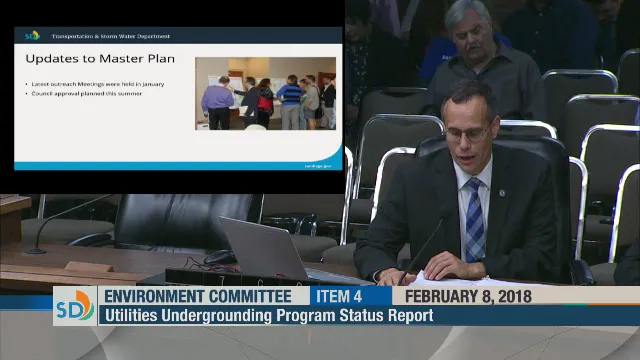
- Item 4 – Utilities Undergrounding Status: Staff reported that over 400 miles are complete, with 1,250 miles remaining under the updated master plan. Annual revenue from the surcharge increased from $50 million to $60 million. Project boundaries now follow SDG&E circuitry to avoid the delays seen in Sherman Heights, where poles remain from a 2004-05 project; completion is expected by next year.
- Item 3 – Kearny Mesa Transmission Line Undergrounding and Joint Use Agreement: The committee unanimously approved a $20.4 million project funded by the undergrounding surcharge to underground 3.7 miles of 69-kV transmission lines (TL663) and associated distribution/communication lines in Kearny Mesa. The city's share includes $9.8 million for transmission and $10.6 million for distribution/communication. A joint use agreement shares future relocation costs 50-50 with SDG&E.
- Item 5 – CAP Phase One and 100% Renewable Energy Update: Staff reported all 18 CAP actions are in progress; phase one actions were completed, deferred, or on track. GHG emissions are trending downward. For 100% renewable energy, the city is exploring both SDG&E's procurement proposal and Community Choice Aggregation. A CCA feasibility study found competitive rates. The PCIA exit-fee proceeding's proposed decision is expected in July; a third-party review of SDG&E's proposal is due early March. Committee members requested better equity metrics and data collection. The city attorney noted San Diego intervened in the PCIA proceeding, with a final decision possibly in August.
- Committee Priorities: Chair Alvarez outlined the 2018 work plan, including Pure Water monitoring, stormwater capture, water conservation, water billing fixes, cost of service study, Tijuana sewage, storm drain maintenance, CAP implementation, lead poisoning prevention, and regional parks/open space.
Key Outcomes
- Approved the December 7, 2017 meeting action record (3–0–1).
- Unanimously approved the Marina Pipeline SRF loan authorization.
- Unanimously approved the third amendment to Dr. Victor's agreement.
- Unanimously approved the Kearny Mesa transmission line undergrounding and joint use agreement.
- Received the water billing update; PUD will return on March 8, 2018.
- Received the CAP/100% renewable update; staff will provide quarterly updates and a decision target of Q4 2018.
- Adopted the 2018 committee priorities; next meeting is March 8, 2018.
Meeting Transcript
Good afternoon, everybody. Welcome to our February 8th, 2018 Environment Committee meeting. First meeting of the year. It's great to see you all here. Thank you for being here. We have uh all council members present, part of this committee, Councilmember Kate, Councilmember Sherman, Councilmember Gomez. Welcome actually to the first meeting, yeah. Uh and welcome back to to the others. First, we will start off with non-agenda public comment. We have a couple of speakers who wish to speak on an item not on today's agenda. So we will start with Martha Welch. And then we will have Sophie Wolfham. Martha Welch. San Diego guests has friends um here to the city. About five per FIPEN revenue. They make us pay the uh um pay back to them because they won't they won't they won't let the money they don't so they make us pay on we have the high highest pay uh killer in the state. The readers talk about Mark uh Marg Dora and Ray Let's talk about this in the radio. Now um we um now everywhere in the state is it flat. Killer walk is flat. Not here we have tiers. Everything the coast is lower and and if everything in that is higher. So it's not flat. So that's where they talked about it. And now you um so we have to pay it because we uh higher because the reader said the uh chart we're the highest kilowatt in the state. And that's not right because uh we have to if we have conferences that we have to not directly, but the higher over here is higher. Our bills are and it affects everybody in the in this county and the city because we have to uh our bills are higher. Now also on go online. We have no sewer park for the city or the county. Now that shows we wouldn't have a sewer plant if you ask me, the county doesn't say they have one, and you don't say you have one, so I don't think you'll you don't care for the ocean. Because no one claims the sewer plant. Now point lone is a water treatment. Now you can't claim that one. So you can't you don't have one. The county doesn't step up, obviously. Now I went to the meetings back in the 90s sometime down to the convention. It was already built. They showed these three plants. We're gonna the county would be three plants. One in Mexico, one in down there, and one in North County. It never built, never built. That's what the county did. So you don't care about the ocean or something, because the readers also said untreated sewage goes into the ocean. Now I care about the ocean. I used to I like the ocean a lot. And now that's why the ocean is so polluted with acid here. Thank you. Our next speaker, Sophie. Um on Tuesday, Climate Action Campaign released its second annual climate action plan report card which assesses climate planning and progress in cities across the region. And I just want to share a quick update with you on the results for San Diego. San Diego scored bronze for cap implementation with room for improvement, especially in its progress on transportation and social equity.
openpublica.com