San Diego Environment Committee Meeting on April 18, 2019
STREAMING COPY IN PREPARATION — RECORDING AVAILABLE FROM THE ORIGINAL SOURCE
San Diego Environment Committee Meeting on April 18, 2019
The Environment Committee of the San Diego City Council met on April 18, 2019, to discuss and vote on several items, including the Mission Trails Regional Park Master Plan Update, urban forestry initiatives, Balboa Park tree inventory, the Independent Rates Oversight Committee annual report, and action items related to water treatment chemicals, remediation cleanup services, and curbside recycling contracts. The meeting included extensive public testimony and presentations from city staff, advisory boards, and community organizations.
Consent Calendar
- The committee approved a routine consent item at the start of the meeting, but no details were provided in the transcript.
Public Comments & Testimony
- Mission Trails Regional Park Master Plan Update: Multiple speakers expressed support or opposition.
- Jim Whalen (Planning Commission) supported staff recommendation, noting challenges with trails and private property issues.
- Dorothy Leonard (Chair, Mission Trails CAC) urged support, highlighting long community involvement.
- Meg Disz (County of San Diego Trails Program Coordinator) voiced county support.
- Susie Murphy, Kevin Loomis, and Ben Stone (San Diego Mountain Biking Association) supported the plan, emphasizing compromise and collaboration.
- Jeff Harkness (former project manager) supported the plan.
- Gail Severins (California Department of Fish and Wildlife) opposed the Spring Canyon to Boulder trail segment, citing impacts on wildlife movement. Requested removal or alternative alignment.
- Frank Landis (community member) opposed the plan as written, requesting prioritization of resource protection over trail closures.
- Michael Beck (Endangered Habitats League) opposed the controversial trail segment but noted a potential compromise.
- Jack Zaruk (East Elliott property owner) opposed the park extension, requesting fairness for property owners.
- Urban Forestry Program: Several speakers supported tree planting and maintenance.
- Janae Krueger (Trees 1000 Foundation) described private tree planting efforts in University City.
- Andrew Meyer (San Diego Audubon Society) supported urban forestry, emphasizing native plants.
- Frank Landis (again) advocated for native trees and multifunctional planning.
- Kathy Copley (ASLA) presented concerns about inadequate soil volumes, standards, and code enforcement, recommending updates.
- Muriel King (Bay Terraces Community Association) requested more trees and city investment.
- Virginia Wilson (Ocean Beach) described a successful street tree education program.
- Dr. Cody Peterson (Resource Conservation District) emphasized the catastrophic loss of trees in canyons and urged higher investment.
- Rob Huitzel (San Diego River Park Foundation) supported tree canopy measurement and partnership.
- Adrienne Heinzelman (San Diego 350) supported urban forestry for climate goals.
- Troy Murphy (CFAB) requested a dedicated code compliance officer.
- Rochelle Mallius (Tree San Diego) stressed water for trees and landscape regulation updates.
Discussion Items
- Mission Trails Regional Park Master Plan Update: Staff presented the update, including new trails, natural resource management, and community plan amendments. The plan had support from the Planning Commission (4-0) and Task Force. Key controversy centered on a 0.5-mile trail segment in East Elliott near SR-52. Councilmember Sherman moved to recommend approval, citing compromise. Councilmember Moreno expressed concern about Fish and Wildlife objections but noted the trail's location near the freeway. The item passed 4-0.
- Urban Forestry Program: Brian Widner (City Forester) reported on 2018 activities: 2,500 trees planted, 40,000 trimmed, 2,000 removed. Tree canopy is 13% with a goal of 15% by 2020 and 35% by 2035. Challenges include pests (palm weevil, shot hole borer) and infrastructure conflicts. Ann Fage (Community Forest Advisory Board) presented four recommendations: engage communities, develop a long-term planting program, update codes and standards, and explore financing options. Councilmembers discussed training, code enforcement, and funding.
- Balboa Park Urban Forest Program: Tomas Herrera-Mischler (Balboa Park Conservancy) presented a tree inventory of 15,302 trees, noting increased species diversity but a 4% decline in excellent health and a 4% increase in dead trees. He highlighted the need for proactive pest management and succession planting. Councilmember Moreno raised concerns about water restrictions during drought and suggested carving out exceptions for historic trees.
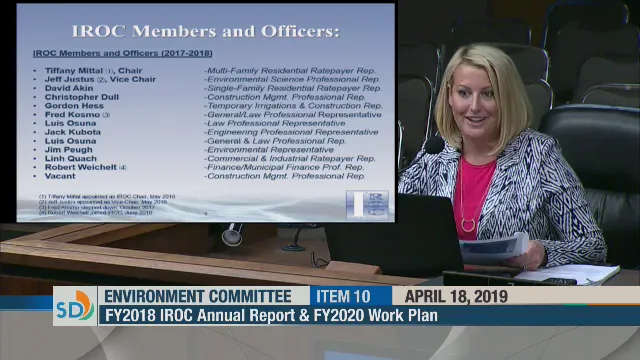
- Independent Rates Oversight Committee (IROC) Annual Report: Tiffany Mittel and Jeff Justice presented 13 recommendations, including tracking Pure Water costs, developing a strategic plan, and conducting informal rate reviews. They requested an independent consultant for IROC. Councilmember Sherman supported the need for independent expertise.
- Action Item: Ferric Chloride Contract: The committee approved a contract with Camera Water Solutions for ferric chloride (no opposition, passed 4-0).
- Action Item: Remediation Cleanup Contract Amendment: The committee approved adding $5 million to the contract with Luth and Turley for cleanup services from water main breaks and sewer backups, following major breaks like Idaho Street (estimated $1.2 million). Motion passed 4-0.
- Action Item: Curbside Recycling Contract Extension: The committee approved a two-month extension (through August 30, 2019) with Allen Company due to market impacts from China's National Sword policy. The new RFP is underway. Motion passed 4-0.
Key Outcomes
- Mission Trails Regional Park Master Plan Update: Recommended to City Council for approval (4-0).
- Urban Forestry: Informational item; no vote. Councilmembers committed to exploring funding and policy improvements.
- Balboa Park Urban Forest Program: Informational; no vote. Councilmember Moreno suggested a formal exemption for historic trees from drought restrictions.
- IROC Annual Report: Informational; no vote. Councilmember Sherman supported funding an independent consultant.
- Action Items: All three action items were approved 4-0: (1) Ferric chloride contract with Camera Water Solutions, (2) $5 million amendment for remediation cleanup with Luth and Turley, (3) Two-month curbside recycling contract extension with Allen Company.
Meeting Transcript
My colleagues agree. Okay, so we have a motion and a second. All in favor, please say aye. Aye. Passes. Okay, and now we're gonna have a little bit of change in our agenda. Um we're going to go to item number five. Is it five? Yes. Item number five, the uh mission trails regional park master plan update. And we have presenting uh Betsy Miller from the planning department. We'll talk about this for us and uh any related amendments to the Navajo Tierra Santa East Elliott Community Plans, Rancho and Cantata Precise Plan and the General Plan. And how many minutes will you need? Betsy? About 13 minutes, please. Okay. All right. Go ahead and get started while they're setting up the PowerPoint. Hi, I'm Alyssa Moodle. I'm the deputy director in the planning department. And I want to introduce to you today Betsy Miller, the project manager for the Mission Trails Regional Park Master Plan Udate, Natural Resources Management Plan, Associated Actions, and the EIR. We're really excited to bring this forward to the environment committee. It has been a long process of working with our task force, our CAC, many of our user groups, wildlife agencies, and environmental stakeholders. And we come to you with a uh master plan update that we'd like to share with you a little bit more about the details and answer any questions that you may have. I'll pass it over to Betsy at this time. Thank you. The Mission Trails Regional Park Area is a natural resource-based park that's located within the East Central Region of San Diego, and it's one of the largest urban parks of its kind. Although it is mostly surrounded by residential development, Mission Trails Regional Park provides a core area of local native habitat and a unique natural park experience that is relatively accessible to the region's urban population. In 2010, the city initiated an update to the 1985 Mission Trails Regional Park Master Development Plan in order to address the current needs of the park and its stakeholders as well as evolving environmental protection requirements. For example, the Mission Trails Master Plan Update recognizes major development projects like the Mission Trails Regional Park Visitor Center that have been completed since the adoption of the original 1985 plan. The update also addresses the expansion of park boundaries from over 5,000 acres to nearly 10,000 acres, with the inclusion of property in both both East Elliott and West Sycamore. The Mission Trails Regional Park Natural Resource Management Plan has been prepared concurrent with the Master Plan update to meet requirements of the Multiple Species Conservation Program, a habitat conservation plan and a natural communities conservation plan, which was adopted by the City of San Diego in 1997. The multiple species conservation program requires development of area-specific management directives for Mission Trails Regional Park in order to guide adaptive management actions based on required environmental monitoring. The park is home to many rare, threatened, and endangered species and is considered a core biological area by the Multiple Species Conservation Program. The objectives of the Mission Trails Regional Park Master Plan Update and the Natural Resource Management Plan are focused on supporting safe and sustainable recreation opportunities while maintaining the high environmental value of this incredible natural area. The plans include a focus on development and maintenance of recreational amenities such as trails and parking, as well as detailed natural resource management strategies for the rare threatened and endangered species that inhabit the park. The master plan update provides recommendations for a range of facilities and park improvements at specific locations within the park that are based on need and feasibility. Recommendations include installation of additional education and interpretive signage, off-street parking facilities near the visitor center, along Mission Gorge Road near the Barker Way Trailhead to Coles Mountain, and near Big Rock Park in conjunction with the City of Santee. Trail improvements, reroutes, extensions and closures, restrooms at West Sycamore and Old Mission Dam, electric vehicle charging stations at the Park Visitor Center, fire resistant shade structures in remote remote areas of the park, and a ranger station at West Sycamore. The master plan update also expands the boundary of Mission Trails Regional Park to include West Sycamore and East Elliott. Both sites were included in the multi-habitat planning area by the multiple species conservation program in 1997. The current park is shown in red and is located south of the SR 52 freeway. West Sycamore is approximately 1,800 acres and is located north of MCAS Miramar and adjacent to the County of San Diego Sycamore Canyon Preserve. This area was conserved through an extraordinary benefits agreement between the City of San Diego and Sycamore Estates LLC, also known as Rancho Encantada. The city accepted the property in fee title in 2012. East Elliott is approximately 2,600 acres and is located north of the current park across SR-52. This area includes approximately 735 acres that have been acquired by the city at fair market value from willing sellers using mitigation or grant funds since the adoption of the MSCP. The master plan update does not change or limit existing development rights on private property in East Elliott. The master plan contains an updated trail system for Mission Trails Regional Park. These proposed changes to the trail system are based on current recreational usage, maintenance and operations needs, and increased sensitivity to environmental areas.
openpublica.com