San Diego Environment Committee Meeting: Stormwater Funding Strategy and Carbon Sequestration Briefings (July 15, 2021)
STREAMING COPY IN PREPARATION — RECORDING AVAILABLE FROM THE ORIGINAL SOURCE
San Diego Environment Committee Meeting: Stormwater Funding Strategy and Carbon Sequestration Briefings (July 15, 2021)
The San Diego City Council Environment Committee met virtually on July 15, 2021, for two informational presentations. The first was an update on the city's Stormwater Funding Strategy, including results of voter polling, focus groups, and a timeline for a potential November 2022 ballot measure. The second was a briefing on carbon sequestration from Wild Coast and Tree San Diego. No action was taken on either item.
Stormwater Funding Strategy Update
- Staff from the Stormwater Department (director Chris McFadden and Bethany) reported significant progress since January/February presentations, but emphasized a continued funding deficit. Fiscal 2021 stormwater needs exceed $500 million annually, with about $50 million coming from the general fund. The department has experienced 11 additional emergency failures at pump stations and pipes.
- Recent wins include $8.6 million in additional fiscal 2021–22 funding, $2.5 million for the funding strategy, and financing from SRF and WIFIA loans—over $700 million from WIFIA and over $54 million from SRF—for more than 100 stormwater, green infrastructure, and flood-resilience projects. A commercial paper issuance (to go to council in August) would unlock about $50 million.
- Stakeholder engagement: a voter survey (March 2021) and focus groups (May 2021) found that education increases support, that water quality and outdoor recreation are highly valued, and that the impermeable-area funding method (vs. property-type) is more popular. A two-thirds vote threshold may be feasible after education.
- Possible single-family residential bills were presented for both funding methods, but no method was selected.
- Next steps: return to committee in November 2021, formal audit recommendation updates in January 2022, rules committee in March 2022, city council vote in June 2022, with a potential ballot measure in November 2022.
Public Comments & Testimony
- Haney Hong (San Diego County Taxpayers Association) opposed new taxes or fees during the COVID recovery, citing chronic underfunding and suggesting the city follow the county's example of reducing fees.
- Leslie Reynolds (Groundwork San Diego, Choice Creek Coalition) applauded staff and supported the ballot measure, while urging immediate action on neighborhood stormwater issues in Districts 4 and 9.
- Matt O'Malley (San Diego Coastkeeper) supported the measure, noting Mission Bay had unsafe postings for 83 days and San Diego Bay for 164 days in 2020; he called taxpayer association comments "uninformed and misguided."
- Danielle Dolan (Local Government Commission) supported a dedicated funding source for multi-benefit stormwater solutions.
- Several speakers from environmental, community, and labor groups spoke in favor: Malika Marsden (Climate Action Campaign), Lucera Sanchez (San Diego Coastkeeper), Megan Flaherty (San Diego Audubon), David Gibson (Regional Water Quality Control Board), Jim Pugh (Audubon), Julie Corrales (Environmental Health Coalition), Andrew Meyer (Audubon), and many others.
- Jack Monger (Industrial Environmental Association) supported the ballot measure but recommended treating stormwater as a resource, arguing the plan spends $274 million per year on a system that wastes stormwater rather than harvesting it.
- Wayne Rosenbaum (IEA Water Committee) raised concerns about proposed rates—estimating industrial/commercial charges of 25 cents per impervious square foot, five times residential and ten times Los Angeles—and requested further discussions.
- Greg Montoya and Alida Chavez urged prioritization of the Green Alley Project in Southcrest and other immediate fixes.
- Victor Avina (Biomed Realty) said his client had no position on a specific mechanism but acknowledged the flooding problem.
- Lonnie Lutar, an individual, criticized the taxpayers association as "fiscally irresponsible," citing a $1.4 billion stormwater infrastructure deficit and a $270 million annual gap.
Discussion Items
- Vice Chair Von Wilpert received confirmation that emergency repairs forced deferral of green infrastructure projects, many of which are proposed for commercial paper funding.
- Councilmember K asked whether the FM3 poll tested funding at the full $274 million need; staff responded that it did not, and that they would seek an incremental amount rather than the full need.
- Councilmember LaCava noted that a November 2022 ballot measure would mean fees would not be imposed until at least 2023, helping the economic recovery.
- Chair Elo-Rivera emphasized that the funding should be framed as a transformative investment, citing the Whiteman Street Park project in District 9 as an example.
Key Outcomes
- This was an informational item; no motions or votes were taken.
- The committee will receive an update in November 2021 and formal audit recommendations in January 2022, with a possible November 2022 ballot measure.
Carbon Sequestration Briefings
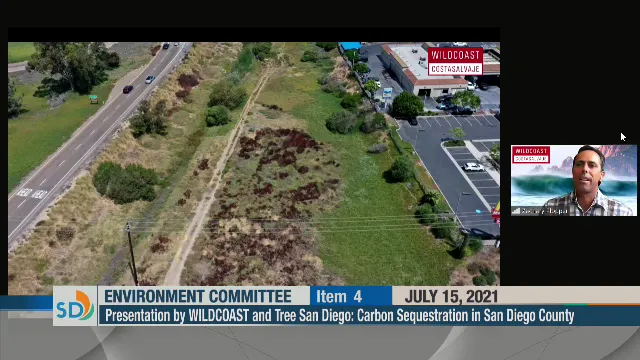
- Zach Flopper (Wild Coast) described blue carbon storage in coastal wetlands—mangroves, seagrass, and salt marsh—and reported fieldwork with Scripps Institution of Oceanography that collected 253 samples from Mission Bay, San Dieguito Lagoon, and Famosa Slough. He recommended restoration, improved tidal exchange, and protecting wetlands to allow migration with sea level rise.
- Electra of Tree San Diego presented the "Branch Out San Diego" program, a $1.2 million grant (with $1.6 million match) funded by California Climate Investments/CAL FIRE, aiming to plant nearly 1,600 trees on residential and tribal lands, sequestering more than 8,000 metric tons of CO2 over the trees' maturation. The program includes tree steward training, multi-spectral imaging, and community engagement.
- Public comment: Jim Pugh (San Diego Audubon and Friends of Famosa Slough) praised the work and urged the city to analyze carbon sequestration in projects like DeAnza Cove.
- Committee members thanked the presenters and discussed the need to integrate blue carbon and urban forestry into city climate planning. Councilmember LaCava asked about street tree barriers; Electra cited the need for greater urban forestry staffing and streamlined processes. Chair Elo-Rivera asked about tribal engagement, and both presenters confirmed ongoing work with tribes.
Key Outcomes (Carbon Item)
- Informational item only; no action taken.
- Presenters will provide recommendations later in the year; Tree San Diego hopes to reach 50% of tree plantings within one year.
Meeting Transcript
Our assistant deputy rector who not only oversees all of operations and maintenance but also has taken on this task. So thank you for taking the time, and this is we're really excited to bring this a lot of information back to committee. I think you'll find it very helpful. We really heard what you all said when we were in front of environment committee just a few months ago in full council. Since then, we're happy to report some more information that we've developed as a result of in response to the audit. A lot of that is listening to stakeholder input, which gave us extremely valuable feedback and what the community hears, what they expect, and what resonates with them. We also will be presenting information on likely surveys that we did from likely voters throughout the city, which I think will be very important for your information as we march forward with the uh proposed 2020 to 2022 ballot measure in November. And with that, I will turn it over to Bethany. Thank you so much, Chris, and it's a pleasure to be with all of you this afternoon. Uh, we appreciate the opportunity to be presenting the update to the stormwater funding strategy. So, as Chris mentioned, we wanted to mark the significant advancements since January and February of this year when we presented to environment committee and to council. There's been a significant amount of work that has occurred over the past six months, and there will be a significant amount of ramp up that will be occurring in the fiscal year 2022. So we wanted to provide you with a look ahead of what that will entail. Before we do so, wanted to present the overall timeline associated with this effort. Um, after this update today in July, we anticipate coming back in November because a lot of stakeholder engagement will be occurring over the next several months. So wanted to present an update in November. Ultimately, we will come back to present the formal recommendation updates to audit recommendation number six in January of 2022. Beyond that time frame, if we are to stay on track for the potential of a November 2022 ballot measure, we would go to rules committee around March, and then ultimately a city council vote in June. There is a significant amount of work that needs to be done. We anticipate staying on schedule, but there will be a significant ramp up to the stakeholder engagement over the next several months. Before we go into the next steps, we wanted to document that there still remains a significant deficit in terms of stormwater funding. In terms of the fiscal 21 funding, as everyone knows, we are heavily supported by the general fund, around 50 million dollars per year. The overall need in fiscal 21 for stormwater for our existing stormwater infrastructure is addition in addition to extra CIP projects is over 500 million dollars. So there remains a significant gap. Ultimately, what we have seen is that status quo is no longer acceptable. We've had an additional 11 emergency failures, both at our pump stations and our pipe failures as well. We've also seen significant delays in our environmental water quality progress. That being said, we did want to celebrate significant momentum that the stormwater department has had over the past six months and will be having as we move forward into fiscal 2022. We've considerably progressed modernizing our stormwater infrastructure. Many of our teams have fully converted into the city's enterprise asset management system. We have gone away from paper forms and we're fully on tablets now moving forward. That allows us to unlock real-time data and be and it allows us to optimize our program in real time. I'd also like to note that there's been uh several wins for us in terms of financing. So both the SRF and the WIFIA loans have unlocked over 700 million dollars for WIFIA and for SRF, over 54 million dollars of low-interest loans that allow uh stormwater projects, over a hundred additional stormwater green infrastructure and flood resilience projects to move forward. These are significant wins for us. It demonstrates that outside entities understand the value for stormwater and the need for stormwater funding in San Diego. I'd also like to highlight that there's been significant progress as far as the increase in funding for stormwater. Uh, it demonstrates a commitment by council and the mayor as well. Um, over $8.6 million of additional funding was provided to the stormwater department over the fiscal 21 levels. Um, that will allow us to expand our water quality response team or our bacteria tactical team will be able to perform over 20 additional in-depth investigations and over 1,500 code enforcement investigations with that new team. In addition to that, that also unlocks us to be able to increase our pipe repairs by over 2,500 lineal feet of repairs of urgent infrastructure upgrades that are needed because of the addition of an in-house piper peer team as well. So significant wins in addition to the fact that $2.5 million was allocated to advancing this stormwater funding strategy. So really wanted to highlight that there's been significant dedication in the recent past months towards stormwater. So all of that being said, there is still a significant gap in funding resources year over year that we expect for at least the next 20 years or so. You can see that what is represented here on the fiscal 2022 need is that there's a significant funding gap because we continue to push forward that backlog of projects, both the operations and maintenance needs for our existing system as well as capital repairs that need to be performed. The bottom line is a dedicated funding measure is still needed, even with the recent wins that we've had. I will also highlight though that commercial paper will be going forward to council in August. That will unlock around 50 million dollars of additional funding for these critical infrastructure repairs as well. So wanted to recognize that that's also very important for us moving forward. Moving forward as far as the long-term funding strategy is concerned, what we presented in January and February is that we benchmarked several communities in terms of how they've been successful with dedicated funding measures for stormwater.
openpublica.com