San Diego Environment Committee Meeting - May 26, 2022
STREAMING COPY IN PREPARATION — RECORDING AVAILABLE FROM THE ORIGINAL SOURCE
San Diego Environment Committee Meeting - May 26, 2022
The City of San Diego Environment Committee met on May 26, 2022, at 9:00 AM under Chair Councilmember Joe LaCava. The committee approved previous minutes, heard public comments on non-agenda items and four agenda items: amendments to beach fire regulations (action item), Climate Action Plan staffing analysis (informational), County of San Diego's Regional Decarbonization Framework (informational), and SDG&E's Path to Net Zero (informational). A motion to advance beach fire code amendments passed unanimously. All other items were informational, with discussion covering implementation needs, regional collaboration, and decarbonization challenges.
Consent Calendar
- The committee unanimously approved the minutes from the April 21, 2022 meeting (4-0 vote). No public comment was offered on the minutes.
Public Comments & Testimony
Non-Agenda Public Comment
- Becky Rapp, public health advocate and lifetime San Diego resident, spoke about negative environmental impacts of marijuana cultivation and manufacturing, including volatile organic compounds and health risks, urging better CEQA reviews.
- Mike McCormick, La Jolla Shores resident, commented on garbage cans on beaches, noting that high tides cause overflow and pollution.
- Dr. V Nguyen, pediatrician and member of Climate Action Campaign and American Academy of Pediatrics, opposed SDG&E's proposed plan, stating it does not meet climate goals and harms children's respiratory health.
Item 1: Beach Fire Code Amendments
- Cameron Naiman, owner of Beach Bonfires (in-person), opposed the amendment, asking for a permitting system for wood-burning bonfire businesses. He stated that banning wood fires would drive people to illegal fires.
- Renee Contreras, owner of an environmentally responsible bonfire company using propane, supported the ban on wood fires but urged the city to permit propane bonfire businesses, noting her company cleans beaches.
- Shupaway Suffolk (virtual), a recent UK transplant, opposed the ban, arguing wood fires are safe, cheap, and important for community, and questioned whether La Jolla residents are driving the change. He suggested more fire rings and better waste management.
- Kathy Ives, South Mission Beach resident and co-founder of Don't Trash Mission Beach, supported propane-only fires and legalizing propane fire companies, citing five illegal fires per night on the oceanfront.
- John Botteroff, CleanEarth4Kids.org, asked to stop all wood fires, citing health impacts of PM2.5 and carcinogens. He proposed ceasing all fires, including propane as a fossil fuel.
- Denise Friedman, co-founder of the bonfire task force, supported the proposal as an excellent start but requested Fiesta Island be explicitly listed. She anticipated eventual violations under air quality and climate action plans.
- Larry Webb, Mission Beach resident (speaking as individual, not Town Council president), expressed ambivalence but supported the measure due to lack of enforcement.
- Jean Walker, owner of Beach Genie (permitted bonfire company using propane), noted value in wood fires but observed beach cleanliness issues near public fire pits, suggesting regulating time, place, and manner.
- Suzanne Hume, CleanEarth4Kids.org, urged stopping all wood fires, citing burn victims, air pollution, and disproportionate harm to vulnerable populations.
- Mike McCormick, La Jolla Shores resident, supported stopping all wood fires, noting observed unsafe practices including use of gasoline to start fires.
- Joe (La Jolla Shores resident, virtual), supported the proposal as a reasonable balance, noting no other West Coast jurisdiction allows portable wood-burning pits.
- Josh Kennedy (with Kayla Kennedy), 20-year residents, said the issue has auto-corrected since COVID restrictions and police response is lacking; they supported permitting and better enforcement.
Item 2: CAP Staffing Analysis
- Mikey Nabb, Climate Action Campaign, applauded aggressive goals but expressed concerns that without a complete implementation plan with costs and funding, the CAP update may not meet CEQA standards and could miss federal/state funding.
- Mike McCormick suggested including zero-emission lifeguard vehicles (trucks and ATVs) in the electric vehicle strategy.
Item 3: County Regional Decarbonization Framework
- Shupaway Suffolk (virtual, also spoke on Item 1) noted that 40% of San Diego's carbon emissions come from transport, criticized poor public transit, and questioned council members' use of public transport. She also linked air pollution from highways and the airport to the decarbonization plan.
- Bertha Rodriguez, Climate Action Campaign and San Diego Green Deal Alliance, supported regional collaboration and urged support for AB 1640 to establish regional climate networks.
Item 4: SDG&E's Path to Net Zero
- John Botteroff, CleanEarth4Kids.org, opposed SDG&E's plan, calling it greenwashing that maximizes profits, prolongs fossil fuel use, and promotes unproven carbon capture. He cited Stanford researcher Mark Jacobson's view that existing technology (solar, wind, storage) is sufficient.
- Joyce Lane, San Diego 350, opposed the plan as a fossil fuel industry effort to delay real climate action, promoting unproven technologies like hydrogen and carbon capture.
- Serena Pelka, Climate Action Campaign, opposed the plan, stating it doubles down on fossil fuels, stalls climate action, and raises energy bills. She urged proven electrification over unproven technologies.
- Sean Kioni Ellis, political organizer for UA Local 230 (plumbers and pipefitters), supported SDG&E's plan, arguing for an all-of-the-above approach, noting that green hydrogen and carbon capture are being deployed (e.g., in Texas, Lancaster, LA ports) and create middle-class jobs. He cautioned that full electrification could increase costs for vulnerable communities.
- Dr. V Nguyen, pediatrician (American Academy of Pediatrics, San Diego Pediatrics for Clean Air), opposed the plan, citing health costs from fossil fuels and stating the plan does not meet children's health needs.
Discussion Items
Item 1: Amendments to San Diego Municipal Code Regarding Beach Fires Presentation by Brian Elliott (Chair LaCava's staff). The proposal clarifies permissible beach fires to city-provided rings and portable propane devices, removing ambiguous language about stoves/ovens. It aims to improve safety (preventing burns from buried coals) and enforcement clarity. The requested action is to direct the City Attorney to prepare an ordinance.
- Chair LaCava opened comments: he noted community input and public safety needs, and moved staff's recommendation.
- Councilmember Campbell (District 2) seconded, emphasizing public health and safety and elimination of confusion.
- Councilmember Von Wolpert asked for clarification on beach area definition and confirmation that fires in adjacent parks (e.g., city grills) are unaffected. Staff confirmed. She also questioned whether there are enough city fire rings to meet demand; staff noted willingness to assess need.
- Councilmember Campillo asked about cleanup of illegal ashes and enforcement; staff explained mechanized crew and park ranger roles. He expressed support, noting improved enforcement and public suggestions.
- A lifeguard representative attempted to provide additional insight but was unmuted briefly. The motion passed 4-0.
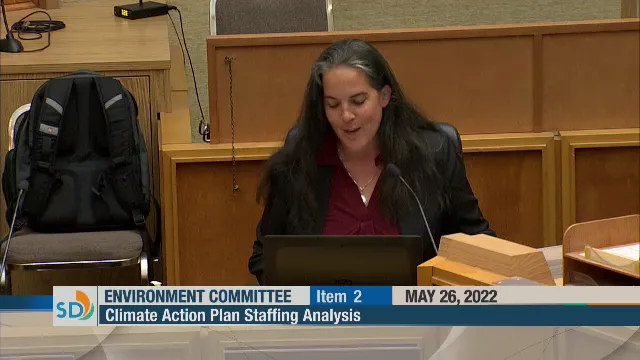
Item 2: Climate Action Plan Staffing Analysis Presentation by Heather Werner, Deputy Director of Sustainability and Mobility Department. The analysis identified six new full-time equivalent positions needed to implement the CAP, which were included in the Mayor's proposed FY23 budget. The methodology focused on CAP actions and gaps. The committee was informed that the updated CAP and draft implementation matrix will be presented in June 2022, with adoption expected. Other upcoming deliverables include the municipal energy implementation plan, CAP implementation plan (early 2023), annual monitoring report, and a zero-emission vehicle strategy (mid-2023).
- Councilmember Campillo asked about the process for each department to develop annual CAP work plans. Staff responded that an administrative regulation with a template is in development, coordinated with the Department of Finance.
- Councilmember Von Wolpert praised the six FTEs and the new EV charging personnel director. She asked about climate resiliency planning; staff noted Resilient SD plan and the hiring of a Chief Resilience Officer in Planning Department.
- Chair LaCava highlighted the new CAP compliance section in staff reports, embedding CAP goals across city operations.
Item 3: Informational Update on County of San Diego's Regional Decarbonization Framework Presentation by Dr. Murtaza Baxamusa, County Land Use and Environment Group. The framework is a science-based, data-driven effort to identify pathways to net zero by mid-century. Key findings: current regional CAP commitments are insufficient; transportation emissions are a major driver; building electrification is a near-term priority; protecting natural lands can cost-effectively sequester carbon. The framework also includes a workforce development study emphasizing high-road jobs (family-supporting wages, benefits, career pathways). Regional collaboration is essential for EV infrastructure, building codes, equity indicators, etc. Dr. Baxamusa noted the City of San Diego's leadership role.
- Councilmember Campillo supported regional collaboration and highlighted AB 1640, community choice energy (SDCP), and the five big moves transportation plan. He praised the estimate of 27,000 green jobs annually.
- Councilmember Von Wolpert commended the county's climate action shift and asked about environmental infrastructure projects under the Bipartisan Infrastructure Law. Staff mentioned active transportation, safe streets, reconnecting communities, and upcoming energy efficiency block grants and grid upgrades.
- Councilmember Campbell asked about geothermal energy; staff confirmed analysis of geothermal sites in Imperial Valley and interest in lithium extraction. Hydrogen discussion: staff noted cautious approach to ensure clean production. Also discussed need for class IV bike lanes to reduce transportation emissions.
- Chair LaCava noted SDCP now includes the County of San Diego as a member, and inquired about rooftop solar analysis; staff confirmed additional scenarios being developed.
Item 4: Informational Update on San Diego Gas & Electric's Path to Net Zero Presentation by Caitlin Haley (Regional Public Affairs Manager), Scott Kreider (Senior Vice President), and Samantha Pate (Director of Strategic Planning). The study, done with Dr. David Victor at UCSD, models a resource mix to achieve net zero by 2045 while maintaining reliability. Key findings: need to double electricity consumption and grid capacity by 2045, requiring 8,000 MW of solar per year (vs. current ~1,000 MW), massive storage, offshore wind, geothermal, and green hydrogen. Clean electricity and electrification (especially transportation and buildings) are primary drivers. The study projects growth from <100,000 to 3.4 million zero-emission vehicles in San Diego and from 7,000 to 640,000 public charging stations. Building electrification is a major challenge: 45% of water heating must be electrified by 2030, 98% by 2045. The presentation was the first of two annual updates to the committee under the Energy Cooperation Agreement.
- Councilmember Von Wolpert praised the franchise compliance monitoring and the Energy Independence Fund, but strongly criticized SDG&E's proposal to shift state-mandated public purpose program costs from ratepayers to the state budget. She highlighted high CEO pay ($25 million for Jeffrey Martin in 2021) and record dividend payouts while residents struggle with bills. She urged the CPUC to cap shareholder returns.
- Councilmember Campillo asked what prevents faster progress; SDG&E cited need for sufficient renewable resources and grid reliability, noting that SDCP now controls resource procurement (65% of customers). He asked about customer education for electrification; SDG&E said they are now supporting policies and starting contractor education; older homes need panel upgrades.
- Chair LaCava asked about
Meeting Transcript
Good afternoon. And welcome to the May 26, 2022 meeting of the City of San Diego Environment Committee. I am Joel O'Donnell, Councilman Chair of the Committee. Until further notice, committee meetings will be conducted pursuant to the provisions of California Government Code Section 54953E, added by Assembly Bill 361, which allows the city to use teleconferencing and to provide the public an opportunity to address the city council via call-in option or an internet-based service option during a proclaimed state of emergency. While the public is allowed to attend the meetings in person, we encourage you to maintain six feet of social distance as well as follow California mask guidelines where masks are strongly recommended. In addition to being able to attend in person, this meeting is being televised and live streamed on the city's website. And the committee liaison will continue to make arrangements for the public to comment using the Zoom webinar platform. Additionally, members of the public who wish to provide testimony via call-in or an internet-based service option must enter the virtual speaking queue within five minutes after the conclusion of in-person public testimony or before the virtual speaking queue is exhausted, whichever occurs first. This will allow for better meeting management between the two platforms and ensure the committee is able to manage and conduct city business. We appreciate the public's cooperation. I will now call the environment committee meeting of May 26, 2022 to order. Let me call the roll. Vice Chair Von Wolpert. Present. Campbell. Here. Member Campillo? Here. And I, Joe LaCava, the Chair, am here as well. So all members are present. All parti also participating in the meeting are Jordan Moore, Office of the Independent Budget Analyst, Deputy City Attorney Nicole Dino, and Randy Wilde, Senior Policy Advisor in the Office of Mayor Todd Gloria. Brian Elliott, our committee consultant, will now go over instructions for participating in the meeting. Brian? Good afternoon. If you are in person, please complete a speaker slip located at the entrance of chambers and place it in the box indicated at the speaker's lectern at the front of the room. Please do so in a timely manner to ensure proper meeting management. Members of the public can join the webinar by computer, tablet, or smartphone by accessing the link which is listed online in the preamble language of the agenda on the city's webpage. The link to join the committee meeting webinar by computer, tablet, or smartphone is listed on the agenda. To join the Zoom webinar by telephone, please dial 1 669-254-5252 when prompted, input webinar ID 161-532-0355 pound. This information is also available on the agenda and will appear on the screen during the public comment period for each agenda item. Members of the public who wish to provide testimony via a call-in or internet-based service option must enter the virtual speaking queue within five minutes after the conclusion of an in-person public testimony or before the virtual speaking queue is exhausted, whichever occurs first. Please note that if you are watching via City TV Channel 24 or online, there may be a delay. Please participate via the audio on your phone and mute your TV or computer when it's your when it is your turn to speak. When I introduce the item you would like to comment on, please raise your hand by either tapping the raise your hand button on your computer, tablet, or smartphone, or by pressing star 9 on your phone. You will then be taken in the order which you raise your hand. You may only speak once during a particular item. When I indicate it is your turn to speak, I will call you by your name as it appears on the Zoom webinar attendee list or read out loud the last four digits of your phone number if you have called into the meeting. That is how you will know it is your turn to speak. If you are in person, please come up to the reserve seats at the front of the room when your name is called and be prepared to come up to the lectern in the order called. If you have joined the webinar by computer, tablet, or smartphone, you will receive a pop-up notice to select to unmute your device if you have called into the meeting by cell phone or landline. Press star six on your phone to unmute yourself. We will review these instructions briefly again when the public comment period on an item is open. Please wait until the item you wish to speak to has been called before raising your hand to speak. If you raise your hand during a non-comment period, your hand will be lowered. When you are announced as the next speaker, please unmute yourself and offer your comments. Also, please mute the volume on your TV or computer before you begin to speak. Chair Lacava. Thank you, Brian. As mentioned, all members are present and we have a quorum. So we will now dispense with the approval of the committee actions of April 21st, 2022.
openpublica.com