San Diego Environment Committee Meeting - March 9, 2023
STREAMING COPY IN PREPARATION — RECORDING AVAILABLE FROM THE ORIGINAL SOURCE
San Diego Environment Committee Meeting - March 9, 2023
The Environment Committee of the San Diego City Council met on Thursday, March 9, 2023, at approximately 9:00 AM in chambers and via Zoom. The meeting included approval of consent items, discussion and votes on stormwater consultant contracts, a presentation on the Climate Action Implementation Plan (Net Zero by 2035), and adoption of a new council policy for prioritizing climate actions. Public testimony addressed a range of concerns including cannabis regulation, airport fuel contamination, transit feasibility, and the urgency of climate action implementation.
Consent Calendar
- Item 1: Second Amendment to Agreement with ATOL Ventures Ocean Imaging – Approved 4-0 unanimously.
- Approval of committee actions from February 9, 2023 – Passed 4-0.
Public Comments & Testimony
Non-Agenda Public Comment
- Paul Kruger (Talmadge resident) expressed support for the committee’s vote against sustainable development areas, citing a disconnect between climate goals and inadequate transit. He urged better transit system design to induce mode shift.
- Terry Ann Skelly (mentor/tutor) opposed increasing marijuana retail outlets, arguing that extension of big marijuana footprints harms communities of color and that smoking/vaping products remain leading causes of preventable disease.
- Sandra Stahl (past executive director, Montgomery Gibbs Environmental Coalition) called for an investigation into the Department of Real Estate and Airport Management for wasting taxpayer dollars on a fuel tank project, estimating a turnkey system could cost under $100,000 versus the authorized $500,000 and escalating to $1 million.
- Jay Powell stressed that energy independence should include local community-based renewable generation, not just 100% renewable imports, to create local jobs and equitable energy justice.
- Kelly McCormick (public health educator) advocated for a smoke-free multi-unit housing ordinance covering both smoking and vaping, noting marijuana smoke contains more toxins than tobacco smoke.
- Kathleen Lippett (longtime planning group attendee) defended planning group decisions against proposed city rules that would disenfranchise them, and opposed marijuana industry expansion, citing synergistic harms with tobacco.
- Becky Rapp (parent and public health educator) raised concerns about the cannabis business division’s plan to remove zoning and sensitive use separation requirements, arguing these barriers protect health and environment.
- Judy Strang described a pot shop named “Cookies” near a middle school in her neighborhood, opposing further marijuana outlets near youth.
Public Comment on Item 5 (Climate Action Implementation Plan)
Over 20 speakers testified, many from youth and environmental organizations. Key positions included:
- Youth Will representatives (Safia Hidari, Maya De La Torre, Claire Snyder) urged meaningful inclusion of youth voices and a just transition to zero carbon.
- Climate Action Campaign representatives (Madison Coleman, Serena Pelka, Brenda Garcia, Mikey Nabb, Ali Dressel) criticized the plan for lacking detailed benchmarks, timelines, and transparency on housing and building electrification actions. They called for an all-electric reach code for new construction without blanket exceptions.
- Paul Kruger (again) emphasized that transit must be useful (buses must go where people need to go) and that affordable housing should be near transit.
- Dennis Glennon supported the CAP but asked for specific completion timelines for each action.
- Nicole Burgess (Mobility Board, District 5) stressed that transportation is the largest GHG source and called for bold leadership on mode shift and street safety.
- Kelly Linden (San Diego 350) asked for interim milestones and quantitative progress tracking.
- Nisha Jean Martin (San Diego Urban Sustainability Coalition) requested that communities of concern be included in accountability processes.
- Ann Fage (Community Forest Advisory Board) supported tree canopy investments but stressed need for irrigation and enforcement of tree requirements in parking lots.
- Christina Marquez (IBEW Local 569) advocated good green union jobs and workforce standards in CAP implementation.
- Melanie Woods (California Apartment Association) warned against costly electrification mandates on existing multifamily buildings, urging incentives and stakeholder consultation.
- Brandon Weber (San Diego Audubon Society) supported tidal wetland restoration and requested biodiversity scoring.
- Matthew Adams (Building Industry Association) called for cost impact analysis on housing and urged engagement with regulated community.
- Blair Beekman suggested using smart streetlight data for environmental sensors and ensuring open data processes.
- Sonja Robinson asked if federal Inflation Reduction Act funds would be used and if advocates must fight for funding each year.
- Molly Kirkland (Southern California Rental Housing Association) advocated incentive-based approaches rather than mandates.
- Andrew Meyer (San Diego Audubon) asked for biodiversity category in scoring and faster wetland restoration.
- Cherry Sadiago (Climate Reality Project) expressed frustration over slow implementation and need for line-item timelines.
Public Comment on Item 4 (CAP Prioritization Policy)
- Lauren Casaris (San Diego Regional Chamber of Commerce) opposed advancing the policy because feasibility scores had been drastically reduced (from 17 to 12 for foundational actions, 22 to 13 for other actions). She urged delay to better incorporate private sector feasibility.
- Nicole Burgess argued that re-timing traffic signals to improve traffic flow (Strategy 3) makes driving easier at the expense of walking, biking, and transit. She supported parking pricing and incentive programs to shift mode.
- Paul Kruger (again) reiterated that 94% of people drive, and without a workable transit system, disincentives like removing parking won’t change behavior.
- Kelly Linden (San Diego Building Electrification Coalition) acknowledged the prioritization scores are one factor but worried they could be weaponized to delay action; she noted that the municipal building decarbonization (lowest score) is already underway and demonstrating leadership.
- Craig Benedetto (NAOP and BOMA San Diego) echoed the chamber’s call to delay, stating feasibility must consider impacts on housing costs and investment.
- Blair Beekman again emphasized mass transit and micromobility examples from Northern California.
Discussion Items
Items 2 and 3: Stormwater Professional Engineering Services Agreements
- Presentation: Interim Stormwater Director Summer Hassanen and Assistant Deputy Director Brianna Menke presented two five-year, $25 million contracts (each) for as-needed engineering services with RIC Engineering and Michael Baker International. Contracts cover MS4 permit compliance, asset management, watershed studies, etc. Both firms committed to over 25% SLBE/ELBE subconsultant participation. Cost estimates from storm drain fund (approx. $5M/year) and general fund.
- Committee Member Questions: Councilmember Campillo noted workforce diversity improvements in both firms but expressed concern about Rick Engineering’s underrepresentation growth in December 2022 report. EOC staff (Mr. Silva) clarified that progress is being made. Chair Lacava asked about previous contract values (historically $12.5M then $25M). He also noted that subconsultant total is larger than prime in some cases, but EOC only analyzes prime’s workforce; Silva confirmed Muni code limits analysis.
- Outcome: Both contracts approved unanimously 4-0.
Item 5: Climate Action Implementation Plan – Net Zero by 2035 (Information Item)
- Presentation: Shelby Rust Rousseau, Mariah Saldania, and Alyssa Mudo (Sustainability & Mobility Department) presented the draft Implementation Plan, a living planning tool with annual departmental work plans, sequencing of actions (preliminary, foundational, related, other), and a cost analysis estimating $4.2 billion over five fiscal years (FY24-28). 96% of costs ($4B) are existing programs; incremental new/expanded costs are $200M? (not explicitly stated but total $4.2B). 112 FTE equivalent in new/expanded programs. The plan includes 50+ actions in progress and 22 complete. Staff highlighted upcoming reach code, municipal microgrids, and policy updates.
- Mayoral Staff Comments: Randy Wilde emphasized the administration’s sense of urgency and noted that implementation has already started with reforms like Council Policy 800-14 and annual work plans.
- Committee Member Discussion: Vice Chair Von Wilpert asked about reach code timeline (expected within months, planning commission first), EV charging plan (RFP next week), mobility master plan (draft by end of FY). She requested regular mid-year check-ins. Councilmember Campillo asked about bicycle master plan funding (grant-dependent, updated with $400K allocation) and roundabout costs ($2M average, but modular options at $200K). He appreciated integration with budget process. Councilmember Campbell noted importance of trees (carbon sequestration takes 5-10 years) and praised cross-department collaboration. Chair Lacava celebrated the plan as a milestone but acknowledged need for constant improvement. He asked about dashboard reporting – staff said they aim for a dashboard similar to performance analytics for strategic plan.
- No formal vote – information item.
Item 4: Adoption of Council Policy 900-22 – Climate Action Plan Implementation Prioritization (Action Item)
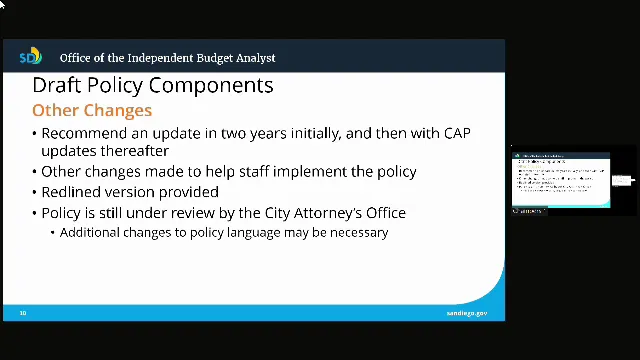
- Presentation: Jordan Moore (IBA) presented the final policy after stakeholder outreach and a virtual public forum. The policy uses action timing categories and seven metrics (GHG reductions, equitable implementation, feasibility, core benefits, jobs/economy, resiliency, co-benefits). Based on public feedback (22 survey respondents), the scoring weights were adjusted to narrow the gap between metrics: GHG remains highest; feasibility dropped from 17 to 12 for foundational actions and 22 to 13 for other actions; jobs/economy and resiliency increased. Policy includes linking preliminary actions to foundational actions via modified scores.
- Committee Discussion: Councilmember Campillo praised the complexity and moved approval. Councilmember Campbell criticized the small sample size of the survey (22/20 respondents) but supported the policy overall, noting GHG should be top priority. She liked the four timing categories. Vice Chair Von Wilpert asked about interaction with CIP prioritization policy 800-14 – Jordan Moore and Mr. Matica explained they are separate but complementary. Chair Lacava noted that feasibility scoring does not currently include private sector cost impacts, but that can be revisited in future CAP updates. He proposed amending the review timeline from two years to one year, which was accepted by the motion maker and seconder.
- Outcome: Motion to adopt policy with amendment to review in one year passed 4-0.
Key Outcomes
- Consent calendar and stormwater contracts (Items 1-3): Approved unanimously.
- Climate Action Implementation Plan: Received as information; staff directed to continue developing implementation with dashboard and regular reporting. No vote.
- Council Policy 900-22: Adopted with amendment to evaluate after one budget cycle (review in 2024). The policy prioritizes actions based on seven metrics and action timing categories, with GHG reductions as the highest-weighted factor.
- Public comments acknowledged: Committee members expressed appreciation for input and emphasized the need for concrete action, accountability, and engagement with both advocates and industry.
Meeting Transcript
Chair of the committee, our committee manager Tyberch will go over instruction for today's meeting. Ty. Thank you very much, Chair Locava. While members of the public are able to attend the meeting in person, this meeting is being televised and live streamed on the city's website, and the council administration will continue to make arrangements for the public to comment using the Zoom webinar platform. Members of the public who wish to provide virtual testimony must enter the virtual speaking queue by raising their hand before the virtual speaking queue closes. The queue will close when the last virtual speaker finishes speaking or five minutes after in-person testimony ends, whichever occurs first. This will allow for better meeting management between the two platforms and ensure the committee is able to manage and conduct safe business. We appreciate the public's cooperation. Chair Lacaba. Thank you, Ty. I will now call the environment committee meeting of Thursday, March 9th, 2023 to order and will call the roll. Councilmember Campbell. Here. Councilmember Campill. Here. And of course, I'm here. Also attending the meeting today, Jordan Moore with the Office of the Independent Budget Analyst. Deputy City Attorney Nicole Dino. Randy Wilde, Senior Policy Advisor in the Office of Mayor Todd Gloria. Brian Elliott, my committee consultant. Tyler, please continue with the public comment instructions. Thank you very much, Chair Lakava. If you are in person, please complete a speaker slip located at the entrance of chambers and place it on top of the box indicated. In-person testimony will conclude before virtual testimony begins. Members of the public can also join the webinar by computer tablet or smartphone by accessing the link which is listed online in the preamble language of the agenda on the city's webpage. If you need to participate by telephone, you may dial 1669-254-5252 and input webinar ID 161-163-9403 pound. This information is also available on the agenda and will appear on the screen during the public comment period for each item. Members of the public who wish to provide virtual testimony must must enter the virtual speaking queue by raising their hand before this uh the speaking queue closes. The queue will close when the last virtual speaker finishes speaking, or five minutes after in-person testimony ends, whichever occurs first. Please note that if you are watching VSC TV 24 online, there may be a delay, so please participate via the audio on your phone and mute your TV or computer when it's your turn to speak. If you wish to speak on a particular item, please wait until that item is called and then raise your hand by selecting the raise your hand icon or inputting star nine if you are calling in by phone. If you raise your hand during a non-comment period, your hand will be lowered. Chair. Thank you, Tyler, for reviewing those instructions for the benefit of the public. As I said, we have a quorum with the three of us present and the vice chair on our way. We will now dispense with the approval of the committee actions of February 9th, 2023. Tyler, please proceed. Thank you, Chair. The public comment period for the committee actions is now open. If you've already joined the Zoom webinar online or by phone, please raise your hand if you wish to speak on the committee actions of February 9th, 2023. Chair, we do not have any individuals in chambers who have submitted speaker slips for the committee actions, but we do have one individual in the virtual speaking queue that has their hand raised for the committee actions. So we will move to Terry Ann Skelly. You will have two minutes. So I'm very good. Sorry about that. We will be at non-agenda public comment next. So, Chair, that will conclude uh public testimony. All right. Uh we'll now go to a vote on the approval of the committee actions of February 9th, 2023. Do I have a motion to approve?
openpublica.com