San Diego City Council Environment Committee Meeting - September 14, 2023
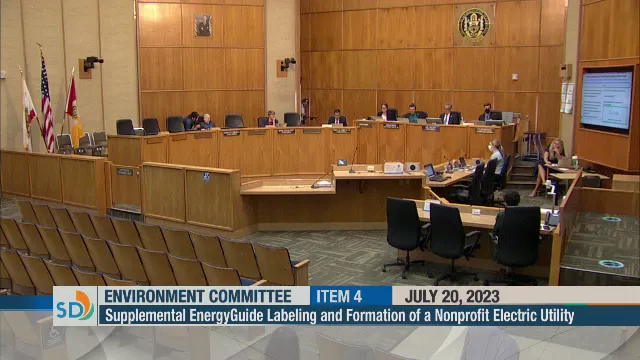
STREAMING COPY IN PREPARATION — RECORDING AVAILABLE FROM THE ORIGINAL SOURCE
San Diego City Council Environment Committee Meeting - September 14, 2023
The Environment Committee of the San Diego City Council, chaired by Councilmember Joel Lakava (District 1), met on September 14, 2023, at 9:00 AM. Members present included Vice Chair Von Wilpert, Councilmember Campbell, and Councilmember Campillo. The committee addressed a consent agenda, received a presentation from the U.S. Department of Energy, and considered two ballot measure proposals. Public testimony, including a large contingent of students from High Tech High, focused heavily on wetland restoration in Mission Bay and other environmental issues.
Consent Calendar
- Item 1: First amendment to contract with Janice Corporation for lead, asbestos, and mold abatement services.
- Item 2: Amendment to municipal code to allow electronic signatures for industrial wastewater control program submittals.
- Item 3: Authorization to execute a contract with West Air Gases and Equipment Inc. for liquid oxygen for city water treatment plants. All three items were approved unanimously (4-0) on a motion by Councilmember Campillo, seconded by Vice Chair Von Wilpert.
Public Comments & Testimony
Non-Agenda Public Comment:
- Several students from High Tech High (representing districts 1, 2, 3, 7, 8, 9) urged the committee to maximize wetland restoration in the northeastern corner of Mission Bay (De Anza Cove). They cited benefits: carbon sequestration (10 times faster than rainforests), flood mitigation, water purification, habitat for endangered species like the Ridgeway rail, and cultural revitalization for the Kumeyaay tribe. They noted the city's goal of 700 acres of new coastal marshland by 2035 and 350 acres by 2030. Students emphasized that climate change will disproportionately affect younger generations.
- Andrew Meyer (San Diego Audubon Society) echoed the students, calling for 315 acres of restoration as the maximum feasible, matching the climate action plan.
- Other speakers addressed tobacco waste (Terry Ann Skelly, Judy String), brush management audit concerns (Tertia Delgen, Ann Faggy), the proposed utility fixed charge (Barbara Jaffe Rose), cannabis dispensary zoning (Peggy Walker), and fentanyl awareness (via Vice Chair Von Wilpert).
- Pierita and Caesar Javier raised concerns about air pollution from a ceramics manufacturing facility in their residential neighborhood.
Public Comment on Item 5 (DOE Presentation):
- Serena Pilko (Climate Action Campaign) thanked the committee for hosting the DOE presentation and stressed the importance of securing federal funds for the climate action plan.
- Lori Saldania (former legislator, now foundation president) urged the convention center to use federal incentives for decarbonization rather than installing gas appliances.
- Jay Powell, John Stump, and Francis Yasmin Matawala commented on the need for a nonprofit utility and criticized SDG&E's high rates.
Public Comment on Item 4, Sub-Item 1 (Energy Labeling):
- Brittany Seats (SDG&E) opposed the measure, arguing labeling is federal/state jurisdiction and the city should not create its own rules.
- John Stump and Francis Yasmin Matawala supported the measure, emphasizing consumer protection.
- Lori Saldania supported the concept, linking it to financial literacy and climate action.
Public Comment on Item 4, Sub-Item 2 (Nonprofit Electric Utility):
- Kelvin Barrios (Laborers Local 89) expressed concern about the impact on union workers and urged more outreach before a ballot measure.
- Brittany Seats (SDG&E) and Bridget Browning (San Diego & Imperial Counties Labor Council) opposed, citing the $8.9 billion acquisition cost and risks from the phase one study, and urged completion of phase two before any ballot measure.
- John Stump, Francis Yasmin Matawala, Lori Saldania, Barbara Jaffe Rose, Jay Powell, and Craig Rose (proponent) spoke in favor, arguing that SDG&E's rates are the highest in the nation, the CPUC has failed to protect consumers, and a public utility would provide lower rates, local control, and better climate action. They noted that two prior studies have already shown feasibility.
Discussion Items
Item 5: U.S. Department of Energy Presentation on Opportunities from the Bipartisan Infrastructure Law and Inflation Reduction Act
- Chris Castro, Chief of Staff of the Office of State and Community Energy Programs (SCEP), presented a comprehensive overview of available federal funding. Key points:
- Over $500 billion in total federal investment; $100 billion at DOE focused on equitable deployment.
- SCEP manages 28 programs with $16 billion, including formula grants (e.g., EECBG – San Diego and County will receive $1.185 million), competitive grants, and technical assistance.
- Highlights: Home energy rebates ($8.8 billion statewide, $582 million for California), tax credits and elective pay for local governments, workforce training programs, and building codes support.
- The Justice40 initiative ensures 40% of benefits flow to disadvantaged communities.
- Committee members asked about workforce just transition, EV charging standardization, timeline for rebates (expected Q1 2024), and support for mass transit and transit-oriented development.
- Castro noted that San Diego is a national leader and praised the city's 100% renewable energy opt-up and high-performance building standards.
Item 4, Sub-Item 1: Supplemental Energy Guide Labeling
- Craig Rose (Public Power San Diego) presented the proposal. He argued that federal energy guide labels understate actual operating costs in San Diego because they use an average national electricity rate (~12-14 cents/kWh) while San Diegans pay ~47.5 cents/kWh. He gave examples: a refrigerator labeled $102/year actually costs $345/year; over 12 years, a more efficient model saves $500. He called for a city-required supplemental label to inform consumers.
- Committee discussion: Councilmember Campbell and Vice Chair Von Wilpert expressed concerns about the city's capacity to implement such a program and potential conflict with federal/state regulations. They suggested internal study rather than a ballot measure. Chair Lakava noted that the Department of Energy is proposing new energy efficiency rules for appliances. No motion was made; the item was not sent to the Rules Committee.
Item 4, Sub-Item 2: Formation of Nonprofit Electric Utility
- Bill Powers (Powers Engineering) presented the ballot measure proposal. He argued that San Diego pays the highest electric rates in the U.S. and that a distribution-only nonprofit utility, funded by customer revenue and exempt from transmission charges on local solar, could lower rates. He cited state law (Public Utilities Code §854.2) protecting union workers during transition. He criticized the city's phase one study as using overly conservative assumptions and a long timeline.
- Committee discussion: Vice Chair Von Wilpert and Councilmember Campbell emphasized the need for more study (phase two) and cited legal complexity, the existing relationship with San Diego Community Power, fire hardening costs, and the $8.9 billion acquisition estimate. Chair Lakava noted that the details are not yet sufficient and that the phase two study should include public engagement. No motion was made; the item was not sent to the Rules Committee.
Key Outcomes
- Consent Agenda (Items 1-3) approved unanimously (4-0).
- Item 5 (DOE Presentation) received as information; no action taken.
- Item 4, Sub-Item 1 (Energy Labeling) – No motion; committee took no action. Chair Lakava indicated his office would continue reviewing the policy concept.
- Item 4, Sub-Item 2 (Nonprofit Electric Utility) – No motion; committee took no action. The city will proceed with the phase two public power study, expected to conclude in summer 2025.
- The meeting was adjourned at approximately 1:00 PM; the next regularly scheduled meeting is October 12, 2023, at 1:00 PM.
Meeting Transcript
I am Joel Lakava, Councilmember for Council District One here in the City of San Diego and Chair of the Committee. Our committee manager Ty Birch will go over instructions for today's meeting. Ty. Thank you very much, Chair Lakava. While members of the public are able to attend the meeting today in person, this meeting is being televised and live streamed on the city's website, and council administration will continue to make arrangements for the public to comment using the Zoom webinar platform. Members of the public who wish to provide virtual testimony must enter the virtual speaking queue by raising their hand before the virtual queue closes. The queue will close when the last virtual speaker finishes speaking, or five minutes after in-person testimony concludes, whichever occurs first. This will allow for bare meeting management between the two platforms and ensure that the committee is able to manage and conduct safe business. We appreciate the public's cooperation. Chair. Thank you, Ty. I will now go over the environment committee meeting of Thursday, September 14th to order, and then call them to order. Call the roll, Vice Chair Vaughn Wilbert. Councilmember Campbell. Here. Councilmember Campillo here. And I'm Cheryl Government attending. Also attending the meeting today is Jordan Moore with the office of the independent budget analyst. Deputy City Attorney Nicole Dino. Randy Wilde, who appropriately wears a green sport coat today, the senior policy advisor in the office of Mayor Todd Gloria, and Brian Elliott committee consultant. And of course, a special welcome to the students of High Tech High from up here. You look fabulous down there. So thank you for coming out to the committee. Ty, please continue with public comment instructions. Thank you very much, Chair. If you are in person, please complete a speaker slip located at the entrance of chambers and place on top of the box indicated at the speaker's electron at the front of the room. Please do so in a timely manner to ensure proper meaning management. In person testimony will conclude before virtual testimony begins. Members of the public can also join the webinar by computer, tablet, or smartphone by accessing the link, which is listed online in the preamble language of the agenda on the city's webpage. If you need to participate by phone, please dial 1669-254-5252 and input webinar ID 161-163-9403 pound. This information is also available on the agenda and will appear on the screen during the public comment period for each agenda item. Members of the public who wish to provide virtual testimony must enter the virtual speaking queue by raising their hand before the queue closes. The queue will close when the last virtual speaker finishes speaking or five minutes after in-person testimony concludes, whichever occurs first. Please note that if you are watching via C TV 24 online, there may be a delay. So please participate via the audio on your phone and mute your TV or computer when it is your turn to speak. If you wish to speak on a particular item, please wait for that item to be called and then raise your hand by selecting the raise your hand icon, or if you're a column participant, star nine on your cell phone or landline. If you raise your hand during a non-comment period, your hand will be lowered. Thank you, Ty, for reviewing those instructions for the benefit of the public. A quorum is now present. All four committee members are here. And we will start by dispensing with approval of the committee actions of July 20th, 2023. Ty. Thank you very much, Chair. The public comment period for the past committee actions of July 20th, 2023 is now open. If you would like to speak on the past committee actions, you may raise your hand at this time. Chair, we do not have anyone in chambers that have submitted speaker slips for past committee actions nor in the virtual queues. That will conclude public testimony for the past actions. Okay. We'll now turn it over to the committee members for a vote on the approval of the committee actions of July 20th. Do I have a motion?
openpublica.com