San Diego Environment Committee Meeting Summary - May 23, 2024
STREAMING COPY IN PREPARATION — RECORDING AVAILABLE FROM THE ORIGINAL SOURCE
San Diego Environment Committee Meeting Summary - May 23, 2024
The Environment Committee of the San Diego City Council met on May 23, 2024, at 1:00 PM PDT. Chair Joe LaCava (District 1) presided, with Vice Chair Vaughn Wolford (District 5) taking over for the final items. The meeting covered consent items, the Climate Action Plan annual report, San Diego Community Power programs, urban forestry, undergrounding of utilities, and SDG&E's climate equity initiatives.
Consent Calendar
- Items 1–6 were approved unanimously (4-0). These included: a contract with DNV GL for water modeling software (Item 1); a fifth amendment to the Regional Stormwater Copermittees MOU (Item 2); as-needed engineering services agreements with Corolla Engineers, HDR Engineering, and Kleinfelder (Item 3); a groundwater services agreement with Rincon Consultants (Item 4); a stormwater environmental monitoring agreement with WSP USA (Item 5); and amendments to the Community Forest Advisory Board composition (Item 6), which reduced seats, allowed the chair to be appointed by members, and enabled flexible expertise.
Public Comments & Testimony
-
Non-Agenda Public Comments: Speakers addressed a variety of topics: a resident (Cesar Javier) reported health hazards from a ceramics business operating in a residential zone since 1984, claiming toxicity from kiln fumes and inadequate code enforcement. Ann Feige, co-leader of the Kate Sessions Commitment, advocated for community engagement in urban forestry grants. Terry Ann Skelly, a public health educator, urged a ban on smoking in all multi-unit housing to protect children from secondhand smoke. Blair Beekman emphasized accountability and openness in government, particularly regarding stormwater issues and the Israel-Hamas conflict. Becky Rapp, a planning group member, reported that a tobacco shop in her neighborhood continues to sell flavored tobacco despite the city's ban. Kathleen Lippett raised concerns about climate policies increasing inflation and the need to consider cost-benefit. Peggy Walker, supporting a smoke-free multi-unit housing policy, cited a 19% drop in heart attacks in cities with smoking bans. Another speaker (the original) criticized the city for allowing migrants to trash the environment. Judy Strang highlighted the health hazards of secondhand smoke, including marijuana, and called for a public places ban. Jay Powell requested that records from the former Sustainable Energy Advisory Board be made available on the city website.
-
Consent Agenda Public Comments: Speakers commented on multiple items. One speaker (Laurie Saldania) raised concerns about engineering contract compliance, tree advisory board training, and the importance of stormwater management. Another speaker (the original) warned about cybersecurity risks in water modeling, linked storms to geoengineering, and opposed the groundwater monitoring program, advocating for drilling instead of recycled water. A third speaker (Blair Beekman) stressed accountability after the January floods and urged connection with Tijuana for regional solutions.
-
Item 7 (CAP Annual Report): Speakers included Cesar Javier (questioning grassroots understanding), Kelly Linden (noting challenges and underfunding), Anthony Deng (Climate Action Campaign – commenting on the dashboard and urging urgent building reach codes), Masada Disenhaus (San Diego 350 – advocating for building reach code, stormwater transit infrastructure, and SANDAG leadership), and Craig Jones (350 SD – supporting microtransit and urging aggressive action).
-
Item 8 (SDCP Customer Programs): One speaker (the original) criticized battery storage, referencing the Otay Mesa fire and calling lithium batteries dangerous. Blair Beekman supported community energy separation from SDG&E.
-
Item 9 (Urban Forestry): Speakers included Cesar Javier (urging faster action), Ann Feige (emphasizing tree protection, quality nursery stock, and information systems), Michael Pallet (West Coast Arborist – praising Brian Wagner), Craig Jones (Urban Collaborative Project – urging community-driven tree planting in Encanto), and others (Tree San Diego – congratulating on grants and announcing a regional urban forestry master plan). Jim Smith (CFAB chair) noted only 1,000+ trees planted last year vs. 100,000 goal, and called for updated codes and data on tree survival. Another speaker criticized the use of toxic chemicals like Roundup.
-
Item 10 (Undergrounding): One speaker (Jay Powell) questioned the $250–300 million fund balance and requested more city control. The original speaker criticized the undergrounding program and the county's corruption.
-
Item 11 (SDG&E Undergrounding): Cesar Javier raised concerns about radiation from high-voltage lines. Jay Powell questioned SDG&E's asset ownership and rate base. Another speaker warned about dangers of underground lines and monopoly.
-
Item 12 (SDG&E Climate Equity): Cesar Javier asked about SDG&E political contributions. Kelly Linden urged SDG&E to pilot gas pipeline decommissioning for building electrification. Other speakers criticized lithium batteries and the World Economic Forum.
Discussion Items
-
Item 7: Climate Action Plan Annual Report and Dashboard – Staff (Shelby Busso, Marissa Westerfield) presented the 2023 CAP annual report and a new interactive dashboard tracking 190 actions across 20 measures. Key highlights: $83 million in direct CAP costs in FY23, rising to $213 million in FY24; greenhouse gas emissions showing a modest reduction in 2022; progress on building electrification, fleet electrification, mobility, waste (200,000 green bins distributed), urban forestry ($10M grant), and water infrastructure. Council members praised the dashboard and asked about cost-benefit analysis (dollar per GHG reduction), the status of the reach code (paused due to Ninth Circuit ruling, being redrafted), the mobility master plan (briefing before adoption), and coordination with departments to embed CAP ownership. Council President Elo Rivera noted the dashboard's 95% retention rate for SDCP customers.
-
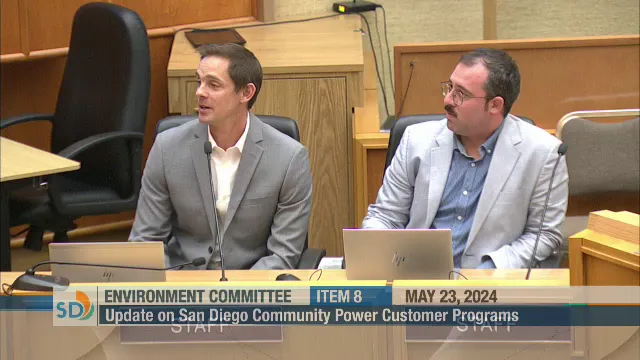
Item 8: San Diego Community Power Customer Programs – Colin Santulli (SDCP) presented programs: solar battery savings program, vehicle-to-grid pilots, roof repair pilot (focusing on Logan Heights), efficient refrigeration pilot for corner stores, application assistance for commercial customers, and funding efforts (regional energy network with county, EPA climate pollution reduction grants, Equitable Building Decarbonization grant). Council members discussed the 95% retention rate, Power 100 product uptake (8–10% of load), coordination with the city, and the potential to expand the roof repair pilot to flood-impacted communities. Chair LaCava highlighted the importance of getting the word out to low-income residents.
-
Item 9: Urban Forestry Program Update – Brian Wagner (City Forester) presented the program overview, accomplishments (Tree City USA 14th year, $10M ReadySet Grow grant, 4,000+ trees to be planted in FY25, Arbor Day wins), and challenges (proposed elimination of Free Tree SD program, pruning cycle increase from 13 to 16 years due to budget cuts, need for canopy data). Council members discussed the 8,333 trees per year goal vs. 1,125 planted in FY24 (net 440 after removals), the cost to achieve the goal, opportunities for philanthropic partnerships, and the tension between palm trees (high maintenance, low climate benefit) and shade trees. The council also discussed tree protection during infill development, sidewalk damage, and the need for code consolidation.
-
Item 10: Utilities Undergrounding Program Update – Chris Gascon (Transportation) presented program improvements: quarterly executive meetings, enforcement mechanisms for timelines, updated naming conventions (clearer phases), and a project pipeline (16 projects in design, 20 miles slotted for FY25). The fund balance is expected to decrease as expenditures ramp up. Council members discussed cost escalation, joint projects vs. SDG&E-delivered projects (joint projects are cheaper but capacity-constrained), and the need for more ENCP staff. Council President Rivera questioned whether the community would always choose undergrounding over other investments, while staff noted safety and reliability benefits.
-
Item 11: SDG&E Presentation on Major Projects and Undergrounding – Erica Schumel Giles (SDG&E) reported that 63% of the regional distribution system is underground (400 miles in San Diego). Active projects: 21 projects spanning 74 miles. FY24 spend ~$16M, projected to exceed $100M in FY25. Risks: permitting (improving, lead times decreasing), design capacity (mitigated by internal/external firms), and supply chain constraints (buying international, qualifying more suppliers). Opportunities: parallel permit reviews, shorter design cycles, earlier SIP communication, bundling, shared staging yards, coordinated traffic control. Council members requested data on savings from undergrounding vs. overhead, and noted that SDG&E's permits are often a bottleneck for builders. They also requested a future presentation on major energy projects beyond undergrounding.
-
Item 12: SDG&E Climate Equity Presentation – Connor Paris (SDG&E) presented the San Diego Solar Equity program (funded by shareholders, $1M/year), which has completed 40 projects in two years, with 15 taking advantage of panel upgrade incentives. Year two introduced a phased approach to better distribute projects across districts. Future plans: launch of SGIP (battery storage for income-qualified, $22M for San Diego) and a market support program (concierge service to navigate incentives – filed at CPUC). Council members appreciated the partnership but expressed concerns about SDG&E's high rates and the proposed fixed charge.
Key Outcomes
- Consent items 1–6 were approved unanimously (4-0).
- Information items 7–12 were received and filed; no votes were taken.
- Staff will follow up on: providing a cost-benefit analysis for CAP actions, briefing council on the mobility master plan and reach code, exploring volunteer watering programs for new trees, increasing ENCP capacity for joint undergrounding projects, and scheduling a future presentation on SDG&E's major energy projects.
- The committee will keep an eye out for a potential special meeting in early to mid-June for timely items.
Meeting Transcript
All right, good afternoon. We're welcome to the environment committee meeting of May 23rd, 2024. I'm Joel Aka, Council Member for District One, Chair of the Committee. Our committee's liaison, Sarah Jordan will go over instruction for today's meeting. Thank you, Chair Lakaba. While members of the public are able to attend the meetings in person, this meeting is being televised and live streamed on the city's website, and Council Administration will continue to make arrangements for the public to comment using the Zoom webinar platform. Members of the public who wish to provide virtual testimony must enter the virtual queue by raising their hand before the virtual queue closes. The queue will close when the last virtual speaker finishes speaking, or five minutes after in-person testimony ends, whichever occurs first. This will allow for better meeting management between the two platforms and ensure the committee is able to manage and conduct city business. Council Member Campbell. Council President Sean Elo Rivera. Present. And I am present and uh welcome to the Council President. I think it's the first meeting that you're attending. So we appreciate uh filling out the uh all the seats. Uh I want to Oh, actually, my notes tell me to thank you. So I figured that out myself. So very proud, yes. Uh also attending the meeting today, Jordan Moore with the Office of the Independent Budget Analyst, Lead Deputy City Attorney Nicole Dino, Randy Wilde with the Office of Mayor Todd Gloria, and Brian Elliott, our committee consultant. Sarah, please continue with public comment instructions. Thank you, Chair. If you are in person, please complete a speaker slip located at the entrance of chambers and place it on the top of the box indicated at the speaker's electron at the front of the room. Please do so in a timely manner to ensure proper meeting management. In-person testimony will conclude before virtual testimony begins. Members of the public can also join the webinar by computer, tablet, or smartphone by accessing the link, which is listed online in the preamble language of the agenda on the city's webpage. If you need to participate by telephone, you may dial 669-254-5252 and enter webinar ID 160-670-8143 pound. This information is also available on the agenda and it will appear on the screen during the public comment period for each agenda item. Members of the public who wish to provide virtual testimony must enter the virtual queue by raising their hand before the queue closes. If you wish to speak on a particular item, please wait for that item to be called and then raise your hand to speak by tapping the raise your hand icon or if if you are a call in participant by pressing star nine on your cell phone or landline. If you raise your hand during a non-comment period, your hand will be lowered, Chair. Thank you, Sarah, uh, for reviewing those instructions for the benefit of the public. The quorum is now present. Unlike the last couple of committee meetings, we are going to be going in the order of the agenda today. And we will start by dispensing with the approval of the committee minutes of April 11th, 2024. Sarah? Thank you, Chair. The public comment period for the past committee minutes is now open. We have not received any speaker slips here in chambers, but I see a few hands raised in the virtual queue, so I will begin the five-minute timer for all those to indicate if they wish to speak to the past committee minutes. We will begin testimony with the original. Please unmute yourself and provide your comments. You will have one minute. Yes, I would just like to recommend that when you are doing the minutes, because you'll you'll write down comments for um public speakers on non-agenda. And I'm not necessarily saying you need to write down whatever the people say in all of their comments, but you could still do a summary or at least show who of the public actually spoke during whatever item it was. Because you'll say, you know, you put information on the council members, but I think that it would um be good for the minutes to also include the public and um you you know, just kind of a little short summary of what they were um talking about because that would be then actual minutes of the meeting, not just partial minutes of the meeting. So not like you guys will do it, but that's a recommendation. Thank you for your testimony, and chair with no other hands raised on the virtual queue. That does conclude public comment on the past committee minutes. All right, thank you. Uh so we will now vote on the approval of the committee minutes of April 11th. Uh, do we have a motion to approve the committee minutes?
openpublica.com