San Diego Environment Committee Meeting - November 14, 2024
STREAMING COPY IN PREPARATION — RECORDING AVAILABLE FROM THE ORIGINAL SOURCE
San Diego Environment Committee Meeting - November 14, 2024
The Environment Committee of the San Diego City Council met on November 14, 2024, at 9:00 AM under the chairmanship of Council Member Joel Ocava (District 1). The meeting covered a consent agenda, multiple discussion and information items, and public comment on environmental and operational topics.
Consent Calendar
- Items 1–3 (approval of October 10, 2024 committee minutes; lead hazard prevention ordinance revisions; first amendment to agreement with CDM Smith for public utilities master plan) were approved unanimously (3–0) with Vice Chair Von Wilpert absent. A motion by Council President Rivera and a second by Council Member Campbell carried the items.
Public Comments & Testimony
- Non-agenda public comment:
- Madison spoke about the environmental harms of disposable vapes, noting that single-use vapes are hazardous waste due to nicotine and battery content and that they contribute to e-waste and microplastic pollution.
- Terry Ann Skelly urged the committee to ban smoking in public places, referencing a WHO report on tobacco’s environmental impact and noting that five other cities in the county have already enacted such bans.
- Becky Rapp advocated for an ordinance prohibiting intoxicating hemp products, citing Sacramento County’s policy and proposing escalating fines ($2,500–$10,000).
- Blair Beekman expressed concern that Vision Zero goals might be reduced to law enforcement and technology, stressing the need for a holistic community-harmony approach.
- Joy Cineata celebrated dam removals on the Klamath River and highlighted the pollution crisis in the Tijuana estuary, urging progress on that border waterway.
- Kelly McCormick shared lung cancer statistics (smokers 15–30 times more likely to develop lung cancer, 85% of cases caused by smoking) and urged adoption of smoke-free multi-unit housing regulations.
- Judy Strang reported that a PTA council had voted to establish an environment committee due to concerns about air and water quality, and noted that PTAs in the City of San Diego were impressed by smoke-free ordinances in other cities.
- Consent agenda public comment:
- Joy Cineata spoke in favor of item 3 (CDM Smith amendment), requesting that the master plan include updated IT systems and the use of AI for data metrics.
- Blair Beekman thanked the committee for its stormwater annual report and requested continued accountability practices.
- Kathleen Lippett opposed item 2 (lead hazard ordinance) and warned against allowing cannabis cafes, citing the health risks of marijuana smoke.
- Item 7 (informational): Joy Cineata praised the outreach and engagement efforts, calling them “five-star” work.
- Item 4 (resolution): Joy Cineata voiced strong support for the resolution and the portal platform; Blair Beekman noted the need to address budget deficits and property tax issues.
- Item 5 (amended agreement): Blair Beekman offered brief acknowledgment and raised the importance of addressing Tijuana River Valley issues in the future.
- Item 6 (ZEMBOP update): Blair Beekman thanked staff for the presentation.
- Item 8 (Port climate initiatives): Blair Beekman praised the port’s work and expressed hope for continued progress on electrification and community accountability.
- Item 9 (Golf update): No public testimony.
Discussion Items
-
Item 7: Informational Update on Outreach & Engagement and Operational Efficiency Study
- Presenter: Kirby Brady, Interim Director of Environmental Services. The update covered the process following Measure B (November 2022). Outreach reached over 10,000 website visits, 38 media stories, 3,400 in-person contacts, and 3,000 survey responses. More than 80% of residents expressed satisfaction with current service. Areas for improvement included bin replacement costs, delayed collections, confusion over organic waste, and need for bulky item pickup. The operational efficiency study (six months, 90+ staff interviews) produced recommendations on safety culture, fleet management, data-driven technology, and facilities/staffing. Next steps include iterative community engagement, a cost of service study, and a proposed fee schedule to be presented in January–February 2025, with a potential 45-day protest period in March and final vote in June 2025.
- Council President Rivera asked about equity and transparency in pricing; Kirby responded that the next round includes interactive exercises for residents to choose services. Rivera also requested a mid-city outreach event.
- Chair LaCava praised the outreach and noted that the educational component about property tax allocation was valuable.
-
Item 4: Resolution of Support for Tax Roll Billing for Residential Waste Fees
- Presenter: Kirby Brady. The resolution supports using tax roll billing (via the County) to collect potential waste collection fees. The city is developing a Salesforce-based portal integrated with Get It Done. Benefits include 98% compliance, low administrative burden (10 cents per parcel), and ease for customers. The resolution is not binding on the fee itself; final approval would come in June 2025. The IBA (Jordan Moore) expressed support and noted strict timelines for the June–July 2025 window.
- Council President Rivera made a motion to support staff’s recommendation, with a request to dual-track an ordinance preventing landlord overcharges to renters. The motion passed 3–0 after a second by Council Member Campbell.
- Chair LaCava acknowledged the efficiency of tax roll billing and agreed with the need to protect renters.
-
Item 5: Amended and Restated Design, Construction, and Reimbursement Agreement with East County Advanced Water Purification Joint Powers Authority
- Presenter: Lisa Salaya, PUD. The agreement was amended to increase the project cost by $47.4 million to a total of $104.1 million for the residuals line. The city’s share is 85.49% (due to system-wide benefit). The scope includes a bypass line to keep the Mission Gorge pump station operational and use of the city’s material lab. The figures are not final and will be reviewed before council consideration.
- Council Member Campbell questioned future growth impacts; staff noted that if the East County plant expands, the residual line may need evaluation. Campbell made a motion, seconded by Chair LaCava, that passed 3–0.
-
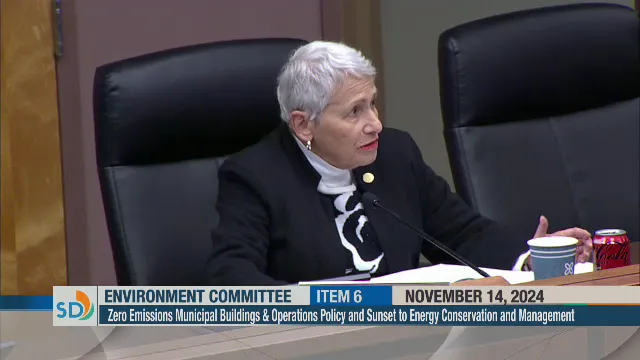
Item 6: Proposed Update to Council Policy 900-03 (ZEMBOP) and Sunset of Council Policies 900-02 and 900-18
- Presenter: Lindsay Hawes, Sustainability and Mobility Department. Minor adjustments include aligning GHG reduction milestones with the Climate Action Plan, extending due dates for fossil fuel elimination plans (to January 2025) and fleet charging plans (to January 2026), and creating an exception process. EV charging requirements are reduced from 50% to 30% (aligning with CalGreen Tier 1). Major renovations by in-house teams can use a prescriptive energy efficiency menu instead of energy modeling. Leased properties: tenants must electrify replacements but are not required to fully electrify upon major renovation.
- Chair LaCava proposed an amendment requiring annual reporting to council on any exceptions granted; staff accepted. The motion (with amendment) was made by Chair LaCava, seconded by Council Member Campbell, and passed 3–0.
- The City Attorney noted that legal review is ongoing and language may change before council.
-
Item 8: Informational Update on Port of San Diego’s Climate Initiatives
- Presenters: Jason Giffen (VP Planning & Environment), Phil Gibbons (Climate Sustainability Manager), Lily Sukiyama (Environmental Planner). The port’s climate work focuses on mitigation, adaptation, and sequestration.
- Mitigation: $125 million committed to maritime electrification. Highlights: electric tugboat “eWolf” (first in U.S.), two electric cranes (first in North America), a microgrid at 10th Avenue Marine Terminal, and a recent EPA grant of $58.6 million for zero-emission projects.
- Adaptation: Sea-level rise planning; projects include e-concrete tide pools (increased biodiversity), an oyster living shoreline at Chula Vista Wildlife Reserve, and a seaweed aquaculture pilot for bioremediation.
- Sequestration: Studies show eelgrass in San Diego Bay stores 170,000 metric tons of carbon and sequesters 1,200 metric tons annually.
- Council President Rivera asked about resilience to changes in federal administration; Jason Giffen noted that funding is obligated and the port will continue to push with state and local partners.
- Presenters: Jason Giffen (VP Planning & Environment), Phil Gibbons (Climate Sustainability Manager), Lily Sukiyama (Environmental Planner). The port’s climate work focuses on mitigation, adaptation, and sequestration.
-
Item 9: 2024 Golf Operations Division Business Plan Update
- Presenter: John Howard, Golf Operations Deputy Director. The division is self-sustaining. In FY24, rounds sold reached a record 420,000, and revenue was $39.4 million. Expenses have risen 22% over three years. Capital improvements: $15 million at Mission Bay Golf Course (irrigation, clubhouse). The Torrey Pines master plan is in negotiation. Green fee increases effective January 1, 2025: 3% for residents, 5% for non-residents. A new business plan consultant RFP will be released.
- Council Member Campbell and Chair LaCava praised the division for its financial self-sufficiency and role in hosting major tournaments.
Key Outcomes
- Consent Agenda approved 3–0.
- Resolution of Support for Tax Roll Billing (Item 4) approved 3–0, with direction to consider renter protections and an annual exception report added at Chair LaCava’s request.
- Amended Agreement (Item 5) approved 3–0.
- ZEMBOP Policy Update (Item 6) approved 3–0 with the annual exception reporting amendment.
- Informational Items (7, 8, 9) received without formal vote.
- The meeting was the last Environment Committee meeting of 2024; the next meeting is scheduled for January 23, 2025, at 1:00 PM.
Meeting Transcript
All righty, good afternoon. Welcome to the environment committee meeting of November 14th, 2024. I am Joel Ocava, Council Member for District One and Chair of the Committee. Our committee's liaison, Sarah Jordan will go over instructions for today's meeting. If you are in person, please complete a speaker slip located at the entrance of the committee room and place it on the top of the box indicated at the table in the front of the room. Please do so in a timely manner to ensure proper meeting management. In-person testimony will conclude before virtual testimony begins. Members of the public can also join the webinar by computer, tablet, or smartphone by accessing the link, which is listed online in the preamble language of the agenda on the city's webpage. If you need to participate by telephone, you may tell one six six nine, two five four five two five two, inputting webinar ID one six zero six seven zero eight one four three pound. This information is also available on the agenda and it will appear on the screen during the public comment period for each agenda item. Members of the public who wish to provide virtual testimony must enter the virtual queue by raising their hand before the queue closes. Please note that if you are watching via City TV 24 or online, there may be a delay. Please participate via your audio on your phone and mute your TV or computer when it is your turn to speak. If you wish to speak on a particular item, please wait for that item to be called, and then raise your hand to speak by tapping the raise your hand icon, or if you're a call and participant by pressing star nine on your cell phone or landline. If you raise your hand during non-comment period, your hand will be lowered. Chair. And if you need to participate by telephone, you may dial 1669-2545252, inputting webinar ID 160-670-8143 pound. And as a reminder, this information is also on the agenda and it will appear on the screen during the public comment period for each agenda item. And as a final reminder, members of the public who wish to provide virtual testimony must enter the virtual queue by raising their hand before the queue closes. The queue will close when the last virtual speaker finishes speaking or five minutes after in-person testimony ends, whichever occurs first. Chair. All right. Thank you, sir, for reviewing those instructions for the benefit of the public. Again, a quorum is present. So we will now take up non-agenda public comment. The council members respect and appreciate the public's input and are fully committed to protecting every participant's free speech rights at council and committee meetings. Sarah, please proceed with non-agenda public comment. Thank you, Chair. Per Rule 2.7 non-agenda public comment is an opportunity for members of the public to comment on items that are not on the agenda but are within the subject matter jurisdiction of this committee. Each speaker will have two minutes. If you have already joined the Zoom webinar online or by phone, please raise your hand if you wish to speak. And if you are in person, please come up to the reserve seats at the front of the room when your name is called and be prepared to come up to the lectern in the order called. If you need to participate by telephone, you may dial 1669-2545252 and putting webinar ID 160-670-8143 pound. Members of the public who wish to provide virtual testimony must enter the virtual queue by raising their hand before the queue closes, and this queue will close when the last virtual speaker finishes speaking or five minutes after in-person testimony ends, whichever occurs first. We've not received any speaker slips here in chambers, so I will start the five-minute timer for all those in the virtual queue to indicate if they wish to speak. We will begin testimony with Madison. Madison, please unmute yourself and provide your comment. You will have two minutes. Hi, thank you. My name is Madison, and I'm here to share the harms that vaping has on the environment. I have noticed tons of people vaping lately from the teenagers in my neighborhood to adults at the beach and all kinds of different scenarios where people are vaping. It's becoming really common, and it's actually overtaken conventional cigarettes as the most frequent form of nicotine consumption among 15 to 24 year olds. Vapes harm not only the consumer's health, but also have a detrimental impact on our planet. And few people seem to be aware of this. Currently, the most predominant vapes on the market are single-use disposable products designed to appeal to younger people. Despite their short lifespan, vapes are complex products that contain several valuable resources. However, there are no practical means to collect or recycle vapes. Most end up as electronic waste or in e-waste landfills. Some are simply thrown on the street as litter. Overall, single-use vapes are clearly a wasteful of resources and dangerous in the environment.
openpublica.com