San Diego Smart Growth and Land Use Committee Special Meeting on Short-Term Vacation Rental Regulations – March 24, 2017
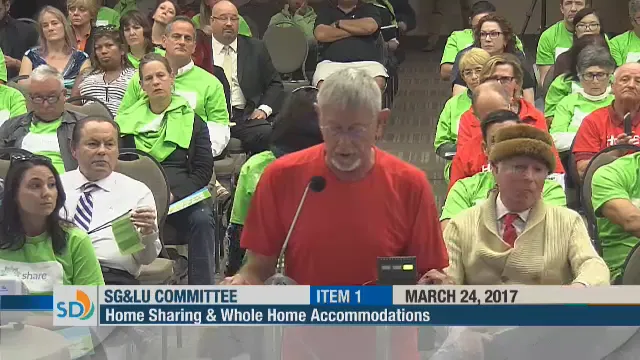
STREAMING COPY IN PREPARATION — RECORDING AVAILABLE FROM THE ORIGINAL SOURCE
San Diego Smart Growth and Land Use Committee Special Meeting on Short-Term Vacation Rental Regulations – March 24, 2017
The Smart Growth and Land Use Committee of the San Diego City Council held a special meeting on March 24, 2017, to receive a Planning Department report on proposed amendments to the Land Development Code and Local Coastal Program relating to home sharing and whole-home accommodations (short-term vacation rentals, or STVRs). The committee heard a staff presentation outlining three regulatory options and then took extensive public testimony. The transcript concludes during individual public comments; no committee deliberation or vote is recorded in the provided material.
Staff Presentation & Discussion
- Planning Department staff (Jeff and Reynard Alos) presented the report, noting that current regulations lack a permit requirement for vacation rentals, making enforcement difficult. They proposed a new annual permit with the ability to revoke permits for chronic violators.
- Three common elements across all options: an annual permit (estimated $100 processing cost), a local contact able to respond to complaints within one hour, and a standardized occupancy agreement with a "good neighbor policy."
- The three options differ in how they treat whole-home rentals and home sharing:
- Option 1: Allows whole-home uses with a ministerial permit for units with 5 or fewer bedrooms and no more than 10 occupants; larger units need a Process 2 Neighborhood Use Permit. Home sharing is tiered: 1–2 bedrooms are exempt, 3–5 require a ministerial permit, 6+ require a Conditional Use Permit. Parking adds half a space per bedroom over two.
- Option 2: Allows whole-home use only for stays of 21 days or more with a ministerial permit; deviations require a Process 2 permit. Home sharing requires a ministerial permit. Requires one additional parking space.
- Option 3: Allows whole-home use with a ministerial permit and no stay limit. Home sharing uses a ministerial permit, with no additional parking beyond the primary use. Companion unit rules vary (Option 3 allows them without additional requirements).
- Staff requested policy direction from the committee to develop an implementing ordinance and enforcement program.
Public Comments & Testimony
- Stricter regulation / banning whole-home rentals:
- James Croake, who started the Pacific Beach planning process, said "nobody is really against home sharing" but called whole-house rentals "hotels" in single-family zones and urged the committee not to allow them.
- Tom Coate held a sign reading "Zoning is a promise," arguing that owner-unoccupied vacation rentals are commercial operations that destroy neighborhoods; he cited the City Attorney's memo that they are already illegal.
- Crown Point residents including Denise Freeman, Tim Lowry, Chris Lichter, and Jim Marshall described rising STVR numbers (14 to 24 in two years), a shooting at a rental, and families being driven out. They supported home sharing but asked for a ban on whole-house, year-round STVRs.
- A speaker called to the podium as "Johnson" presented data: 12,854 short-term rental listings in San Diego, expected to rise 30% to 16,710; 8,612 were entire-home rentals; Airbnb paid $7 million in TOT in 2016; the value of homes removed from the market was $4.779 billion. He argued this worsened the housing crisis.
- Marcy Beckett, Bill Vail, Eve Anderson, Sue Hopkins, Larry Gustafson, David Austin, and others spoke against whole-home rentals while often supporting home sharing.
- John Ampert, chair of the Ocean Beach Planning Board, said approximately 400 units in Ocean Beach are used as STVRs, resulting in a net loss of nearly 1,500 rental units and displacement of 720 residents. He called for restrictions, caps, and coastal-specific overlays.
- Gary Wanicott, president of the Mission Beach Town Council, said Mission Beach has 50–65% STVRs, harming community character; he supported community-tailored ordinances and strong code enforcement.
- Hotel industry representatives Namara Mercer and Lynn Moorefield said "sharing yes, commercialization no," advocating a level playing field, taxation, and safety requirements.
- Permissive regulation (especially Option 3):
- Robert Miller, a real estate professional with four rental units, supported short-term rentals and argued that bans devalue property, while hosts provide tax revenue.
- Thomas Griego said Airbnb helped his family and supports the sharing economy.
- Jan Reynolds, Jim Manor, Clinton Smith, Greg Ross, Ross Pettett, and others shared personal stories of renting spare rooms or casitas, saying it supports their retirement or families.
- Caitlin O'Neill, public policy director for Sonder, supported Option 3, describing Sonder's managed short-term units with 24/7 rapid response.
- Stephanie Benvenuto of the San Diego Regional Chamber of Commerce urged support for Option 3, citing economic benefits.
- Belinda Smith, co-founder of the Short-Term Rental Alliance of San Diego, supported registration, TOT taxes, and enforcement, but opposed caps and minimum stay requirements.
- Patty Sears, who manages 11 units, said TOT was over $12 million (disputing the $7 million figure) and advocated strict but fair regulation.
- Middle-ground or community-specific approaches:
- Several speakers, including Martin Laracy, Lucas Murdoch, and Matt Thompson, supported regulation over a ban, with Thompson endorsing Option 1 plus modifications.
- Austin Hong, an attorney, noted former City Attorney Jan Goldsmith's concerns that current code language is too vague to enforce and called for sensible regulations.
- Sylvia Land and Richard Hill supported owner-occupied home sharing and warned against one-size-fits-all rules.
- Craig Klein suggested a cap on whole-home rentals and a $1,000 permit fee to fund enforcement.
- John Leppard recommended Option 2's 21-day minimum stay to reduce conflicts.
- Nancy Kramer, a vacation rental agency owner, said duplicate listings inflate STVR count and advocated reasonable permits and fines.
Key Outcomes
- No formal action or vote appeared in the transcript; the meeting was still in public comment when the record ended.
- Staff had requested direction on which regulatory option to develop into an ordinance; the committee did not provide that direction in the captured portion.
- The item was expected to be forwarded to the full City Council, but that motion/decision was not recorded.
Meeting Transcript
All right, hello. Good morning, everybody. We could all find our seats. We will get started with this morning's special meeting of the Smart Growth and Land Use Committee. We are here with Councilmember Chris Kate, Councilmember Georget Gomez, Councilmember Alvarez will not be with us today. We have Jack Straw from the Mayor's Office. Chris Ojeda from IBA, Leslie Fitzgerald from the City Attorney's Office, and Sarah Jarman, committee consultant for this committee. Seeing none that passes by unanimous consent. We have no speaker slips on something not on today's agenda. Everybody here is here to speak about today's agenda, so that's a good thing. Seeing none, we'll move on to our action agenda and item number one, which is report from the planning department requesting amendments to the land development code and local coastal program related to home sharing and whole home accommodations. Staff is before you today for your consideration and direction with three possible options that could become the regulatory framework for vacation rentals. For all three options, we are proposing a permit requirement that currently does not exist today. Under our current process, infractions of our noise standards or nuisance laws often resort in warnings or fines. However, the use of the property as a vacation rental may continue. With the options before you today, we are introducing a tool where chronic violators of our regulations could have their permit revoked, prohibiting them from using their property as a vacation rental for a period of time. The introduction of a permit also ensures that both the property owner and the renter are aware of the rules and the results for non-compliance. Staff understands that council is equally interested in the enforcement of vacation rentals. However, the scale and the costs associated with enforcement can significantly vary depending upon how the council wishes to regulate vacation rentals. A program that significantly limits vacation rentals will look and cost very different than a program that is very permissive. Our goal today is to try to narrow the scope of this regulatory framework and ask the committee to move the item forward to council where staff will present not only the ordinance language, but also options and costs associated with an enforcement program. At this time, I'd like to pass the presentation to Reynard to summarize staff's three options for a possible framework. Thank you, Jeff, and good morning, Council members. Again, my name is Reynard Alos with the planning department. Over the course of the last few years, we've seen a rapid increase in the use of private residences for short-term vacation rentals, especially within our coastal communities. For many cities, including San Diego, the subject has attracted interest from those on all sides. Within the last two years, the city has held three formal meetings on the issue as shown on this slide. These meetings highlighted the various viewpoints, opinions, and guidance on the subject. Although public testimony at these meetings address short-term vacation rentals throughout the city, these uses within coastal areas were of particular concern. In a letter dated December 6, 2016, the California Coastal Commission provided guidance on this matter. The letter recognizes vacation rentals as an important source for visitor accommodations in the coastal zone, but also acknowledges that reasonable and balanced regulations may be needed to allow vacation rentals and to address specific issues within the community. The letter also states that the commission has historically found blanket bans to be inconsistent with the Coastal Act because those prohibitions unduly limited public recreational access opportunities. Before we discuss the three options, for purposes of our discussion, it's important to note that we've identified and we refer to short-term vacation rentals as two distinct uses. The first use is described as whole home and means the occupancy of an entire dwelling unit for 30 or fewer consecutive days. A primary resident does not need to reside on the property for this use. The second use would be categorized as home sharing and describes a home where a bedroom or bedrooms are provided to transients, but where the primary resident is present during the stay. The next few slides will describe the common limited use requirements that are shared between each of the three options that we'll discuss later today. These include the annual permit, the occupancy agreement, and the local contact requirements. The annual permit will be required for all whole home and home sharing uses that are subject to the limited use regulations. The permit must be reviewed, renewed annually, ensuring up-to-date information is gathered and allowing the city staff to reevaluate permits based on the established criteria. One thing we should note is that the annual permit can be revoked for noncompliance. If revoked, a property must wait at least one year for a new permit. It's anticipated that the permit will cost approximately 100%. This is only an estimate based on staff's comparison of some existing permits and only includes the anticipated cost of processing the permit. The annual permit is one of the more important pieces of regular regulating short-term vacation rentals. By requiring the annual permit, the city will be able to better track and monitor listings. This could make it easier for city staff to identify on permitted short-term vacation rentals. The next slide will describe the local contact requirement. This is another important piece to regulating home sharing and whole home uses. The local contact is a person designated by the applicant who would remain available during the use of a property as a whole home or home sharing use to respond to complaints related to potential nuisance activities, including excessive noise, excessive accumulation of trash, and also illegal parking.
openpublica.com