Smart Growth and Land Use Committee Special Meeting on Qualcomm Stadium Future - August 11, 2017
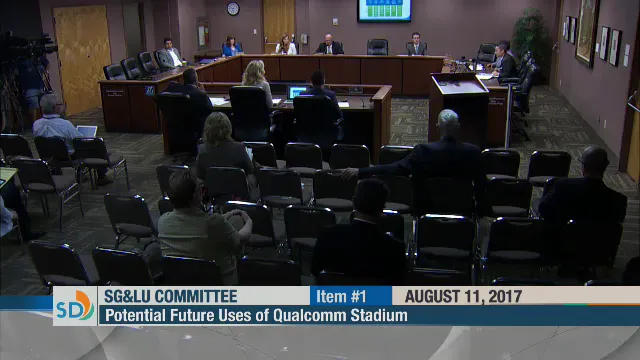
STREAMING COPY IN PREPARATION — RECORDING AVAILABLE FROM THE ORIGINAL SOURCE
Smart Growth and Land Use Committee Special Meeting Summary – August 11, 2017
The Smart Growth and Land Use Committee held a special meeting on August 11, 2017, to receive an informational report from the Mayor's Office on current and potential future uses of the Qualcomm Stadium property. Members present included Chair Sherman, Vice Chair Alvarez, Councilmember Gomez, and Councilmember Kate. The meeting included presentations, public testimony, and committee discussion, with no formal votes taken.
Presentations
- Sibel Thompson, Director of Real Estate Assets, presented current stadium operations: 568 events are scheduled through December 31, 2018, including 21 interior events (primarily San Diego State games, Holiday Bowl, concerts, soccer) and 547 exterior events (RV and auto sales, autocross, swap meets, cultural events). The FY18 budget includes $3.7 million in personnel expenses and $7 million in non-personnel expenses. Anticipated revenue is about $3.5 million, including an additional $500,000 for suite and advertising revenue, with a projected net loss of about $7.2 million.
- Jack Straw, Mayor's Director of Land Use and Economic Development Policy, provided an update on the Mission Valley Community Plan update process. The process began in June 2015; phases 1–3 (existing conditions, visioning, alternatives) are complete, and phase 4 (community review and plan development) is underway. Staff has held 22 community meetings and 3 workshops, with another workshop this weekend. Expected completion is the end of 2018.
Public Comments & Testimony
- Corey Briggs: Submitted written questions and argued the presentation lacked detail on potential future uses. He urged the committee to direct the mayor to identify public purposes for the Soccer City proposal and any sale to San Diego State or other public agencies, and to seek legal analysis on the city's authority and Surplus Lands Act compliance.
- Robert McNamara: Stated the budget should include debt service and TOT transfers; the stadium cannot be considered surplus due to scheduled events and the pending citizens' initiative. He supported placing the soccer plan on the November 2018 ballot to allow more options, and expressed interest in seeing a San Diego State proposal.
- Joe La Cava (Public Land/Public Vote coalition): Encouraged the city to explore all options for the 230+ acres of city-owned land, consider competing proposals, and involve the Mission Valley Planning Group in discussions. He emphasized that competition yields the best results for the public.
- Mike Stepner (Professor, New School of Architecture): Called for an open, inclusive process to develop a vision and criteria to evaluate the highest and best use of the site. He cited Uptown District and NTC as successful examples of large-scale redevelopment planning.
Discussion Items
- Vice Chair Alvarez requested a per-event cost and revenue breakdown, information on costs associated with the community plan update specific to the Qualcomm site, and asked who from the city helped draft the citizens' initiative. He requested a City Attorney analysis of Municipal Code Section 22.0907 regarding council authority to sell city land to public agencies.
- Councilmember Gomez asked about contract terms with San Diego State and the Bowl Association (staff stated contracts run through December 2018; other agreements are individual permits that can be terminated sooner). He questioned whether the planning department had directed staff not to discuss Qualcomm in the community plan update (staff said no such direction). He expressed concern about not including the initiative as an alternative in the plan update, stressed the need for a "Plan B," and suggested creating a subgroup to develop a site-specific vision.
- Councilmember Kate referenced a recent City Attorney memo and asked for a summary. Deputy City Attorney Melissa Abels explained: Council Policy 710 gives the mayor authority to determine surplus property and initiate sales; council can authorize sales; Charter Section 221 applies to sales over 80 contiguous acres, with exceptions for sales to a government agency for a bona fide governmental purpose or a previous public vote; "governmental purpose" is not defined in the charter but traditionally includes roads, schools, parks, and public safety facilities.
- Chair Sherman noted the community plan update serves as a "Plan B" to the citizens' initiative, requested the event cost/revenue breakdown, and clarified that the City Attorney would need to analyze any specific action that might interfere with the pending initiative.
Key Outcomes
- No formal motions or votes were taken; the item was informational.
- The City Attorney's Office agreed to provide an analysis of Municipal Code Section 22.0907 and to address questions submitted by the public and committee members at a future meeting.
- Staff were asked to provide follow-up information on event-level revenues and costs, and the costs associated with the community plan update for the Qualcomm site.
- The next special meeting was scheduled for Thursday, September 21, 2017, at 2 p.m.
Meeting Transcript
All right. Thank you all for being here. Call the order, the August eleventh, twenty seventeen special meeting, Smart Growth and Landers Committee. We have with us today Council members Chris Kate, George Eck Gomez, and Councilmember David Alvarez. We have Jack Straw from the Mayor's Office. Moving right through. We have no request for continuance, I'm assuming. All right. Then we will get right into item number one. First, I want to say thank you all for taking the time for being here during legislative recess. Um, you know, this committee's schedule after recesses. Very ambitious, so I appreciate you all coming in and taking the time to hear this. Um be a report from the mayor's office regarding the current and potential future uses of the property located at or near Qualcomm Stadium. We will now move on to see who's going to be doing the presentation. Who's starting? Uh good morning, Chair Sherman and honorable committee members. My name is Sibel Thompson. Let me make sure we have a Sidel Thompson, Director of Real Estate Assets, and with me is Ron Ved, Deputy Chief Operating Officer of the Internal Operations Branch. Can you hear me okay? Now it's definitely an honor. I don't know if it's not working. Okay, I'll say closer. So today we'll be presenting an informational item on current and projected uses of San Diego Stadium for the next two years. San Diego Stadium currently has 568 events scheduled through December 31st of 2018, and those are detailed here on the PowerPoint presentation. We've got 21 interior events, which are primarily inside the bowl. They primarily consist of San Diego State games, which are planned and the holiday bowl. We've got a couple of concerts and a couple of soccer events planned as well. Inside our exterior events, which includes the parking lot, the concourse, and the practice field. We've got about 547 events planned through December 31st of 2018. Examples of those are RV and auto sales, autocross, swap meet, cultural events, et cetera. This slide details the personnel personnel expenses uh budgeted for fiscal year 18 for the stadium. As you can see, we've got $3.7 million in personnel expenses budgeted. In non-personnel expenses for fiscal year 18, we have got $7 million budgeted. And this does not include TOT transfers in and out and debt service. Um the purpose of today's presentation is really to get to what the operating expenses are for the stadium. Uh for example, with debt service, we will have that expense no matter whether the stadium is open or not. And then finally, revenue anticipated for the stadium in fiscal year 18, which has been updated since the fiscal year 18 budget process. We're anticipating about 3.5 million. And you'll notice an addition of about $500,000 for suite and advertising revenue that we didn't previously have included in the fiscal year 18 budget. So the fiscal year 18 budget summary is that we anticipate losing about $7.2 million at the stadium. And we would anticipate that continuing into the future were the stadium to remain open. And we are available for questions. Thank you. I think Jack, you're next. Welcome, sir. Morning, Chair Sherman and Council members. My name is Jack Straw, and I am the mayor's director of land use and economic development policy. I'm here today presenting an update to the Mission Valley Community Plan update process on behalf of the planning department because staff is coincidentally starting a week-long workshop or a weekend long workshop for this plan today out in the community. As a quick refresher, our community plans are blueprints for land use planning throughout the city. Updating these plans is our standard mechanism for guiding land use decisions and allows for robust involvement from community members in decision making.
openpublica.com