San Diego Smart Growth & Land Use Committee Meeting, September 21, 2017
STREAMING COPY IN PREPARATION — RECORDING AVAILABLE FROM THE ORIGINAL SOURCE
San Diego Smart Growth & Land Use Committee Meeting, September 21, 2017
The Smart Growth and Land Use Committee of the San Diego City Council met on September 21, 2017, to discuss several significant items, including a housing production goals report, companion unit (ADU) fees, and a proposed road connection in the Serra Mesa community. The committee voted unanimously to recommend approval of the Serra Mesa Community Plan Amendment for the Phyllis Place/Franklin Ridge Road connection, moving it to the full City Council.
Consent Calendar
- Item 1: Approved a consent item related to a bike lane and parking mitigation project on University Avenue. The motion by Councilmember Kate, seconded by Councilmember Gomez, passed unanimously after public speakers (Jerry Trussell, Executive Director of the Uptown Community Parking District, and Josh Clark, District 3 representative for the Bicycle Advisory Committee) expressed appreciation for the city's efforts.
Public Comments & Testimony
- Martha Welch: Expressed concern about housing development in downtown San Diego, stating that too many studios and one-bedroom units are being built, while family-sized units are lacking. She argued that recent housing is "not smart growth" and that buildings remain empty.
- Carol Green: Opposed the expansion of commercial marijuana facilities, citing the police chief's concerns about increased homelessness and negative community impacts. She urged the committee to prioritize community health and safety over industry profits.
- Kathleen Lippett (from San Diego's for Safe Neighborhoods): Criticized the City Council for ignoring the police chief's warnings and for supporting marijuana commercialization, which she argued would exacerbate crime and homelessness.
- Stephen Russell (from an unnamed housing advocacy group): Expressed strong support for the Housing Commission's report and recommended a local affordable housing bond, noting that state funds would require matching local resources.
Discussion Items
Housing Production Objectives and Targets
- The San Diego Housing Commission presented a report titled "Addressing the Housing Affordability Crisis: San Diego Housing Production Objectives 2018–2028." The report recommends that San Diego produce between 17,000 and 24,000 housing units annually to meet the 10-year need, which includes a backlog not accounted for in regional housing assessments.
- The report identified five main sources for potential housing units: transit-area rezoning, redevelopment of underutilized parcels, adaptation of disused light industrial zones (including MTS parking lots), infill on vacant lots, and accessory dwelling units (companion units).
- Analysis showed that approximately 40% of potential housing capacity exists in five central neighborhoods: Mira Mesa, Mission Valley, City Heights, North Park, and Uptown.
- The report also outlined six opportunities to unlock additional housing production, including changing parking requirements, moving to floor-area-ratio (FAR) zoning, improving development services capacity, and creating a cross-departmental grants working group.
- Councilmember Gomez expressed support for the report but called for a follow-up focusing on housing affordability, specifically for low-income residents, because he does not believe market-rate construction alone will solve the crisis.
- Vice Chair Alvarez echoed the need for targeted affordable housing, noting that the report's numbers must be accompanied by strategic decisions to ensure housing is accessible to those who need it most.
Companion Unit (ADU) Fees
- Planning Department staff presented an informational item on companion unit fees, at the council's request, to consider a two-year pilot program to reduce fees.
- The report identified 11 fees across three departments (Development Services, Public Utilities, and Planning). Nine fees are city fees that could be waived; two fees (school fees and the Regional Transportation Congestion Improvement Program (RTCIP) fee) are outside city jurisdiction.
- Presentation noted that current fees for a hypothetical 1,200-square-foot new detached companion unit total approximately $29,975. If all city fees were removed, the fee would drop to about $6,000, with a potential general fund cost of $1.4 million (based on assumptions).
- Public speakers expressed support for fee reduction, including Mary Leiden (Housing You Matters), Jared Bassler, Joan Ward, David Gadski, and Christy Little Mar. Joan Ward questioned the RTCIP exemption and asked for clarification from SANDAG.
- Councilmember Gomez proposed bringing an action item to the full City Council to reduce fees, specifically to exempt companion units from development impact fees (DIFs) for a two-year pilot. She noted that guest quarters (10 permitted annually) outpace companion units (likely 10 per year) because guest quarters are cheaper.
- The chair committed to working with the city attorney to draft resolutions for council action, sending a letter to SANDAG to request clarification on RTCIP exemptions, and exploring the possibility of waiving school fees.
Serra Mesa Community Plan Amendment for Phyllis Place Road Connection (Item 4)
- Staff Presentation: Planning staff recommended approval of a community plan amendment to add a 460-foot, four-lane road connection between Phyllis Place and Franklin Ridge Road, connecting Serra Mesa to Mission Valley (at Civita) and improving access to I-805. The project was initiated in 2008 as part of the Quarry Falls (now Civita) project approval. The road would not create new trips but would redistribute existing traffic, reduce VMT and GHG emissions, and improve police/fire response and evacuation.
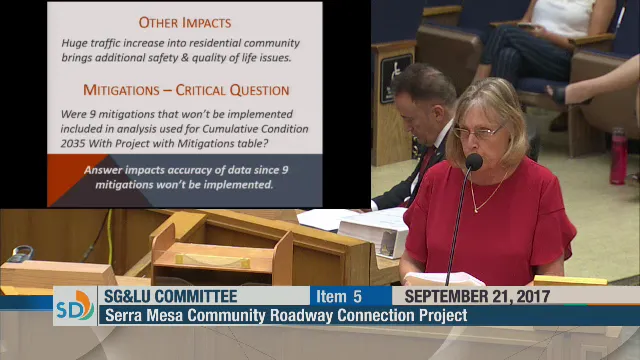
- Public Testimony: Numerous speakers presented both in support and opposition. Supporters included former Councilmember Jim Madaffer, representatives from H.G. Fenton, LCG Friars, Circulate San Diego, and several homeowners associations (High Park, Escala, and others). They cited safety (emergency access), connectivity, reduced congestion on Mission Center and Friars Roads, and regional benefit. Opponents included the Serra Mesa Planning Group, residents of Abbott's Hill, and the Save Civita group. They raised concerns about pedestrian safety, increased traffic on residential streets, failure to achieve emergency access improvements, questionable VMT analysis, and the impact on the local park and school.
- Committee Discussion: Chair Sherman made a motion to approve staff's recommendation, stressing public safety and the road's regional benefit. He noted that Civita residents signed leases indicating the road was a possibility. Fire Marshal Perry emphasized the critical need for a second access route. Councilmember Kate seconded the motion. Councilmember Alvarez requested that the EIR be amended to explicitly note bike lanes and street design manual compliance, and that drawings of the lane transition be provided to council.
Key Outcomes
- Housing Report: Accepted as informational; no formal vote.
- Companion Unit Fees: No formal vote; the chair committed to bringing an action item to the full City Council to reduce fees, likely exempting companion units from DIFs, and to send a letter to SANDAG about RTCIP fee exemptions.
- Serra Mesa Road Connection: The committee voted unanimously (5-0) to recommend that the City Council certify the EIR and approve the Serra Mesa Community Plan Amendment. The vote included a directive to amend the EIR to ensure bike lanes and street design manual standards are included in mitigation measures, and to provide additional engineering drawings to the council before final action.
Meeting Transcript
We have uh some non-agenda public speakers here. We'll go first with Martha Welch. Thank you, Ms. Welch. You have three minutes. Martha Welch. We build the wrong things in this building and we tear um housing, about 10,000. Replaced with hotels and venting housing. They're not filled yet. We build more than we uh all the time. They're saturated right now. We're building about 12 or millions of your right growing up right now. All over. That's what we don't have the low end because you took it away. But what we replaced with the studios and one bedroom only. I don't think everybody wants that. Also, I think people like one bedrooms, but studios I versus only one studio is a townman's gate studios, one bedroom, atmosphere studios, one bedroom, Celadon one studios, one bedroom. And this is not this is not um smart growth, believe me. There's so many of seventh now is going up. Um the rays open. Um gateways almost open. There's two by Powell of uh there's two over there behind the other one, there's two over there. There's a ballpark one. There's the one across might be a hotel across, might be a hotel, I'm not sure across the street from that. Now call the Imperial um caller station, there's one going over there. Um by the trolley, that's where we should build for low income. Um the new one for Father Joe, also uh forty four four hundred and four, most of them are very studios. It's you know, if there's families and there's people with kids and think now on and the housing showed a picture, they had four people in one bedroom with a twin bed. Now come on, they need they need two, they need two bedrooms with two kids at least, and a full bed and two beds. So it's you know, if that's not smart growth. It's not smart what you do. You build the wrong thing constantly downtown at least. I don't know if look around the county, I don't see much of going on either. But it's it's wrong. These buildings are going to be mostly empty right now, EVs not full, form 50 is not full, spray is not uh filled, vantage points not filled, arrays not fulfilled. So we they're saturated, and we still get the same thing over and over. Thank you, Ms. Welch. Next we have Carol Green. And then after that is Kathleen Lippitt. Welcome, Ms. Green. Good afternoon. I saw a couple of you on television this morning, so um Mr. Sherman and Mr. Alvarez, nice job. Um I want to let you know that as the city council moves forward with the new um land use um for commercialized marijuana growth and sales, that this committee really needs to keep a few things in mind. Um, and that it's important to keep in mind, first of all, what the police chief said, citing the many negative impacts of having these commercialized facilities in our city and expanding them along with the cultivation. Um one of the points that she made was the increase in homelessness that they had um observed on their trip to Colorado. So please keep in mind as we grow in a smart way that we're keeping in mind the commercialization of marijuana in other cities has increased homelessness.
openpublica.com