Smart Growth and Land Use Committee Meeting - February 21, 2018
STREAMING COPY IN PREPARATION — RECORDING AVAILABLE FROM THE ORIGINAL SOURCE
Smart Growth and Land Use Committee Meeting - February 21, 2018
This meeting of the Smart Growth and Land Use Committee (formerly known as Smart Growth in the AMUs) was held on February 21, 2018, with Chair Gomez presiding and Vice Chair Alvarez, Councilmember Sherman, and Councilmember Hillary Sach present. The committee approved minutes from January 31, 2018, heard non-agenda public comments, discussed the sale of city-owned land, received an informational status report on the housing affordability crisis, a presentation on the proposed California Sustainable and Affordable Housing Act (CASA), and reviewed the 2018 work plan. Numerous members of the public testified on affordable housing, parking, transit-oriented development, and inclusionary policies.
Consent Calendar
- Approval of minutes from January 31, 2018 – approved unanimously without discussion.
Public Comments & Testimony
- Rambesis Surban (Rancho Peñasquitos Planning Board member, speaking as an individual) called attention to the Pacific Village redevelopment project on the March 5 City Council docket. He stated that the project would replace 332 affordable housing units with only 60 affordable units (10% minimum required), representing a net loss of affordable housing. He urged the committee to remember city policy goals to protect affordable housing when voting on the project.
- Martha Walsh complained about Section 8 housing management, property taxes, and lack of affordable housing construction. She claimed managers give vouchers arbitrarily and called for accountability.
- David Modi (Community Planners Committee) proposed a compromise on lot consolidation: allow it citywide except for communities like Greater Golden Hill and North Park that have specific concerns in their community plans.
- Joy Sonietta (District 3 resident) highlighted a statistic that 23,800 K-12 youth are homeless in San Diego County, urged attention to prevention efforts, and noted Councilmember Ward's plan focusing on prevention.
- Mark Jules criticized San Diego's lack of expertise in smart growth, arguing the city's development is car-dependent. He suggested obtaining outside expertise and cited the high cost of auto-oriented infrastructure.
- José Rodriguez (San Diego Organizing Project / Build Better San Diego Coalition) called for increasing on-site affordability beyond the current 10% requirement and argued the housing crisis requires urgent solutions.
- Vicky Granowitz (San Diego Planning Commission, speaking personally) expressed concern about affordable housing units losing their certification and urged the city to plan for preservation. She cited the PQ project as an example where more affordable units could have been included.
- Maya Rosas (Circulate San Diego) supported the work plan, especially parking reductions and DIF restructuring. She also recommended reforms to community planning group voting procedures.
- Mariana Usamante (Build Better San Diego Coalition) emphasized the need for inclusionary housing and anti-discrimination policies to prevent displacement, noting that families with Section 8 vouchers face discrimination.
- Eric Tilkmeyer (City Heights Community Development Corporation) supported the aggressive work plan, especially inclusionary housing and anti-displacement policies, and urged actual development of habitable units rather than fees in lieu.
- Molly Kirkland (San Diego County Apartment Association) thanked the committee and suggested education and outreach to increase landlord participation in housing voucher programs.
- Marta Flores (Our Lady of Guadalupe Church, Barrio Logan) urged expedited action on affordable housing, especially for families, and called for a progress report to track the city's efforts.
- Brad Mills (same parish) echoed the need for family-sized affordable housing and supported requiring 25% of new units to be affordable.
- Matthew Adams (San Diego Building Industry Association) supported the committee’s collaborative approach and cautioned that inclusionary housing must be carefully designed to avoid harming middle-income housing production.
Discussion Items
Item 1: Sale of 2.7 Acres of City-Owned Land to OTI Land Company
Mary Carlson (Real Estate Assets) presented the proposal to sell city-owned land in Chula Vista (appraised value $51,000, reflecting an easement for a water pipeline) to the adjacent property owner. The property is not needed for municipal use, and the sale would put it back on tax rolls. Councilmember Sherman moved approval; Councilmember Alvarez asked about the appraisal date (February 2, 2018, independent). The motion passed unanimously.
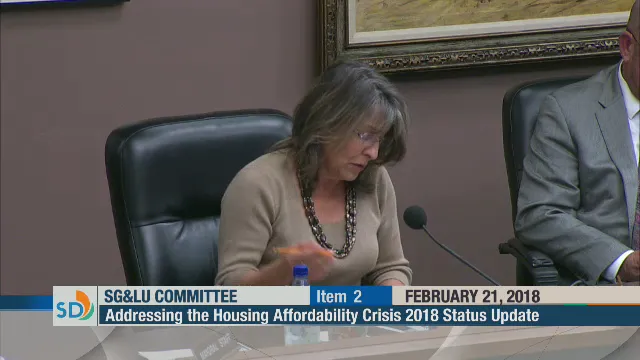
Item 2: Informational Item – Addressing the Housing Affordability Crisis 2018 Status Report
Wendy and Jenny Vanderheid (San Diego Housing Commission) reported progress on all 11 action items from the 2015 report. Highlights included citywide housing production goals, AB 1637 (middle-income housing pilot), the 11th code update, reduced parking near transit, and increased density bonus from 35% to 50%. Councilmembers expressed frustration with slow progress on parking requirements, CEQA thresholds, and inclusionary housing. Vice Chair Alvarez urged bolder action and noted that the report should go to full council. The item was informational; no vote was taken.
Item 4: California Sustainable and Affordable Housing Act (AB 2372) – CASA Act
Lara Gates (Councilmember Gomez’s office) presented a proposed state bill that would allow cities to opt into a floor-area-ratio (FAR) density bonus for developments that set aside 20% of units at 50% AMI or less, reduce parking to 0.1 spaces per unit, and allow impact fees on a per-square-foot basis. The bill aims to incentivize smaller, naturally affordable units along transit corridors. Developers David Allen and Andrew Malik spoke in favor, as did Matthew Adams (BIA). Sophie Wolfram (Climate Action Campaign) urged ensuring livable wages and family-sized units. The item was informational; no vote was taken.
Item 3: 2018 Work Plan
Chair Gomez presented a draft work plan focusing on parking requirement updates, preservation of existing affordable housing, companion units, and other priorities. Public comments highlighted inclusionary housing, anti-discrimination policies, and expedited action. Councilmembers Alvarez and Sherman stressed the need for bold measures, including upzoning, CEQA reform, and reducing parking requirements. Elise Lowe (Mayor’s Office) provided a timeline: TPA parking study by early June, code updates in fall, and DIF methodology workshop in April. The work plan was discussed but not formally voted on.
Key Outcomes
- Consent Calendar: Approved unanimously.
- Item 1 (Land Sale): Approved unanimously. The 2.7-acre property will be sold to OTI Land Company at the appraised value of $51,000, with proceeds to the capital outlay water fund.
- Item 2 (Housing Report): Informational; no action taken. Councilmember Alvarez indicated the report should be presented to full council.
- Item 4 (CASA Act): Informational; no action taken. The city is a sponsor of the state bill.
- Item 3 (Work Plan): Discussed. The committee will continue to refine the work plan. Upcoming milestones: parking study completion in June 2018, DIF methodology workshop in April 2018, and CEQA threshold review in fall 2018.
- The committee’s next meeting is scheduled for March 21, 2018.
Meeting Transcript
Good uh afternoon, everyone, and welcome to the Smart Growth in the AMUs committee meeting on February twenty-first of twenty eighteenth. So I believe we all have our designated uh seats. So we um we have a quorum present from um Councilmember Alvarez, Councilmember Sherman, as well as Councilmember Hillary Sach. Also joining us today are Leslie Fitzgerald from the City Attorney's Office, Elise Lowe from the Mayor's Office, Emma Kou Patel with the independent budget analysts. Welcome, Bakud, I believe it's your first committee meeting with us. Uh thank you for joining us, and committee consultant Karina Johnson. Uh the committee records of action from January thirty-first, two thousand eighteen will be approved by unanimous consent unless poll for discussion. I see none, so they stand approved. We'll move to non-agenda public comment. You will have two minutes to address the committee. Uh we first have uh Ramise Rami Ramses. I apologize. And then following Martha Walsh. Good afternoon. My name is Rambesis Surban. I am here to call the committee's attention to an item that will appear on the City Council docket on March 5th. That item is titled as Pacific Village. The reason why I'd like to call the committee's attention to this item is to focus the committee's attention on the issue of affordable housing. I know that's part of what will be discussed later in the agenda. The Pacific Village redevelopment proposal will appear before the City Council in an and would and uh and the City Council has a discretion to either approve or deny this proposed redevelopment project. The project itself will result in the loss of affordable housing units in Penisquitis. There are currently 332 affordable housing units now. The proposal uh would like to build 600 units, of which 60, the which is the ten percent minimum that's required under the inclusion of your housing ordinance. Of those six hundred units, only sixty will be affordable. In other words, we're going from three hundred and thirty-two affordable housing units in Penosquitas to sixty. This is the only one of the only affordable housing uh one of the only uh affordable housing unit complexes available in the district, one of the few that are available north of the eight. And I'd like to remind this committee that the City of San Diego's goals and policy goals and objectives are to protect and preserve affordable housing. And I ask the council members to remember that when they consider their vote on the project. Thank you. Thank you, sir. Uh Martha Walsh. And then next, David Modi. Martha Welch. About that bond uh um th uh through the uh three nine that million property. How can we press these people? Housing, where they do, section eight. You can't call them or anything. You can't call them. I've called, it just looped. That's all they do. Now, Section 8, I know it has I was product, I used to live there. And the managers give the uh gives you out if she likes you only. After one month, if she liked you, they'll give they'll give you Section H. So how do you call you can't um uh it's no qualifier or anything like that? That's what they do. And also property use tax. How can we trust the county about that? Because on our property right now, they have things we didn't vote for. RTC P. Now we didn't vote for that.
openpublica.com