Smart Growth and Land Use Committee Meeting – March 21, 2018
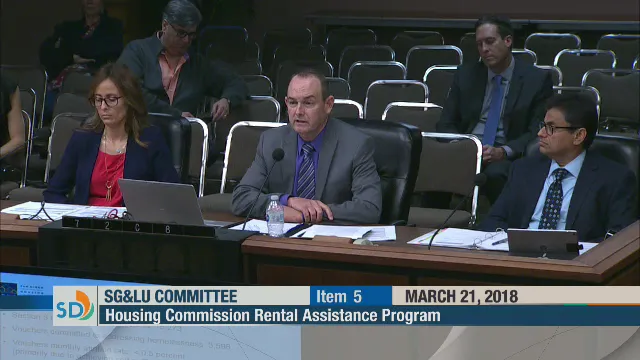
STREAMING COPY IN PREPARATION — RECORDING AVAILABLE FROM THE ORIGINAL SOURCE
Smart Growth and Land Use Committee Meeting – March 21, 2018
The Smart Growth and Land Use Committee met on March 21, 2018, to consider a consent calendar, a discussion item on street dedication, and an informational presentation from the San Diego Housing Commission on rental assistance programs. Committee members Sherman and Gomez were present; Councilmember Alvarez was absent. The committee also heard extensive public testimony on rent control, marijuana regulation, and housing vouchers.
Consent Calendar
- The committee approved the minutes from February 21, 2018, by unanimous consent.
- The consent agenda was approved unanimously, with no items pulled.
Public Comments & Testimony
- Rent Control: Gregory Morales, Catherine Mendoca (San Diego Tenants United), Rafael Bautista, and Sandra Galindo urged the committee to adopt an emergency rent control ordinance, citing rising rents, displacement, and homelessness. Mendoca requested an actionable item on the next agenda. Several speakers noted that over 50% of San Diegans cannot afford rent on a single paycheck.
- Marijuana Regulation: Scott Shipman (San Diego Agents for Safe Neighborhoods) alleged that some marijuana businesses are lying about state permits, that only one conditional use permit is required for manufacturing and distribution (while state law requires separate permits), and that a court injunction against operator Willie Sin has not been enforced. Kelly McCormick and Kathleen Lippett described Mira Mesa being overrun by marijuana businesses, with concerns about smell, contamination, environmental impacts, and diversion to the black market. They cited a study showing 93% of dispensary products contaminated with illegal pesticides.
- Vacation Rentals: JD Stahl, a vacation rental owner, argued that the city’s proposed regulations ignore zoning disparities. He suggested a seven‑night minimum in residential zones, a three‑night minimum citywide, and restrictions on apartment‑complex units. He noted that 5–6 00 whole‑house rentals in downtown San Diego exist, but only 30–40 are likely legal under HOA rules.
- Housing Commission / Section 8: Martha Walsh criticized the San Diego Housing Commission for poor communication, lack of unit‑type data, and alleged mismanagement. Mariana Bustamante (Bill Better San Diego Coalition) urged the city to adopt a source of income discrimination ordinance, to fully implement HUD’s small area fair market rents (SAFMR), and to hold a public forum. Brian Peace argued that the Housing Commission’s “Choice Communities” initiative is a facade and that SAFMR would raise voucher values, not lower them. Parisa E. Jadie Maxudi, a poverty attorney, detailed five inaccuracies in the Housing Commission’s presentation, emphasized that SAFMR is a desegregation rule, and noted that the Housing Commission’s “Choice Communities” program can require tenants to pay 50% of income toward rent, which is above the federal standard of 30–40%.
Discussion Items
- Dedication of Street Right‑of‑Way for a Portion of Nobel Drive: Brenda Chilvers (Supervising Property Agent) presented a cleanup action to dedicate a previously undeveloped portion of Nobel Drive as a public right‑of‑way. The road was built in the early 2000s but never dedicated. The dedication is needed to complete design for future Fire Station 50. No public comments were offered. The committee adopted the resolution unanimously.
- San Diego Housing Commission Rental Assistance Programs (Informational): Jeff Davis, Executive Vice President and Chief of Staff, along with Asuzana Valadelid and Suket Dial, presented the Housing Commission’s Moving to Work (MTW) initiatives. They highlighted the “Choice Communities” initiative (three payment tiers based on zip code groups) and the “Path to Success” initiative (modified rent calculations for workable families, proposed minimum rent increases tied to minimum wage). They noted that the Housing Commission is one of 39 MTW agencies nationwide and that 74% of families would see no change in rent under the proposed Path to Success modifications. The presentation also addressed the status of HUD’s small area fair market rents rule, which the Housing Commission opted not to implement, citing fiscal uncertainty and the availability of a more conservative approach. Committee members asked about the use of 2016 payment standards, potential for reevaluation, landlord recruitment lessons from the “Housing for Heroes” program, and data tracking.
Key Outcomes
- The committee unanimously adopted the resolution to dedicate the street right‑of‑way for a portion of Nobel Drive.
- The informational presentation from the San Diego Housing Commission was received; no formal action was taken.
- Committee Chair Gomez noted that the April 18, 2018 meeting will include a workshop on anti‑displacement and affordable housing preservation.
- The committee did not take action on the requests for an emergency rent control ordinance, but public comments were entered into the record.
- The Housing Commission’s “Path to Success” proposal will be heard by the full City Council in April 2018.
- The Housing Commission committed to sharing data on voucher retention, lease‑up success rates, and other metrics with committee members.
Meeting Transcript
Good afternoon, everyone. Welcome to this Mark Ruth and Landis Committee meeting of March 21st, 2018. We're going to do roll call. This meeting is now called to order. Let the record reflect that committee members, Sherman, Councilmember Staff are present. Councilmember Alvarez is not joining us today. We also have Elise Lowe from the Mayor's office. Leslie Fitzgerald from the City Attorney's Office. And we don't have someone from the IBA, but hopefully they'll be joining us. We have Laura Gates filling in for uh as my committee consultant. The committee records of action from February 21, 2018 will be approved by unanimous consent unless polled for discussion. I see none. They stand approved. We will move to non-agenda public comment. The public is limited to two minutes, and we have a few speakers. I'm going to call Gregory Morales. And then next will be Scott Shipman as well as Kelly McCormick. If you can please light up against the wall, and uh you'll follow next. Two minutes. Hi. I'm Greg Morales. I live at 1256 Sparrow Street in San Diego, California, 92114. Um I'm here to uh say that we have an economic imperative of putting in place rent control, emergency rent control similar to what is happening in other large cities across the across California. Now, the reason why this is imperative is we've we've already had what I call an elastic expansion of rents. Rents have so far exceeded the uh falling the earned wage incomes that the continuation of increase in homeless population is going to continue for the foreseeable future at exponential rates. Now, if we were to act in rent control today, the expansion would be incremental and still be we just double digit rates, but at least would not be compounding exponentially. We're seeing a doubling of the homeless children population in San Diego just over the next three years. Just over the next three years. So right now, over 50 percent of our people living in San Diego cannot afford rents on a single paycheck. Paychecks are falling. The uh value of the earned wage income continue to decrease. So we're gonna see larger and larger homeless populations, just like San Francisco, just like LA, just like every major metropolis. So we can act and slow it? Or we can do nothing and allow it to compound. Thanks. Thank you. Scott Chipman, Sandy Agents for Safe Neighborhoods. Sorry I wasn't able to get a parking place this morning. Uh but I want to continue your education or uh informing uh the City Council what's going on in the marijuana industry. Uh first um we're attending planning group meetings where manufacturing um facility representatives are coming in and saying that they already have state permits, which is not possible because if they don't have a city permit, they can't get a state permit. So there's a lot of lying going on in the planning groups have no idea what's what the truth is. Um just to be aware, it appears that only one CUP is being required for manufacturing and distribution, whereas the state has separate agencies for and uh and permitting processes for manufacturing distribution and production. So it appears that the uh conditional use permit from the city should be required for each of those steps. Uh we're also uh need to be aware that uh uh Willie Sin uh has multiple pot shops in San Diego, and as of five months ago, I asked Mark Skiels of the City Attorney's Office to respond uh regarding an a Superior Court injunction against him operating in the marijuana industry, and you have a copy of that. Uh Mark has not replied uh in five months, and so we would like the City Attorney and the Mayor's office and this city council to require the city attorney to respond to why it is that there is an injunction against this man and he has operating four pot shops. Uh and finally, uh the University of uh California, San Francisco just came out with a report indicating that uh secondhand marijuana smoke is three times more harmful uh than tobacco smoke. So there's a lot going on in this industry and all of it's bad. Um since I have a couple more seconds, Colorado marijuana enforcement agent is being indicted for um actually helping the industry rather than regulating the industry is full of uh lawlessness. Thank you. Thank you, sir.
openpublica.com