Smart Growth and Land Use Committee Meeting - May 21, 2018
STREAMING COPY IN PREPARATION — RECORDING AVAILABLE FROM THE ORIGINAL SOURCE
Smart Growth and Land Use Committee Meeting
Date: May 21, 2018, 5:15 PM (UTC) | Location: San Diego City Hall
The Smart Growth and Land Use Committee, chaired by Councilmember Georget Gomez, met to discuss a range of items including affordable housing preservation, a proposed middle-income housing incentive program, the Midway-Pacific Highway Community Plan update, and community parking district budgets. The meeting included public testimony, staff presentations, and votes on several items. Notable outcomes included forwarding the middle-income housing regulations and the Midway plan to the full City Council without recommendation, subject to further study on specific issues.
Consent Calendar
- The committee approved the meeting record of action from April 18, 2018 (noted as 2020 in transcript but corrected per actual date) by unanimous consent without discussion.
Public Comments & Testimony
- Marcella Escobar Eck (Chair, Code Monitoring Team) reported that since the code was adopted in 1997, over 38 ordinances and 11 code updates have been processed, with 18 volunteer members providing over 500 hours annually. She highlighted the team's work in keeping the code current.
- John Zivarth (representing the Technical Advisory Committee) thanked the committee for providing a forum and mentioned work on streamlining measures. He suggested a historical review exemption for projects not identified in community plan surveys, such as Midway.
- Kathleen LeBitt raised concerns about marijuana businesses operating with business tax certificates while pursuing conditional use permits, arguing that the city allowed them to continue without proper notification or oversight, displacing churches and others.
- Maya Rosos (Circulate San Diego) presented a report titled "Democracy in Planning" with recommendations to make community planning groups more democratic, including prohibitions on restrictive voting policies, agenda reform, and changes to term limits. She requested the committee bring community planning group reform forward as an agendized item.
Discussion Items
Affordable Housing Preservation (Informational)
The San Diego Housing Commission (Jenny Vander Hyde) presented an overview of efforts to preserve affordable housing. Key points:
- Affordable housing is defined by recorded covenants. Between 2013 and 2017, affordability restrictions were extended on four developments totaling 709 units at an estimated preservation cost of nearly $200 million.
- Since 2005, the Housing Commission has helped create or preserve 7,500 affordable units (35% preservation/rehab, 65% new construction).
- Recommended process improvements include a comprehensive database, expanded outreach to at-risk property owners, an annual analysis of highest-risk properties by the California Housing Partnership Corporation, an interagency task force, and creation of an affordable housing preservation coordinator.
Councilmember Gomez and others expressed support for creating a database and a coordinator position. Councilmember Sherman noted that the city lacks middle-income housing and needs to produce more units. Councilmember Alvarez called for key performance indicators (KPIs) to measure housing production. The item was informational; no vote was taken.
Item 2: Fiscal Year 2019 Affordable Housing Fund Supplement
The Housing Commission requested approval to add a preservation and anti-displacement program, setting aside $1 million from the rental housing finance allocation to extend affordability for up to 15 years for at-risk units (targeting 80% AMI or below). The total fund remains at $62 million. Councilmember Sherman made the motion, seconded by Councilmember Alvarez. The committee approved the motion unanimously.
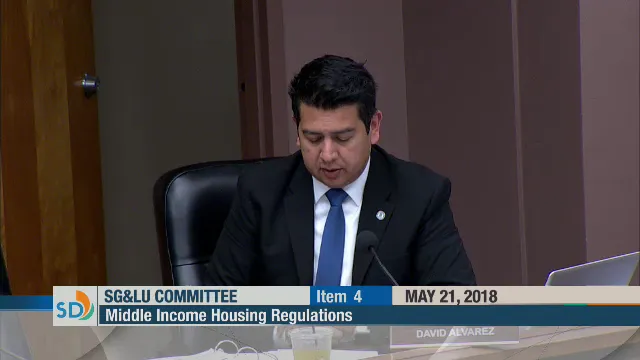
Item 4: Middle-Income Housing Regulations Proposal
The Planning Department presented a new density bonus program for middle-income housing (120-150% AMI). Key features:
- Projects in transit priority areas with at least 10% of units reserved for middle-income households can receive a 25% density bonus, incentives, and waivers.
- Inclusionary housing fees still apply unless an additional 10% of units are provided for low/very-low income.
- Parking reductions available.
- The program can be combined with the affordable housing density bonus.
- Advisory bodies: Code Monitoring Team (10-3 approve), Technical Advisory Committee (11-2 approve), Community Planners Committee (12-3-3 recommend denial), Planning Commission (5-0 approve).
Public testimony: Jim Schmid (Chelsea Investment Corp.) gave a detailed example of how the program could produce middle-income units with no additional public subsidy, but stressed the need to allow income up to 150% AMI (not just 120-150%). Several speakers from business and labor groups supported the program, while some from community organizations expressed concerns about undermining low-income housing production, gentrification, and displacement. The San Diego Housing Federation requested replacement provisions for lost low-income units.
The committee moved the item to City Council without recommendation, with direction for staff to study: (1) changing the definition to "up to 150% AMI," (2) additional parking reductions, and (3) replacement requirements for affordable units lost due to new development. The working group will reconvene to finalize language.
Item 5: Midway-Pacific Highway Community Plan Update and Local Coastal Program Amendments
Staff presented the plan, which envisions:
- Increase residential build-out from ~5,000 to ~11,600 units (130% increase), mostly in transit priority areas.
- Creation of mixed-use villages (Sports Arena, Dutch Flats), new parks, and enhanced pedestrian/bike infrastructure (Bay to Bay Multi-use Path).
- Program Environmental Impact Report (PEIR) certified.
- Planning Commission recommended approval with direction to analyze two requested changes: (a) land use designation change for 9 acres in Camino del Rio (from business park to mixed commercial/residential), and (b) change the proposed Class II bike lane on Hancock Street to a Class III bike route (requested by businesses).
Public testimony: Several speakers supported the plan but raised concerns about traffic mitigation, the 30-foot height limit (Proposition D), the need for Class II bike lanes, and requests to change zoning on certain parcels to allow residential use. Councilmember Zapf expressed strong concerns about unmitigated traffic impacts on adjacent communities (Point Loma, Ocean Beach). Councilmember Alvarez supported studying a 30-foot height limit change and requested that the heavy commercial zone on Hancock Street allow residential use. Councilmember Gomez questioned whether city-owned sports arena property could support higher density.
The committee voted to forward the item to City Council without recommendation, with instructions for staff to study: (1) feasibility of an Enhanced Infrastructure Financing District (EIFD) to fund traffic mitigation, (2) parking management along Hancock Street, (3) potential changes to the heavy commercial designation to permit residential, (4) further analysis of traffic impacts and public safety, and (5) maximizing density on city-owned sports arena property. The 30-foot height limit issue was noted as requiring a separate ballot measure.
Item 6: Community Parking District FY2019 Annual Plans and Budgets
City staff (Elizabeth Studebaker) presented the annual plans for five parking districts (Uptown, Downtown, Mid-City, Old Town, Pacific Beach). Only Uptown, Downtown, and Mid-City require committee approval as they use parking meter revenue. The plans include parking management and alternative mobility projects. Councilmember Alvarez moved approval, which was seconded. The committee approved the item unanimously.
Key Outcomes
- Approved the FY2019 Affordable Housing Fund supplement, including $1 million for preservation and anti-displacement.
- Forwarded the Middle-Income Housing Regulations to City Council without recommendation, with staff directed to study income definition, parking, and replacement requirements.
- Forwarded the Midway-Pacific Highway Community Plan Update to City Council without recommendation, with extensive direction to study traffic mitigation, EIFD feasibility, zoning changes, and density.
- Approved the FY2019 Community Parking District plans and budgets for Uptown, Downtown, and Mid-City.
- The committee's next regular meeting is June 27, 2018 at 2 PM, with a special meeting on June 15, 2018 at 1 PM.
Meeting Transcript
If I can I please ask the audience to uh lower your voices, I would really appreciate it. We're gonna get started. Um thank you all for being here, and just for the re record, we have committee members, uh, councilmember Sherman, Councilmember SAF, um, Mr. Alvarez is not present right now, but hopefully he'll join us. We have uh representatives from the City Attorney's Office, Leslie Fitzgerald, as well as the independent budget analysts, um, Baku Patel, and my committee consultant Karina Johnson. This meeting record of action from April 18, 2020 will be approved by unanimous consent unless pulled for discussion. I see none. They stand approved. Uh we'll move to non-agenda public comment. I have a few speaker slips. I'm first going to call Marcella Hiscobar. Maybe you have two minutes. Thank you, Councilmember Georget Gomez and members of the committee. My name is Marcella Escobar Eck, and I'm here speaking to you as the chairperson of the code monitoring team. And we were asked to just come and give you a brief update of some of the work that's been going on. Um as you probably recall, the code monitoring team got moved, or excuse me, the code update team got moved to the planning department just last year. Um but just to give you an idea, on the code monitoring team, since the code was adopted in 1997. The code monitoring team with the staff that uh and keep in mind that staff up until recently was only two staff members doing all of these changes. But since 1998, when the monitoring program was actually put in place, um, over 38 ordinances, not inclusive of the 11 code updates, have gone through the code monitoring team. And by way of example, it's made up of 18 volunteer members from different professions. When you look at it collectively, we probably give over 500 hours a year towards reviewing some of the work that staff brings to us. And so we think it's a pretty major effort. We don't know of any other jurisdiction that has this ongoing effort to keep its code current, to look at current issues, to look at current technology and trends that are evolving. So we think it's a pretty good use of our time. Um those of us that do volunteer on the code monitoring team take it very seriously. Um we look at it from a lot of different angles. We actually look for loopholes so that we can try and plug them. And we think again that staff has done a fantastic effort. When you look at the 11 code updates that have actually come through comprehensively, aside from the other 38 changes that have happened, each one of those code updates probably has anywhere from 30 to 50 items in them every time. And so we think that that allows your staff to be more effective, all of those of us that are in the industry practicing to be more effective in the community to address issues that are starting to come up. So that was just a quick update. Happy to answer any questions you might have, but thank you for giving us the opportunity to be a subcommittee. Thank you. Um thank you for that report. Up next, John Sieber, and then after John, we have Kathleen Lippid and then Maya Rosos. Good morning, uh Chair Chairperson uh Gomez and members of this committee. My name is John Zivarth. I've had the privilege of representing the American Institute of Architects for 25 years on the Citizens Advisory Committee for the Zoning Code Update, the Code Monitoring Team, and the Technical Advisory Committee. I'm here to speak on behalf of the Technical Advisory Committee. I've passed out a list of all the 18 uh organizations, members who are dedicate their time, the mission statement for this. These are people who deal on a daily regular basis with the development services so they can have that insight. Uh we have several uh subcommittees, such as the code monitoring team that uh Marcella talked about, technology and process. We're proactively working with staff to develop uh with on the process committee to um create streamlining measures, how to reduce regulatory provide regulatory relief, reduce time, money to both the city and the uh applicant while we um maintain quality development. Um example of that, and I'm gonna bring hope look forward to bringing some of those ideas forward in the future. But one example is irrelevant today. What if you granted historical uh review exemption to all projects that are not identified as part of a survey for the community plan updates, such as with Midway, which is before you today. We need those surveys for Mission Valley, Claremont, Kearney Mason, which are all moving forward. This requires City Council action. I would like to take a few moments though to thank my colleagues, my dedicated colleagues, such as Kathy Riser, the chairperson of the TAC, who has been involved since the inception of uh the TAC. Steve Soberman, a planner, John Leopard, a civil engineer who have worked with me for 25 years so that we can provide architectural engineering and planning insight into the project.
openpublica.com