Smart Growth and Land Use Committee Meeting - June 27, 2018
STREAMING COPY IN PREPARATION — RECORDING AVAILABLE FROM THE ORIGINAL SOURCE
Smart Growth and Land Use Committee Meeting - June 27, 2018
The Smart Growth and Land Use Committee of the San Diego City Council met on June 27, 2018, at 10:15 AM. The agenda included public comments on marijuana businesses, a consent calendar, a lease extension for the Mission Bay Hilton Hotel, a proposed ordinance prohibiting housing discrimination based on source of income (Section 8 vouchers), and amendments to live/work quarters regulations.
Consent Calendar
- Two items were approved unanimously without discussion.
Public Comments & Testimony
- Non-Agenda Public Comments:
- Judy Strong expressed concerns about marijuana production facilities (MPFs) on Argens Street, noting that language in CICRA notices indicates products may be manufactured from cannabis grown outside San Diego and distributed statewide, contradicting the original intent of a local supply chain. She also noted that 40 MPF sites could host multiple businesses (cultivation, manufacturing, distribution), leading to saturation.
- Martha R. Welch (speaking unclearly) criticized the lack of affordable housing, blaming county supervisors for not using HUD funds to build housing over 20 years, calling it a fraud.
- Barbara Gordon urged rigorous environmental review for marijuana businesses, citing 273 calls for service to legal marijuana businesses in the past year, problems with smell, noise, crime, and potential negative impacts on neighboring businesses. She asked that all CEQA issues be checked off before CUPs are granted.
- Kelly McCormick noted that planning groups lack transparency and information on CEQA issues (stormwater, traffic, etc.) when reviewing marijuana business applications. She highlighted that the 10-day appeal window often falls between meetings, and the appeal fee has increased from $200 to $1,000, deterring public participation.
- Public Comments on Item 4 (Source of Income Discrimination):
- Supporters: Legal Aid Society (Gregory Knoll) cited federal fair housing mandates and the need to protect Section 8 voucher holders, who are 86% people of color. Human Relations Commission (Steph Gross) supported. Community members (Rebecca Miranda, Rawa Walde Silas, others) shared personal stories of discrimination. Center on Policy Initiatives (Dr. Peter Brownell) noted 10-year wait times for vouchers. Alliance San Diego (Christopher Rice Wilson) called it a proxy for racial discrimination. San Diego Organizing Project (Jose Rodriguez) emphasized displacement of seniors from PQ Village.
- Opponents: San Diego County Apartment Association (Molly Kirkland) argued participation should be voluntary, citing administrative burdens, delayed payments (up to 4 months), and inspections. Small landlords (Bill Snell, Steve Dorner, Kendra Bork, Lucinda Lilly) expressed concerns about bureaucracy, loss of income during delays, and forced contracting with government. Atlantic and Pacific Management (Kim Arnold) noted that all but 10 voucher holders from Pacific Village have relocated voluntarily. Mark Scott cited a case where the housing commission did not comply with 60-day notice requirements.
- Public Comment on Item 5 (Live/Work Amendments):
- Matt Adams (only speaker) strongly supported the amendments, calling them part of a needed supply-side solution to the housing crisis, citing Seattle's success in building enough units to stabilize rents.
Discussion Items
-
Item 3: Approval of 50-Year Percentage Lease for Mission Bay Hilton Hotel (Rossi Hotel)
- Staff (Sibel Thompson, Director of Real Estate Assets) presented a 50-year lease extension (23 years beyond current term expiring 2045). The lessee (LaSalle Hotels, operator Noble House) will invest $15 million in renovations. Key terms: increased percentage rents (rooms from 7.5% to 7.75%, food & beverage from 6.5% to 7%, new telecom category at 50%, other from 10% to 12%). City receives $500,000 lump sum consideration and increased assignment fee (2% vs 1%). Estimated additional rent: $13.5 million through 2045, $171 million for extended term (2046-2068). The property is in Mission Bay, subject to 50-year lease limit. Al Young (COO, LaSalle Hotels) highlighted the property's economic impact (350 employees, $16 million payroll, $7 million local vendor spending, charitable support). Councilmember Alvarez questioned compliance with Council Policy 710 regarding competitive bidding and market appraisal. Staff confirmed the lease is a renewal under policy, with market appraisal ($60 million range) and minimum rent set at 80% of average prior three years. Alvarez asked about protections for the city at lease end; staff noted maintenance requirements and inspections. Councilmember Sherman supported the deal, noting the need for long-term amortization. The motion to approve staff recommendation passed unanimously.
-
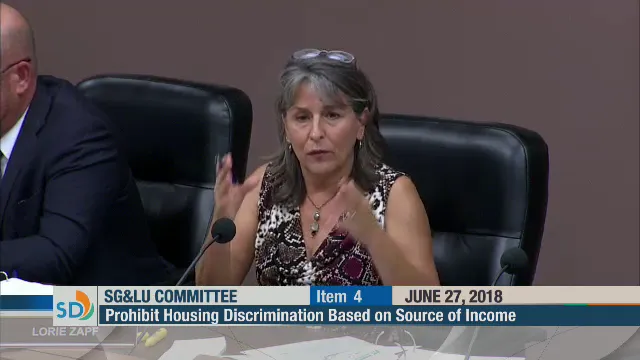
Item 4: Municipal Code Amendment Prohibiting Housing Discrimination Based on Source of Income
- Consultant Karina Johnson presented background: triggered by displacement of Section 8 voucher holders from Pacific Village. Over 15,000 active vouchers (36,000 people), 86% people of color, 1/3 families, over 50% seniors or disabled. HUD maps show geographic concentration of voucher holders in minority areas. The ordinance would prohibit landlords from refusing to rent solely because of a voucher; landlords retain screening criteria. The Housing Commission has streamlined processes (inspection within 1-2 business days, first payment within 7-10 days, inspections every 2 years, self-certification of repairs). Implementation: year one voluntary compliance with education/outreach, year two enforcement with damages equal to three times rent. City Attorney noted preliminary review with potential changes. Housing Commission CEO Rick Gentry supported, noting current 100% voucher utilization but tightening market. He addressed concerns: 5,200 landlords currently participate, 68% with only one voucher. The Commission would fund education and a contingency fund for damages. Councilmember Sherman expressed concerns about legal exposure for landlords and unintended consequences, preferring a year of education first. Councilmember Safé questioned the scope of the problem given 100% utilization and noted many landlords participate voluntarily. She worried about frivolous complaints and litigation. Councilmember Alvarez strongly supported, citing historic segregation and council policy for balanced communities. The motion to forward to full council (by Alvarez, seconded by Sherman? Actually seconded by Gomez? Clarification: Chair Gomez called for a vote; two ayes (Alvarez and Gomez?) and two oppose? The vote was 2-2, but city attorney noted two affirmative votes are sufficient to move forward. The item was moved to full council with no recommendation.
-
Item 5: Amendments to Land Development Code and Local Coastal Program - Live/Work Quarters
- Staff (Edith Gutierrez) presented amendments expanding live/work use to additional zones (CC2, CN1, CR2 from the 11th LDC update, plus CO1 and CV1 per councilmember request). The CV1 zone within coastal overlay is excluded due to Coastal Commission concerns. Key changes: minimum floor area reduced from 750 to 500 sq ft, residential floor area increased from 33% to 49%, use no longer limited to artists/artisans, commercial offices and employees allowed, no additional parking required. The Code Monitoring Team, Technical Advisory Committee, and Community Planners Committee all voted unanimously to approve. Councilmember Sherman moved to approve staff recommendation, seconded by Councilmember Alvarez. The motion passed unanimously.
Key Outcomes
- Item 3 (Mission Bay Hilton Lease): Approved unanimously. The existing lease will be terminated and a new 50-year percentage lease executed, with the lessee investing $15 million in renovations.
- Item 4 (Source of Income Discrimination Ordinance): Moved to full council with no recommendation by a 2-2 vote (Alvarez and Gomez in favor; Sherman and Safé opposed). The ordinance will be considered on Housing Day, July 31, 2018.
- Item 5 (Live/Work Amendments): Approved unanimously. The amendments will be forwarded to city council for adoption.
- Mayor's Staff Update: The short-term residential occupancy proposal will go to City Council on July 16, 2018; all docket items will be posted online by end of the day.
Meeting Transcript
Okay, we have a couple non-agenda public comments. First, we have Judy Strong, followed by Martha R Welch. And there's some things that we've noted at the planning group meetings that I'd like to share with you. One is that with the marijuana production facilities that are coming out with CICRA determination notices with the capacity to appeal them. We've noticed some of the language, and we had some concerns. For instance, the language on one of the MPFs on Argens, one of six on Argens, as a matter of fact, uses this language. Project operations would include manufacturing of cannabis oils and raw flowers provided and cultivated by others to produce finished products to transport and distribute to the State of California licensed outlets. Our concern was when those regulations were passed for MPF. It was to uh create a supply chain for the storefronts in San Diego. And now we have language that suggests that products, cannabis products, marijuana products are going to be coming from other places outside the city and leaving the city after their return to a manufactured state or they're grown to other parts of the state. And we're concerned because we already know there's a glut of marijuana being produced in the state of California, and it seems unfortunate that we've set up regulations that are going to allow more marijuana from our city to go somewhere else and impact other parts of the state. We're also concerned that there are 40 MPFs, and that doesn't mean 40 businesses, that means 40 sites. So at any one site, there could be marijuana production, marijuana cultivation, marijuana manufacturing, and marijuana distribution, creating more like 120 or so businesses because the state licensed them, permits them by individual type, not by site. And we're concerned about the saturation. We are already seeing it on Argens with the six that I noted. Thank you. Martha Welch does not spur um scrowth. Too many um buildings, mostly empty. None of um right now. Now I have rules right now by sound um now who makes that money right now. It's 70 70 million um thousand. No one makes that much. And it's six right now you see five and fifty and fifth and six right now. Used to be three um 30 and 40, but now they don't use that anymore. So it's higher right rent on when you do these um things right now, it's higher rent because uh multiple bonds. You use that for the park west. Now that's studios. It's not family or anything like that. I think that's not right to use those kind of bonds for that. Um the blame for shortage of housing is the supervisors in the county. They got HUD money for 20 years, let's say, uh millions, a hundred million every year average, probably, all these years, and they didn't build anything, no buildings, no HUD buildings at all for 20 years, and they had the money for all those years, and it's a fraud if you ask me. They didn't build all this stuff. So um it's it's wrong what goes on here because if you had HUD buildings, people a low income would be 30 percent of their um b um income. They would have housing right now, they have no no place to go one bedroom for family, stuff like that. I've seen on TV they have they had the one person that had four kids three kids in one bedroom, the housing did a video about that, two kids in a one bedroom. So that's not right. If we had HUD, we'd have all this housing here, but that's the problem with our county. They don't work right. So they they cheated us out of housing and they took the money. That's typical of our county. They don't do anything right. And I went told the supervisor the same thing this morning. I'm not afraid to go there either. I told them what they were doing. They're wrong. They're they're not they don't do this, it's a fraud on us. Okay, next we have Barbara Gordon and Kelly McCormick. Um thank you for letting me address you. A vigorous environmental review is needed as the marijuana production facilities and the marijuana outlet businesses come through the permitting process. These are not benign businesses as they would like you to believe.
openpublica.com