San Diego Smart Growth and Land Use Committee Meeting - July 26, 2018
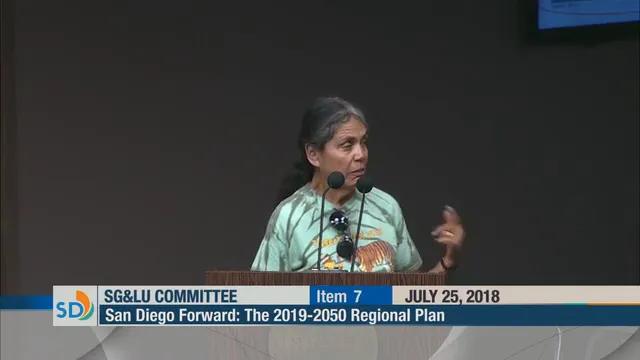
STREAMING COPY IN PREPARATION — RECORDING AVAILABLE FROM THE ORIGINAL SOURCE
San Diego Smart Growth and Land Use Committee Meeting - July 26, 2018
The Smart Growth and Land Use Committee, chaired by Councilmember Gomez, met on July 26, 2018, to discuss several agenda items including a lease for the Chicano Park Museum and Cultural Center, an amendment to the SDSU stadium use agreement, a police department property lease, and informational presentations on the SANDAG regional plan and the city's housing inventory. The meeting included public comments on marijuana facilities, vacation rentals, and other topics. Votes were taken on consent items and discussion items.
Consent Calendar
- Unanimously approved records of action from June 27, 2018.
- Items 1 and 3 on the consent agenda were approved unanimously.
- Item 2 (Neil Good Day Center lease agreement) was pulled for discussion and later approved with a request for additional information on HUD expenditures and 24/7 operations feasibility.
Public Comments & Testimony
- Martha Welsh criticized the city's housing policies and marijuana regulation, stating the county mismanaged HUD funds and that Prop 64 has negative effects.
- Barbara Gordon expressed concern that marijuana production facilities ended up predominantly in Mira Mesa, Sorrento Valley, and Otay Mesa, and noted issues with smell, safety, and unpermitted operations.
- Kathleen Lippett argued that marijuana facilities should require CEQA review, not exemption, and that the process denies public input.
- Jack Shu (Cleveland National Forest Foundation) urged the city to seek an extension for the public review period of the airport authority's EIR, which he said was rejected locally and regionally.
- Kelly McCormick reported difficulties appealing CEQA determinations due to high costs and short windows, and code enforcement failures regarding marijuana businesses.
- Catherine Rhodes addressed the HUD OIG audit debt repayment, asserting that accrued interest could add $135 million to community development funds, and noted money was hoarded for five years.
- JD Stoll, a vacation rental business owner in a commercial zone, pleaded for reconsideration of short-term rental regulations, noting his investments were in areas zoned for visitor accommodations.
- Several speakers supported the Chicano Park Museum and Cultural Center lease, including Lucas Cruz (field rep for Assemblywoman Lorena Gonzalez Fletcher), Manuel Galabis, Maria Gaede (retired principal), and Isabel Sanchez (Chicano Park Steering Committee), emphasizing cultural preservation and community benefit.
- On the SDSU stadium item, speakers included Catherine Rhodes who questioned differing budget numbers, Mary Kuran (Campanile Foundation) highlighted SDSU's economic impact, Patty Roscoe spoke in support, and others like Julian Haddad (Taxpayers Association) argued for waiting until after the November ballot to protect taxpayer interests. Multiple SDSU representatives including Tom McCarron, JD Wicker, Jeff Horton, and alumni spoke in favor of the lease extension. Opponents like Jessica Pierre, Will Griffith, David Norris, and Hector Trujillo argued against subsidizing SDSU football at a loss to the city.
- During the SANDAG regional plan discussion, Maya Rosos (Circulate San Diego) called for fiscally constrained transit-advancing scenarios, Sophie Wolfram (Climate Action Campaign) emphasized VMT reduction and consistency with the city's Climate Action Plan, and others including Ravi Gopinathan, Lucas Curlan, Jennifer Hunt, Maria Cortez, Jack Shu, Randy Van Vleck, Anna Reynoso, and Lydia Van Ot (IBEW 569) urged no freeway widening, more transit and affordable housing near transit, and stronger climate goals.
Discussion Items
- Committee Comments – Accessory Dwelling Unit (ADU) Ordinance: Councilmember Alvarez raised a technical issue in the code that requires property owners in multi-family zones to build additional regular units before allowing a companion unit (granny flat), which is cost-prohibitive. He requested a code change to allow companion units without building other units first. Councilmember Sherman agreed and noted other fine-tuning needs.
- Item 4: Chicano Park Museum and Cultural Center Lease: Staff presented a new 20-year nonprofit lease for a city-owned property at 1960 National Avenue. The lease includes annual administrative rent of $3,597.50 (subject to CPI), with the city possibly funding key building systems. The committee heard strong community support. Councilmember Alvarez moved to approve staff recommendations, including a waiver of strict compliance with Council Policy 700-12. Councilmember Sherman seconded, noting the waiver was reasonable for a community-centered project. The motion passed unanimously.
- Item 5: SDSU Stadium Lease Amendment: Staff from Real Estate Assets presented a first amendment to extend SDSU's use and occupancy agreement for SDCCU Stadium for two years (2019-2020). The new terms include a flat annual rent of $1.1 million plus city retention of all parking and concessions revenue (estimated at $700,000), netting the city about $1.7 million more per year than the current agreement. However, the IBA reported that continuing stadium operations would result in net annual losses of approximately $5.5 million, even with the increased revenue. Councilmembers discussed the operating deficit, revenue from other events, and the possibility of better terms. Councilmember Sherman moved to send the item to full council without a recommendation, directing staff to conduct further negotiations and provide more detailed cost and revenue data. The motion included a second by Councilmember Alvarez and passed.
- Item 6: Police Department Property Lease: Staff proposed a 10.5-year lease for 22,428 square feet at 3354 Ruffin Road South to house the Special Events and Property Room units. The lease rates ($1.30/sq ft base + $0.23 operating) are below market average. Councilmember Alvarez asked about due diligence, ADA compliance, and potential additional costs. Staff confirmed the improvements are at landlord cost and that space allocations comply with regulations. The item was moved to full council with a recommendation (motion by Sherman, second by Alvarez), with Councilmember Alvarez reserving further questions for council.
- Informational Item: SANDAG 2019-2050 Regional Plan: SANDAG staff presented an overview of the plan, including a regional growth forecast of 700,000 more people, 360,000 jobs, and 452,000 housing units by 2050. Emphasis was placed on VMT reduction, greenhouse gas targets, and scenarios for transportation networks incorporating new technologies. Public comment criticized freeway widening and called for transit and climate action alignment. Councilmember Gomez requested that SANDAG work with city staff to develop scenarios that help the city meet its Climate Action Plan. SANDAG agreed to return for further committee discussion.
- Informational Item: Housing Inventory Annual Report: Planning staff presented the first comprehensive housing report, showing a median home price of $605,000, low vacancy rates, and about 38% of RENA goals met (33,000 of 80,000 units). Councilmembers noted data limitations (e.g., affordable units counted only if covenanted) and requested more detailed reporting by community, incorporation of housing goals, and measurement of past initiative effectiveness. The report will be presented to full council on July 31.
Key Outcomes
- Approved consent calendar records and items 1 and 3.
- Approved Item 2 (Neil Good Day Center) with a request for information on HUD expenditures and 24/7 operations analysis.
- Unanimously approved the Chicano Park Museum and Cultural Center 20-year lease (Item 4).
- Forwarded the SDSU stadium lease amendment (Item 5) to full council without a recommendation, with directions for further negotiations and a detailed financial analysis. The city attorney clarified the motion was to recommend rejection of the staff recommendation and return for further negotiations.
- Forwarded the police property lease (Item 6) to full council with a recommendation for approval.
- Noted informational items; SANDAG will coordinate with city staff on climate action scenarios; the housing report will be discussed at the July 31 council meeting with additional data requested.
Meeting Transcript
Good afternoon, everyone. So I'm gonna call this meeting to order, but before we start our official agenda, just a couple of housekeeping. Um if you are standing, there is an overflow room uh for safety purposes. You cannot be standing. I ask that you please go to the next room and there is uh live TV, so you'll get a chance to uh view and hear what's going on here. And then also please, if you can silent your cell phones, I would really appreciate it. Um so with that we're calling this meeting to order. Uh we have a quorum of committee members Alvarez, Councilmember Sherman, and Councilmember Staff are all present. Also present is Leslie Fitzgerald with the City Attorney's Office, Lee Friedman with the mayor's office, uh Charles Modica with the IBA and Karina Johnson, committee consultant. The committee records of action for June 27, 2018 will be approved by unanimous consent unless poll for discussion. And I see none. Um they stand approved. We'll move to non-agenda public comment. The public is limited to there's several, so I'm gonna limit the time to one minute. So I'm gonna call Martha Welsh. Following is Mr. Chipman. Martha Welch, we have all these L's in here in the tape. Um, what whether they like the old um low costs? They take um um atmosphere did the first one, and the back is you can't rent. And that's not right because um it's where's the specters and all that stuff. I don't know where they are. So that's there's there's four of them. They're uh eight for eight, three parks half as and the new one is trolley say. You know what happened in this county? The Board of Super got a HUD for 20 years, and they 100 million every year average that they didn't mower many um, so they didn't build anything, nothing, no hiding, no, nothing, nothing in this county. Only they're here in 1989 on the courthouse. They have their the there's that's that's the only proof you can say how long they're here. They're termed out. But this is wrong what they did with the money. That's why we have a crisis with housing. And smart growth is wrong. All we have these big buildings down there, they're empty, they should roll the land if they run lose their money if they don't lose their money. I'll stick to the headlines. Here's a brochure. You read this through twice, you'll be the smartest person you know about marijuana. Pot isn't even good for pain, as we were told. Prop 64 continues to disappoint. Marijuana users feel more pain. Study finds cannabis lowers pain tolerance, meaning users need more painkillers after uh an injury. Local bans, we were promised local control. The state is now considering uh taking away some of that control by allowing deliveries everywhere, even in cities that have banned marijuana commercialization. Latest numbers, more teens going to juvenile hall in San Diego are testing positive for pot. Forty-five percent of juveniles tested positive. Most the on average, juveniles reported they were under 13 when they first tried marijuana, most before alcohol or tobacco. We do not have regulation. Real regulation is what you get when a fire department comes into your business unannounced and says, I want to see your books and I want to tour your facility. We've got none of that related to marijuana. Thank you. Next we have Barbara Gordon, followed by Kathleen Lippett.
openpublica.com