San Diego Land Use and Housing Committee Meeting – April 10, 2019
STREAMING COPY IN PREPARATION — RECORDING AVAILABLE FROM THE ORIGINAL SOURCE
San Diego Land Use and Housing Committee Meeting – April 10, 2019
The San Diego Land Use and Housing Committee met on April 10, 2019, to discuss and vote on several items including middle-income housing incentives, the annual affordable housing fund plan, an update to the encroachment policy, a performance audit of community planning groups, and the creation of a citizens committee to recommend reforms to community planning group policies. The meeting included public testimony on cannabis testing facilities, housing affordability, parkland leasing, and community planning group transparency.
Consent Calendar
- Approval of Record of Action (March 6, 2019): Approved unanimously.
- Consent Agenda Item 2: Partnership with the American Institute of Architects for redevelopment at downtown Johnny Brown’s. Councilmember Ward expressed excitement. Approved unanimously.
Public Comments & Testimony
- Kelly McCormick: Public health educator. Expressed support for local cannabis testing facilities, citing a severe shortage of licensed testing facilities in San Diego County. Noted that heavy metals (lead, cadmium) and pesticides become concentrated in marijuana, and testing reveals microbial impurities.
- Martha Welch: Criticized the city’s housing policy for building expensive, empty buildings and neglecting family-sized units. Stated that medium and low-income housing are not being built.
- Kathleen Lippitt: Public health practitioner. Expressed concern that unpermitted marijuana shops are operated by the same individuals applying for legal business licenses, and that city regulations do not disqualify scofflaws. Cited an Orange County Register article about complex ownership schemes.
- Bob Kazuski: Argued that Torrey Pines Glider Port, a city park, is being leased exclusively to a business, violating park purpose. Stated that the lease expired in 2008 and the business has made over a million dollars annually. Asked the committee to consider returning the land to public park use.
Discussion Items
-
Item 3 – Amendment to Municipal Code and Local Coastal Program for Middle Income Housing Incentives: Staff presented a proposal to incentivize construction of middle-income housing (80-120% AMI) with density bonuses, fee waivers, and parking reductions. Many public speakers expressed support, with some recommending amendments:
- Maya Rosas (Circulate San Diego): Supported with amendments: deed-restriction at 80-120% AMI, allow 100% affordable projects to use the bonus, include anti-displacement rules, and allow stacking with density bonus.
- Angie Kallanog (BIA): Supported but recommended maximum flexibility up to 150% AMI; disagreed with deeper affordability requirements.
- Sean Carafin (Chamber of Commerce): Supported, noting that the housing crisis is making San Diego unaffordable for middle-income workers.
- Dr. Murtasa Batsmusa: Conditionally supported, urging that low-income housing be included on-site and that the program be tied to the inclusionary housing ordinance.
- Melanie Cohn (Biocom): Supported to help house life-science employees.
- Laura Nunn (Housing Federation): Suggested covenant-protected units, rents at least 10% below market, and income averaging to serve the full 80-120% range.
- Joe Lakava (Build Better SD Coalition): Opposed current form; urged focus on 80-120% AMI and stratified income levels.
- Satomi Rosh Ziegler (Labor Council): Opposed as written; willing to support if amendments include on-site inclusionary and passage after inclusionary ordinance revision.
- Susan Baldwin (We the People): Opposed process; wanted more public input and consideration alongside inclusionary ordinance.
- Tim Hutter (developer representative): Opposed requiring stacking with density bonus, arguing it would reduce flexibility and may discourage participation.
- David Modi (CPC): Supported but asked for progress on census of deed-restricted housing. Councilmembers debated: Councilmember Sherman seconded a motion by Chair Marino with amendments including stacking, definition of middle income at ≤120% AMI, deed restriction, income range from 80-120%, anti-displacement rules, and allowing mixed-income and 100% affordable projects. Councilmember Ward expressed concern that the proposal was premature without other housing policies moving concurrently. The motion passed 3-1 (Ward opposed).
-
Item 4 – Proposed Fiscal Year 2020 Affordable Housing Fund Annual Plan: Staff presented a plan with $72 million total, including $7 million new funding and $65 million fund balance. 86% allocated to rental housing finance, remainder to home ownership, homelessness programs, and administration. Public speakers: David Modi requested progress on census of affordable housing; Michael McConnell asked for outcome-based metrics and highlighted issues with homeless programs (e.g., closed showers at Neil Good Day Center). Councilmembers discussed administration costs, homeless funding, and the need for more traditional affordable housing. Motion to approve carried unanimously.
-
Item 5 – Update to Council Policy 700-06 (Encroachment on City Property): Staff presented updates to streamline and remove telecommunications references. No public speakers. Motion to approve carried unanimously.
-
Item 7 – Performance Audit of Community Planning Groups: The City Auditor presented findings: city provides limited oversight; many CPGs are not compliant with council policy or Brown Act; rosters, annual reports, and minutes are incomplete; some members exceed term limits; renters are under-represented; unclear project review deadlines. Recommended training, record retention, renter category, and better communication. Public speakers: David Modi (CPC) supported reforms but opposed a renters category; Maya Rosas (Circulate) supported reforms; Stephen Bossey (Atlantis Group) supported recommendations. Informational item; no vote required.
-
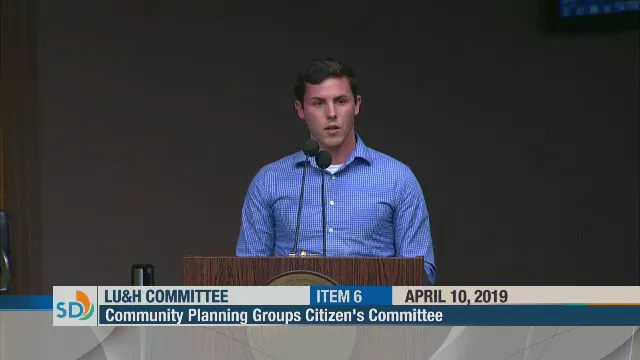
Item 6 – Creation of a Citizens Committee to Recommend Revisions to Council Policy 600-24 (Community Planning Groups): Staff proposed a 7-member committee (later amended to 11) to consolidate recommendations from the Grand Jury, City Auditor, and Circulate San Diego reports. Public speakers: Many supported the committee but with concerns about membership balance. Speakers included Randy Wilde (North Park Planning), Maya Rosas (Circulate), Melanie Cohn (Biocom), Sean Carafin (Chamber), Stephen Bossey, Ian Epley, Matthew Vasilakis (Climate Action Campaign), Sharon Gale, David Modi (opposed membership composition), Joe Lakava (opposed forming a committee; advocated immediate action), Kathleen Lippitt (opposed process), Clint Daniels (supported reforms), and DK Aniwo (Midway Planning, supported with caution). Councilmember Sherman made a motion to create the committee, seconded by Councilmember Ward with amendments to expand to 11 members including three CPC representatives, a past DSD/planning employee, two small business representatives, two housing/infill/environmental advocates, one mobility advocate, one planning commissioner, and one BIA representative. Motion passed unanimously.
Key Outcomes
- Item 3 – Middle Income Housing Incentives: Approved 3-1 with amendments (stacked density bonus, 120% AMI ceiling, deed restriction, anti-displacement rules). Referred to full City Council.
- Item 4 – FY2020 Affordable Housing Fund Plan: Approved unanimously.
- Item 5 – Encroachment Policy Update: Approved unanimously.
- Item 7 – Audit of Community Planning Groups: Received as information; no vote.
- Item 6 – Citizens Committee for CPG Reform: Approved unanimously with amendments to membership. Referred to full City Council for final creation.
Meeting Transcript
Good afternoon. I'll call to order the April 10th, 2019 land use and housing committee meeting. Uh Councilmember Ward Campbell and Sherman are present. The first thing that we'll take up is the approval of the record of action item for March sixth, two thousand nineteen. Do I hear a motion? Thank you. So all those in favor of the motion. Oh, did you have something to add? I'm sorry. No. Okay, good. All those in favor of the motion, please say aye. Okay, and motion carries unanimously. Uh next, we're going to go to non-agenda public comment where members of the public may speak on any item not on today's uh agenda. And first up, we have Kelly McCormick. Okay. Okay, great. Thank you. Good afternoon. I'm Kelly McCormick, a public health educator and an advocate for public policies that are transparent and promote a healthy environment for our youth and young adults. Since San Diego is allowing the cultivation, manufacture, and sale of marijuana products in the city, there's a critical need for local testing facilities. Most people are not aware that there's a severe shortage of licensed testing facilities in the state, and there are no licensed testing facilities in San Diego County. Heavy metals and pesticides also become more concentrated. According to the State Bureau of Cannabis Control, lead and cadmium are among the heavy metals that have caused marijuana batches to fail testing. There is no amount of lead thought to be safe for human consumption. It accumulates in the body and can cause severe birth defects and a wide range of health disorders. Cadmium is known to cause cancer. Testing also reveals microbial and other impurities, so it's important to have extra testing capacity and public education on the issue. Thank you. Thank you. Miss Martha Welch. Followed by Kathleen Lipton. Lippitt, I'm sorry. Mark Watch, we never voted for two minutes in non dinner. We have these rule uh housing only this county. No one in the state doesn't have this rules. Used to be lower, now 65. It used to be 30, 40, 50. Property section also. No really HUD buildings because it's probably San Diego housing and counting is the problem with that. All we build is expensive buildings. There's too many of them in saturated. Who did it? Civic, I'm not sure. Most are empty also, and they lack two buildings and three bedrooms, also. Cell of a meeting, and they told us about the garbage stuff that they don't have big um pipes. That's how I found about that. I bet that everybody does that. Um it's supposed to be looking good. Don't use garbage space, and I bet it's all the buildings here, and I think the problem also.
openpublica.com