Land Use and Housing Committee Meeting - July 17, 2019
STREAMING COPY IN PREPARATION — RECORDING AVAILABLE FROM THE ORIGINAL SOURCE
Land Use and Housing Committee Meeting - July 17, 2019
The Land Use and Housing Committee of the San Diego City Council met on July 17, 2019, at 10:00 AM. The meeting included approval of the previous meeting's record, non-agenda public comments, presentations on mental health services and homelessness coordination, a client survey update for the Storage Connect Center, an amendment to push cart regulations, and a comprehensive presentation on the Mission Valley Community Plan Update. Several votes were taken, and all items were moved forward as recommended.
Consent Calendar
- The record of action for the June 12, 2019 committee meeting was approved unanimously on a motion by Councilmember Sherman and second by Councilmember Campbell.
Public Comments & Testimony
- Martha Welch expressed strong support for more affordable housing, criticized rules such as time limits on rental assistance, and stated that the county lacks adequate low- and moderate-income housing. She urged building more units with multiple bedrooms for families.
- Terry Ann Skelly called attention to a media report about a marijuana extraction lab at 7542 Trade Street that had dumped 28 drums of contaminated ethanol (1,500 pounds) at four locations around the county. She requested that the committee consider revoking the business's permit and ask for a report from the county environmental health department.
- Kathleen Lippitt opposed increasing the number of marijuana production facilities (MPFs), arguing that rewarding illegal operators encourages further violations and that the city should not spend more resources on additional MPFs. She also commented later on mental health prevention, stating that commercializing marijuana undermines prevention efforts.
- Michael McConnell (supported the mental health presentations) stressed the need for regional coordination, consistent messaging, and a unified strategic plan across city and county entities.
Discussion Item: Mental Health Services and Homelessness Coordination
- Toby Ewing (Executive Director, MHSOAC) presented on the state's Mental Health Services Act (MHSA). He highlighted that California invests $2 billion annually in MHSA funds, with 20% set aside for prevention and early intervention. He showed that San Diego County had $128 million in unspent MHSA funds at the close of FY 2016-17 (122% of annual revenue), though the county has since spent down significantly. He demonstrated the commission's transparency website and discussed innovation programs, such as Santa Clara's Alcove youth drop-in center and a Trieste-based model in Los Angeles. He noted that San Diego's suicide rate is above the state average and that the state is developing a suicide prevention plan.
- Omar Passins (Director, County of San Diego Integrative Services) presented the county's efforts to coordinate housing, health, and homeless services. He stated that the county has 72 PERT officers (Psychiatric Emergency Response Team) countywide, with 56% (approximately 40) working in the City of San Diego and 30 positions filled. The county's Project OneforAll, started in 2016, has housed 899 individuals with serious mental illness out of an estimated 1,250 homeless residents with SMI. The Whole Person Wellness program, funded at $10 million, has permanently housed 31% of enrolled individuals. He also noted that 36 homeless outreach workers are funded by the county, with 15 covering central and south regions.
- Committee discussion: Councilmember Ward asked about workforce development and the state's 5-year plan for mental health workforce (proposed $35 million in governor's budget). Councilmember Sherman inquired about SB 1045 conservatorship; Passins said the number of eligible individuals under state definitions was very low. Councilmember Moreno pressed for a commitment to work with city staff on using innovation funds, but Passins deferred to the county's behavioral health department. Moreno also asked about the Tri-City crisis center closure and bed availability; Passins said he would follow up with behavioral health.
Discussion Item: Storage Connect Center Client Survey Findings
- Lisa Jones and Marley Williams (San Diego Housing Commission) presented the survey results. The center, opened June 2018, has up to 500 bins. As of June 30, 2019, 495 clients were enrolled. Since opening, there were 26,231 return visits. Of 114 clients who formally closed their bins and indicated a destination, 79 exited to permanent or other long-term housing. A survey of 210 clients showed: 73% were chronically homeless, 70% slept in downtown San Diego the night before, 68% were actively looking for housing (75% cited insufficient income as a barrier), 13% were employed full- or part-time, and 30% were seeking employment. Most clients were not working with a case manager.
- Committee comments: Councilmember Ward noted that 70% of clients slept within a half-mile radius, dispelling the myth that storage centers attract homelessness. He also observed the high percentage of clients looking for housing. Councilmember Sherman asked about tracking clients through HMIS and the new Clarity system.
Discussion Item: Amendment to Push Cart Regulations
- Renee Mezzo (Planning Department) presented an amendment to comply with SB 946 (effective Sept. 17, 2018), which allows local regulation of sidewalk vending in public rights-of-way. The amendment removes existing push cart regulations for public rights-of-way while retaining regulations on private property. Future sidewalk vending regulations are being developed for the Land Development Code (Ch. 3) and will be presented to the Economic Development & Intergovernmental Relations Committee on July 25, 2019, with a City Council hearing scheduled for September 2019.
- Public comment: Matthew Peterson (attorney representing Chemco Realty) spoke neutrally but expressed concern that SB 946 has led to unlicensed vendors setting up shops on sidewalks, causing congestion and unfair competition for brick-and-mortar businesses. He asked that comprehensive regulations be adopted.
- Committee discussion: Councilmember Ward supported the amendment and looked forward to broader regulations. Councilmember Sherman seconded, noting concerns about competition with established businesses but understanding state requirements. Councilmember Moreno emphasized supporting immigrant and low-income entrepreneurs. The committee voted unanimously to move the item to City Council.
Discussion Item: Mission Valley Community Plan Update
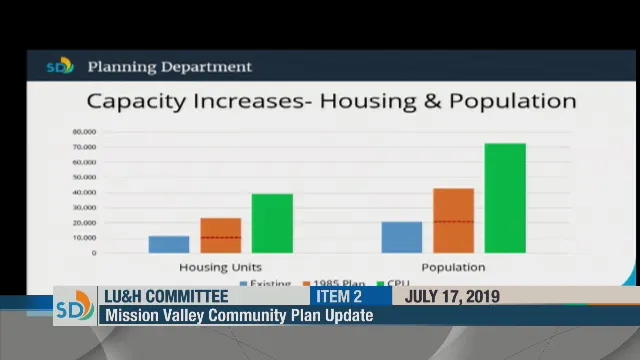
- Nancy Graham (Planning Department) presented the comprehensive update, the first since 1985. Key statistics: The plan adds capacity for 28,000 new homes (approximately 50,000 new residents) and 7 million square feet of commercial space. The current jobs-housing imbalance (40,000 in-commuters daily vs. 600 living and working in MV) will be improved. Mode share projections show daily drive-alone dropping from 54% to 42%, transit doubling from 4.6% to 8.3%, and active transportation rising from 11.7% to 24.3%. Vehicle miles traveled (VMT) per capita for Mission Valley residents is projected to drop from 99% of the regional average to 67%. Bicycle infrastructure will increase significantly: 132% more bike paths, 47% more bike lanes, and 522% more cycle tracks. Two bridge connections are included (Fenton Parkway extension and Riverwalk Street J) to improve north-south connectivity across the river. The plan includes design guidelines, a parks and open space plan (94.15 acres planned, but the PEIR states a minimum of 203 acres needed per city standards). The Planning Commission recommended approval with modifications, including that the impact fee study not include improvements to Mission Bay Park and that the city continue to explore alternative stormwater compliance.
- Public comments: Rob Hutzel (San Diego River Park Foundation) opposed due to a parks deficit, arguing the plan overcounts park acreage (10 acres committed to Navajo community). Malika Marsten (Climate Action Campaign) supported the mode share improvements but opposed the bridges, saying they would induce driving demand. Jennifer Hunt (San Diego County Bicycle Coalition) supported bike infrastructure but asked for bike-ped only bridges. Kim Brewer (Westfield) supported the plan, praising flexibility for redevelopment. Bernie Nofeld (Mission Greens HOA) opposed lack of height restrictions on a specific parcel. Elizabeth Leventhal (subcommittee co-chair) supported. John Zebarth supported moving forward but noted 288,000 new daily vehicle trips and major unmitigated traffic impacts. Dan Smith (Grantville) supported but asked for better connectivity between Grantville and Mission Valley. Matt Adams (BIA) supported the plan. Ken Gotthealth (property owner) supported.
- Committee discussion: Councilmember Sherman, whose district includes Mission Valley, strongly supported the plan, noting the necessity of the bridges for emergency access and fire truck mobility. He asked about funding for the connectors; staff responded that an impact fee study will be brought to Council by end of 2019, and other funding sources (RTP) will be sought. Councilmember Ward seconded the motion, praising the mode shift, bike infrastructure, and river focus. He asked about monitoring mode share and child care facilities. Councilmember Campbell thanked staff but expressed concern about lack of parkland, hoping developers will include more open space.
- The committee voted unanimously to approve staff's recommendations and forward the plan to the full City Council.
Key Outcomes
- The record of action for June 12, 2019 was approved unanimously.
- The amendment to push cart regulations (Item 1) was recommended for City Council approval unanimously.
- The Mission Valley Community Plan Update (Item 2) was recommended for City Council approval unanimously, with the understanding that an impact fee study will be brought by end of 2019 and that the city will continue to explore alternative stormwater compliance.
- All other items (Items 3, 4, and 5) were informational and required no action.
- The next regularly scheduled Land Use and Housing Committee meeting is set for September 11, 2019.
Meeting Transcript
Good afternoon. I'll call to order the July seventeenth, two thousand nineteen, Land Use and Housing Committee meeting. Council members Ward Campbell and Sherman are present. Uh welcome to all the members of the public who are attending this committee meeting today. Uh the first thing that we're gonna take up is the approval of the record of action item for June twelfth, two thousand nineteen. Do I hear a motion? Okay. Councilmember Sherman. Seconded by Campbell. All in favor of the motion? Please say aye. Okay, no opposed. So motion carries unanimously. Uh next we're gonna go to non-agenda public comment where members of the public may speak on any item not on today's agenda. And we are gonna start with Miss Martha Welch, followed by Terry Ann Skelly. Two minutes. We didn't vote for that in communities. Martha Welch. All these rules in housing like A min for rent. Fifty years of for uh for that's not really lack of two the two three bedrooms also. And also we are low and mode. Housing. What's missing is head like sell it on where I live. It's property um space um head for two years only. I wrote it's uh the rule also that's not right also. After two years, you're on section eight. So that's another thing, head only two years. That's another rule. That's not right also. Because if you get on hydrogly for years and years and everywhere else, but not here. We have all these rules that it doesn't have only San Diego has that rule. HUD is it's for life. And that's not right. You know, I've seen families um studios one bedroom, and that's not right because that's all I can find that's affordable also. We haven't um built stuff for years. Also you always talk about units but more than units we mean we'll have to have more bedrooms, how many bedrooms stuff like that we need that. I know you want to be smaller but what about families? We have a lot of families that are homeless and stuff too that need cheaper put rent also and if we don't do the right thing here we won't have um cheap because it's based on income how it is based on your income of 30% or two of two eight point five is uh that's how much you pay on your income so they can afford it. So that's what we should do here but we don't have it's lacking here. Now other places have this stuff but we don't have again all these rules in this county are against people low income and moderate moderate also and so that's the problem here. When we build stuff it's always like market rate and a few of only a few and that's not right. We need more build we need more and more all the time because we didn't do it for years. Thank you. Miss Terry Ann Skelly followed by Ms. Kathleen Lippitt afternoon my name is Terry Ann Skelly. I'm a mother of three sons I live and work in San Diego. I'd like to call to your attention the media report which was just distributed regarding one of 40 permitted marijuana businesses at 7542 Trade Street a butane marijuana extraction lab which has been dumping its hazardous waste products at at least four locations around county the county the interstate intersections of state 52 and 125 Jamaica Road in El Cajon Avocado Avenue in Alcajon and Logan Avenue in San Diego. This MPF at 7542 Trade is one of the marijuana businesses given preemptively at a mysterious business tax certificate to operate a marijuana business while the city staff was repairing regulations for marijuana businesses for a city council vote. In September 2017 City Council considered and voted on regulations. However this marijuana business and extraction lab was already operating an unfortunate breach of the usual way the city does business it was given a second chance to put its house in order and go through the permitting process honestly by September of 2019.
openpublica.com