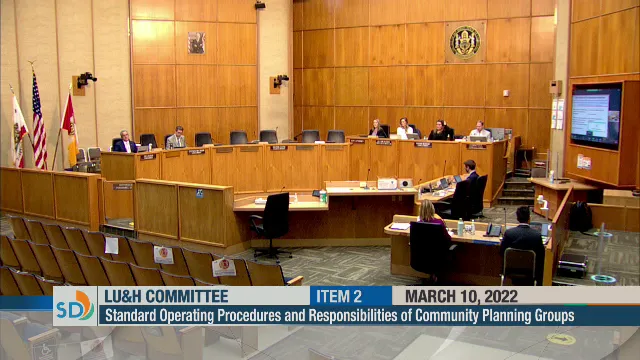
Land Use and Housing Committee Meeting - March 10, 2022
STREAMING COPY IN PREPARATION — RECORDING AVAILABLE FROM THE ORIGINAL SOURCE
Land Use and Housing Committee Meeting - March 10, 2022
The Land Use and Housing Committee of the San Diego City Council met virtually on Thursday, March 10, 2022, at 9:00 AM. The meeting was held via teleconference due to the COVID-19 public health emergency, with public comment available via Zoom. Key agenda items included an informational update on the San Diego Housing Commission's Accessory Dwelling Unit (ADU) pilot programs and an informational update on proposed amendments to council policies governing community planning groups (CPGs). The committee also approved the minutes from the February 10, 2022 meeting.
Consent Calendar
- The committee unanimously approved the committee actions of February 10, 2022 (motion by Vice Chair Lacava, second by Councilmember Whitburn, all members voting yes).
Public Comments & Testimony
Non-Agenda Public Comment:
- Daniel Schmikowski (Bay Park, Bay Ho) expressed concern about state and city ADU policies, arguing that setbacks and neighborhood integrity are being compromised and that the pace of change is too fast.
- A caller (last four digits 7234) raised issues regarding the unsheltered population, including physical handicaps, mental health, and drug addiction.
- Becky Rapp (San Diego resident, public health educator) criticized Councilmember Whitburn's memorandum on marijuana outlet ordinances, arguing that communities of color do not want more marijuana businesses as reparations.
- A speaker advocated for banning car-centric uses around transit priority areas (TPAs) to meet climate action and vision zero goals, urging the committee to revisit the proposal.
- Judy Strang noted that a county webinar on social equity in marijuana businesses lacked Latino, Vietnamese, and Asian parent leaders, and emphasized that communities of color want community centers and youth transition support, not marijuana stores.
- Joy Sanyata (District 3) reflected on Mayor Gloria's statement about unsheltered people on sidewalks, expressing sadness and frustration, and wishing for more bathrooms and blanket distribution.
- Lorna Zukis opposed road diets and parking requirement reductions, citing that only 8% of San Diego residents bike and that such policies hurt working-class car-dependent residents. She also noted that population growth projections (17.6% from 2016-2050) are lower than the 33% housing increase, suggesting overbuilding.
- Kelly McCormick (public health advocate) thanked the council for regulating street vendors, particularly regarding marijuana products, and urged adding drug paraphernalia to the list of prohibited items.
Public Comment on Item 1 – ADU Pilot Programs:
- Joy Sanyata (District 3) praised the ADU program but questioned the 7-year deed restriction and 80% AMI requirement, suggesting longer affordability. She also proposed using similar small homes for the unsheltered.
- Nicole Burgess applauded the program but suggested including two-story ADUs to capture density and preserve gardens.
- Daniel Schmikowski expressed skepticism, citing unanswered questions about zoning, property tax, Proposition 13, and Fannie Mae, and warned about neighborhood integrity.
- Lorna Zukis supported the program in concept but cautioned about potential financial risks for low-income homeowners, referencing the 2007-2008 housing crisis, and asked about safety nets.
- Sharon Gale (District 3) commended the housing commission and suggested developing plans for ADUs above garages, noting that ADUs have existed in Mission Hills for over 100 years without harming neighborhood character.
- Susan Baldwin advocated for longer and deeper affordability requirements in the pilot program.
- Oscar Tavera (Mission Hills resident, age 32) strongly supported the ADU program, stating it provides flexibility for young people who cannot afford to live in San Diego, and argued that it does not negatively change neighborhood character.
Public Comment on Item 2 – CPG Reforms:
- Rudy Lopez (Chair, San Isidro CPG) spoke in defense of community planning groups, expressing concern about loss of review ability due to SB 9 and other policies. He generally supported the CPC recommendations but opposed the requirement for CPGs to take ownership of official documents and designated seats/quota categories.
- Wally Wolfeck (Chair, CPC and planning group) criticized the proposal for lacking proactive measures to assist CPGs in achieving democracy and for potentially severing the long-standing relationship between the city and CPGs.
- Aidan Lynn supported the reforms but expressed concern that common-sense changes like term limits and fair election requirements were being watered down in response to criticism from the same institutions that need reform. He called for more outreach to equity-based stakeholders.
- Chris Nielsen (Chair, University CPG, speaking personally) emphasized that CPGs are voluntary and time is a scarce resource; he asked for clarity on social media use to avoid Brown Act violations.
- Liana Cortez (University City) supported reform, noting that her CPG is 86% white and dominated by homeowners, while the community is 48% white and 52% people of color, with 50% aged 15-34. She argued that structural barriers exclude young renters and people of color.
- Egan Lai (renter) supported reform, stating that land use decisions directly affect housing affordability and that renters' voices are often excluded.
- David Modi (Chair, Kensington-Talmadge CPG) disagreed with prior comments, stating that the proposal drastically tightens term limits, including a two-year break in service, which he argued is unnecessary.
- Ashika Shrinivas (University City) supported reform, describing a structural bias toward single-family homeowners in her CPG, where South University City (25% of population) holds a large majority of seats.
- Rachel Graham (young renter, Carmel Mountain Ranch) supported reforms, particularly prohibiting meeting attendance requirements to vote, and advocated for greater outreach to renters.
- Joy Sanyata (District 3) thanked Councilmember Lacava for his passion and support for CPGs, agreeing that they should reflect the communities they represent.
- Matt Adams (Building Industry Association) supported the reforms as practical and important for consistency and bringing fresh perspectives, noting that planning groups often lack diversity and that attendance requirements to vote should be removed.
- Melanie Cohn (University Community Plan Update Committee) supported reform, noting that the University City CPG disenfranchises students by designating only one seat for on-campus students, and called for more transparent voting processes.
- Jesse O'Sullivan (Circulate San Diego) supported the reforms and recommended that annual funding for CPGs continue, be available upfront, that planning department staff be assigned to each CPG, and that training be expanded.
- Sally Small (Chollas Valley CPG, representing Emerald Hills) appreciated positive changes but noted that minimum meeting requirements are necessary to prevent takeover by troublemakers, and that term limits with a two-year break may be too burdensome for hard-to-fill seats.
- Madison Coleman (Climate Action Campaign) supported the reforms, emphasizing that CPGs must include diverse voices, and echoed recommendations for planning department staff and expanded training.
- Caleb Shimke (young renter, District 2) supported reform, noting low voter turnout in CPG elections and the need for better public information and removal of obstacles to participation.
- Mario Grassi (Eastern Area Committee member) expressed concern about attracting young people and renters, and advocated for at least one meeting attendance requirement for candidates.
- Rob Hickson III (Chair, Otay Mesa CPG) thanked the committee and emphasized the challenge of getting more people involved, particularly in areas with limited rental housing.
- Paul Jameson strongly supported reforms, encouraging further outreach to underrepresented groups and collection of demographic data, and argued that CPGs should work within the RHNA framework.
- Amanda Nelson (Uptown Community Planner, black woman renter in her late 30s) supported reform, stating that she was scared off by animosity from getting involved as a renter and that such hostility discourages participation.
- Alexis Goldschmidt supported reform, citing a land use survey in University City where 70-75% supported medium and high density, but the planning group's narrative does not reflect that, and argued that inequitable structures must be addressed.
- Sharon Gale (District 3) argued that unrepresentative CPGs give bad advice and should not get city support to fight middle-class housing, and opposed no-cost appeals.
- Eva Yakutis (former member, College Area Planning Board) focused on the need for better training and building stronger relationships between CPGs and City Hall.
- Monica De la Cruz (Greater Golden Hill CPG) supported reforms, stating that attendance requirements are exclusionary, and called for collecting demographic data.
- Deborah Knight (University City, 20-year attendee) supported no attendance requirement to vote but argued that candidates should be required to attend at least one meeting to know what they are getting into.
- Ryan Klumpner (Vice Chair, Housing Commission, speaking personally) supported reform, stating that CPGs often delay or kill affordable housing, and that opposition is often from a small minority of older homeowners; he noted that renters face hostile comments when they participate.
- Clint Daniels (Uptown CPG) supported reforms, arguing that meeting attendance requirements are anti-democratic, and urged moving the item to full council.
- Alex Azukas thanked Councilmember Lacava but suggested two amendments: the city should provide a website repository for CPG documents, and at least two meetings attendance should be required to show commitment.
- Sandra Stahl (Sierra Mesa CPG) requested templates for required documentation, and expressed difficulty in attracting minorities and renters to meetings, asking for suggestions.
- Brenda Fake (La Jolla Parks and Beaches, personal capacity) noted that the proposal stems from a grand jury and audit, but also suggested an audit of the planning department.
- Suzanne Barricchini (newly elected, La Jolla CPG, speaking personally) supported greater outreach, noting that in the March election only 0.6% of the population participated, and only 60 of 90 eligible voters actually voted.
- Jeff Huder supported the changes but cautioned against mandating demographics or seat allocations, arguing that planning groups are being transformed into unpaid elected offices and that mandating outcomes violates election principles.
- Judy Strang (attends three CPGs) noted that CPC did not vote in February due to unanswered questions, and that the current proposal is very different from earlier discussions. She supported outreach but advocated for at least one meeting attendance requirement and noted that CPG votes are usually mixed.
- Dickie Granowitz (former chair, North Park CPG) thanked Councilmember Lacava, warned against the fallacy of one meeting requirement (people sign in and leave), and supported demographic data collection.
Discussion Items
Item 1 – Informational Update: San Diego Housing Commission ADU Pilot Programs
- Emily Jacobs (Executive Vice President, SDHC) presented two pilot programs: the ADU Development Pilot Program and the ADU Finance Pilot Program. The development pilot built five ADUs (224 to 1,200 sq ft) in Council District 8, with costs ranging from $116,803 to $342,078. The finance pilot will provide up to $200,000 in construction loans to low-income homeowners (≤80% AMI) with a 7-year affordability covenant, in partnership with First Republic Bank. Technical assistance will be provided. The programs aim to increase ADU production, which could yield up to 5,500 units over 10 years per the Housing Commission's report.
- Committee members (Councilmembers Kate, Whitburn, Vice Chair Lacava, and Chair Moreno) asked questions about loan terms, down payments, closing costs, deed restrictions, hardship provisions, and program scale. Chair Moreno commended the program and noted that pre-approved plans and manufactured homes reduce costs. She also read the 16-page lessons learned report during the holiday break.
- No motion was taken on this informational item.
Item 2 – Informational Update: Proposed Amendments to Council Policies 600-09 and 600-24 (Community Planning Groups)
- Kathleen Ferrier (Policy Director for Councilmember Lacava) presented proposed amendments to clarify CPG independence, ensure compliance with the city charter, and increase community representation. Key changes include: CPGs will take ownership of official documents, agendas, and compliance with the Brown Act; they will be encouraged to designate seats for renters, business, and nonprofits; meeting attendance requirements for voting or candidacy will be prohibited; term limits will include a two-year break; and the city will continue to provide stipends, meeting space, agenda posting, and training. The city will not support no-cost appeals. Planning groups will need to submit revised bylaws and seek recognition from City Council within six months to a year.
- Councilmember Kate asked about a sentence in the policy regarding preference for previously recognized CPGs; Councilmember Lacava clarified it was intended to ensure current groups are recognized under the new policy. Chair Moreno suggested strengthening the language from "may give preference" to "shall give preference." She also raised concerns about the burden on planning groups, including costs of maintaining websites, printers, and reports, and asked whether the proposed $500 stipend is sufficient. She requested that the city attorney's office clarify whether stipends can be provided upfront rather than on a reimbursement basis. Deputy City Attorney Noah Brazier confirmed that non-reimbursement stipends are possible. Chair Moreno also asked about the requirement for projects to be heard by CPGs; Mr. Brazier noted that in most cases there is no requirement, and the municipal code amendments remove the few remaining requirements. Chair Moreno advocated for a longer recognition period (end of calendar year 2023) and for city staff to provide ongoing resources, including a webpage with external support groups.
- Councilmember Whitburn discussed the balance between encouraging diversity and not forcing outcomes, and leaned toward opening participation and removing barriers.
- Councilmember Kate noted that running for city council does not require attending a meeting, so requiring attendance for CPG candidacy sets an unnecessary barrier.
- No motion was taken on this informational item.
Key Outcomes
- The committee approved the minutes of February 10, 2022, unanimously.
- No formal votes were taken on the informational items (ADU pilot programs and CPG reforms).
- Councilmember Lacava will continue to refine the CPG policy based on feedback from the committee and public, with the intent to return to the Land Use and Housing Committee for a recommendation before going to City Council for adoption.
- The meeting was adjourned to the next meeting on Thursday, April 14, 2022, at 1:00 PM.
Meeting Transcript
Good afternoon. Uh per California government code section 54953E added by Assembly Bill 361, which allows the city to use teleconferencing and to provide the public an opportunity to address the city council via call-in option or an inner internet uh base service option. No member of the public will be in attendance at the meeting in the interest of public health and safety. In addition, this meeting is being televised and live streamed on the city's website, and the council administration has made arrangements for the public to comment using the Zoom webinar platform. We appreciate the public's call cooperation. I will go over the specifics on how to join the webinar and will give details on how the public can offer their public testimony. I will now call the land use and housing committee meeting of Thursday, March 10th, 2022 to order. I'm gonna call uh the roll call now, Vice Uh Chair Lakava Present. Councilmember Whitburn. Here and Councilmember Kate. Here. Wonderful. And I'm Councilmember Vivian Moreno. Uh also attending the meeting is Chris Ackerman Avila with the mayor's office. Uh Cory Newfer with the City Attorney's Office, Juline uh Julian Cassie with the Independent Budget Analysts Office, and Kevin Smith, Land Use and Housing Committee Consultant. Uh the public may view the meeting on public television on City TV Channel 24 for Cox Communication and Spectrum or Channel 99 for ATT, or view the meeting online by going to the City Council Committee homepage at Sandiego.gov and selecting the City TV Live Webcast blue button on the right hand side of the of the page. The committee meeting will be held virtually using the Zoom webinar platform. Members of the public can offer public comment on items by accessing the Zoom webinar online using a desktop, computer, laptop, tablet, or smartphone, or by calling into the meeting using a smartphone, cellular phone, or landline. The link to join the committee meeting webinar by computer, tablet, or smartphone is listed on the agenda on how to join by iPhone one tap. To join the Zoom webinar by telephone, please dial 1669-254-5252. When prompted, input webinar ID 161-700-3853 pound. Information is also available on the agenda and will appear on the screen during the public comment period for each item. When I introduce the item you will like to comment on, please raise your hand by either tapping the raised hand button on your computer tablet or smartphone or by pressing star 9 on your phone. You will be taken in the order in which you raise your hand and you may only speak once on a particular item. When our committee consultant Kevin Smith indicates it's your turn to speak, he will call you by your name as it appears in the Zoom webinar attendees list. If you've joined by webinar by computer, tablet, or smartphone, you will receive a pop-up notice to select to select to unmute your device. If you've called into the meeting by cell phone or landline, please press star six on your phone to unmute yourself. Also, please wait until the item you wish to speak to has been called before raising your hand to speak. If you raise your hand during a non-comment period, your hand will be lowered. And when you're announced as the next speaker, please unmute yourself and offer your comments. Also don't forget to mute the volume on your TV or computer before you begin to speak. A quorum is now present. We will take up the approval of the committee actions of February 10th, 2022. The public comment period for this item is now officially open. We're going to proceed with public comment. Yes, Chair Marina, we do have some public speakers. Schmikowski, please begin when you're ready. Uh thank you for having me. While I appreciate the horrible housing crisis we're involved in right now in California, and the governor and the mayor. I want to remind the city council that many. Mr. Schmikowski, um uh this is uh comment for the approval of the uh L UN H minutes on February 10th. Are you intending to submit non-agenda public comment? I would like to make a comment on the um granny flat uh provision and the housing issue. I think the ADUs the IDUs, okay. Go ahead. Okay, uh now if you could put the clock back a little farther back and give me another second, but anyway, I'm sorry, Mr. Schmikowski. Would you like to speak on item number one on the agenda today? Is that what you're intending to speak on?
openpublica.com